Author: Group Captain VP Naik VM, Senior Fellow, Centre for Air Power Studies
Keywords: Modern battlefield, Warfighting, Air Power, Bunker Buster, B2 Bombers, Operation Midnight Hammer
Introduction
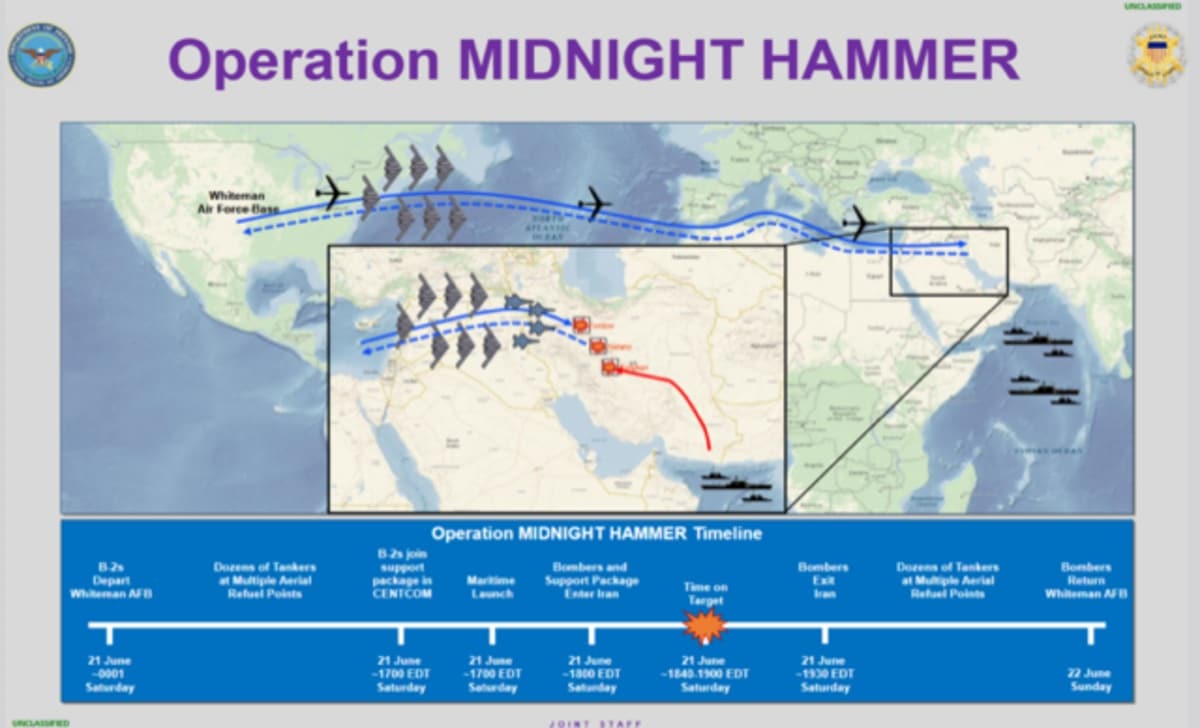
On June 22, 2025, at approximately 0230 Iranian Standard Time, the United States Air Force (USAF) and the US Navy (USN) carried out a joint attack on three nuclear facilities in Iran. The Fordow Uranium Enrichment Plant, Natanz Nuclear Facility and the Isfahan Nuclear Technology Center were targeted using the GBU-57A/B Massive Ordnance Penetrator (MOP), 30,000 pounds bombs carried by seven Northrop B-2 Spirit Stealth bombers and a barrage of Tomahawk missiles fired from a submarine. This operation, codenamed “Operation Midnight Hammer”, was aimed at destroying Iran’s weapon grade Uranium manufacturing capability, which posed a direct threat to the US and the West in general. In the first ever operational use of the GBU-57 MOP, six B-2 bombers dropped a total of 12 MOPs on the Fordow facility while the seventh B-2 targeted the Natanz facility with two MOPs. Following this aerial assault, a US submarine launched multiple Tomahawk Land Attack Cruise Missiles (LACM) on the Isfahan facility. [1]
Israel attacked Iran on June 13, 2025 by launching a series of strikes on Iranian military and nuclear facilities. In the first few hours, Israeli forces attacked and killed some of Iran’s top military leaders, nuclear scientists and politicians and damaged/destroyed Iran’s Air Defenses and associated military infrastructure. Iran responded by launching a series of drones and missile attacks on Israel. For the first nine days, the United States refrained from joining the war and then on June 20, 2025, President Donald Trump gave Iran two weeks to surrender. Just two days later, the US launched the attack. Whether this was a part of a larger deception plan or not is unclear. The Israel-Iran War 2025 is an escalation of decades-long animosity between the two nations, with Israel considering the Iranian nuclear programme as an existential threat and Iran challenging the legitimacy of Israel, calling for its destruction.
Historical Background
Although not known to possess nuclear weapons, Iran is often called a nuclear threshold state with the availability of technology needed to build nuclear warheads. Over the years, Iran has been stockpiling highly enriched uranium large enough to fuel multiple weapons with minimal further enrichment. [2] Iran has long maintained that its nuclear programme is benign and authorised by its membership as a non-nuclear weapon state in the Nuclear Non-Proliferation Treaty (NPT), which guarantees its members the right to develop nuclear energy for peaceful purposes, Iran is known to have secretly developed the technology to build nuclear weapons. These clandestine activities date back to the 1980s when Iran began a secret uranium enrichment programme, importing essential equipment from Pakistan and China. Throughout the late 1990s and early 2000s, Iran’s covert project, known as the AMAD Plan continued to develop this technology. It was eventually discovered by the International Atomic Energy Agency (IAEA), the United Nations (UN) body responsible for monitoring compliance with the NPT. [3] In 2002, the National Council of Resistance of Iran (NCRI), an umbrella organisation made up of several Iranian dissident groups, revealed the existence of two Iranian nuclear sites, a Uranium enrichment facility at Natanz and a heavy-water production facility at Arak, both possible dual use facilities. [4] Iran’s concealment of these facilities from the IAEA raised significant international concerns and suspicions.
Throughout the 2000s and 2010s, Iran failed to follow through on its commitments to the IAEA and its declarations in 2004 and 2005 were deemed incomplete and inconsistent, hindering the IAEA from developing a comprehensive and complete understanding of Iran’s nuclear programme. Over the years, the UN Security Council (UNSC) adopted a series of increasingly severe resolutions imposing international sanctions on Iran’s nuclear programme. Diplomatic efforts reached a new level of urgency in September 2009, when a new covert facility for uranium enrichment was discovered near Qom, later renamed as Fordow Fuel Enrichment Plant (FFEP). The 2010s saw Iran continue its enrichment programme. By 2013, Iran had amassed a stockpile of about 9,700 kg of uranium enriched up to five per cent and 370 kg enriched up to 20 per cent, which could yield enough weapons grade fissile material for a nuclear weapon, with further enrichment within two to three months. [5]
By October 2013, owing to secret back-channel talks between the USA and Iran and negotiations with P5+1 (UNSC members plus Germany) large scale negotiations led to a preliminary agreement called the Joint Plan of Action (JPOA) granting certain relief to Iran provided it resumed its commitment to the IAEA and allowed increased monitoring and access to its nuclear sites. In return, the P5+1 agreed to reduce sanctions, not impose new ones and released more than USD 4.2 billion worth of Iranian funds held abroad. [6] It also laid down a framework for negotiations toward a more comprehensive agreement called the Joint Comprehensive Plan of Action (JCPOA), announced in July 2015. After more than two years of implementation, the USA withdrew from the JCPOA citing Iran’s lack of transparency and reimposing sanctions on Iran, curbing its oil sales. Even as the US (under Trump 1.0) withdrew from the JCPOA in 2018, the remaining P5+1 countries and the IAEA were satisfied with Iran’s actions. In January 2020, the US killed Qassem Soleimani, an Iranian Major General, in a drone strike (ordered by the then President of the USA, Donald Trump) near Baghdad International Airport in Iraq. Iran reacted by reducing its compliance with the deal and by January 2020, announced that it had abandoned all JCPOA limits on its uranium enrichment programme. Ever since, Iran has continued to expand its nuclear activities and amassed a stockpile of uranium enriched to 60 percent, sufficient to fuel several nuclear weapons if enriched further.[7]
The Iran-Israel conflict has its roots in the larger Israel-Palestine conflict where Iran has championed the cause of the Palestinians, whom Iran believes to have been oppressed by Israel. By doing so, some scholars believe that Iran has been seeking a greater acceptance among Sunnis and Arabs, both of whom dominate West Asia. Israel has also accused Iran of supporting proxy terrorist organisations such as Hezbollah, Hamas, and the Houthis, thereby adding to the threat matrix of Israel. As a result, Israel views Iran as an existential threat and has sought sanctions and military action against Iran to stop it from acquiring nuclear weapons.
The Build-up Phase
Israel attacked Iran on June 13, 2025. It was touted as a resounding success by President Trump and his associates. The attack targeted key military infrastructure, nuclear sites, top Iranian leadership (both political and military) and Iranian air defence sites. Embedded within this plan was another plan awaiting approval by the President of the United States regarding when and how the US would join the fray. On June 20, 2025, President Trump gave Iran two weeks to surrender while contemplating whether the USA would join the war effort. This was conveyed to Iran and the world via a press conference by the White House Press Secretary, Karoline Leavitt, who stated that President Trump would decide whether to strike Iran “within the next two weeks”. What followed was a series of coordinated actions on television and social media to build a narrative that the USA was still keen on talks and that a large scale war could be avoided if Iran came to the negotiation table. Meanwhile, the order for planning the attack must have been given and preparations underway. It is likely that the orders for planning the attacks had already been issued, and preparations were already underway. An attack of this magnitude requires discretion and should include a well-developed decoy or deception plan along with a clearly defined end state. The possibility of a large scale escalation could not have been ruled out; therefore, a thorough analysis of the escalation matrix must have been done. The plan would have to be dovetailed with Israel’s ongoing war effort so as not to duplicate things and capitalise on gains made by Israel. Towards that, Israeli efforts to create the desired degree of control of air would add to the essential pre-requisites for the conduct of strategic bombing operations by the American forces. Shaping operations such as Intelligence, Surveillance and Reconnaissance (ISR), Electronic Warfare (EW), radar jamming, and cyber operations would be intrinsic to the entire mission.
The Execution Phase
The attack was launched from mainland USA giving the bombers almost 18 hours to fly from the USA to Iran undetected, bomb the targets and fly back. The total mission duration was approximately 37 hours and involved various elements of the USAF and the US Navy including submarines, to create the desired effect. This was to be the first American military strike inside Iran since 1979 and would put the USA firmly into a large-scale conflict in one of the world’s most volatile regions. The aircraft selected for the mission was the B-2 Spirit Stealth bomber, which has a service ceiling of 50,000 feet, an unrefuelled range of more than 6,000 nm and can carry an array of conventional and strategic weapons in stealth configuration. Capable of high subsonic speed with a payload of 40,000 pounds (18,144 kg) kg in two internal bays. Built with low observable technology, the aircraft’s stealth features make it the platform of choice for such strategic missions. [8]
Suppression/destruction of Enemy Air Defences (SEAD/DEAD) operations by Israeli and US forces, deception and decoy attacks and Electronic Warfare (EW) was carried out prior to the main attack. The B-2s dropped 14 MOPs on Fordow and Natanz to cause the desired degree of destruction and the Tomahawk LACMs attacked the Isfahan facility. The MOP, also known as the “bunker buster”, was developed by Boeing for the USAF in 2011. Weighing 27,125 pounds (12,304 kg) and carrying a warhead of approximately 5,342 pounds (2423 kg), the MOP has impressive penetration capabilities reaching a depth of 60 m of earth or 18m of concrete with a compressive strength of 5,000 PSI. [9] The B-2 is the only aircraft in the USAF capable of carrying and dropping these bombs. The entire mission included more than 125 aircraft and utilised about 75 Precision Guided Munitions (PGMs) during the operation. Excitedly, 4th and 5th generation aircraft acted as sweeps ahead of the main package, and dozens of refuelling aircraft provided vital support during the mission. Remarkably, Iranian air defence remained inactive, with no Surface to Air Missiles (SAMs) being launched either during ingress or egress.
A post-strike damage assessment would have been conducted by various ISR platforms such as Unmanned Aerial Vehicles (UAVs) and satellites. These assessments would have evaluated the extent of damage to the targets and determined whether a revisit would be necessary. Media reports suggest that there was significant damage to all three targets, potentially hindering Iran’s nuclear weapons development and may have set Iran back by four to five years. However, this claim might not be entirely accurate.
The Aftermath
While Russia and China have condemned the US strikes, calling them a serious violation of international law further inflaming tensions in the Middle East, the United Nations Secretary-General, Antonio Guterres has said that he is gravely alarmed by the use of force by the USA and that there is a growing risk that this conflict can get out of control. Iraq has also condemned the US strikes, calling them a grave threat to peace and security in the Middle East and has called for diplomatic efforts to de-escalate the crisis. Surprisingly, Pakistan has condemned the US strikes, calling them a violation of international law and warning of the risk of further escalation of violence in the region. Iran has closed the Straits of Hormuz for all traffic and vowed to strike back and has also launched a series of missile attacks on Tel Aviv. A raging internal debate within the USA has also started, led by the members of the Democratic Party, questioning the legality of the attacks and whether the US should have got involved. They are also questioning President Trump for not having taken the US Congress’ approval prior to launching such an operation. What Iran does is something that the world is watching with abated breath. Meanwhile, the Iran-Israel conflict rages on.
Points to Ponder
Leading up to the attack, some interesting events occurred that warrant further examination and analysis.
(a) Especially with regards to the US, there are no free lunches, so why would President Trump invite Pakistan’s Army Chief Field Marshal Asim Munir for lunch? What is brewing and what could have been offered to the USA by Pakistan. Could it be the use of military bases, intelligence on Iranian officials, or just access to the Pakistani airspace. Pakistan has been known to sell its soul to the highest bidder. What have they sold here?
(b) The USA has supported Pakistan’s International Monetary Fund (IMF) bailout package despite its involvement in terrorist activities across the world. What does it seek in return from Pakistan?
(c) New trends in warfare are visible in this Israel/USA vs Iran conflict, like direct and open targeting of leadership, both military and political, including scientists and academia involved in Iran’s nuclear project. This trend has been partially seen in the Russia-Ukraine war but not on such a large scale. Direct threats to the head of the government are also being made, signalling a possible new trend. All of this suggests that the Americans may be considering a regime change in Iran.
(d) Meanwhile, Pakistan has been playing its cards quite smartly by cosying up to both China as well as the USA. The United States has supported the IMF bailout plan for Pakistan, while China has offered the J-35 fighter. This scenario presents a win-win situation for Pakistan.
(e) Will Iran attack US bases in the Middle East? This is a question that might raise eyebrows, but if it were to happen, what would be the repercussions and how would the USA react?
(f) How long can Iran keep the Strait of Hormuz closed? What would be the global impact? Does Iran have the residual military capability to ensure long-term closure of the strait?
(g) Have these attacks really and unequivocally caused sufficient damage to Iranian nuclear capability especially in terms of the capability to build a nuclear weapon? The answer to this is known only to the Iranians but based on photographs in the media, it does not seem to be the case. Therefore, the question remains, whether this attack was just a show of American might with no substantial aims being achieved.
(h) China has been watching the USA’s actions in Russia and Iran. Most of it points to empty threats and unwillingness to get embroiled in large scale conflict. What lessons is China learning from these conflicts, especially when it comes to Taiwan and the South China Sea?
(i) These attacks have yet again demonstrated the use of air power as an instrument of choice for modern military action. Important characteristics of air power such as reach, flexibility, shock effect, concentration of force, mobility, offensive action and responsiveness have been amply demonstrated. What lessons can India draw from such strikes? Does India need to fast track its IAF capability development plans and whether the current numbers are adequate? A fact check needs to be done at the earliest.
(j) Control of air is a pre-requisite for all air and surface action. This must be accomplished through shaping operations and adequate effort must be earmarked for them. There are no shortcuts.
(k) Operation Midnight Hammer is being touted as a resounding success. However, that was possible due to complete air supremacy in the area of operation. Such missions can be safely carried out when only there was no prohibitive interference, but in contested air space, the story can be very different.
(Disclaimer: The article was written on June 23, 2025)
(Disclaimer: The views and opinions expressed in this article are those of the author and do not necessarily reflect the position of the Centre for Air Power Studies [CAPS])
CLICK TO VIEW THE PDF
Notes:
[1] The Straits Times, “Operation Midnight Hammer: Pentagon Press Conference on US strikes on Iran Nuclear Sites,”. YouTube, June 22, 2025, https://www.youtube.com/watch?v=stFTEn93d6o. Accessed on June 23, 2025.
[2] “A History of Iran’s Nuclear Program,” Iran Watch. December 19, 2003 https://www.iranwatch.org/our-publications/weapon-program-background-report/history-irans-nuclear-program. Accessed on June 23, 2025.
[3] Ibid. Accessed on June 23, 2025.
[4] Ibid. Accessed on June 23, 2025.
[5] Ibid. Accessed on June 23, 2025.
[6] Ibid. Accessed on June 23, 2025.
[7] Ibid. Accessed on June 23, 2025.
[8] Department of the Air Force, The United States of America, https://www.af.mil/About-Us/Fact-Sheets/Display/Article/104482/b-2-spirit/. Accessed on June 23, 2025.
[9] “GBU-57/B Massive Ordnance Penetrator (MOP),” Global Security.org, https://www.globalsecurity.org/military/systems/munitions/mop.htm. Accessed on June 23, 2025.