Author: Ms Radhey Tambi, Research Associate, Centre for Aerospace Power and Strategic Studies
Keywords: MAHASAGAR, Mozambique Channel, Island Countries, Western Indian Ocean, India’s Maritime Engagement
The Indian Ocean Region (IOR) has emerged as a contested space among various nearby and distant players, and this trend is expected to continue in the future. India has historically maintained strong ties in the region and must continue to exert its influence while adapting to changing circumstances. A review of India’s interactions with the island countries of the Indian Ocean reveals a disjointed approach to collaboration with the East African island nations, particularly with Madagascar and the Comoros. However, the expansion of India’s maritime approach from Security and Growth for All in the Region (SAGAR) to Mutual and Holistic Advancement for Security and Growth Across the Regions (MAHASAGAR) appears to adopt an integrating approach. A significant increase in defence engagements, including visits and exercises, reflects this reality and suggests a more promising and comprehensive future for India as it seeks to balance asserting its influence and leadership role while being the first responder in the Indian Ocean.
Resurgence of the Mozambique Channel in the Twenty-First Century
The location of the East African Islands in the vicinity of the Mozambique Channel amplifies their geostrategic and geoeconomic significance. Until the opening of the Suez Canal in 1869, which reduced the distance between Europe and Asia, the Mozambique Channel was the primary facilitator of trade between the East and the West. The resurgence of this important chokepoint, located between Madagascar to the East and Mozambique to the West in the twenty-first century, is attributed to several factors, including economic, strategic, and ecological.
First, the continuously evolving nature of challenges at sea and the consequential traction it has generated among different players in the IOR to make sure the region remains free and open. Not that the issues were previously absent. However, the advancements in technology have altered the nature, intensity, and scale of these challenges. The Houthi attacks in the Red Sea since October 2023 exemplify a growing threat, as the use of missiles and drones to target global shipping is intensifying the need for increased presence, attention, and interest from various regional and distant powers whose goods pass through the region. Iran’s threat warnings to disrupt shipping through the Straits of Hormuz have added another layer to the disruption of both trade and trust. To this end, a scholar from an American think-tank noted that Iran has naval mines, Unmanned Aerial Vehicles (UAVs), and missiles in its arsenal to disrupt global shipping from the Straits of Hormuz. [1] While the possibility of it remains low, it cannot be sidelined. Any disruption to the vital chokepoints in the Western Indian Ocean (WIO), like the Bab-el Mandeb Strait in the Red Sea or the Straits of Hormuz, will divert traffic to the third and less critical channel, the Mozambique Channel, until now. This means more countries, more struggle, in less geographical space.
Second, the Mozambique Channel is rich in hydrocarbon reserves and various rare earth minerals. Although some resources, like the swathes of natural gas deposits in the northern section, have been identified — where India also has interests — many areas, particularly in the southern part, remain largely unexplored. Madagascar has the sixth-largest reserves of rare earth elements, which are the foundation of many cutting-edge technologies. Minerals like dysprosium, neodymium, and europium are among the most sought-after minerals found abundantly in Antananarivo, after Beijing. China has already made significant inroads in this sector, alongside other Western players, including Singapore, Russia, the US, Australia, Brazil, and others. Some Indian industries have also invested, while others are exploring opportunities to enhance cooperation in this regard further.
Third, the WIO is also a fertile and favourable ground for fisheries due to the meeting of the cold Benguela Current and the warm Agulhas Current. However, this has led to the problem of Illegal, Unreported, and Unregulated (IUU) fishing by foreign vessels in the region. It has further disturbed the symbiotic relationship between fisheries and corals, thereby leaving the larger ecosystem under stress. According to the Red List of Ecosystems, the reefs in East and South Madagascar, the Comoros, and the Mascarene Islands are classified as critically endangered and require improvement in local fisheries management. [2] This is in addition to the other challenges that the region is infested with, like piracy, drug smuggling, and others.
The three factors underscore the region’s significance not just for India but also for other countries whose involvement may influence the outcome in the region. In this backdrop, the expansion of India’s maritime policy from SAGAR to MAHASAGAR is a signal towards inclusivity and mutuality, and a step in the right direction. For a long time, New Delhi took a fragmented and scattered approach to its relations with the island countries. However, recognising that the region is increasingly vulnerable to external pressures and is likely to be entangled in the broader competition between the US and China in the Indo-Pacific, as well as India and China in the Indian Ocean, India is now moving decisively to advance its ambitions.
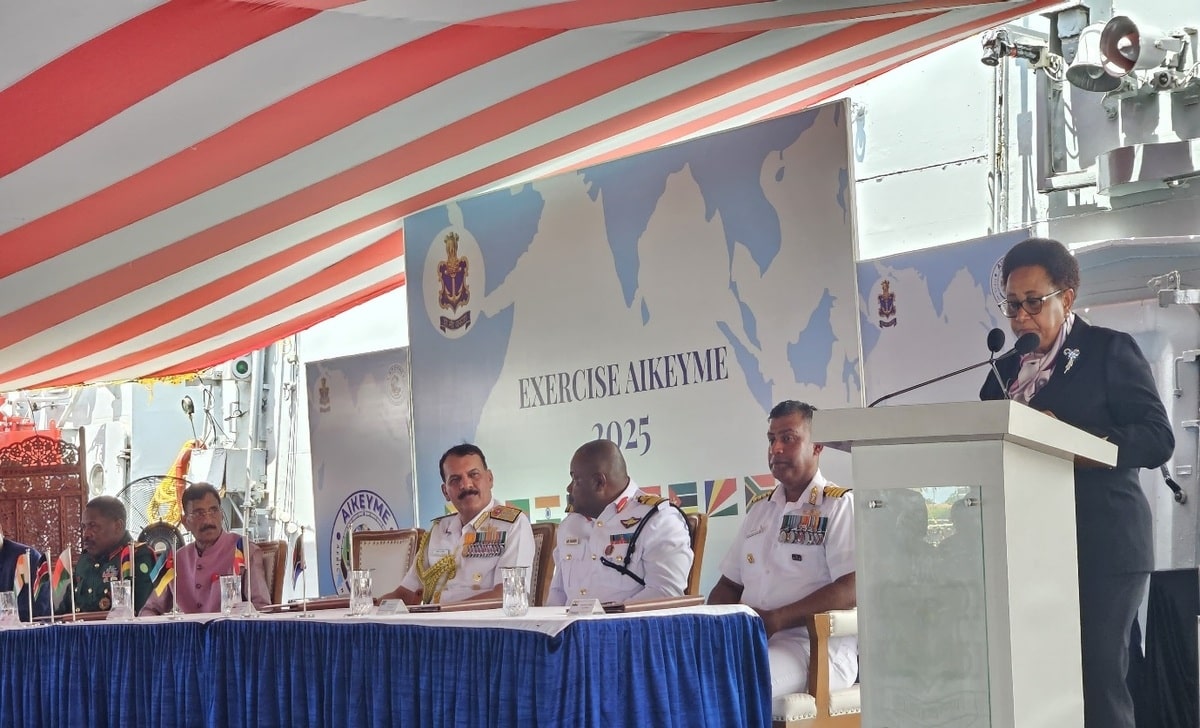
To this end, India’s timely initiatives, such as conducting the first edition of the Africa India Key Maritime Engagement (AIKEYME) exercise, which brings together all four East African island countries (Comoros, Madagascar, Mauritius, and Seychelles), along with other countries, are an example of a collaborative effort to address maritime challenges and ensure interoperability. [3] Further facilitating cohesion between the navies of all the island countries in the IOR, New Delhi deployed INS Sunayna for its Indian Ocean Ship SAGAR initiative that includes joint training and surveillance, and port calls. [4] While India now attempts to evenly spread its gaze across the length and breadth of the Indian Ocean, as it takes the island countries together, it is likely to meet many distant and proximate powers on the way with both divergences and convergences. Choosing the right set of friends and navigating the path of MAHASAGAR will shape the next decade of India’s maritime engagements in its backyard.
******
CLICK TO VIEW THE PDF
Notes
[1] “Four questions (and expert answers) about Iran’s threats to close the Strait of Hormuz,” The Atlantic Council, June 23, 2025, https://www.atlanticcouncil.org/blogs/new-atlanticist/four-questions-and-expert-answers-about-irans-threats-to-close-the-strait-of-hormuz/. Accessed on July 20, 2025.
[2] “Coral reefs in the Western Indian Ocean at high risk of collapse,” Red List of Ecosystems, December 06, 2021, https://iucnrle.org/news/coral-reefs-in-the-western-indian-ocean-at-high-risk-of-collapse. Accessed on July 15, 2025.
[3] Press Information Bureau, Government of India, “Africa India Key Maritime Engagement (AIKEYME) 2025 Inauguration,” April 13, 2025, https://www.pib.gov.in/PressReleasePage.aspx?PRID=2121521#:~:text=by%20PIB%20Delhi-,The%20Africa%20India%20Key%20Maritime%20Engagement%20(AIKEYME)%202025%20was%20inaugurated,regional%20cooperation%22%20beyond%20military%20affairs. Accessed on April 10, 2025.
[4] Press Information Bureau, Government of India, “Indian Navy’s Maiden Initiatives of Indian Ocean Ship Sagar (Ios Sagar) and Africa India Key Maritime Engagement (AIKEYME),” March 24, 2025, https://www.pib.gov.in/PressReleasePage.aspx?PRID=2114491#:~:text=A%20large%20scale%20multilateral%20maritime,Arms%20firing%20and%20Helicopter%20Operations. Accessed on June 10, 2025.