Author: Ms Vranda Sharma, Research Scholar, Unni Kartha Chair of Excellence
Keywords: 1962 War, IAF, Ladakh, NEFA, An-12, Packet C-119, Tank Airlift
Introduction
In the autumn of 1962, as tensions escalated along the icy peaks of the Himalayas, India found itself embroiled in a fierce conflict with China. The Sino-Indian War, fought in the rugged terrains of Ladakh and the North-East Frontier Agency (NEFA), was a test of endurance, strategy, and sheer willpower. While the ground battles often steal the spotlight, a quieter yet indispensable force was at work in the skies—the transport Squadrons of the Indian Air Force. Operating under extreme conditions, flying ageing aircraft through treacherous mountain valleys, the transport Squadrons, particularly 43 and 44, along with 19 Squadron,[1] became the lifeline for Indian troops, delivering supplies, equipment, and even tanks to remote outposts. This is the story of their courage, ingenuity, and unwavering commitment to keeping the front lines alive as they sustain the war effort.
The War That Tested a Nation
The war was a logistical nightmare that left India blindsided. The battlegrounds were perched in some of the most inhospitable terrains-snow-covered peaks, narrow valleys, and altitudes that pushed both men and machines to their limits. In August 1962, Ladakh lacked road networks, isolating Leh, a key strategic point, from the rest of India until air links were established. In NEFA, troops stationed at Thagla Ridge and Assam Rifles posts relied entirely on airdropped supplies to survive. Without air transport, the Indian Army’s deployment, maintenance, and very survival would have crumbled. The IAF’s transport Squadrons were tasked with bridging this gap, ensuring the survival of ground forces. With the Army being pushed beyond its limits, the 19, 43, and 44 Squadrons became India’s only means for keeping troops supplied. The backbone of the transport fleet consisted of Dakota and Packet C-119 aircraft, both piston-engine workhorses with a ceiling of approximately 15,000 feet. The newly inducted AN-12s were limited in number, and the Russian Ilyushin II-14 planes lacked the power needed to operate effectively in the Himalayan heights. In addition to the efforts of these squadrons, 106 Squadron, equipped with Canberra aircraft fitted with cameras, conducted nearly 50 hours of reconnaissance missions from October 13 to November 11, 1962. Their objective was to detect the deployment of Chinese forces in the Aksai Chin, Tawang, Sela, and Walong areas.[2]
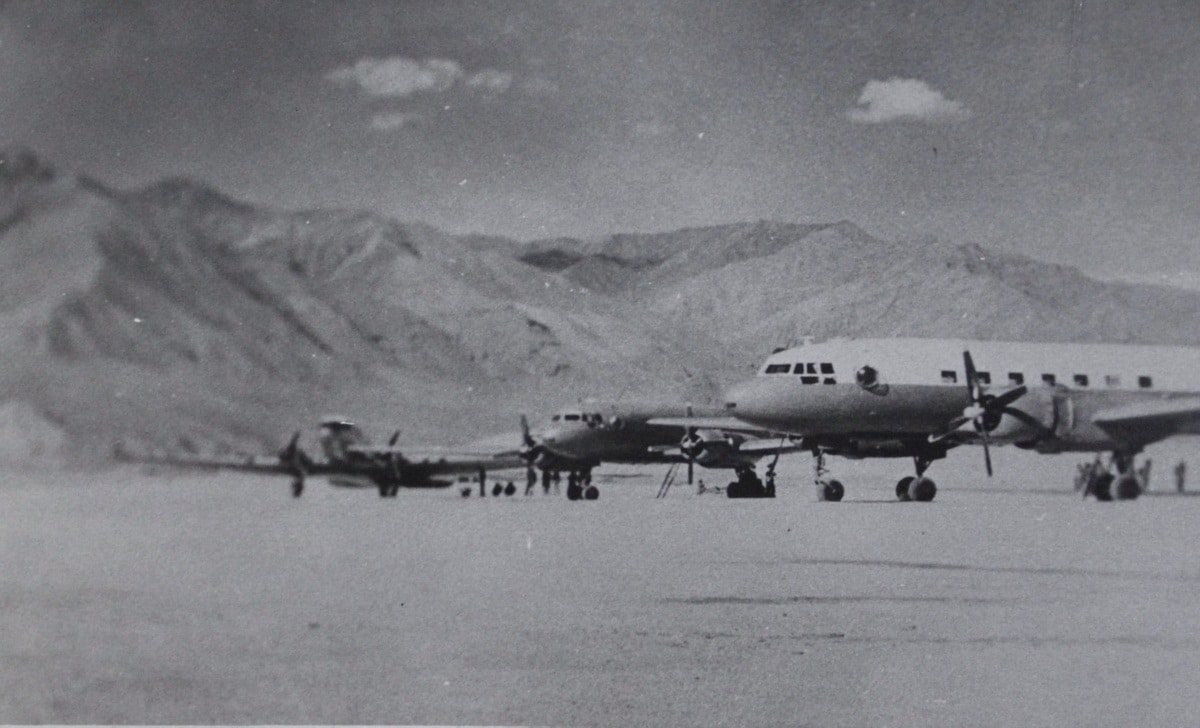
Flying in the Himalayas was no ordinary feat at the high-altitude airfields, such as Leh (10,682 feet) and Chushul (14,000 feet), and many other passes which soared above 18,000 feet. They were often covered in fog and demanded exceptional skill and precision. The region’s thin air reduced engine performance and lift, while unpredictable weather, marked by sudden fog, turbulence, and snowstorms, further complicated navigation. Fly pilots had to navigate through rugged terrains and valleys on meticulously planned routes, such as the lengthy Srinagar-Leh circuit, which led to increased fatigue and fuel consumption. Airstrips such as Daulat Beg Oldi, located at an altitude of 16,000 feet—making it one of the highest in the world—were cleared patches of dirt, requiring pilots to execute hair-raising landings and takeoffs. These aircraft were not pressurised, forcing pilots to rely on oxygen cylinders and wear bulky clothing to protect themselves from the cold. The psychological toll on aircrews was immense, as navigation aids were virtually non-existent, and pilots relied on visual landmarks and dead reckoning to locate drop zones and airstrips.
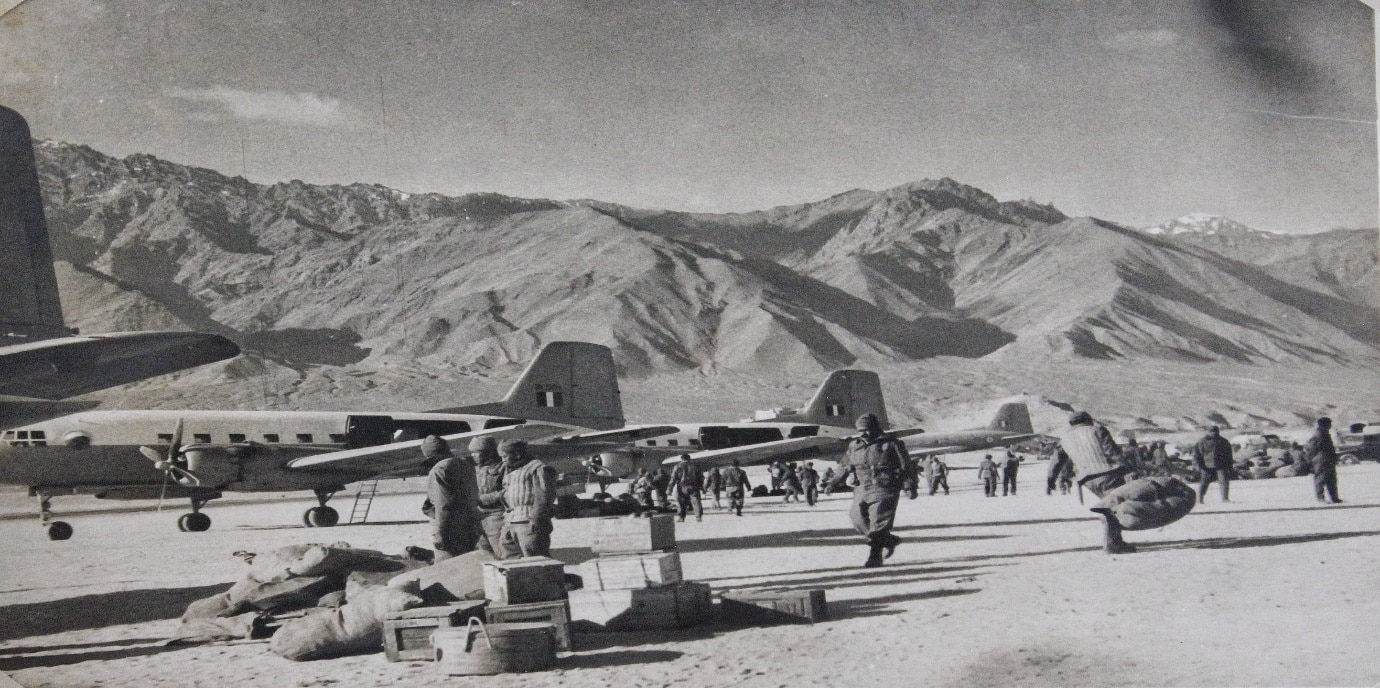
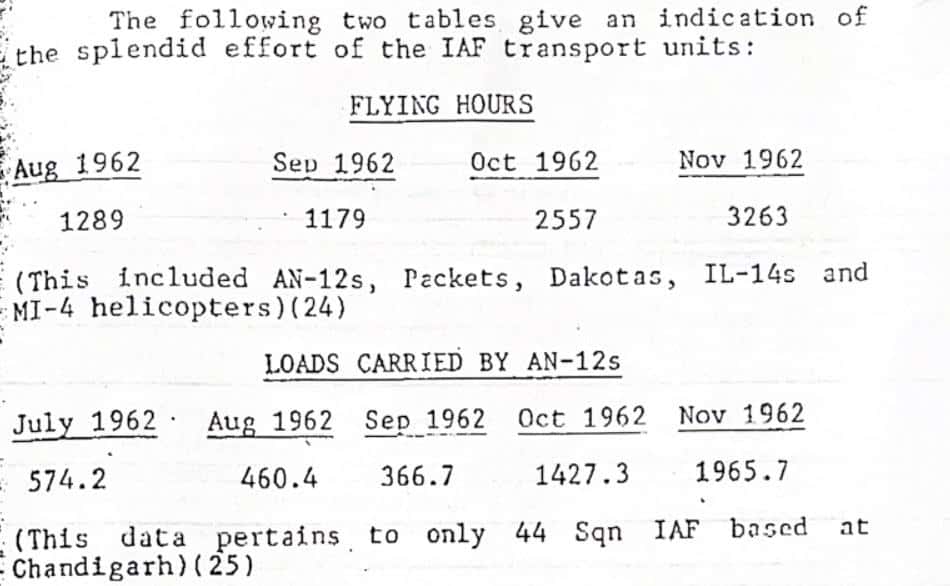
The IAF’s transport Squadrons rose to the challenge. The numbers highlight the scale of the task: in June 1962, the Army required 44,000 tonnes of supplies airlifted to Ladakh by the year-end (which mostly consisted of troop induction, material for improving airfields, and road construction material), but the IAF’s capacity was only 21,600 tonnes. [3] Despite this shortfall, the Squadrons flew tirelessly, delivering food, ammunition, medical supplies, and equipment to scattered outposts. One remarkable feat was the twilight drops on October 23 and 24, 1962, at Tsogtsalu and Phobrang. [4] Packet aircraft, ill-equipped for night operations in mountainous terrain, executed these missions to ensure troops remained supplied even as Chinese forces advanced. These operations, conducted in fading light, underscored the Squadrons’ determination to keep the front lines operational, even at significant risk. Together, they flew thousands of sorties, dodging storms, enemy fire, and the mountains to deliver everything from rice to rifles. This story isn’t just about logistics — it’s about human will in the face of impossible odds. [5]
The Squadrons That Defied the Odds
43 Squadron: The Ibexes in Ladakh
Established on January 20, 1958, 43 Squadron, nicknamed the “Ibexes,” was a transport unit equipped with Douglas Dakota aircraft during the 1962 war. Stationed in Srinagar during summer and Jammu in winter, the Squadron undertook critical air maintenance and supply drop missions to support Indian troops in remote outposts in the Ladakh sector. During the war, the Squadron operated in the rugged terrain of Ladakh, where roads were scarce, and air supply was the lifeline for forward posts. On September 08, 1962, when Chinese forces advanced across the Thagla Ridge, the Army was dependent on airlift and required high-altitude airdrops. Three Dakota aircraft, along with the crew, Flt. Lt. KR Rajagopalan, Flt. Lt. PR Singh, Flt. Lt. MP Singh, a junior pilot at the time, and Flying Officer PPS Gill were immediately sent to the Eastern sector. [6] The Squadron flew round-the-clock missions to deliver food, ammunition, and medical supplies to troops at high-altitude positions like Chushul and Rezang La. One notable operation involved a young Flying Officer Joseph Thomas, [7] who served with 43 Squadron in Ladakh, navigating perilous conditions to ensure supplies reached isolated units. The Dakotas, although reliable, were not designed for high-altitude operations, and pilots faced numerous challenges, including thin air, unpredictable weather, and the risk of anti-aircraft fire from Chinese forces. Despite these, the Ibexes maintained a high sortie rate, often landing on makeshift airstrips like Nyoma, where a historic landing was recorded in 1962 by 19 Squadron.
The Dakotas, a World War II workhorse, faced significant operational constraints. They were capable of carrying up to 1.36 tonnes of cargo. But their slow speed and lack of pressurisation posed substantial challenges in high-altitude Operations. On certain occasions, the crews had to fly without oxygen, risking fatigue and hypoxia. The Squadron’s aircrews carried out relentless missions from bases like Tezpur, using their Dakotas to navigate fog, rain, and enemy fire to supply remote outposts such as Walong, Kibithu, and Tawang. They delivered essential supplies, including food, ammunition, and medical aid. Airdrops were a critical component of their operations, especially since many outposts lacked airstrips. These missions required pinpoint accuracy because a misplaced drop could either fall into enemy hands or be lost in the dense jungle. [8] One notable operation involved supplying the 7th Infantry Brigade at Namka Chu, where troops were under heavy Chinese pressure. Despite deteriorating weather and limited visibility, the Squadron’s Dakotas executed multiple airdrops, sustaining the brigade until its eventual withdrawal. The Squadron’s efforts were not without cost; several Dakotas returned riddled with bullet holes from ground fire, and crews lived under the constant threat of Chinese interception. [9]
“No one can speak of these Ops with as much clarity as someone who lived it- like Flying Officer Joseph Thomas, who joined 43 Squadron on July 1, 1962.”
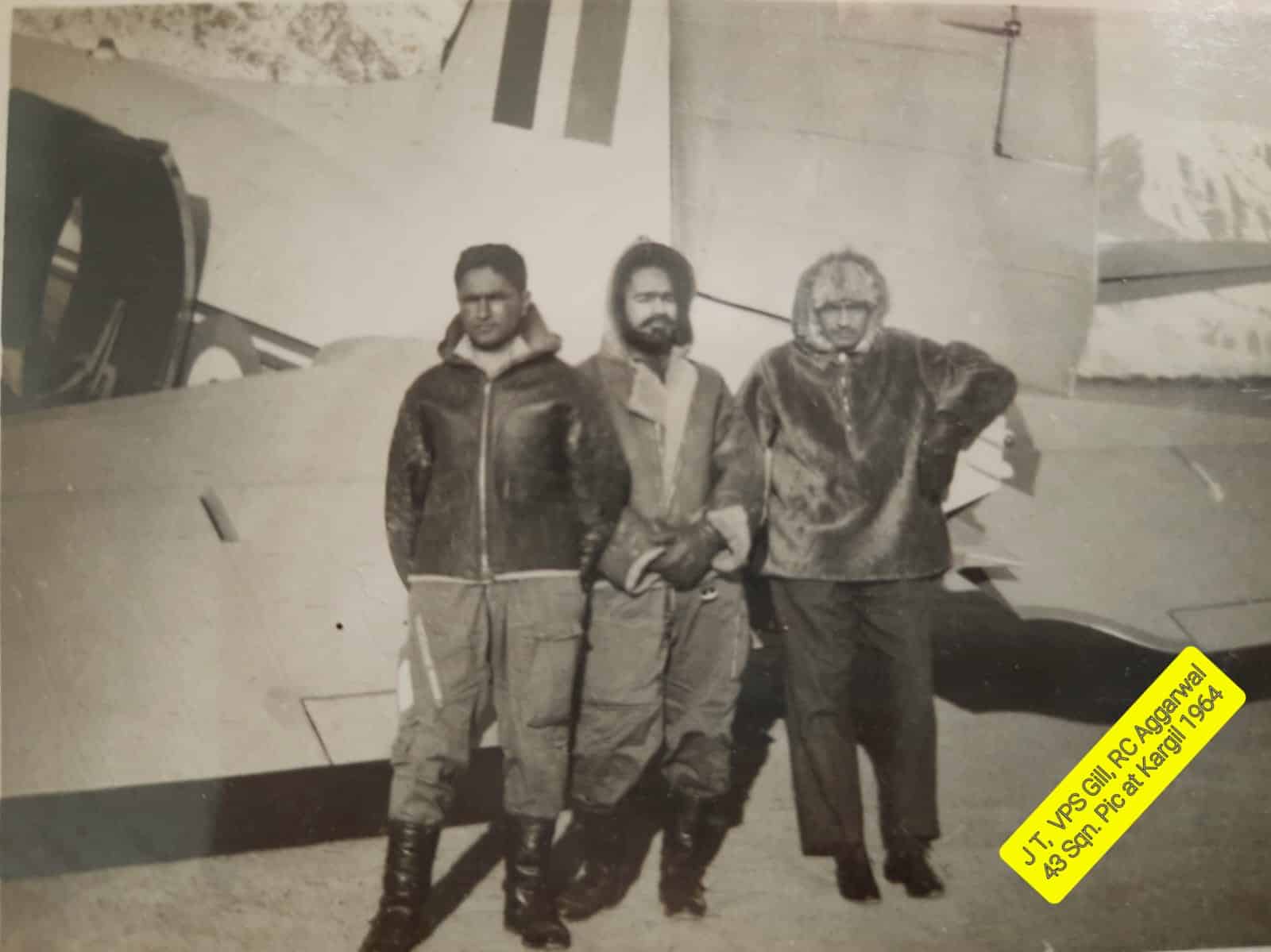
From his Experience, he Narrates –
“You know, when I think back to ’62, people often talk about the big battles and the strategies, right? But for us, the real story, the true grit of it all, was in the day-to-day. Just ten days after I joined, the Galwan incident blew up, and by mid-July, we could just feel the tension in the air. Then, on September 08, the Chinese attacked Thagla Ridge in Namka Chu—that’s now part of Arunachal Pradesh. And that’s when the war really began for us.
I was primarily serving in Kargil and Thoise, and my Squadron mostly flew Dakotas because, unlike the larger An-12s, these aircraft could handle the short, challenging runways in those regions. I was a co-pilot, having completed my training just before the hostilities erupted.
Oh man, Ladakh was a beast of its own. It’s a high-altitude semi-desert, basically shielded by the Himalayas. The mountains, they block all the rain and moisture, and in winter, the Zoji La pass? It gets buried under a staggering 60 feet of snow. So, for the troops up there, air-supplied stores weren’t just important; it was their only lifeline. And my Squadron, we were crucial for those missions. If the weather suddenly changed, bam, zero visibility at high altitudes, with clouds constantly obscuring everything. And to make things even more miserable, our heating systems often failed, so we’d have to bundle up in bulky clothing just to deal with the biting cold. We’d often fly without oxygen, risking fatigue and hypoxia.”
But perhaps the most harrowing task belonged to the unsung heroes: the ejection crew of the transport aircraft. These were often Jawans from the Army whose names largely remain unknown. In a time of limited communication and immense operational difficulties, their job was to physically push supplies out of the aircraft and drop them into the designated dropping zones, keeping the Army lines functional through sheer grit and bravery. They truly were the lifeline. [10]
44 Squadron: The Himalayan Geese
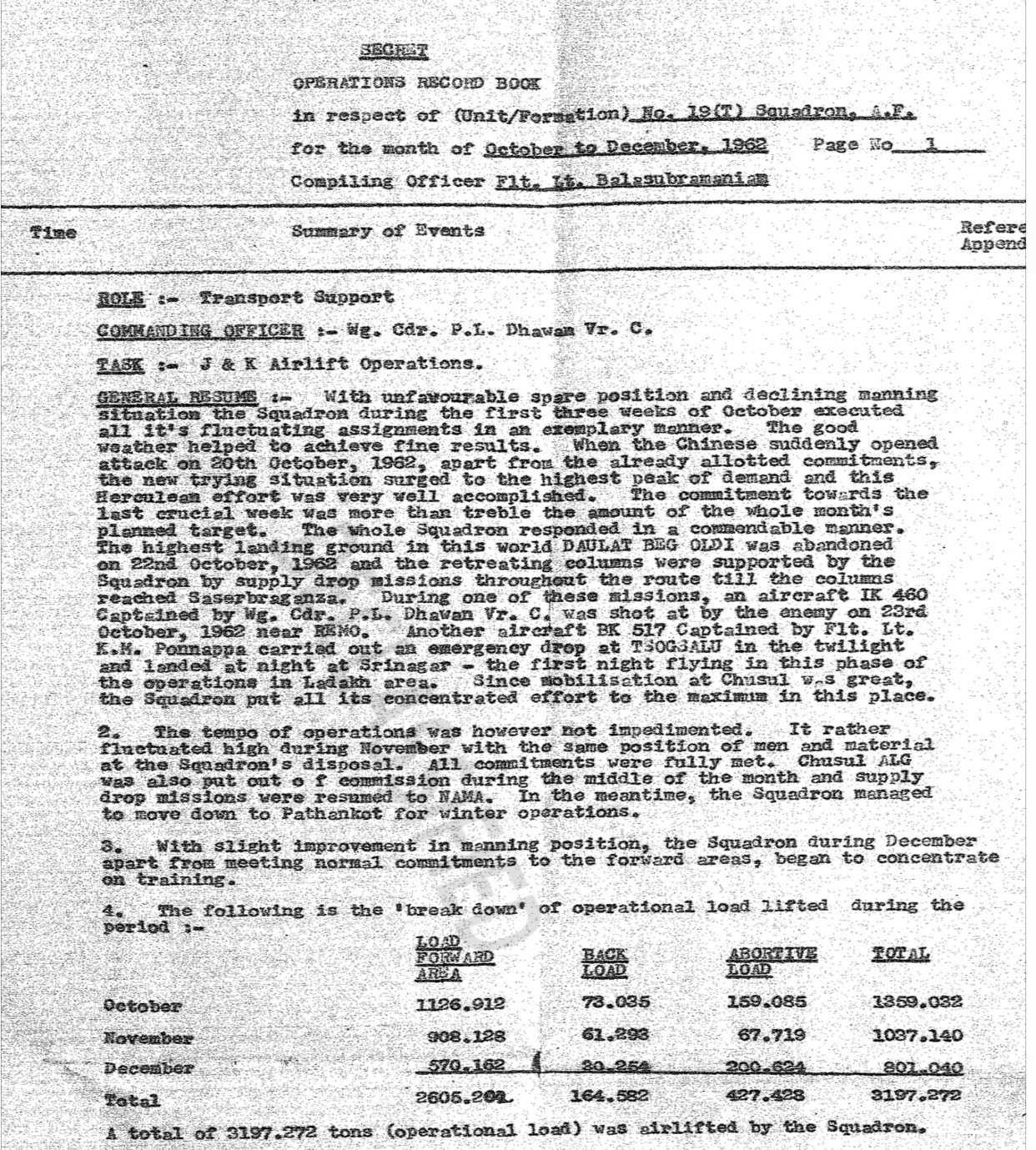
44 Squadron, established in 1961, earned the nickname “Himalayan Geese” and was equipped with Antonov An-12 transport aircraft. Assigned to Maintenance Command, the Squadron was relatively new when the war broke out, but quickly adapted to the demands of the conflict. It undertook extensive air maintenance sorties in both the Ladakh and Jammu and Kashmir (J&K) sectors, earning its emblem for its high-altitude operations. The An-12s were a significant upgrade over the Dakotas, offering greater payload and range, which was crucial for supplying larger troop concentrations. With a payload capacity of up to 20 tonnes, the An-12’s ability to carry heavy equipment, including artillery pieces and vehicles, to airfields such as Leh and Chushul significantly enhanced the Army’s firepower. Its four turboprop engines allowed it to operate at altitudes exceeding 20,000 feet, though its large size required longer runways, limiting its use in some forward areas. A standout mission was the resupply of Chushul airfield, where An-12s landed under threat of Chinese artillery. No. 44 Squadron’s missions included airdropping supplies to forward bases in NEFA and Ladakh, often under tight schedules to counter Chinese advances. Their operations in Ladakh supported key defensive positions, ensuring troops had the resources to hold their ground. [11]
19 Squadron: The Transport Pioneers
19 Squadron, formed in June 1960, was a transport unit equipped with packets C–119 during the 1962 war. The Squadron operated out of Srinagar and Pathankot during the 1962 operations. The pilots skillfully navigated dense forests and mountainous terrain, often under low cloud cover, to deliver critical supplies. Their efforts were crucial during the early stages of the war when Indian forces were rapidly deployed to counter the Chinese advances. One epic moment involved Wing Commander Purshotam Lal Dhawan, who led the charge of the Transport Squadrons in the J&K Area. When news came that Chandni Post was under fire and Daulat Beg Oldi’s situation was a mystery, knowing that he would encounter enemy fire, he flew into the danger zone to gather vital intel on the frontline about the latest situation. Later, he located the retreating soldiers and dropped essential winter clothing and food, which they desperately needed to survive. [12]
The Tank Airlift – A Triumph of Ingenuity
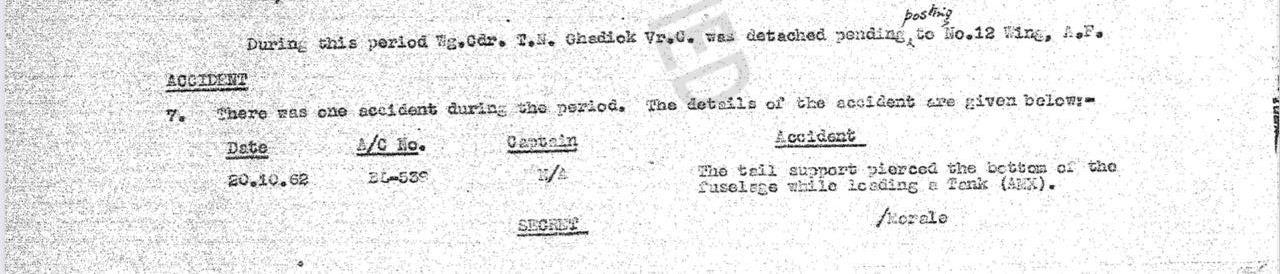
The most historic moment of the transport Squadrons’ contribution came with the airlift of AMX-13 tanks to Chushul. On October 21, 1962, Chinese forces attacked the Sirijap post with tanks. The 20 Lancers’ AMX-13 tanks were ordered to Chandigarh, but transporting them to Chushul’s high-altitude airstrip posed a formidable challenge. The newly inducted AN-12, [13] the only aircraft capable of carrying such heavy loads, had a steep ramp that caused tank tracks to slip on the aluminium floor. On October 22, initial trials damaged an aircraft’s floor, halting the operation. With time running out, Army engineers and the IAF technicians collaborated on a solution. They constructed a makeshift ramp and reinforced the aircraft floor with wooden planks. By October 24, the trials were successful, but a new issue arose: the IAF insisted on dismantling the tank guns to reduce weight, a demand that the Army rejected to maintain combat readiness. [14]
The pilots made a courageous decision. They took off with reduced fuel, accepting significant risks to accommodate the full weight of the tanks. At Chushul, with engines running to save time, the tanks were unloaded in just 15 minutes. On October 25, 1962, six AN-12s flew through the early morning mist, delivering eight tanks to Chushul successfully. The next day, a second troop was airlifted, along with two batteries of the 13th Field Artillery, demonstrating the transport Squadrons’ ability to adapt and deliver under pressure. [15],[16]
NEFA: Sustaining the Eastern Front
In NEFA, the challenges were distinct but equally daunting. The region’s dense jungles, steep ridges, and lack of roads made ground logistics nearly impossible. The IAF, alongside Kalinga Airways’ experienced Dakota pilots, became the sole means of providing supplies to Assam Rifles posts and troops at Thagla Ridge. The transport fleet faced the same altitude constraints as in Ladakh, navigating through valleys to avoid peaks. The absence of radar and limited radio links added to the complexities, yet the Squadrons delivered. Kalinga Airways, owned by aviator and politician Biju Patnaik, played a key role in the conflict by utilising the expertise of its pilots to ensure consistent supply drops to isolated posts. The IAF’s efforts in NEFA were vital in maintaining troop morale and operational capability, even as Chinese forces sought to gain an advantage. [17]
The Human Heart of the Mission
Behind every flight was a crew of ordinary people doing extraordinary things. One striking event occurred on July 23, 1962, when a historic landing took place in the Himalayas at Daulat Beg Oldi (DBO). The DBO was more than an airstrip—it was a cornerstone of India’s defence strategy. Perched at 16,000 feet, it was one of the highest airfields in the world, posing unrelenting challenges.
Despite the challenges, the IAF pilots were determined to persevere. They adapted, innovated, and turned the impossible into reality. The breakthrough came with the creation of the Jet Pack for Packet C-119. This was developed through a collaboration between Hindustan Aeronautics Limited (HAL) in Bangalore and the American company Stewart Davis. [18] It featured a jet engine mounted on its tail, which provided extra thrust. This innovation was a game-changer, providing the aircraft with an extra boost during take-off, and it proved to be a great advantage in high-altitude areas. After its first test flight on June 9, 1961, and operational trials in Ladakh by June 1962, the Jet Packet was ready for its defining moment. That moment arrived on July 23, 1962, when Squadron Leader C.S. Raje, the man behind the controls on that historic day, piloted the Jet Packet C-119 to a historic landing at DBO. Located near the Line of Actual Control (LAC) with China, DBO is one of the highest airstrips in the world. This wasn’t just a technical triumph—it was a bold statement of India’s ability to defend its remote borders.
Pilots like Squadron Leader Chandrakant Shantaram Raje [19] flew until they were on the verge of collapse, battling high altitude sickness and exhaustion. Ground crews, working in freezing hangars, kept planes flying with spit, grit, and whatever spare parts they could scrounge. The toll was real, planes came back riddled with bullet holes, and some didn’t come back at all, yet the crew never wavered. They flew without navigation aids, without weather reports, and often without sleep, driven by a deep sense of duty. Their courage wasn’t just in facing danger but in doing it again and again, knowing the stakes.
The Missed Opportunity – A Lifeline in Crisis
While the transport Squadrons excelled, their contributions extended beyond immediate logistics. By sustaining forward posts, they delayed Chinese advances, buying time for the Indian Army to regroup. The IAF’s fighter and bomber Squadrons remained grounded, a decision that remains a contentious “what-if” of the war. On September 09, 1962, the IV Corps Commander signalled for the IAF fighter aircraft to support an assault on Thagla Ridge. A more desperate signal on October 07 warned of a potential Chinese offensive, urging the use of all air resources. Both requests were denied by the Army HQ on September 11 and October 07, respectively, citing the risk of Chinese retaliation disrupting air supply lines. Air Marshal H.C. Dewan, the IAF’s Director of Operations, argued that NEFA’s jungle terrain made close air support ineffective against dispersed infantry, and the lack of tank concentrations limited viable targets. [20] He also feared Chinese bombing of Indian airfields and cities, noting the Chinese Air Force’s numerical superiority and India’s inability to replenish losses quickly. The U. S Ambassador J.K. Galbraith reinforced this caution, warning that Chinese bombers could devastate Indian cities like Calcutta, while Indian aircraft would find few targets in Tibet. However, India’s air capability was significant. The decision to forgo offensive air support left the transport Squadrons as the IAF’s major contributors. [21]
A Legacy of Resilience
The Sino-Indian War of 1962 was a sobering chapter in India’s history, to such an extent that it led the Directorate of Operations to be split into two for the very first time. The first segment was the Directorate of Operations – Fighters and Bombers, and the second segment was the Directorate of Operations – Transport and Logistics. The division of the premier Directorate clearly emphasised the utmost importance of transport support. [22]
Logistical challenges and strategic miscalculations marked the war. Yet, the IAF’s transport Squadrons emerged as unsung heroes, sustaining India’s military presence against overwhelming odds. They delivered 21,600 tonnes of supplies, supported troop deployments, and executed courageous missions such as the Chushul tank airlift. Their twilight drops and relentless supply runs ensured that troops in Ladakh and NEFA were never entirely without supplies.
The tank airlift, involving eight tanks and artillery batteries, stands as a testament to the pilot’s ingenuity and bravery. The Squadrons’ ability to operate in the absence of ground support facilities, navigating treacherous terrain with outdated aircraft, reflects their extraordinary dedication. Though the war ended in defeat, their efforts prevented a total collapse, preserving India’s foothold in the Himalayas. [23]
As we reflect on 1962, the stories of dedication and courage of the IAF’s transport Squadrons are a reminder of the quiet heroism that often goes unnoticed in war. They were the lifeline that kept hope alive, proving that even in the darkest moments, courage and determination can soar above the clouds. Their legacy endures as a testament to the power of resilience in the face of adversity. [24]
CLICK TO VIEW THE PDF
Notes:
[1] Ministry of Defence, Government of India, “Operation Record Books – 19,43,44 Squadron.”
[2] Ministry of Defence, Government of India, “1962 War- Official History,” History Division, 1992.
[3] Ibid.
[4] Ministry of Defence, Government of India, ” 1962 War- Official History,” History Division, 1992.
[5] Indian Air Force, “1962 Operations,” https://indianairforce.nic.in/our-operations.
[6] From the Logbook of Wing Commander Joseph Thomas during 1962.
[7] Blue Skies Podcast, “S1 Ep09: Joseph Thomas – Part 1 – Supporting the Army and Mapping the Country,” YouTube, May 16, 2021, https://youtu.be/YVjGxx0VG8s?si=7PyGYRugviXItlrr.
[8] Ministry of Defence, “1962 War- Official History.”
[9] Ministry of Defence, Government of India, “Operation Record Book- 43 Squadron.”
[10] Wing Commander Joseph Thomas (Junior Officer, 43 Squadron during the 1962 War), in discussion with the author, June 2025.
[11] Ministry of Defence, Government of India, “Operation Record Book, 44 Squadron.”
[12] Bharat Raksha, Indian Air Force, “Service Record of Group Captain Purshotam Lala Dhawan,” https://bharat-rakshak.com/indianairforce/database/2351. Accessed on May 20, 2025.
[13] Ministry of Defence, “1962 War- Official History.”
[14] Ibid.
[15] Ministry of Defence, “Operations Record Book 44 Squadron.”
[16] Prakhar Gupta, “On This Day in 1962: When India Airlifted Tanks to Ladakh’s Chushul to Halt the Invading Chinese Army,” Swarajya, October 26, 2023, https://swarajyamag.com/defence/on-this-day-in-1962-when-india-airlifted-tanks-to-ladakhs-chushul-to-halt-the-invading-chinese-army. Accessed May 20, 2025.
[17] Ministry of Defence, “1962 War- Official History.”
[18] Ibid.
[19] Bharat Raksha, Indian Air Force, “Service Record of Air Marshal Chandra Kant Shantaram Raje,” https://www.bharat-rakshak.com/indianairforce/database/4038. Accessed on May 21, 2025.
[20] Ministry of Defence, “1962 War- Official History.”
[21] Ministry of Defence, “1962 War- Official History.”
[22] Mr. Anchit Gupta (Military Historian), in discussion with the author, June 2025.
[23] Ministry of Defence, “1962 War- Official History. ”
[24] Sudha Ramachandran, “The Long Shadow of the 1962 War and the China-India Border Dispute,” The Jamestown Foundation, vol. 22, no. 1, 2022, https://jamestown.org/program/the-long-shadow-of-the-1962-war-and-the-china-india-border-dispute/. Accessed on May 21, 2025.