

Author: Group Captain (Dr) Swaim Prakash Singh, Visiting Senior Fellow, Centre for Aerospace Power and Strategic Studies
Keywords: Warfare, Airspace Management (ASM), Tactical Battle Area (TBA), Air Littoral, Op Sindoor
“Future warfare is all about air, space and sub-surface domains.
The conventional land and sea domains will restrict to holding territories.”
–Author
Group Captain Swaim Prakash Singh, PhD
Introduction
Warfare is an inherently complex and serious business that cannot be conceptualised or executed on the flawed premise of the primacy of a single warfighting arm. The long standing assertion that ‘the nature of warfare remains same, while its character evolves with time’ warrants nuanced deliberation, structured reasoning and a contextually grounded understanding especially in the light of a few western narratives being built on the topic of Air Littoral. As expected, like others, this term has also been picked up by few land warfare enthusiasts trying to embed into the Indian context.
In this regard, the proposition of delineating fixed geographical limits under the construct of Air Littoral and advocating for its control under a land forces-led command structure[1] reflects a myopic view with borrowed and ill-conceived unprofessional arguments. Such construct[2] not only risks diluting the core integrated Airspace Management (ASM) but also contravenes the doctrinal imperatives of jointness and integration across Services by diluting the basic tenets of air power.
This approach appears counterproductive and potentially regressive in the context of contemporary and future warfare especially when the Indian Armed Forces are making concerted efforts to overcome legacy challenges and institutional frictions in pursuit of a genuinely integrated battle management architecture.
Essentially, the stated narratives focus on two distinct issues of defining the term ‘Air Littoral’ and the concept of its ‘Control by the land forces.’ This paper aims to highlight the drawbacks in the philosophy behind the control of the air littoral, using source based, conceptual and contextual arguments. It will also underscore the critical importance of ASM in the Tactical Battle Area (TBA) and why it must continue to remain under the control of the Indian Air Force (IAF) within the integrated battle management framework.
Air Littoral: A Conceptual Misfit
Militarily, the term ‘Maritime Littoral’ is broadly defined worldwide as “the portion of land and sea adjacent to the coast that is susceptible to influence or control from the sea and to influence or control the sea from the land.” Operationally, this zone demands specialised capabilities such as amphibious operations, coastal defence, mine countermeasures and the integration of naval gunfire and air support with land operations through an integrated tri-services mechanism.
Drawing a simile with this, a few academicians have coined the term Air Littoral, though it does not appear in any doctrinal publications globally. In reality, Air Littoral is an inconsiderate borrowing[3] from Western narratives and lacks conceptual validity.
In the air domain, there is no equivalent physical or geographical feature. Airspace is a continuous, three dimensional medium defined by altitude, range and threat environment. It is in no case by fixed boundaries like a shoreline. Both Indian and global air doctrines already classify airspace by altitude bands (very low, low, medium, high etc), threat environment (permissive, contested, denied) and mission type (Counter Air, Coordinated Operations, Air Defence (AD) etc).
The proposed concept of Air Littoral adds no doctrinal clarity. Rather, it risks creating artificial silos and confusion over command and control (C2) responsibilities. The low altitude fight is not a distinct ‘special zone’ requiring separate service ownership as envisaged by land warfare enthusiasts. It is simply a segment of airspace within the Joint Air Defence System managed through layered AD Systems, counter Unmanned Aerial Systems (UAS) measures, Close Air Support and Rotary Wing Operations through Joint Air Defence Centre (JADC) under centralised command of the Integrated Air Command and Control System (IACCS).
Furthermore, the Indian Armed Forces Joint Doctrine, the IAF Doctrine and the Joint Services Study Group (JSSG) documents make no reference to Air Littoral as an independent operational construct. Likewise, leading air forces such as the United States Air Force (USAF), Royal Air Force (RAF) and People’s Liberation Army Air Force (PLAAF) do not recognise the term in their doctrinal lexicon. It just remains an academic expression without operational relevance.
Source Based Arguments
Borrowed Western Narrative: Not Suited for Indian Context
The core argument of Air Littoral is largely based on foreign doctrinal experimentation and recent conflict-specific adaptations (eg Ukraine, Israel, USA) from couple of foreign literatures. These examples emerge from unique geopolitical, technological and command structure environments. Attempting to replicate these foreign constructs especially regarding the C2 of the air littoral without contextual adaptation, amounts to simply force fitting foreign models into India’s vastly different strategic, organisational, and doctrinal ecosystem.
India’s battle management philosophy is shaped by the following realities:
-
-
India is not expeditionary in nature, like the US or North Atlantic Treaty Organization (NATO).
-
Joint operations are driven by sovereign geographical imperatives, not global force projection requirements.
-
Within this framework:
-
-
India already operates under established joint doctrines and procedures governing air-land cooperation, including the so-called Air Littoral zone in form of TBA.
-
JSSG is the master document which unambiguously brings out the detailed coordination and operating procedures for all aerial platforms in the highly contested and congested TBA.
-
Reviewing Foreign Literature
Foreign literature on the subject is largely academic or opinion-based and cannot be applied to the Indian context either selectively or in entirety without due consideration of India’s doctrinal outlook, geography and capabilities. In most cases, the Indian Joint Doctrine and the IAF’s existing capabilities already address the stated vulnerabilities thereby negating the case for creating a new concept of an ‘Air Littoral’.
Various doctrines and documents such as the Joint Doctrine Indian Armed Forces (2017), IAF Doctrine (2012, 2022), JSSG and the précis of Staff and War Colleges categorically negate the validity of this borrowed construct in its entirety. The following table, however, brings out opposing statements from Western literature itself, thereby validating the inadequacies of these arguments.
Table 1: Air Power Doctrinal Stand against Imported Quotes
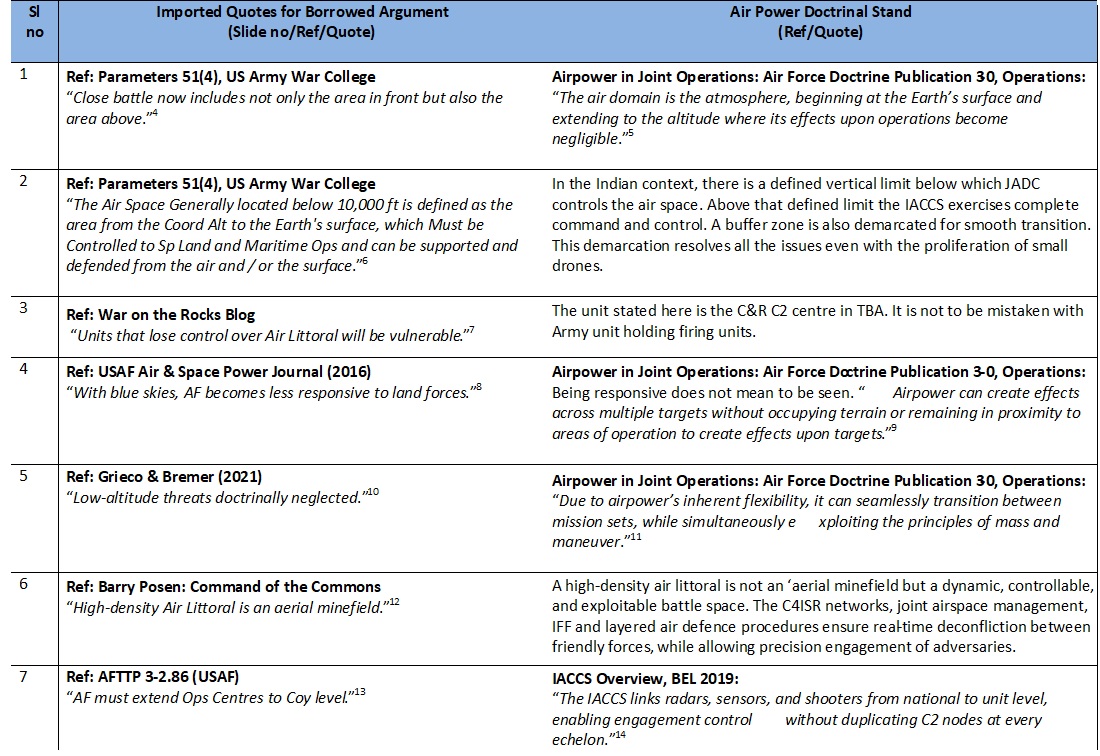
Interestingly, the Air Littoral concept mentioned in the above-referred documents has been notably downplayed by USAF airpower practitioner Lt Col Grant Georgulis in his article “Drone Hype and Airpower Amnesia”, published in Air & Space Forces Magazine on 25 July 2025.[15]
The aforesaid paper presents several arguments which seem to accord considerable emphasis to the perceived impact of drones on land warfare. The bottom line is that the loosely used term ‘Drones’ for UAS, now being projected as a revolution in land warfare had already evolved within air forces at least two decades ago. Consequently, the Tactics, Techniques, and Procedures (TTPs) including ASM in the TBA have long been in practice. The devastating effect of such technology has been widely witnessed during Operation Sindoor in May 2025.[16]
In the Indian context, particularly for drones of nuisance value (eg Swarm drones), a chain of counter-UAS (CUAS) systems with both soft and hard kill capabilities already operate under the centralised command of IACCS with decentralised execution with full operational freedom meeting the requirements of the IA, thereby eliminating the need for a separate structure. Further, the wide variety of UAS spread over the flight envelope in terms of height and speed of operation makes any separate structure needless. Nevertheless, it requires further strengthening and it has to be both joint and integrated effort.
Notably, NATO’s Joint Air Power Strategy of 26 June 2018 negates all aforesaid imported quotes. Also, USAF Doctrine Publication 3-0, Operations published in 22 Jan 2025 provides a self-explanatory paragraph on ‘Fires’ and ‘Air Space Control.’ An excerpt is mentioned below:
“The fire’s function is supported by the airpower tenets of synergistic effects and concentration as airpower masses and maneuvers to surprise adversaries by creating effects at the times and locations of the JFC’s choosing. USAF contributions to fires are primarily captured in AFDP 3-01, Counter Air Operations, AFDP 3-03, Counter Land Operations, AFDP 3-04, Counter Sea Operations, AFDP 3-12, Cyberspace Operations, AFDP 3-14, Air Force Space Support, AFDP 3-70, Strategic Attack, and AFDP 3-72, Nuclear Operations. In addition, for long-range fires considerations, see AFDP 3-52, Airspace Control, and AFDP 3-60, Targeting”.
The Fallacy of Drawing Lessons from Ukraine
-
-
The literature has also tried to draw inferences from Ukraine as a template for battlefield air control which is rather problematic.
-
OSINT indicates Ukraine operates under a ‘weapons free’ environment characterised by minimal restrictions on engagement within contested zones, primarily because the protracted conflict has not manifested as a classical air war in the conventional sense.
-
Indian Rules of Engagement (RsOE) are more controlled, disciplined and politically calibrated. Airspace is a regulated battlespace, especially given proximity to nuclear thresholds with both adversaries and escalation management.
-
Drawing conclusions from a unique warzone with permissive engagement and applying them to a structured Indian context or TBA is operationally dangerous with flawed foundation.
-
Operation Sindoor has clearly reminded that joint and integrated warfare is the only key to success in the Indian context.[17]
-
Conceptual & Contextual Arguments in the Indian Context
Understanding the Tactical Battle Area (TBA)
The TBA refers to a geographically defined zone of military operations that is dynamically flexible and horizontally fluid. While land operations form its core air operations conducted by both manned and unmanned platforms are an integral component of the TBA. These flying platforms vary significantly in speed, ranging from slow movers to high-speed and very high-speed systems and operate across a wide vertical envelope from terrain hugging altitudes to high altitude flight levels thus making it Multi-Level Multi-Domain (MLMD) warfare.
Given this multi-layered tactical environment, all aerial platforms within the TBA operate under a complex, multi-level threat scenario, often from friendly weapon systems. To prevent fratricide and ensure the optimal employment of the most suitable weapon systems, a designated authority must regulate the use of airspace. This function is known as Airspace Management. This aims to provide freedom of action to all operators through defined and dynamic procedures while avoiding fratricide and simultaneously denying the use of the air medium to the enemy.
In the Indian context, the responsibility of Air Defence of the country lies with the Air Force as mandated by the Union War Book. The Control and Reporting (C&R) element of the IAF as the designated authority through IACCS exercises the entire air space management 24x7x365, be it during peacetime, wartime and No War No Peace (NWNP).
With the advancement of technology and the availability of longer-range weapon systems, it has been necessary to reassess vertical boundaries within the TBA. As a result, it was revised once in late 2000. However, such reassessment must not infringe upon the operational freedom of other combat elements within the same space in increasing the vertical limits manifold, as envisaged in the said concept. It is to be ensured that C2 continues to be centralised irrespective of the number of users in the TBA.
In light of the narrative of the proposal to allocate a vertical limit of coordinating altitude of 3 km (10,000 feet) exclusively to land forces[18] is a tall claim lacking not only operational rationale but also conceptual and contextual application.
Conceptual Divergence Vs Conceptual Overreach
The proponent of Air Littoral who claim the concept to be the so-called ‘Conceptual Divergence’ with air forces is less an innovative doctrinal breakthrough and more a case of ‘Conceptual Overreach’ under a borrowed maritime metaphor that has no intrinsic significance in the air domain.
The contribution of UAS to warfare is substantial and complementary but not transformational. Drones can observe, harass or even sting, but they cannot control. Air power is characterised by control of the airspace, strategic reach and decisive impact.
In the Indian context the divergence between the need of land and air forces is already doctrinally resolved in existing joint documents and related SoPs through integrated C2, layered engagement and shared situational awareness via IACCS. By ignoring these established mechanisms and importing a non-doctrinal term like Air Littoral, the argument is creating an artificial fault line between Services where joint doctrine already provides the solution.
Therefore, the assertion of Air Littoral as a key imperative needs correction in light of established doctrinal considerations. A few of the critical questions that merit introspection by the land forces are mentioned below:
-
-
What is the rationale for setting a vertical limit of 3 km (10,000 feet)? Are only guns, artillery, AD guns, and UAVs intended to operate below this altitude?
-
Will the land forces not also be controlling the Short, Medium and Long Range Surface to air Guided Weapons (SAGWs) of Army units deployed in the TBA or in adjacent areas falling within their engagement ranges?
-
Will Special Heliborne Operations (SHBO) be restricted to altitudes above 3 km, and would that be tactically and doctrinally viable?
-
Will fighter aircraft be permitted to ingress and egress within the TBA only above the 3 km ceiling?
-
How will the land forces ensure that fighter aircraft can switch from subsonic to supersonic speeds and change altitudes rapidly during BVR hot/cold patterns, in order to optimise missile performance while remaining outside enemy radar coverage within the 3 km altitude band?
-
The IAF inventory of 4.5-generation aircraft achieve optimal engine performance at around 3 km altitude, while deep-penetration aircraft require even lower altitudes for maximum effect. How would the land forces effectively control and coordinate the operations of such aircraft?
-
What mechanisms will ensure effective deconfliction of multi-domain operations, particularly in high-threat and high-tempo scenarios?
-
Would interdiction missions under coordinated air operations be excluded from TBA or fall under land forces control within it?
-
How will air-landed and air assault operations transition between outside and inside the TBA?
-
What measures will protect aircraft operating within the TBA from aerial threats and standoff weapons originating outside this envelope?
-
What would be the implications for air operations near forward airfields or Advanced Landing Grounds (ALGs), often located within or adjacent to the TBA?
-
How will land forces manage airspace across the International Border (IB), Line of Control (LoC), Line of Actual Control (LAC), and rest of the sectors during peacetime, wartime and in the NWNP scenarios near/ adjacent/ within TBA?
-
These few questions out of many underscore the need for a balanced and integrated approach to airspace control, rather than adopting vertical limitations and seeking command and control that risk operational friction and tactical incoherence affecting strategic outcomes.
Lack of Doctrinal Merit
In another work, the notion of an ‘‘Air-Surface Littoral’’[19] has been introduced. This reflects a divergence in the understanding of doctrinal nuances related to integrated operations in the TBA. The following arguments indicate that the proposed construct of an Air Littoral or Air-Surface Littoral does not align with established doctrinal principles.
-
-
Joint document on the subject exists both at the joint level and Service specific level.
-
It clearly defines roles & responsibility, C2 structures and deconfliction procedures in the TBA.
-
There is no doctrinal void per se, only a need for adherence is missing.
-
There is a need to trust the process and adhere to the joint document for better interoperability, strengthening air-ground coordination mechanisms and not command takeover or Army ownership.
-
Elevating a threat perception into an argument for Army-led control of the airspace dilutes the very purpose of jointness which is meant to synergise not override the inter Service roles.
-
Unity of Command is essential to ensure optimal employment and freedom of action for all weapon systems (land or air, manned or unmanned, across multiple operational levels) in TBA.
-
The fundamental doctrinal tenet of Centralised Command, Distributed Control and Decentralised Execution remains non-negotiable and sacrosanct for implementing dynamic ASM within TBA.
-
The stated joint document stands as one of the most comprehensive operational documents for integrated battle management. However, its utility remains under leveraged due to limited understanding and non-ratification by the land forces.
-
Air Littoral is not about Control but Efficiency and Safety Issues
Though the term Air Littoral is undefined, is inherently a shared battle space, it is not about one that must be ‘controlled’ solely by one Service. While the Army is the primary user in the TBA especially with the advent of drone swarms and loitering munitions, this does not logically lead to the Army ‘owning or leading’ the air littoral. This remains applicable globally.
Instead, existing and time-tested JADC structure need to be further strengthened by trained manpower and digital communication from land forces for both voice and data in the Indian context. The very fact that most of the air domain threats to land forces now emerge from the low altitude envelope makes it more imperative for the IA to be familiar to the nuances of air power and its utilisation in MLMD warfare. It needs to be internalised that the Air Force retains:
-
-
Generation of Integrated Air Picture through feeding by Army and Navy networks (Digital/Manual) as well.
-
Building up of Recognised Air Situation Picture (RASP) in indispensable congested airspace through sensor fusion, real-time data links, and air deconfliction.
-
Battlefield air strike coordination and execution.
-
Control of air traffic, deconfliction and dynamic management of weapon fire areas/zones (WFA).
-
Instead of displacing the IAF, Army integration can be enhanced through:
-
-
Empowered Ground Liaison Officers (GLOs) and embedded TACs with enhanced operational training.
-
Need based shared access to IAF’s ISR and C2 pictures.
-
Creating/Strengthening Joint battle planning cells at Corps HQs through effective implementation of procedures in Corps Area Control Centre (CACC).
-
Integration with the proposed Drone Airspace Management Cells (DASM) at airbases.
-
Immediate operationalisation of Akashteer at the unit level and seamless integration into the IACCS architecture.
-
To ensure fratricide-free airspace management, enhance war-footing training of IA operators in C&R digital reporting and in executing orders received from IACCS.
-
Participation of IA troops in the realistic tactical and operation exercise/war gaming in TBA.
-
Trust in the Joint Process is the Real Need
A recurring theme in such arguments is the perceived trust deficit concerning timely decision making, execution of orders, responsiveness and communication latency. These concerns however, can be effectively mitigated, if IA acknowledge that ‘Unity of Command’ is a non-negotiable principle in the regulation of airspace especially in an environment where a diverse range of aerial platforms (manned-unmanned, slow-fast and hypersonic) operate simultaneously.
The land forces’ apprehensions regarding responsiveness are best addressed by Tactical Air Centers (TACs), Forward Area Controllers (FACs), and enhanced IA-IAF integration at lower echelons which need to be further institutionalised, not bypassed. Also the land forces coercing the concept of ‘persistent presence’ and ‘under command’ must be examined within the bounds of available technology, capability and survivability, which the Air Force is best equipped to manage for an effective integrated battle management.
Operation Sindoor: A Contextual Reality Check
Future warfare is increasingly shifting its centre of gravity towards the air, space and sub-surface domains where speed, precision, stealth and information dominance are decisive. As technology redefines the character of conflict, these domains offer strategic advantages far beyond the physical occupation of land or sea. Air and space provide unparalleled reach, surveillance and rapid strike capabilities while sub-surface operations ensure stealth, survivability and disruption of critical infrastructure.
In contrast, the traditional land and maritime domains are progressively being relegated to roles focused on holding ground and securing strategic chokepoints rather than initiating or shaping the battle. This statement is not an off-the-cuff remark but requires a serious, impartial, and futuristic professional brainstorm that rises above the arguments of structures, notions of victory, etc. The essence of future war lies in mastering the intangibles such as electromagnetic spectrum, cyber space, orbital dominance and deep sea superiority where control equates to deterrence, denial and domination.
Operation Sindoor, with clearly defined conflict termination criteria, has redefined this argument within the Indian context. The punitive impact delivered through the medium of air achieved in less than 30 minutes during each wave of targeting has reaffirmed that contemporary conflicts are increasingly being shaped in the vertical dimensions rather than solely on the ground.
While the primacy of land and maritime domains remains undisputed, it is time to acknowledge a significant shift. The traditional roles are reversing with air power now taking a decisive lead and surface forces assuming more supportive functions in shaping and concluding conflicts.
Before advocating for the Control of Air Littorals, it is important to recall the operational realities witnessed during Op Sindoor. The air operations were orchestrated in a manner that enabled tactical freedom of action for all types of weapon systems (manned, unmanned aircraft and surface weapons) based on real-time threat assessments and the required response. However, classical airspace management, wherein both aircraft and surface-based weapons operate with full freedom, remained limited.
The prevalence of mass unarmed drone saturation, often deployed as a nuisance and harassment wave, necessitated prioritising surface based weapon engagement in most scenarios. Fighter aircraft were thus employed primarily for offensive missions and maintaining air defence (AD) watch beyond the effective envelope of surface based weapons. This operational arrangement dictated by situational constraints cannot be misconstrued as a precedent for reshaping or rewriting an Air Littoral doctrine under the primacy of Indian Army.
Op Sindoor demonstrated the IAF’s operational acumen and responsiveness to an unprecedented situation. A robust joint AD and CUAS grid was rapidly put in place, utilising existing procedures and coordination arrangements to excellent effect.
The operation was conducted with de-novo operating procedures for the first time while dealing with such scenarios that already exist in the joint operating mechanism. It is just a matter of how best and timely it is orchestrated. The forward looking planning and careful planning facilitated unproblematic utilisation of available platforms, networks and procedures.
The success highlighted the power of jointness, agility and innovation within real-time battlefield scenarios. Notably, the operation also produced valuable lessons and the process of consolidating tactics, techniques and procedures continues to be an ongoing effort to improve future readiness.
In fact, it is to be internalised by the land forces that such smooth conduct of operations could take place only because of Unity of Command with the principle of Centralised Command, Distributed Control and Decentralised Execution through IACCS of IAF.
Conclusion
In contemporary and future warfare technology plays a pivotal role in shaping capabilities enabling new forms of engagement and offering enhanced situational awareness. However, the formulation of military doctrine must remain a product of strategic foresight, operational logic and historical military wisdom and not of reactionary impulses triggered by emerging technologies under the trap of ‘technological panic.’
The discourse advocating for the creation of new C2 structures redefining air domain boundaries ostensibly to accommodate unmanned systems and slow movers risks distorting the fundamental principles of joint warfare.
The proposal to give land forces command over the air littoral is an agenda based conceptual overreach based on foreign models, false doctrinal gaps and misapplied conflict lessons. Building narrative of Control of Air Littoral is operationally risky and counterproductive leading to mass fratricide scenario. Rather than questioning the IAF’s primacy in airspace management and gaining control of airspace by the IA, efforts must focus on the following:
-
-
Airspace remains centrally controlled for safety, deconfliction and tactical flexibility for achieving operational and strategic effects.
-
Land-Air synergy is achieved through joint training, empowered liaison and procedural reforms not structural domination.
-
Strengthening joint structures for air-ground integration.
-
Joint planning and execution of operational fires.
-
Avoiding doctrinal fragmentation in pursuit of temporary tactical convenience.
-
Operationalisation of Akashteer and enmeshing into IACCS without any more delays.
-
Army to devise and revise the ground tactics in view of emerging technological challenges in multi domain scenario.
(Disclaimer: The views and opinions expressed in this article are those of the author and do not necessarily reflect the position of the Centre for Aerospace Power and Strategic Studies [CAPSS])
CLICK TO VIEW THE PDF
Notes:
[1] Maximilian K Bremer and Kelly A. Grieco. “The Air Littoral: Another Look,” Parameters 51, no. 4 (2021): 67-80, doi:10.55540/0031-1723.3092, United States Army war College Press. https://press.armywarcollege.edu/parameters/vol51/iss4/7/ Accessed on 06 Aug 2025.
[2] David Barno and Nora Bensahel “Drones, the Air Littoral, and the Looming Irrelevance of the US Air Force” War on the Rocks, 7 March 2024. https://warontherocks.com/2024/03/drones-the-air-littoral-and-the-looming-irrelevance-of-the-u-s-air-force/. Accessed on 06 Aug 2025.
[3] “Control of Air Littoral by Land Forces: A Key Battle Imperative” An Indian narrative in circulation. Accessed on 31 July 2025.
[4] Ibid N1. Bremer and Grieco.
[5] Airpower in Joint Operations: Air Force Doctrine Publication 3-0, Operations (AFDP3.0) https://www.doctrine.af.mil/Portals/61/documents/AFDP_3-0/AFDP3-0Operations.pdf. Accessed on 05 Aug 2025.
[6] Ibid N1. Bremer and Grieco.
[7] Ibid N2. Barno and Bensahel.
[8] Air and Space Power Journal. Volume 30, Number 2, Summer 2016, https://apps.dtic.mil/sti/tr/pdf/AD1018276.pdf. Accessed on 20 Aug 2025.
[9] Ibid N5. (AFDP3.0).
[10] Ibid N1. Bremer and Grieco.
[11] Ibid N5. (AFDP3.0).
[12] Posen Barry. “Command of the Commons: The Military Foundation of U.S. Hegemony.” Summer 2003, Harvard Kennedy School – Belfer Center for Science and International Affairs, https://www.belfercenter.org/publication/command-commons-military-foundation-us-hegemony. Accessed on 06 Aug 2025.
[13] Air Force Doctrine Publication 3-03, Counterland Operations, https://www.doctrine.af.mil/Portals/61/documents/AFDP_3-03/3-03-AFDP-COUNTERLAND.pdf. Accessed on 05 Aug 2025.
[14] “India’s Integrated Air Command & Control System (IACCS): A NCW Milestone”, ANALYSIS, IndraStra Global, 5 October 2015. https://indrastra.medium.com/analysis-india-s-integrated-air-command-control-system-iaccs-a-ncw-milestone-e1f4fea09f2b. Accessed on 12 Aug 2025.
[15] Grant Georgulis. “Drone Hype and Airpower Amnesia” Air & Space Forces Magazine, 25 July 2025. https://www.airandspaceforces.com/article/drone-hype-and-airpower-amnesia/. Accessed on 06 Aug 2025.
[16] “Operation SINDOOR: The Rise of Aatmanirbhar Innovation in National Security: India’s growing technological self-reliance” Press Information Bureau, New Delhi, 14 May 2025. https://www.pib.gov.in/PressReleasePage.aspx?PRID=2128746#:~:text=Loitering%20munitions%20also%20known%20as,minutes%2C%20demonstrating%20India’s%20technological%20edge. Accessed on 18 Aug 2025.
[17] “Operation SINDOOR: Forging One Force- The Synergy of India’s Armed Forces” Press Information Bureau, New Delhi, 18 May 2025. https://www.pib.gov.in/PressReleasePage.aspx?PRID=2129453. Accessed on 18 Aug 2025.
[18] Ibid N3. Control of Air Littoral……
[19] Abhishek Singh, “The Air-Surface Littoral: Tomorrows Kurukshetra (Battleground)” Centre for Joint Warfare Studies, 4 March 2025. https://cenjows.in/the-air-surface-littoral-tomorrows-kurukshetra-battleground/. Accessed on 09 Aug 2025.