
Author: Ms Smriti Singh, Research Scholar, Unni Kartha Chair of Excellence
Keywords: Gaganyaan, Helipcopter, Indian Air Force, Choppers, World War II, Helicopter Units, Helicopter Operations
“Aapatsu Mitram- Friend in Time of Trouble”- that’s what they came to be called; as they rescued citizens from a flooding Yamuna, barely a year into their raising. Quietly flying into storms, floods, and conflict zones, putting their lives on the line for their country. For all the thunder their rotors brought to the skies, their own stories of inception and rise often went silent… Stories of grit, duty, perseverance and quiet heartbreak… Told by and known to only a select few.
So today, we ask- have we paid enough attention? Have we truly honoured their service? It’s time we did. It’s time we remembered.
**********
I sat down to write this piece at a time when historic tailwinds are propelling India’s aerospace theatre forward…
Op Sindoor dealt an unmistakable blow. India’s stand-off arsenal and air defence web got cracking like never before. ISRO is racing against time to launch its Gaganyaan mission. And amidst all, Group Captain Shubhanshu Shukla has become the first Indian to board the International Space Station.
I look above and around and see India blazing forward, soaring, writing history…
But as I lower my gaze, they fall on my hands. And clutched within, carved on the tattered, frayed pages of India’s old historical documents, sit stories from another bygone era… Another age. Another sky. Another storm.
Of all the wounds etched into India’s memory, the winter war of 1962 cut the deepest. The
Indo-China War. Raging on the world’s highest mountains- the Himalayas. A place where oxygen thins, wind howls like a predatory beast and the morbid cold breaks your bones and soul… A frozen graveyard. That’s where our soldiers fought- under fire, outgunned, outmanned…
Over six decades ago, in that thick fog of war, on those godforsaken windswept mountain ridges, whirring birds of steel and blades had dived in and saved lives. In that dead of winter, the Indian Air Force helicopter arm, barely ten years old, had found its fire.
To tell the story of these helicopters, it is essential to tell the story of that war. While the outcome of the war and its true victor remain entangled in political haze, the contributions and achievements of the IAF choppers stand clear- unanimously celebrated by historians and experts. New, untested, thrust into their first-ever war. Operating in sub-zero temperatures, rarefied air, and sustained enemy engagement
But to understand the staggering grit of that hour, one must fly back. Back to the ashes of a world war. To the burning Burma of 1944.
1944
Over The Burmese Sky: A New Kind of Flight
A tale that begins not in India, but in the war-ravaged jungles of Burma. As four men lay wounded and stranded behind enemy lines, a strange buzzing filled the sky. And then, it appeared…
April, 1944. During the Allied Burma Campaign of World War II, a Sikorsky YR-4B helicopter of the United States Army Air Forces’ (USAAF) 1st Air Commando Group executed what is widely recognised as the first combat helicopter rescue in history. Under the command of Lieutenant Carter Harman and operating from a forward base in Lalaghat, Assam, the YR-4B conducted four sorties into hostile jungle terrain. Its mission was to extract three wounded British soldiers and a downed USAAF pilot from behind Japanese lines near Mawlu, Burma. [1]
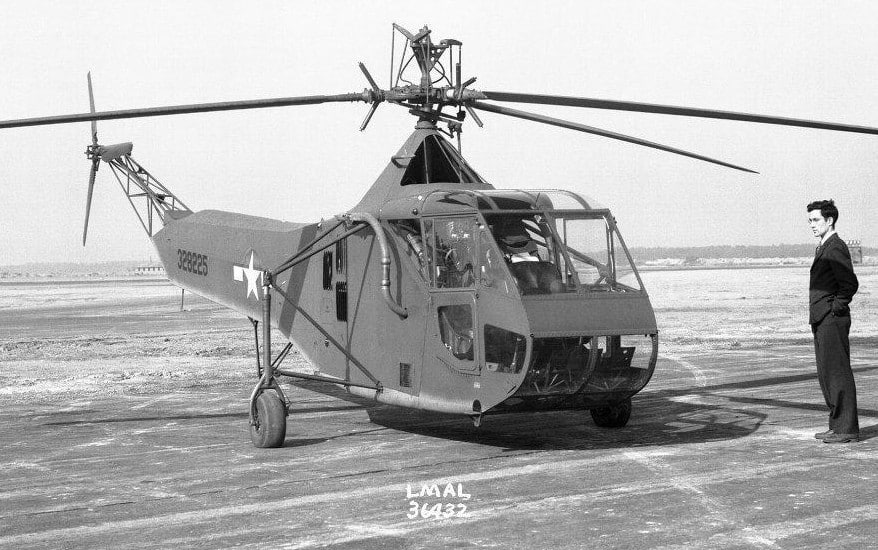
Figure 1. The Sikorsky YR-4B Hoverfly. Courtesy: Picryl archives.
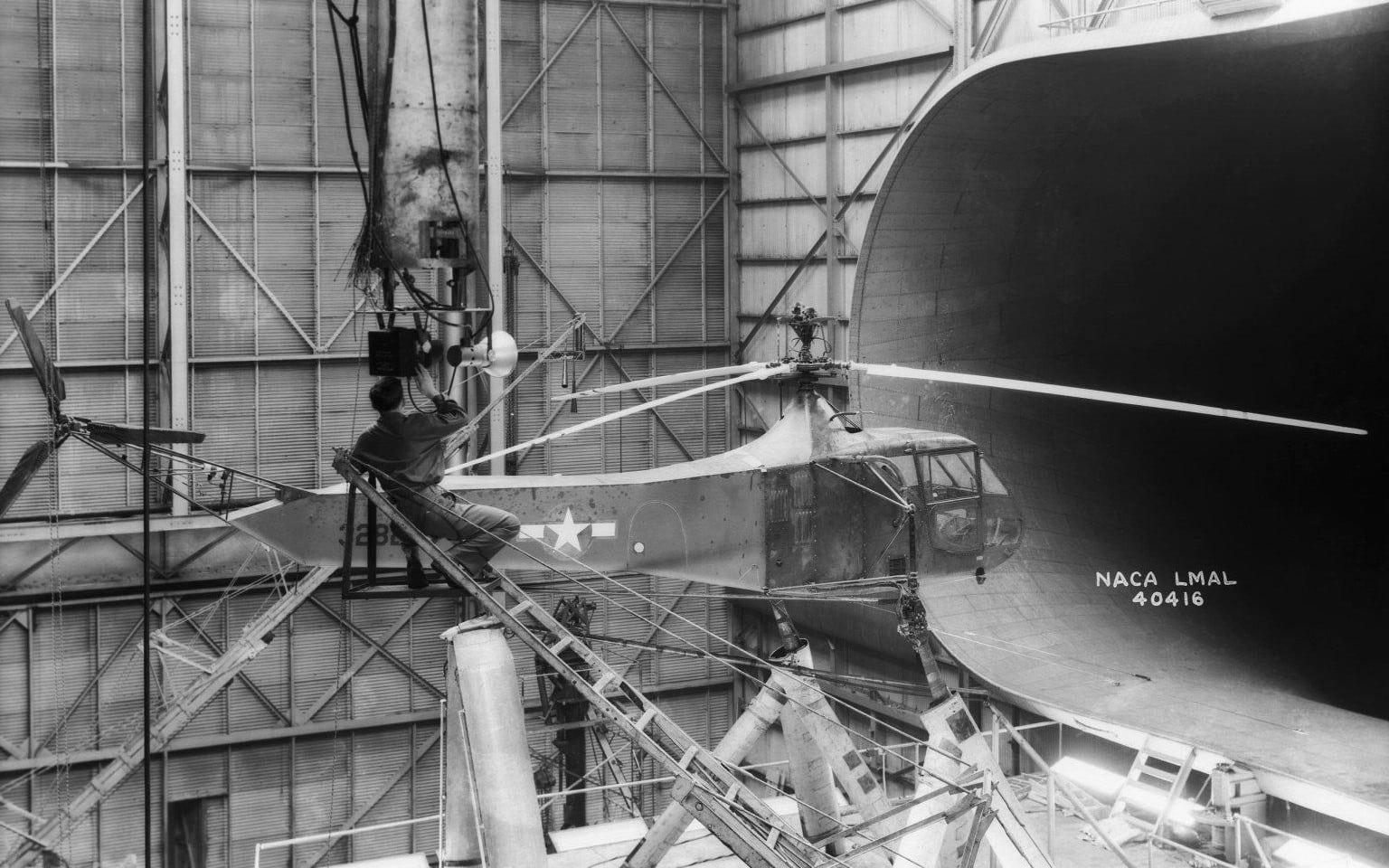
Figure 2. A Sikorsky YR-4B/HNS-1 undergoes testing at the Langley Air Force Base’s historic 30 x 60 Full-Scale Tunnel, where a technician prepares camera equipment for stopped-action rotor blade photography. Courtesy: DVIDS archives.
Back then, the Sikorsky YR-4B, the world’s first operational rescue helicopter, was less of an aircraft and more of an experimental platform, a prototype. And yet, when all else had failed for the wounded and trapped in those dense Burmese Jungles, “Send the eggbeater in!” Colonel Philip Cochran (Commanding Officer- 1st Air Commando Group) had demanded. [2]
And in went the eggbeater…
Untested, unproven- a rattling, shuddering contraption, flying on as much optimism and prayers as on fuel. Compared to today’s multi-role helicopters, the YR‑4B was little more than a flying skeleton. Vibrating in protest as it barely flew with only Lt. Carter Harman (pilot) aboard. Its Warner 500 radial engine wheezing against the tropical heat- trying to climb the altitude it clearly didn’t want to.[3]
The thin, hot Burmese air had made the underpowered engine’s life harder. The rotor’s chopping ability was compromised, and the lift was so weak and uncertain that leaving the ground felt like asking for a favour from gravity. And the payload? One passenger only, if he promised not to inhale too hard.[4]
The eggbeater obviously offered no armour.
No redundancy or backup systems. Minimal instrumentation. No insulation either. Just the pilot sweating into the controls while heat, vibration, and noise seeped straight into his hands, spine, and nerves. And fuel? Lt. Harman had to strip away the copilot’s seat, pack petrol cans in its stead (21 gallons in four jerrycans), fly halfway, land in any scrap of clearing he could find, and refuel before daring the next leg.[6]
But between a brave, ingenious pilot and a machine refusing to acknowledge its own flying manual, the eggbeater made it work. Despite the constraints, the YR‑4B achieved what neither fixed‑wing aircraft nor ground transport could: precise vertical rescue from terrain that was otherwise inaccessible under combat conditions.
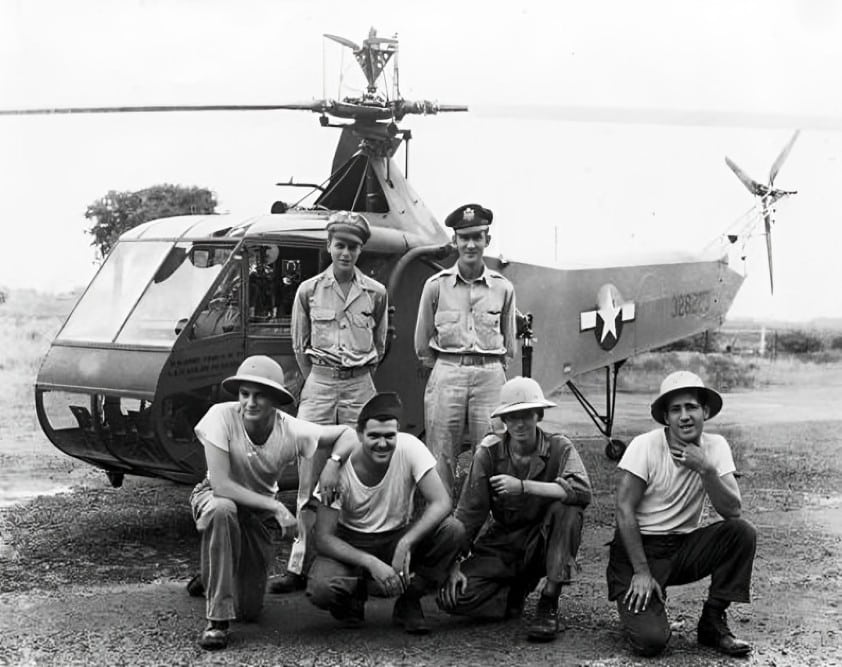
Figure 3. First Expeditionary Rescue Group Activation: A U.S. Air Force Museum photo, likely taken in January 1945, shows Lt. Carter Harman (standing left) with his ground crew, including crew chief and mechanic Sgt. Jim Phelan (front row right). Beside Lt. Harman stands Lt. Frank Peterson, an experienced R-4 test pilot who later carried out another notable Burma rescue mission in a YR-4B. Courtesy: DVIDS archives.
That day, the helicopter added a new dimension to aviation and airpower, one in which aircraft could also reach and recover with pinpoint precision… A solution to one of the most intractable problems of warfare- the CASEVAC (Casualty Evacuation). The helicopters could operate where runways didn’t exist, roads were impassable, and every minute could mean the difference between life and death.
History’s first-ever military helicopter evacuee had summarised this fact in one sentence. “You look like an Angel!” he had told Lt. Harman.[6]
Fighters could destroy, but helicopters could bring you home.
But how does a rescue in the Burmese jungle- carried out by a helicopter bearing American markings, saving British soldiers- connect with the inception of the IAF’s helicopter arm? Because this was where the idea took root. The first operational use of a helicopter in the Indian subcontinent, flown by American pilots and launched from an Indian airfield, played out before Indian military personnel. Serving alongside British and American forces at Ground Zero, they saw, up close, what a helicopter could do.
An unmistakable lesson: from the Himalayas to the Indo‑Burmese jungles- where fixed wings were constrained by runways and space, the rotary wings could offer mobility without boundaries.
Post-Independence, as the newborn India grappled with rebuilding its military, the memory of that jungle buzz and the imagery of that absurd little craft saving lives would return soon.
1947-1954
An Independent India: Setting Blades in Motion
The newly independent India inherited a military patterned after the British Empire’s. Fixated on fighter and bomber squadrons as the jewels of the crown, and the transport squadrons as the workhorses. The idea of helicopters remained mostly an observation, a footnote.
But not for long.
April 5, 1949. The Chiefs of Staff Committee, India’s highest inter‑service planning body, agreed on one thing: Helicopters could serve the military services. India’s defence forces were manning a jagged terrain. With a threadbare infrastructure. And here was a machine that could drop into a paddy field, land on a mountain top, or hover over a river. Orders were given to raise a flight and find out what more it could do. But first, a Joint Planning Sub‑Committee was to probe its potential, costs and limitations.[7]
Brigadier Sam Manekshaw took the chair, flanked by naval and air officers. But the report that rolled out was far from being an endorsement… Credits and praises were tempered with caution and limitations.
In its report, some of the key points the sub-committee observed were:[8]
CAPABILITIES |
LIMITATIONS |
FINANCIAL REALITIES |
Service ceiling: 10,000-19,000 ft.Cruising speed: Around 90 mph. |
“Still in the development stage.” Mechanically intricate; dense with moving parts; constant inspection and early replacement required. |
Total Initial Cost: INR16 lakhINR8 lakhs for three helicopters,INR 2.60 lakhs for one reserve. |
Payload: From three passengers in light types to 24 fully‑equipped troops in heavy ones such as the Piasecki HRP‑1. |
Shaken by summer turbulence, vulnerable to monsoon gusts. Flying hours are limited because of mechanical fragility. |
INR3.40 lakhs for initial spares, ground equipment, stores, etc., and INR 1 lakh for initial training, pay, and allowances. |
Can land on a field, a clearing, even a snow‑bound plateau.Operate in the mountains of Assam and Kashmir, or inriverine jungle. |
Night flying only in fairweather- blind‑flying gear and navigation aids were primitive. |
Recurring Cost: INR 5 lakh annually.Maintenance: 30 per cent ofpurchase cost per year- twice that of a fixed‑wing. |
Roles: Resupply isolated posts; deliver intelligence teams behind enemy lines; jungle or mountain rescue; reconnaissance; artillery fire observation. |
Air superiority is essential before deployment. Slow speed andlow‑level approach makes it aneasy target and prey to small‑arms fire. |
No Indian experience: every pilot and mechanic will have to be trained abroad. |
Sitting in 2025, when helicopters are an indispensable part of defence forces across the globe, the ‘1949 view’ of them reads almost amusing. Back then, the helicopter was a curious case. So unfamiliar, in fact, that the Sub‑Committee had to begin its deconstruction from the very basics, which could have almost unfolded like:
It flies: Vertically Up! Vertically Down! Backward! Sideways! Can hover in place!
It lands: In paddy fields! On clearings! Even on snow plateaus!
The committee spoke of these abilities as “peculiar flying characteristics”! Possibly a polite, 1949 military way of marvelling at how this thing could even stay up?! Stopping mid-air. Just hanging in there!
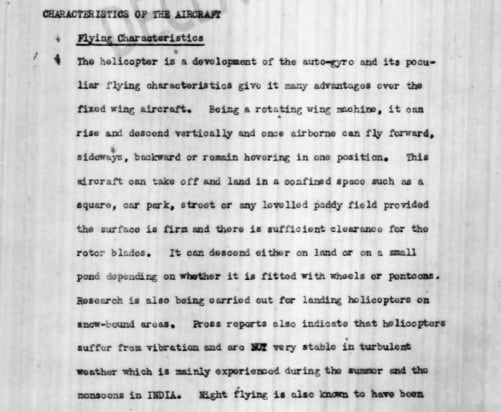
Figure 4. The actual non-dramatic text from the sub-committee report. (Pardon the author’s knack and need for dramatising things), Courtesy: “Requirement of a helicopter flight for the defence services” (Chiefs of Staff Committee Agreement and JPSC Report), JPSC Paper No. 10(49).
A helicopter’s uses sounded heroic enough. From extracting stranded people from jungles and the sea to slipping intelligence agents into enemy countries. But the romance faded quickly. It was found to be mechanically temperamental, stuffed with parts that wore out quickly, prone to sulking in bad weather, and happiest only when the skies were calm. It could, in theory, land anywhere- provided it had a cover of air superiority and provided that “anywhere” was done slowly, low, and away from the enemy’s rifles.
The cost calculation didn’t help either. For a military struggling with post-independence budgetary constraints, four machines, their spares, tools, and training, would drain INR 16 lakh at once and INR 5 lakh each year thereafter. Maintenance costs (30 per cent of the initial aircraft cost) alone were twice those of a fixed-wing aircraft (15 per cent).[9]
And since no one in the Royal Indian Air Force or the Army had so much as touched a helicopter, 60 per cent of the personnel- from pilots to fitters to riggers- would have to be trained in the UK or the USA.[10]
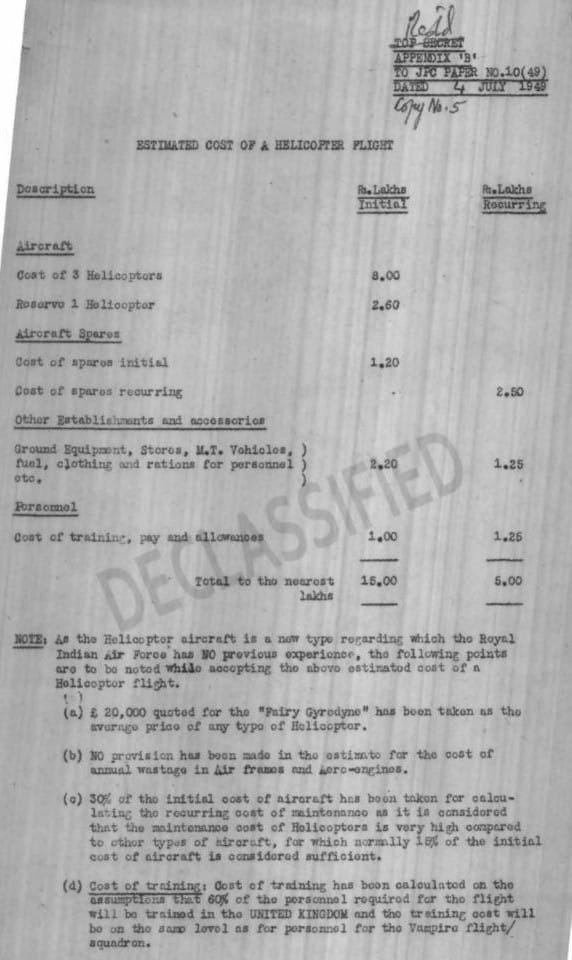
Figure 5. A page from the subcommittee report detailing the cost projections, Courtesy: “Estimated cost of a helicopter flight” (Chiefs of Staff Committee Agreement and JPSC Report), JPSC Paper No. 10(49).
Perhaps one of the most telling lines, buried in the ‘personnel’ section, read:
“A trained pilot of a fixed‑wing aircraft finds some difficulty in learning to fly a helicopter as he has to unlearn quite a lot about flying.”
To which the subcommittee had added, without irony, that “ab‑initio pilots do not experience such a difficulty.”
In other words, the clean slates learnt the fastest.
In that July 1949 report, the recommendation was clear: Wait. Let the technology mature. Let the engineers iron out the gremlins. Wait until India’s scarce defence budget can spare the funds without harming higher priorities. The helicopter would have to wait a little longer for its moment.
The IAF did propose an expansion plan in December 1952, proposing the establishment of a helicopter flight with Sikorsky S-55 helicopters.[11]
And although the sentiments supporting the need to have them were further bolstered by their exemplary performance in the Korean War, probably the final, decisive push came from a civilian.
In 1953, India’s first CHPL (Commercial Helicopter Pilot Licences) was granted to Capt Rustom C. Captain, a civil aviator. And in a symbolic masterstroke, he flew Prime Minister Nehru and the Bombay Home Minister in his Hiller UH-12B. The short flight left a strong impression and placed helicopters firmly on India’s leadership radar.
But there is another version, or rather, another layer to this history. The Indian Navy’s ambition for an aircraft carrier fleet unexpectedly brought the IAF and helicopters together. The Naval Aviation Directorate needed air-sea rescue helicopters, and when a single-platform solution for all services was considered, the proven S-55 (already in use across the US military in Korea) emerged as the obvious choice. In October 1953, Air Marshal Gerald Gibbs, then Chief of the Air Staff, approved Naval Chief Admiral Pizey’s proposal: the IAF would temporarily take custody of the S-55s, train its pilots and technicians to induct India’s first military helicopters, and later hand them over to the Navy once personnel were ready.[12]
**********
December 27, 1953. Wheels in motion. The Defence Committee of the Cabinet overruled the earlier financial objections. Sanction granted. Decision made- Raise India’s first helicopter flight. The machine was coming… and with it, a new chapter in military aviation…
1954
104 Helicopter Flight: The Vanguard’s Rise
Motto: APATSU MITRAM- “Friend in Time of Trouble” Formation Date & Place: March 10, 1954, Palam (3 Wing) Founding Personnel: Two pilots, one engineering officer, five technicians
First Commanding Officer: Flt Lt A Neal Todd
Initial Aircraft: Sikorsky S‑55 (IZ‑648, IZ‑649, IZ‑650)
Year |
Notable Feats |
1957 |
First overseas mission for IAF helicopters (Ceylon). First rooftop landing in India. |
1959 |
First overseas mission for IAF helicopters (Ceylon). First rooftop landing in India. |
1961 |
High‑altitude world record (19,500 ft). |
1961 |
Actively participated in the Sino-Indian conflict. Squadron Leader VK Sahgal, the then CO, became the first war casualty of 104 HU after being killed in action in the Tawang sector. |
1962 |
During the Indo-Pak war, its Mi-4 helicopters were modified to carry a0.5-inch calibre gun (semi-gunship role). |
1965 |
Five helicopters fitted with 20mm guns operated in Ceylon (Apr-May) to assist the government in Counter Insurgency Operations (flying 573:35 hours in 1122 sorties). Participated in the Indo-Pak War (recce, communication, Cas Evac) (flew 268 hours over 433 sorties). Two Chetaks were gifted to the Bangladesh Air Force. |
1971 |
Actively participated in the Sino-Indian conflict. Squadron Leader VK Sahgal, the then CO, became the first war casualty of 104 HU after being killed in action in the Tawang sector. |
1977 |
The unit’s role was re-designated as an ATGM (Anti-Tank Guided Missile), becoming the IAF’s first ATGM Unit. |
March 10, 1954. 104 Flight was raised. A handful of men stood at the edge of the unknown. Two pilots, one engineering officer, five technicians. Four of these- Flight Lieutenant S.K. Majumdar and Flight Lieutenant Allison Neil Todd (both pilots), Flying Officer K.K. Mitra (engineering officer) and technicians Flight Sergeant Rawat and Sergeant Sharma had come back after getting trained in the United States.
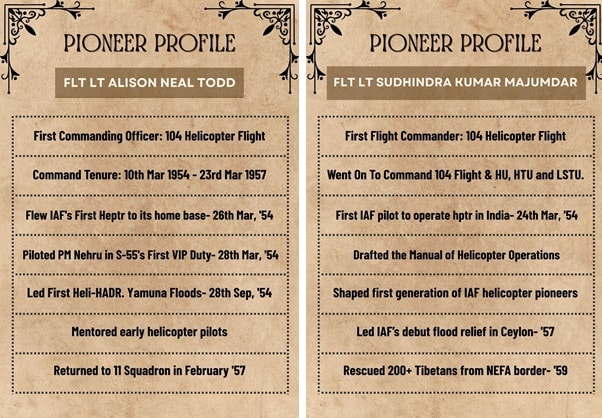
The Flight’s very first helicopter, the Sikorsky S-55 (tail number IZ-648) had arrived by sea at Bombay on March 19, 1954. By March 23, its assembly was complete. At Juhu, it underwent rigorous ground and air tests. And finally, on March 26, Flt Lt A. Neal Todd and Flt Lt Mitra, the Engineering Officer, ferried the IZ-648 to Palam- the base, destined to be the cradle of Indian military rotary-wing aviation. [13] And the men went on to become the pioneers shaping rotary aviation in India. Flt Lt A N Todd, as the first Commanding Officer of the 104 Helicopter Flight, spearheaded the IAF’s initial foray into rotary-wing aircraft, piloting the first Sikorsky S-55 ferry, and undertaking the first mercy mission that earned helicopters the “Harbingers of Life” sobriquet.[14]
Flt Lt S K Majumdar, the flamboyant architect of helicopters in India, laid the foundational operational and training doctrines. He single-handedly trained many early helicopter pilots, penned the essential Manual of Helicopter Operations, led the first overseas helicopter mission, and achieved India’s first rooftop landing. His command tenures of the 104
Helicopter Unit (HU) and the Helicopter Training Unit further cemented his enduring legacy in Indian rotary aviation.
Flt Lt Mitra was the person behind the first Maintenance Conversion Flight (MCF), soon after the first Sikorsky reached Palam. The painstaking task of training the IAF’s first aircrew and technicians in this strange, vertical-flying craft started under his watchful eyes.
For these pioneers, there were no manuals. No veterans to turn to. No precedent in the IAF’s proud history of fighters and bombers… A never-before-done first. Looking back, one can only try to imagine what this small band of pioneers, standing at the Palam dispersal, looking at the Sikorsky, would have felt like… Perhaps the burden of this responsibility? Perhaps a raw conviction that they would make the machine fly. Whatever the truth, that morning, cracking open a new chapter, they added a vertical dimension to our air ops. In those Palam dispersals, the IAF’s first helicopter flight was born, tilting the IAF’s horizon skyward and upward.
It was a ‘Flight’, not a ‘Unit’, by design. The Chiefs of Staff Committee recommended that helicopters be first tried in a limited, experimental formation to assess suitability before committing fully. Financial caution had also weighed in. And therefore, the plan was to begin with the smaller of the two formations.
But in that choice, history repeated itself. When the IAF itself was born in 1932, its first operational component was not a squadron but a Flight raised at Drigh Road in 1933: four Westland Wapiti biplanes, six RAF-trained Indian officers, and nineteen Havai Sepoys (from that humble kernel grew an Air Force, which 93 years on, has gone on to become one of the world’s biggest and most powerful).[15] Two decades after the IAF’s first unit was raised, the Sikorsky Flight at Palam was cast in the same mould… Compact team, limited tech- but each unlocking new strategic dimensions. Just as the early fighters allowed India to begin building aerial combat and reconnaissance capacity, the early helicopter flights opened up vertical mobility in conflict and disaster zones.
The Wapiti Flight had given India its wings; the Sikorsky Flight gave it lift.
Just two days after its arrival, the S-55 found itself in the middle of a spectacle of aerial power. A show which was to be witnessed by over one Lakh people.
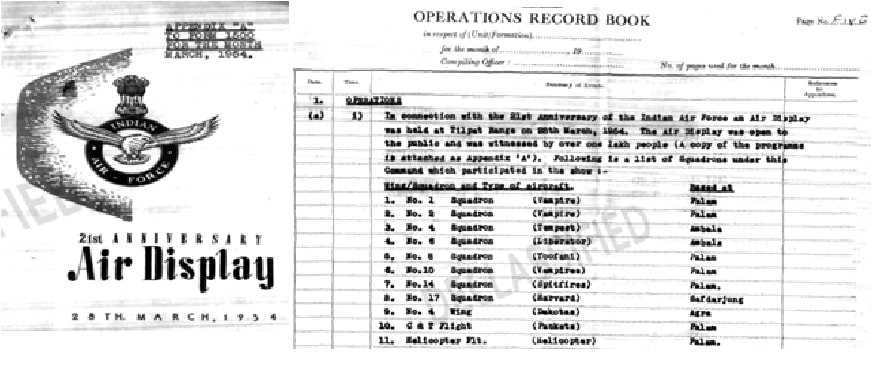
Figure 5. Details regarding the Air Display from 104 HU’s ORB.
On March 28, 1954, at the IAF’s 21st Anniversary Air Display (then part of the April 01 “Air Force Day” celebrations tradition, observed from 1933 till 1976, to mark No. 1 Squadron’s formation on April 01, 1933; the date gained added significance in 1954 when Air Marshal Subroto Mukerjee became the first Indian Chief of Air Staff. In 1976, the observance was moved to October 08, the date of the IAF Act in 1932 and the first Indian officer commissions), at Tilpat Range, the programme listed an impressive roster. No fewer than 10 combat squadrons and two specialist units (Dakotas for paratrooping and Packets for demonstration) are taking part, fielding Spitfires, Vampires, Ouragans (Toofanis), Tempests, Liberators, and Harvards in precision aerobatics, bombing runs, and rocket firing sequences.[16]
Amid this thunder of piston and jet fighters, a solitary new entrant appeared. The S-55. The fledgling IAF helicopter crew had been assigned its maiden mission: carrying Prime Minister Nehru himself to the venue, and half an hour later, demonstrating for the first time in public its existence and flying capabilities.
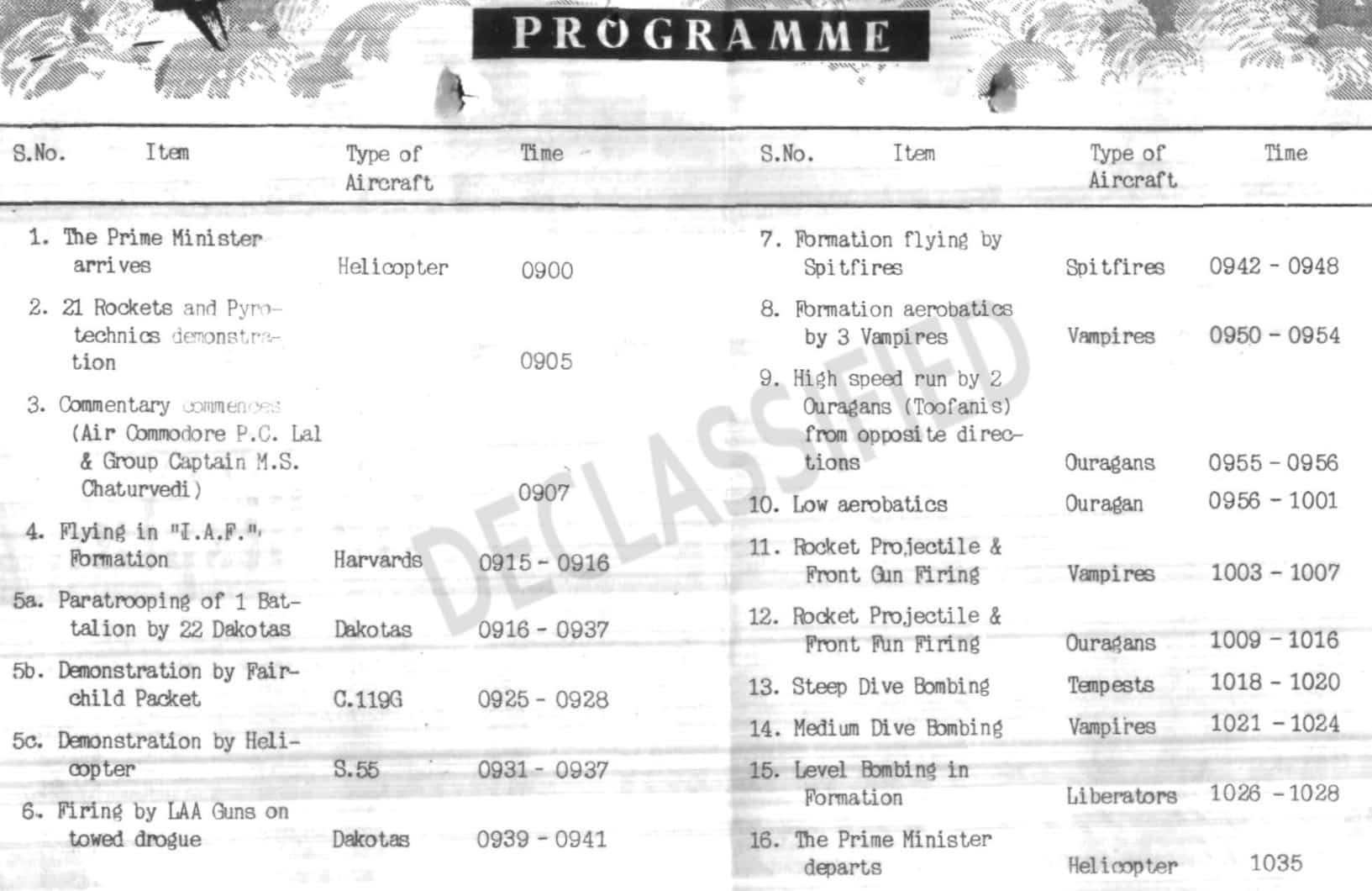
Figure 6. Details regarding the Air Display from 104 HU’s ORB.
For almost all of the spectators, this would have been their very first glimpse of a helicopter in flight. And the contrast would not have been any sharper. Sleek jets tearing the sky with their speed and sound, while the helicopter entering with a whirring, thrashing presence of its own. Vertical flight, hovering abilities, extreme precision and control.
The lone helicopter would have caught the fancy of its spectators- both within and outside the service. Despite the initial hesitation, the ‘eggbeater’s’ capabilities were coming to light and were probably being acknowledged and appreciated, for 104’s infrastructure was slowly expanding. By March 31, nine airmen of various technical trades were posted to the flight. And on August 31, 11 more were provided.

Figure 7. A page from the 104 HU ORB detailing the expansion of 104’s unit strength.
In the meantime, the lone S-55 was already proving its worth in daring rescues. On July 20 and again on August 14, downed Vampire pilots Flight Officers Sher Karan Singh and M.S. “Minhi” Bawa were extracted to safety. The latter, piloted by Flt Lt S.K. Majumdar, was probably India’s first ‘Search and Rescue’ mission. A highly accomplished pilot and instructor, Majumdar was not just flying missions but also, in effect, writing the operational manual and evolving procedures for various helicopter roles, including search and rescue.
With no established procedures for helicopter rescue, the pilots had to rely on raw skill, judgment, and improvisation. And the single S-55, loyal to its masters, pressed on relentlessly, executing more missions, cementing more feats. And soon, on September 21 that same year, it was joined by a second S-55 in the unit.
Then came a mission that spoke of science as much as aviation. 1954 was the year India formally expanded its atomic programme by creating the Department of Atomic Energy. And soon, the newborn 104 HF was drawn into an unlikely role. On September 23, 1954, it lifted off on a radiation survey, the helicopter fitted with specialised detection gear and carrying the Government’s atomic research advisor, Darashaw Nosherwan Wadia. In effect, the aircraft became a flying laboratory, testing whether this strange new machine could serve as the eyes and ears of atomic science.[17] It was uncharted work, but the fact that the IAF’s newest and least proven arm was chosen for such a sensitive task spoke volumes: a signal of trust in the helicopter’s potential to serve science, security, and the nation’s future.
On September 28, 104 Helicopter Flight undertook the IAF’s first mercy mission. Flt Lt A.N. Todd piloted a Sikorsky S-55 to rescue 15 villagers stranded on a sandbank of the flooded Yamuna near Delhi. In that moment, the helicopter revealed a role far beyond combat.[18] A saviour in times of crisis. The press hailed it as the “Harbinger of Life,” while the newspaper
Dainik Jagaran coined the term Aapatsu Mitram, meaning a friend in times of distress. This powerful motto subsequently became, and for a long time remained, the official motto for all helicopter units in the IAF.
That single act marked a decisive shift in public perception and internal strategy. It underscored that the IAF was not merely a defender of the Indian airspace, but also a vital saviour of its citizens in times of calamity. What is commonplace today- helicopters saving lives in flash floods, earthquakes, avalanches and other disasters- was born that day on the banks of the Yamuna.
In December 1954, following the operational order no 51/54, Flt Lt Majumdar set course to Bombay to test-fly and ferry the third S-55 back to Palam. And a month later, on January 26, 1955, the unit flew at the Republic Day fly-past for the first time.
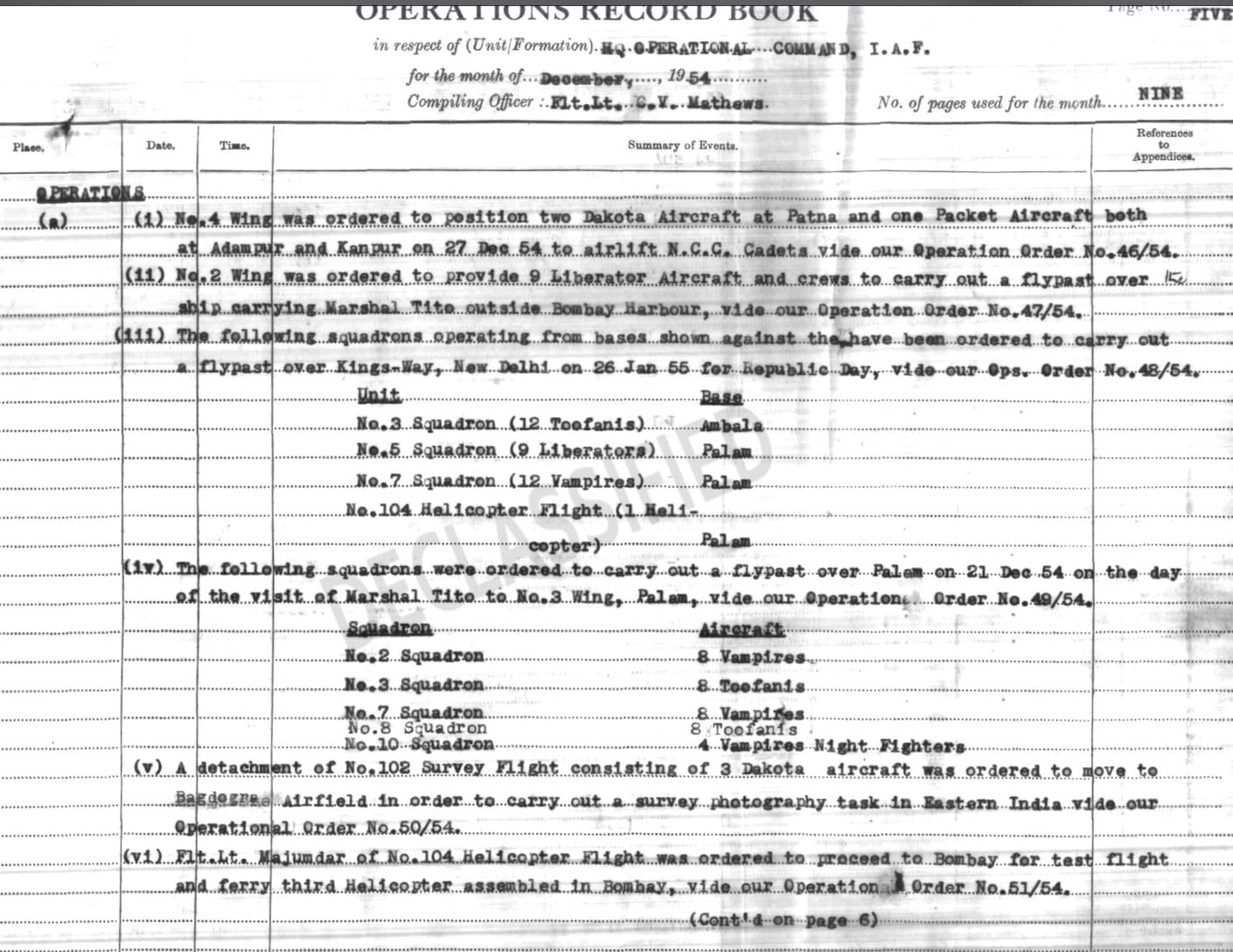
Figure 8. The 1955 Republic Day fly-past was the first time an IAF helicopter flew in an RDFP.
Courtsey: ORB, 104 HU.
However, the very missions that proved the helicopter’s worth also exposed its vulnerabilities. By April 1955, reality bit. The S‑55s were mechanically demanding. Serviceability sank to 46.6 per cent. Of the three helicopters, maintenance nightmares grounded two. Only one remained serviceable.[19] Yet operational demands grew. And in May 1955, the sole flyable S‑55 was sent to Jorhat for civil relief duties during floods in Assam. An uncharted territory, no backups, no margin for error.
Floods in Odisha and Punjab in late 1955 wrung the machines further. Crashes came. Floods worsened. The unit relocated to Kanpur for repair support. And by December 1956, serviceability dropped to zero. Zero.
But 104 didn’t shut down.
In September 1956, the unit temporarily shifted to Kanpur, a move driven by investigations into recurring accidents and the urgent need for stronger maintenance support. Operating under the shadow of the No. 1 Base Repair Depot offered direct access to specialised expertise, and the gamble paid off. Serviceability improved, and the unit was soon back to high-profile VVIP lifts for the Prime Minister and the Defence Minister, until December, when mechanical attrition once again brought serviceability to zero.
To save precious hours on the hard-pressed S-55s, the IAF ordered Bell 47G light helicopters in 1956 for ab-initio and conversion training. The decision stemmed from a clear recognition that a dedicated trainer was essential, much like the pattern followed in fixed-wing aviation. A comprehensive audit of early helicopter operations had shown that without such an aircraft, the bigger, more complex S-55s were being consumed by basic training tasks at the cost of operational availability. The Bell 47G thus offered a dual advantage: conserving the flying life of the larger machines while providing a structured training platform. It was also earmarked for Army reconnaissance and liaison duties, giving it an operational relevance beyond the classroom.
On December 26, 1957, two Bell 47Gs were inducted. And barely a day after their induction, they were dispatched overseas on flood relief duty in Ceylon. Led by Squadron Leader S.K. Majumdar, the detachment flew round-the-clock sorties dropping supplies, ferrying medical teams, and rescuing the stranded. It was the IAF’s first overseas helicopter mission, and its success won widespread acclaim.
On May 1,1958, the Flight came of age. Its achievements, daring missions, and growing responsibilities had already proven that the helicopter had a rightful place in the IAF’s order of battle. It was formally upgraded to the service’s first Helicopter Unit. Squadron Leader S.K. Majumdar, the pioneer who had shaped its ethos and written the very manual of helicopter operations, now took command of the historic unit. A milestone that marked the true birth of helicopter power in the Indian Air Force.[20]
From thereon, the pace of innovation only quickened. On March 31, 1959, Majumdar achieved India’s first rooftop landing, delicately placing a Bell 47G3 on the roof of ‘Ram Kutir’ in Calcutta, the Headquarters of No. 1 Operational Group. That same year, in April, the unit trained the first two naval pilots on helicopters. This demonstrated that the IAF was responsible for training both fixed-wing and helicopter pilots for the Navy. Subsequently, a Sikorsky S-55 helicopter was even loaned to the Navy for Air-Sea Rescue and plane guard duties aboard INS Vikrant.
Humanitarian missions, too, followed. A detachment under Majumdar moved to Daporijo in the North-East Frontier Agency (NEFA) with two S-55s and two Bells. They evacuated more than 200 Tibetan refugees from the remote village of Limiking in 1959, following the Chinese invasion of Tibet. It was a dramatic demonstration of the helicopter’s ability to bring hope and relief to the most inaccessible corners of the Himalayas.
As the tempo of operations increased, new machines joined the fleet. The Soviet-built Mi-4, inducted in 1960 after outperforming the S-62 in trials, soon earned the title of the IAF’s “Workhorse.” For a time, 104 HU simultaneously operated three types- S-55s, Bells, and Mi-4s- each serving a different purpose but together forming a potent force.
The pioneering spirit was evident again in early 1961, when the Alouette III was put through its paces in Indian conditions. Squadron Leader V.K. Sahgal, then commanding 104 HU, flew with Sud Aviation’s chief test pilot, M. Boulet, to an altitude of 19,500 feet in the Spiti Valley, setting a world record and proving the aircraft’s worth for India’s demanding terrain.[21]
By mid-1961, the unit was already operating at the edges of war. In July, Bell 47Gs flew into the Ladakh sector during the Galwan Valley crisis, evacuating casualties from Chushul and Leh at heights above 10,000 feet- a first for Indian helicopters. Only weeks earlier, Sahgal
himself had led search-and-rescue missions near the Tibet border to find a missing Dakota transport aircraft. Braving hostile weather and high mountains, he eventually located survivors and personally evacuated them. His leadership and gallantry earned him the Vayu Sena Medal on Independence Day.
By the eve of the Chinese aggression in late 1962, the Firebirds had transformed from a handful of men and one untried helicopter into India’s most battle‑ready helicopter unit. They had lifted Prime Ministers, rescued airmen, flown atomic surveys, pioneered rooftop landings, and touched record‑breaking altitudes.
But their greatest test and their first war was yet to come. And when it did, the price would be paid in both machines and men.
1959
105 Helicopter Unit: The Rise of the Eastern Shield
Motto: APATSU MITRAM- “Friend in Time of Trouble” Formation Date & Place: November 23, 1959, Jorhat (10 Wing) First Commanding Officer: Flt Lt MS Kapoor
Initial Aircraft: Bell helicopters, specifically Bell 47G-3 or Bell 47G-5
105 Helicopter Unit was raised on November 23, 1959, at Jorhat, Assam. Its starting aircraft were Bell 47Gs, small and nimble, but tasked with an outsized role: to cover some of the most forbidding terrain in the world. From Bhutan to Burma, across dense jungles, insurgency-hit valleys, and skies ruled by hostile weather, the unit carried its fragile machines into places where few others dared.[22]
Year |
Notable Feats |
1962 |
NEFA Ops (Deployment to far-flung areas in Subansari and Siang sectors, including Tawang, Pasighat, Kibitoo, Chaklagaon and Maza regions). |
1962 |
Contributed personnel who received the unit’s first honours (VrC, VM, VSM) for service during Himalayan tasks/1962 ops (Sqn Ldr AS Williams, Flt Lt B Johnson, Sgt AN Verma). |
1971 |
Airlifted 6,023 troops & 1,79,160 kgs of military hardware around Dacca during day and night operations. |
Figure 9. Image Source: Unit History, 105 Helicopter Unit.
By the early 1960s, 105 HU was already pushing into the frontlines of counter-insurgency operations in Tawang, Pasighat, Kibitoo, and beyond. These were theatres where maps were often vague, helipads were little more than afterthoughts, and combating guerrillas demanded precision from the air. Its pilots flew night drops, executed single-pilot landings on tiny clearings, and carried out vertical casualty evacuations under fire. In these years, for its precise, almost surgical missions, the unit earned its first gallantry awards.
The IAF, meanwhile, looked to expand its training base. To train, to convert, to dream- it turned to the Bell 47G. Four had been ordered in 1956, and by December 26, 1957, two had arrived. They were pressed into service almost immediately, in time for a proud moment: the IAF’s first overseas helicopter deployment, flown to aid flood relief in Ceylon (now Sri Lanka).[23]
From Jorhat’s dispersals to the forward ridges of Arunachal, 105 HU became the IAF’s Eastern Shield. Its early missions were the proving ground, but the true test of shield and sword was still to come- in the high Himalayan war of 1962.
1960
107 Helicopter Unit: The Desert Hawks in the Himalayas
Motto: APATSU MITRAM- “Friend in Time of Trouble”
Formation Date & Place: January 1, 1960, Jorhat (1 Wing)
First Commanding Officer: Sqn Ldr Arnold Sochindranath Williams
Initial Aircraft: S-62 and Bell 47 G-3 helicopters
Year |
Notable Feats |
1961 |
First unit in the Indian Air Force to convert to Mi-4 helicopters (in Nov 1961) |
1962 |
Deployed in Kashmir during the war with China, undertaking air support, supply, and casualty evacuations |
1971 |
Helicopter attacked by F-86 Sabres and MiG-19s; pilots avoided being hit via sharp S turns. This was perhaps the genesis of the tactics employed by helicopters for aerial combat with a fighter in the IAF |
1977 |
Involved in cyclone relief in Tamil Nadu and Andhra Pradesh |
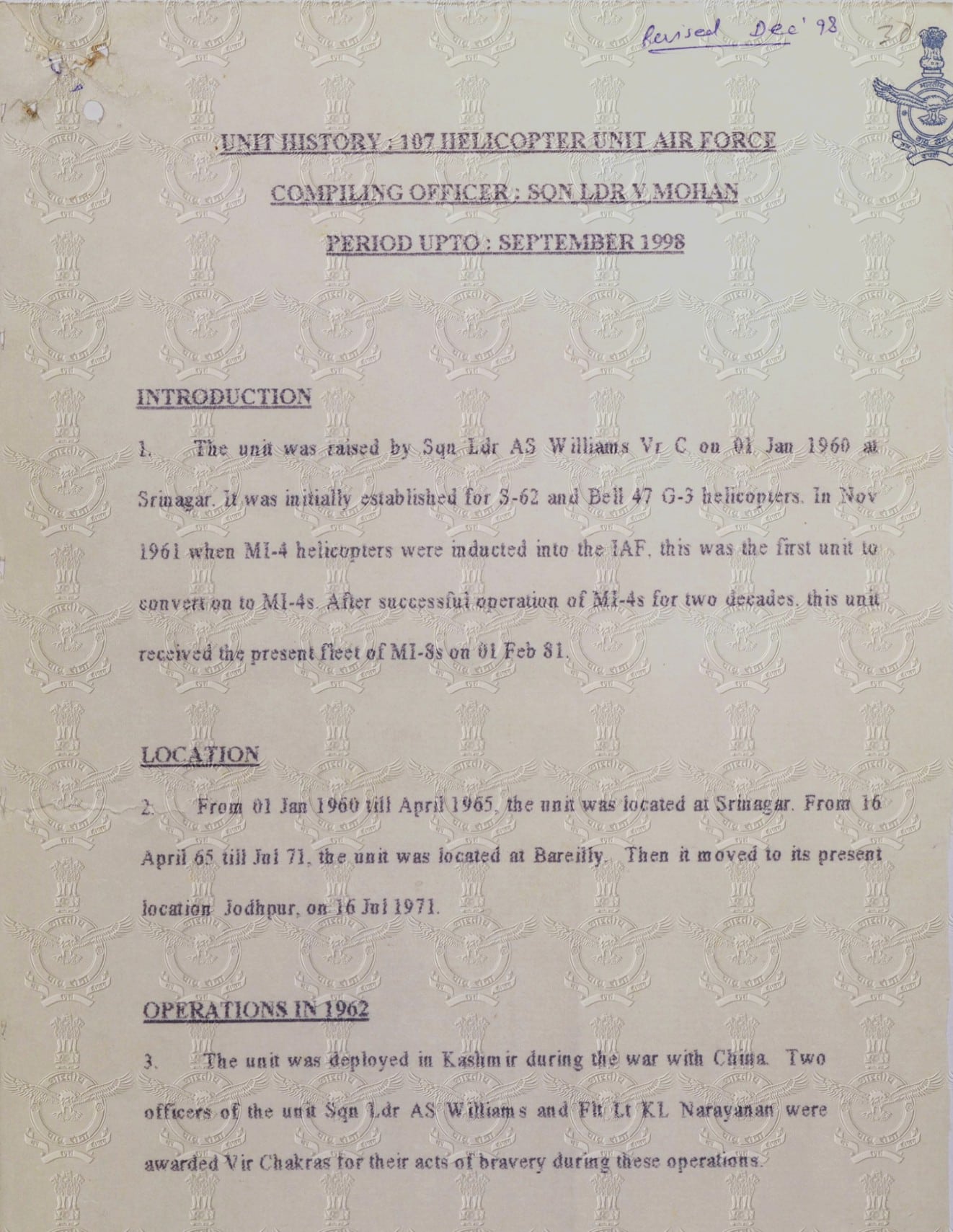
Figure 10. Image Source: Unit History, 107 Helicopter Unit.
January 01, 1960. The 107 Helicopter Unit was raised at Srinagar. Starting with S-55s and Bell 47G IIIs, it faced its first significant test within little more than a year. On May 13, 1961, it became the first IAF helicopter unit to be permanently deployed at Leh. [23]
Operating at 11,000 feet above sea level was no routine feat- it was an outright miracle of rotorcraft engineering and of human will. Engines gasped in the thin air, rotors struggled for lift, and every sortie demanded the last ounce of skill from its pilots. Yet 107 HU carved out its reputation in Kashmir and Ladakh. It was here that the “Desert Hawks” were born, a moniker that contrasted the frozen white of the mountains with the ferocity of their flying.[24]
When war came in 1962, the unit’s Mi-4s were thrown straight into the line of fire. One helicopter was hit in action; it landed, regrouped, and returned to the fight. The daring of its crew was recognised when Sqn Ldr S.K. Badhwar, Sqn Ldr A.S. Williams and Flt Lt K.L. Narayanan were awarded Vir Chakras for their courage in impossible conditions.
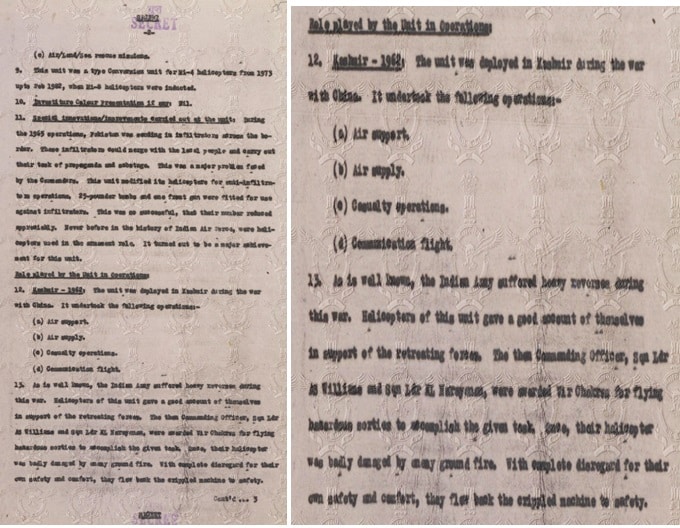
Figures 11 and 12. Image Source: Unit History, 107 Helicopter Unit.
From Srinagar’s valleys to Leh’s rarefied airstrips, the Desert Hawks had already shown that helicopters could bend the Himalayas. Their reward was not rest but the harsher crucible of 1962, where every contour of Ladakh would be fought for.
1961
109 Helicopter Unit: The Knights Take Flight
Motto: APATSU MITRAM- “Friend in Time of Trouble”
Formation Date & Place: August 26, 1961, Chandigarh (12 Wing)
Year |
Notable Feats |
First Commanding Officer: Sqn Ldr William Joseph Liddle 1961 |
Actively participated in ‘Op Vijay’ (Liberation of Goa) (Dec 08-20, flying 28 hours) |
1962 |
Involved in the Sino-Indian conflict (Leh sector and NEFA, present Arunachal Pradesh), undertaking extensive casualty evacuation and supply dropping missions |
1966 |
Took part in Mizo Hills Operations in the Eastern Sector (Cas Evac, logistics support, communication |
1971 |
During the Indo-Pak conflict, performed admirably in diverse roles (Cas Evac (468 casualties), border recce). Airlifted ejected PAF pilots for interrogation. Helicopter crew rescued a surviving pilot of a burning Krishak after sunset (Flt Lt Chandani awarded VM) |
1974 |
Re-equipped with Mi-8 helicopters |
1979 |
Undertook the challenging task of placing a troposcatter unit (1.5 tonnes) on top of the eight-story IIT building in Delhi |
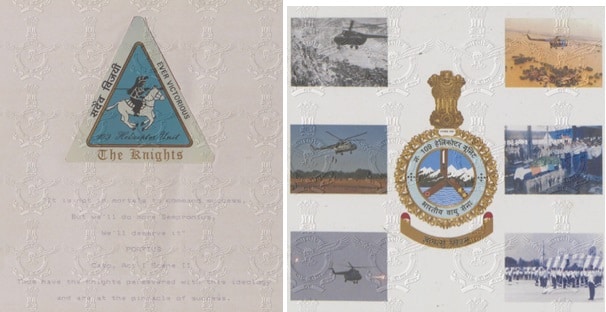
The 109 Helicopter Unit (HU), famously known as ‘The Knights’, was officially raised on August 26, 1961 at Chandigarh. Equipped with Soviet-built Mi-4 helicopters, the Knights bore their own distinctive insignia: a gallant knight on his steed, lance poised for jousting, with the motto “Ever Victorious” beneath. Its crest, trisected by rotors and framed by mountains, symbolised service on land, sea, and air, and the harsh environments where the unit was destined to operate.
Figures 13 & 14. Courtesy: Unit History, 109 Helicopter Unit.
From the outset, 109 HU was envisioned as a full-fledged helicopter unit with multifarious and multifaceted capabilities-communication and logistic support, VVIP/VIP flights, air maintenance of remote and unapproachable areas, casualty evacuations from high-altitude terrain, close air support to the Army, and large-scale troop induction by heli landing and para-dropping. The unit immediately embraced this sweeping charter and was soon fullyoperational in the Sugar sector, flying into helipads perched on the razor edge of altitude.[25]
The Mi-4 helicopters themselves were unlike the Bell or Sikorsky helicopters that had preceded them. Chosen after comparative trials in July 1960, where they outclassed the Sikorsky S-62 in almost all aspects, the Mi-4s marked the dawn of the Soviet helicopter era in the IAF. They were machines of brute force and robust construction. Unapologetically noisy, but able to climb higher, haul more, and absorb greater punishment. It was for good reason that they quickly earned the sobriquet: the “Workhorse” of the IAF.
Even before the Chinese war clouds gathered, the Knights proved their mettle. In ‘Operation Vijay’ (Liberation of Goa), between 8 and 20 December 1961, they logged 28 hours on transport and reconnaissance sorties, blooding themselves in active operations within mere months of their raising.[26]
Thus, from the plains of Goa to the frozen ridges of NEFA, the Knights carved their legend in the first year of their life. And in 1962, barely a year old, 109 HU was thrust into a full-scale conflict during the Sino-Indian War.
1961
110 Helicopter Unit: Forged in Conflict
Motto: APATSU MITRAM- “Friend in Time of Trouble” Formation Date & Place: September 11, 1962, Tezpur (11 Wing)
First Commanding Officer: Flt Lt Nirmal Chandra Banerjee Initial Aircraft: MI-4 helicopters
Year |
Notable Feats |
1962 |
Entered the 1962 Indo-China War within months of its formation. Roles included logistic support, communication duties, and casualty evacuations. |
1963 |
Unit formally raised/re-raised on August 10, 1963, at 11 Wing, AF Tezpur. The primary role assigned was air maintenance in Nagaland, Tripura, Mizoram, and Arunachal Pradesh. |
1965 |
Provided logistics support to the army in the Eastern sector during the Indo-Pak War. |
1966 |
Mi-4s landed emergency troops at Aizwal (March 03) when the town was besieged by hostiles during the Mizo Hills Operations. |
1971 |
Carried out four major SHBO operations (Sylhet, Raipura, Narsinghai, and Vaidehi Bazaar/Baidya Decar) during the Indo-Pak conflict, enabling troops to reach Dhaka within 12 days. |
If you ever want to start a lively debate among Air Force historians, just bring up the question: “When exactly was No. 110 Helicopter Unit raised?”
One version, often quoted, is September 11, 1962.[27] Sounds neat, except other “official” records boldly declare the raising on August 10, 1963, at Tezpur.[28]
A grave error, because by then the Sino-Indian War was long over. And anyone suggesting 110 HU wasn’t around in ’62 is effectively erasing its role in that conflict.
In fact, veteran Air Cmde Melville Rego, who flew Mi-4s with the unit in those fateful months, is quite clear on this matter. In his detailed account of the 1962 war in an online article, he reminds us bluntly, “I should know, because I was there.” Rego flew missions during the height of the crisis, and his writing confirms 110 HU’s operational reality in ’62.
But just when you think you’ve settled the date, a third possibility emerges. One of the unit’s history cell pages claims:
“No 110 H U, AF was formed on 11 Sep 62 at 11 Wing, AF under EAC. First commander of the unit was Flt Lt N.C. Banerjee. This information gathered from Form 1500 seems erroneous as the existence of the unit before 11 Sep 62 is available in the documents of a helicopter accident BZ 590 which occurred on 30 Aug 62. Further clarification is not possible at this stage as the Government of India establishment letter and original Policy Page are not traceable. Form 1500 prior to June, 1969 are also not available to authenticate any information. Action to acquire a copy of the original policy page has already been initiated and further amendment to the above dates and information will be furnished on receipt of the required documents.”[29]
And therefore, its leadership details too, vary in available sources. While Flt Lt N.C. Banerjee is said to have held its first command between September 11, 1962 and August 17, 1963; some sources, citing 1963 as its origin year, give that honour to Sqn Ldr N.K. Gaikwad.
So, was it August 30, September 11, or August 10 of the following year? The honest answer: the original paperwork is missing, but the only certainty is that 110 HU was already in the fight when India was locking horns with China in 1962.
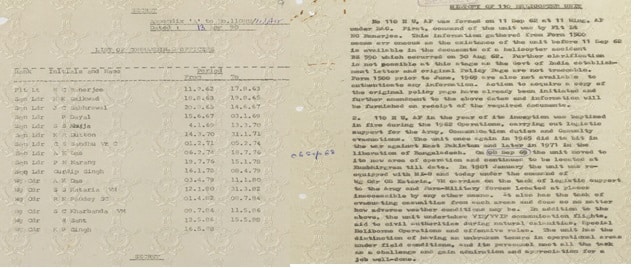
Figures 15 & 16. Courtesy: Unit History, 110 Helicopter Unit.
The unit was equipped with the Mil Mi-4, reflecting India’s growing reliance on Soviet rotary-wing platforms for lift and support in high-altitude and rugged terrain. From its inception until 1968, 110 maintained a two-helicopter detachment at Kumbhirgram airfield to support operations in the northeast. The same year, it formally started shifting to AF Station Kumbhirgram, completing the move on September 8, 1969, positioning itself as a permanent asset for counter-insurgency and regional air support.
From the outset, the unit was tasked with operating in some of the most challenging conditions in India’s northeast, balancing military, humanitarian, and civil roles. Its primary role was to conduct air maintenance missions across Nagaland, Mizoram, Tripura, and Arunachal Pradesh, ensuring logistical connectivity in difficult terrain, while being able to execute Special Heliborne Operations (SHBO) for counter-insurgency and troop induction.
Additionally, it was also trained for CASEVAC (Casualty Evacuation) from inaccessible and high-altitude zones, communication sorties linking forward posts with headquarters, and VVIP and VIP communication commitments.
The story of 110 HU reflected how the IAF’s rotary-wing arm was shaped in the Northeast- born of detachments, hardened by rugged terrain, and entrusted with sustaining troops in some of India’s most remote frontiers. But these formative years were not without trial. Because then came the crucible. Then came the war.
Prelude to the Fire: The Quiet Years Before 1962
In the years leading to 1962, India was gathering copious intelligence- maps, patrol reports, radio intercepts… Yet it failed to read the silence that preceded the storm. As one
retrospective account put it: “while Indian intelligence assessed Chinese military capabilities accurately, it overlooked Beijing’s political-military intentions.” The data was collected; the danger was not internalised.
The then Director of the IB, B. N. Mullik, later described the state of India’s communications-intelligence (COMINT) apparatus as a “serious handicap,” even admitting that before 1958 India was “almost at the start of our monitoring and other mechanical methods of intelligence.”
China, meanwhile, was hardly idle. The PLA had sharpened its edge in Tibet. From March 1959 to March 1962, it fought 12 major battles in central Tibet-operations that Chinese leaders later acknowledged were as much about suppressing Tibetan resistance as they were about training for Himalayan warfare. Internal PLA documents reveal that Mao saw the Tibetan campaigns as a crucible. China prepared for a conflict that few in Delhi imagined. Beijing also decreed that “the main front would be the eastern sector, specifically Tawang and Walong,” even before hostilities began.
In contrast, India’s “Forward Policy” posture was partly formed on assumptions that the Chinese would not react with force. So much so that the then Prime Minister Jawahar Lal Nehru had paid no heed to the warnings given by Sardar Vallabhai Patel, India’s then Home Minister. Sardar Patel, famously in his last letter to Nehru had written:
“While our western and non-western threat to security is still as prominent as before, a new threat has developed from the north and north-east. Thus, for the first time, after centuries, India’s defence has to concentrate itself on two fronts simultaneously. Our defence measures have so far been based on the calculations of superiority over Pakistan. In our calculations we shall now have to reckon with communist China in the north and in the north-east, a communist China which has definite ambitions and aims and which does not, in any way, seem friendly disposed towards us.”
On the morning of October 20, 1962, when thousands of Chinese troops silently descended cliffs and ridges, India’s leadership was still reciting the mantra: “the Chinese will not attack.”
That misjudgment was fatal. Without threat perception, our helicopter units- the 104, 105, 107, 109, and nascent 110- were thrown into a war that had been quietly preparing while Delhi slept. Actually, in hindsight, an even bigger mistake lay in not utilising offensive air power. The decision to restrict the Indian Air Force’s involvement, while denying it a combat role, deprived the services of a force multiplier that could have turned the tide.
At the time, Indian planners feared escalation, convinced that using the IAF offensively would trigger Chinese bombing of Indian cities. Intelligence also overestimated PLAAF strength, reinforcing a political aversion to deploying fighters and bombers. But experts now argue this was a major misread: PLAAF operations from Tibet were severely limited by altitude, short runways, and poor infrastructure, which crippled their payloads and range.[30]
Post-war reviews show India actually held a clear air advantage. Offensive air support in NEFA and Ladakh could have compensated for weak artillery, disrupted Chinese supply lines, and lifted frontline morale. IAF’s Hunters, Gnats and Mystères were fully capable of striking Chinese concentrations while facing minimal aerial retaliation. In short, by withholding its Air Force, India sidelined the one capability that could have reshaped the battlefield at a moment when China’s own air threat was limited.[32]
What unfolded next made the stakes painfully clear. NEFA and Ladakh’s skies turned hostile- thin air, no maps, invisible borders; with the enemy waiting beneath, without the fear of an offensive airstrike, ready to attack. For the first time, India’s fledgling helicopter units were all thrown into a single war effort, and they became lifelines, flying into impossibly high terrain to keep scattered troops supplied and alive.
1962
Indo-China War: Into the Storm
104 Helicopter Unit
By 1962, the 104 HU, India’s first helicopter unit had already carved out a reputation for pathbreaking sorties in Leh, Mana Pass, and Chushul. It was no stranger to thin air and uncharted ridges. But when the war came, its detachment at Jorhat/Tezpur was thrown into the teeth of combat in NEFA.
On October 20, 1962, tragedy struck. Sqn Ldr V.K. Sahgal, commanding officer of 104 HU, was flying a Bell 47G on a casualty evacuation mission from Zimithang to Tsangdhar in the Tawang sector. His light helicopter was hit by PLA small arms fire. He and his passenger, Maj Ram Singh, were killed. The helicopter, captured intact, was later displayed in Chinese hands. Sahgal’s death marked the IAF’s first helicopter war casualty. A searing symbol of sacrifice at the very outset of hostilities.
Yet 104’s sorties before and after this loss carried immense weight. Its Bells performed unprecedented feats in Leh and Chushul, flying above 10,000 feet AMSL, carrying casualties and supplies where fixed-wing aircraft and even mules could not dare to tread. After Sahgal’s death, Sqn Ldr S.K. Majumdar briefly returned to steady the unit. The very officer who had authored the Manual of Helicopter Operations years earlier.
For 104 HU, 1962 was both an ending and a beginning: the loss of its first CO, and the cementing of helicopters as indispensable frontline assets in the Himalayan war.
105 Helicopter Unit
If 104 bore the war’s first loss, 105 HU bore its heaviest load. Raised in 1959 at Jorhat, its mandate was reconnaissance, communications, and evacuation. In the war, it became the rotary wing’s backbone of the entire NEFA sector.
The numbers alone tell a staggering story: over the course of the conflict, 716 sorties in
558.15 flying hours; 14,625 kg of supplies transported; 356 casualties evacuated; 135 personnel airlifted. Within those totals lay operations of almost impossible daring.
1. October 1962, Zimithang detachment: 293 sorties flown, 135 hours logged, 57 casualties saved.
2. Tsangdhar operations: 4,200 kg of supplies carried into forward posts under fire.
3. November-December mercy missions: Over 100 sorties dropping 7,000 kg of rations and evacuating 35 soldiers.
4. December alone: 90 sorties pulled 70 men out of the jaws of death.
But statistics alone cannot capture the desperation in those valleys. Pilots of 105 HU flew Bell 47Gs, S-55 Sikorskys, and later Alouette IIIs, often overloaded, carrying up to 10 passengers in one lift, rotor blades inches from trees and rocks. Landings were on helipads barely the size of a rotor disc. On one night mission, Sqn Ldr A.S. Williams used a hand torch for illumination to drop ammunition and evacuate casualties, earning a Vir Chakra.
The human toll was heavy. A detachment at Zimithang lost three helicopters- two to enemy fire, and one abandoned as the post fell. When the position collapsed, one officer and eight airmen trekked for eight days through the jungle without food or shelter, even denied assistance by some Army authorities. Morale wavered as aircrew saw posts they had supplied fall within days, their efforts seemingly “wasted.” Yet they flew on.
105 HU spanned the entire border from Bhutan to Burma. It ferried, it rescued, it endured. In the Himalayas of 1962, it was the IAF’s workhorse of flesh and steel.
107 Helicopter Unit
In the western theatre, the burden fell on 107 HU, raised just two years earlier in Srinagar. It was the first unit to operate permanently out of Leh, a pioneering move that positioned it at the very edge of Himalayan aviation.
By 1962, its aircraft were Mi-4s- piston-engined, brutish, but capable of carrying heavy loads. The war tested them to their limits. Operating in Ladakh meant not just thin air but altitudes exceeding 9,000 ft, with operational ceilings stretched and exceeded daily.
In one defining episode, a Mi-4 was struck by enemy ground fire at an altitude of 4.8 km. The helicopter force-landed, avoiding immediate destruction. But in a feat bordering on impossible, the crew restarted, lifted off from that barren plateau, and flew the crippled machine back. Sqn Ldr A.S. Williams and Flt Lt K.L. Narayanan, who pulled this off, were awarded Vir Chakras for their gallantry.
107 HU became the first IAF helicopter unit to operate Mi-4s in Leh–Ladakh. Its pilots landed on icy strips, riverbeds, and cliff edges. They evacuated wounded, ferried supplies, and returned again and again to the front, even as hostile fire chewed at their machines. Theirs was a war of altitude and endurance, with rotor blades straining against physics itself.
109 Helicopter Unit
When the war came, 109 HU was barely a year old. Raised at Chandigarh in August 1961, it had already flown in Goa during Op Vijay. In 1962, it was flung headlong into the eastern Himalayas, its Mi-4s carrying the burden of a nation still learning the language of helicopter warfare.
109 HU’s aircraft flew CASEVAC, supply drops, communications, and troop movements. Detachments operated under HQ Eastern Air Command, often flying blind through clouds and blizzards, improvising helipads on ridgelines, landing on riverbeds. For a unit so young, every sortie was both a mission and training.
Its pilots quickly learnt that helicopter operations were not luxuries but lifelines. Their endurance transformed 109 HU from a fledgling squadron into what contemporaries called a unit that had “matured directly into adulthood.” In 1962, the Knights carved their place in the lineage of the IAF.
110 Helicopter Unit
No unit embodies the crucible of 1962 more than 110 HU. Barely formed, it was hurled into Walong and adjoining battle zones. Its missions included logistics, communication, and casualty evacuation in the most hostile sectors.
In one emblematic sortie, aircraft BZ 537, piloted by Flt Lt K.K. Saini, was hit by enemy fire near Walong. Forced down, the helicopter was captured by Chinese forces. For two months it lay in enemy hands before being recovered after the ceasefire and made airworthy again… A symbol of resilience… Saini was awarded a Vir Chakra for his courage.
110 HU’s baptism was immediate and total. Born in the heat of war, it proved that India’s rotary arm could adapt, improvise, and endure even when created mid-conflict.
Together, these units: 104, 105, 107, 109, and 110, shouldered a war that India had not foreseen. Each flew different machines, faced different terrains, and endured different tragedies. Vir Chakras were awarded to Sqn Ldr A S Williams, Flt Lt K L Narayanan, and Flt Lt K K Saini. India now knew: helicopters were not auxiliaries. They were the beating wings of survival in the Himalayas.
The Aftermath: Learnings in the Wake
The war profoundly reshaped the IAF’s helicopter doctrine and infrastructure:
1. Seamless air-ground coordination became vital, as helicopter missions were almost entirely in direct support of the Army (for casualty evacuation, resupply, and reconnaissance) making inter-service communication and planning indispensable.
2. By 1969, advance HQs of the Western Air Command (WAC) and Eastern Air Command (EAC) were co-located alongside the respective Army Commands. This institutionalised cooperation was at the strategic and operational level. This structure ensured that the planning for the deployment and logistics of helicopter assets (such as the Mi-4s and Chetaks active in this period) was done in constant synergy with the Army’s overall strategy, rather than operating independently.
3. The creation of Tactical Air Centres (TACs) established at each Army Corps HQ, now directly integrated air asset deployment, including helicopter support, into frontline ground operations. This structure allowed ground commanders to effectively utilise the “available assets”, which by the late 1960s included helicopters performing roles like troop transport, search and rescue and close air support.
4. A realisation had dawned: that helicopters weren’t just luxury tools. They were force multipliers. And most importantly, India needed more. 76 additional Mi-4s were thus, ordered post-war.
5. New units were established to handle expanded responsibilities:
5.1.111 HU- January 3, 1963, at Tezpur with Mi-4s.
5.2.112 HU- August 1, 1963, at Jorhat with Bell 47Gs.
5.3.114 HU- April 1, 1964, at Leh, initially with Chetaks.
6. The extensive operational use of the helicopters in the 1962 war underscored the critical need for logistical support capabilities and a specialised training establishment to meet the sudden, high demand for pilots and technical staff. The formal renaming of the Helicopter Training Unit (HTU) to Logistic Support Training Unit (LSTU) on December 1, 1962, reflected this shift in focus. To prepare pilots for the newly expanded units, the fledgling LSTU needed more space, specialised infrastructure, and dedicated resources than were available at Palam.[33] Therefore, it was moved to Allahabad (Bamrauli) between November 30 and December 1, 1962, placing it alongside the existing Pilot Training Establishment (PTE), facilitating the necessary expansion and conversion training required to support the rapidly growing fleet.
7. Indigenous Production Boost: Post-war importance given to HAL-SNIAS (Société Nationale Industrielle Aérospatiale, later known as simply Aérospatiale) Chetak production agreements.
8. The war prompted consideration of armed helicopter variants, as Mi-4s, even with Red Cross markings, were fired upon. Between 1962 and 1965, the IAF experimented with gun and bomb rack mounts (and used remodeled 0.5-calibre Browning machine guns from B-24 Liberator bombers) on helicopters. It then put its modified Mi-4s into action during the Indo-Pakistani War of 1965. The missions proved the value of rotary platforms in offensive roles and paved the way for the IAF’s eventual induction of modern, purpose-built attack helicopters.
9. As a ‘consequence of the faux pas in 1962’, the nation realised the importance of good roads in the mountainous borders for defence. This spurred units like 109 HU to undertake extensive flying tasks for the Border Roads Development Board to construct mountain roads in the Northeast.
Epilogue: Coming Back a Full Circle
As the rotors fall silent on this story, we return to where we began. For all the thunder that the helicopters brought to our skies, their own stories of inception and rise often went silent…
Sometimes due to oversight, sometimes due to errors, and sometimes because helicopters began as an auxiliary arm, and carried that “supporting role” tag for far too long before their true value was recognised…
Take the case of No. 110 Helicopter Unit (Vanguards). Here was a formation forged in fire, flying and fighting in 1962. And yet its very date of birth is mired in contradictory, erroneous records. Was it August 1962? September 1962? Or August 1963 (which would incongruously mean the unit did not exist during the war it actually fought!)? That we cannot say with certainty today is troubling. For if something as basic as a unit’s origin date can vanish into archival fog, what else have we lost?
And 110 is not alone. The 107 Helicopter Unit (Desert Hawks) has equally confusing paperwork: some sources fix its raising at January 1, 1960, others at 1st June 1960- both at Srinagar, both under the same commander. Meanwhile, the 105 Helicopter Unit (Daring Eagles), credited as one of the first dedicated helicopter units of the IAF, is variously listed as being raised on November 22, 1959 or November 23, 1959, at Jorhat. These may seem like small discrepancies, but together they point to a deeper problem: the institutional memory of entire squadrons can blur within a single generation.
This is not a mere quibble about paperwork. Militaries and governments the world over recognise the critical value of history-keeping, of institutional memory. Because accurate records have the power to shape doctrine, training, honours, and legacy. They give future officers something to build upon.
Despite the official irregularities, the painstaking work of historians, veterans, researchers and think tanks has kept most of these stories alive. Without them, much of this history would remain buried under clerical errors and lost files. To them, kudos. For today’s policymakers and officers, the questions remain: How do we ensure that these contradictions do not multiply? How do we institutionalise the telling of our own stories?
Because if history teaches us one thing, it is this: helicopters may have been the underdogs of the IAF fleet, but time and again they proved themselves indispensable- in war, in disaster, in peace. They carried soldiers to battle, lifted the wounded from impossible valleys, and dropped hope into villages cut off by floods… becoming lifeline, becoming saviours.
Moving forward, the author wishes and hopes that their story will not be neglected. That we will preserve the truth of when they rose, where they fought, and how they served. That future generations of air warriors will not have to ask: “But when were we born?”
Because for the men who flew those missions, and for the country they served, this is the least a nation can do. We may have forgotten their imprints on our history, but they were there the day India needed them.
*****
Notes:
[1] “The World’s First Military Combat Rescue,” Igor | Sikorsky Historical Archives, The World’s First Military Combat Rescue – Igor I Sikorsky Historical Archives. Accessed on June 8, 2025.
[2] Christopher L. Kolakowski, “Stout Pilots and Aircraft: Air Transport in the 1944 Burma–India Campaigns,” Air University (AU), November 24, 2020, https://www.airuniversity.af.edu/JIPA/Display/Article/2425703/stout-pilots-and-aircraft-air-transport-in-the-1944-bur maindia-campaigns/. Accessed on April 18, 2025.
[3] Bob Bergin, “In 1940s Burma, a New Kind of Flying Machine Joined the War: The Helicopter,” Smithsonian Magazine, August 2019, https://www.smithsonianmag.com/air-space-magazine/helicopter-goes-to-war-180972605/. Accessed on April 19, 2025.
[4] Mark Albertson, “Saga of the Eggbeater,” Warfare History Network, October 2016, https://warfarehistorynetwork.com/article/saga-of-the-eggbeater/. Accessed on April 19, 2025.
[5] Igor | Sikorsky Historical Archives, n. 1, p. 1.
[6] Jaglavaksoldier, “Sikorsky R-4 Hoverfly,” YouTube, July 19, 2009, https://www.youtube.com/watch?v=o3o1SFeLJTY&t=98s. Accessed on April 18, 2025.
[7] Joint Planning Sub-Committee (Brigadier S H F J Manekshaw, Chairman), “Requirement of a Helicopter Flight for the Defence Services” (Chiefs of Staff Committee Agreement and JPSC Report), JPSC Paper No. 10(49), TOP SECRET, Copy No. 5, July 4, 1949. Accessed on August 23, 2025.
[8] Joint Planning Sub-Committee, “ESTIMATED COST OF A HELICOPTER FLIGHT” (1949 Financial Estimates and Maintenance), JPSC Paper No. 10(49) Appendix ‘B’, July 4, 1949. Accessed on July 12, 2025.
[9] Ibid.
[10] Joint Planning Sub-Committee, “PROBLEMS PECULIAR TO HELICOPTERS” (Personnel and Training), JPSC Paper No. 10(49). Accessed on August 23, 2025.
[11] Nijjar, Wg Cdr B. S. “National Security Management: Some Concerns.” AIR POWER Journal, Vol. 13, No. 1 (2018). https://capsindia.org/managewebsiteportal.com/files/documents/9ee52394-a9dc-44e4-a353-abf9568b249e.pdf. Accessed on May 30, 2025.
[12] Gupta, Anchit. “The Accidental Fleet of the IAF.” IAF History, March 27, 2024. https://iafhistory.in/2024/03/27/the-accidental-fleet-of-theiaf/#:~:text=Enter%20Air%20Marshal%20Gerald%20Gibbs,Navy%20after%20training%20their%20personnel. Accessed on May 30, 2025.
[13] History of No. 104 HU. AIR FORCE, “BRIEF HISTORY OF 104 (H) SQN (Formation and First Mission)”,
Official Unit History (221.pdf). Accessed on September 22, 2025.
[14] History of No. 104 HU. AIR FORCE, “BRIEF HISTORY OF 104 (H) SQN (Formation and First Mission)”,
Official Unit History (221.pdf), accessed on September 22, 2025.
[15] Press Information Bureau, Government of India, “The Story of the Indian Air Force: A Journey Through Time,” October 07, 2024, https://www.pib.gov.in/PressNoteDetails.aspx?NoteId=153257&ModuleId=3. Accessed on August 11, 2025.
[16] History of No. 104 HU. AIR FORCE, “BRIEF HISTORY OF 104 (H) SQN (Formation and First Mission)”,
Official Unit History (221.pdf), accessed on September 22, 2025.
[17] Ibid.
[18] History of No. 104 HU. AIR FORCE, OPERATIONS (First Mercy Mission and Motto), Official Unit History (221.pdf). Accessed on September 22, 2025.
[19] Nijjar, Wg Cdr B. S. “National Security Management: Some Concerns.” AIR POWER Journal, Vol. 13, No. 1 (2018). https://capsindia.org/managewebsiteportal.com/files/documents/9ee52394-a9dc-44e4-a353-abf9568b249e.pdf. Accessed on May 30, 2025.
[20] History of No. 104 HU. AIR FORCE, “BRIEF HISTORY OF 104 (H) SQN (Formation and First Mission),” Official Unit History (221.pdf). Accessed on September 22, 2025.
[21] History of No. 104 HU. AIR FORCE, Meritorious/Outstanding Achievements (High Altitude World Record and Rooftop Landing), Official Unit History (221.pdf). Accessed on September 22, 2025.
[22] BRIEF HISTORY OF 105 HU AF, Formation (Daring Eagles), Official Unit History (220.pdf). Accessed on September 22, 2025.
[23] HISTORY OF IAF: 107 HU, INTRODUCTION (Formation, Location and Conversions), Official Unit History (209.pdf). Accessed on August 23, 2025.
[24] Ibid.
[25] HISTORY OF NO. 109 HU. AIR FORCE, Introduction: Birth of a Colossus (Formation and Aircraft), HAWS Cell Series, Squadrons of the IAF 49, 109 HU, AIR FORCE ‘THE KNIGHTS’ (334.pdf). Accessed on September 22, 2025.
[26] Ibid.
[27] HISTORY OF NO. 110 HU. ATR FORCE, Introduction (Formation and 1962 Conflict), Official Unit History (212.pdf), Accessed on September 22, 2025.
[28] Ibid.
[29] Ibid.
[30] Praveen Davar, “Why air power was not used in 1962,” Indian Strategic Studies, November 18, 2016, https://www.strategicstudyindia.com/2016/11/why-air-power-was-not-used-in-1962.html. Accessed on November 15, 2025.
[31] Rahul K. Bhonsle. “Strategic Lessons of 1962: A Contemporary Retrospective”, Journal of Defence Studies, Vol. 6, Issue. 4. P-9 (2012), https://www.idsa.in/system/files/jds_6_4_RahulKBhonsle.pdf. Accessed on November 19, 2025.
[32] R. Sukumaran, “The 1962 India-China War and Kargil 1999: Restrictions on the Use of Air Power,” Strategic Analysis journal, July-September 2003,https://ciaotest.cc.columbia.edu/olj/sa/sa_jul03/sa_jul03sur01.html. Accessed on November 19, 2025.
[33] HELICOPTER TRAINING SCHOOL. AIR FORCE, Introduction (Formation and Motto), Official Unit History(221.pdf). Accessed on September 22, 2025.


