
Author: Dr Sreoshi Sinha, Research Fellow, Centre for Aerospace Power and Strategic Studies
Keywords: Bangladesh, July Charter, election, BNP, Awami League
The political landscape in Bangladesh has shifted decisively following the engineered ousting of Prime Minister Sheikh Hasina in August 2024.[1] This was followed by months of coordinated uprisings and mass mobilisations. In the immediate aftermath, an interim government led by Nobel Laureate Mohammad Yunus was placed to assume authority and was tasked with stabilising the state while responding to popular demands for accountability and institutional reform. It was in this context that the July Charter 2025 emerged as a proposed constitutional framework, exactly one year after, in July 2025 and was finalised in October 2025.[2]
The July National Charter 2025 is a political agreement made after the July Revolution of 2024. It was prepared through discussions between 30 political parties and the interim government, and signed on 17 October 2025 at the South Plaza of the Jatiya Sangsad. The Charter contains 80 measures[3] covering areas such as the constitution, elections, the judiciary, and public administration. Because of the wide range of changes it suggests, like setting limits on how long a prime minister can serve, increasing the powers of the president, strengthening basic rights, and protecting judicial independence, the Charter is more than just a regular policy document. The Charter will operate alongside the existing Constitution of Bangladesh, potentially reshaping governance and power distribution might be without formally replacing it.
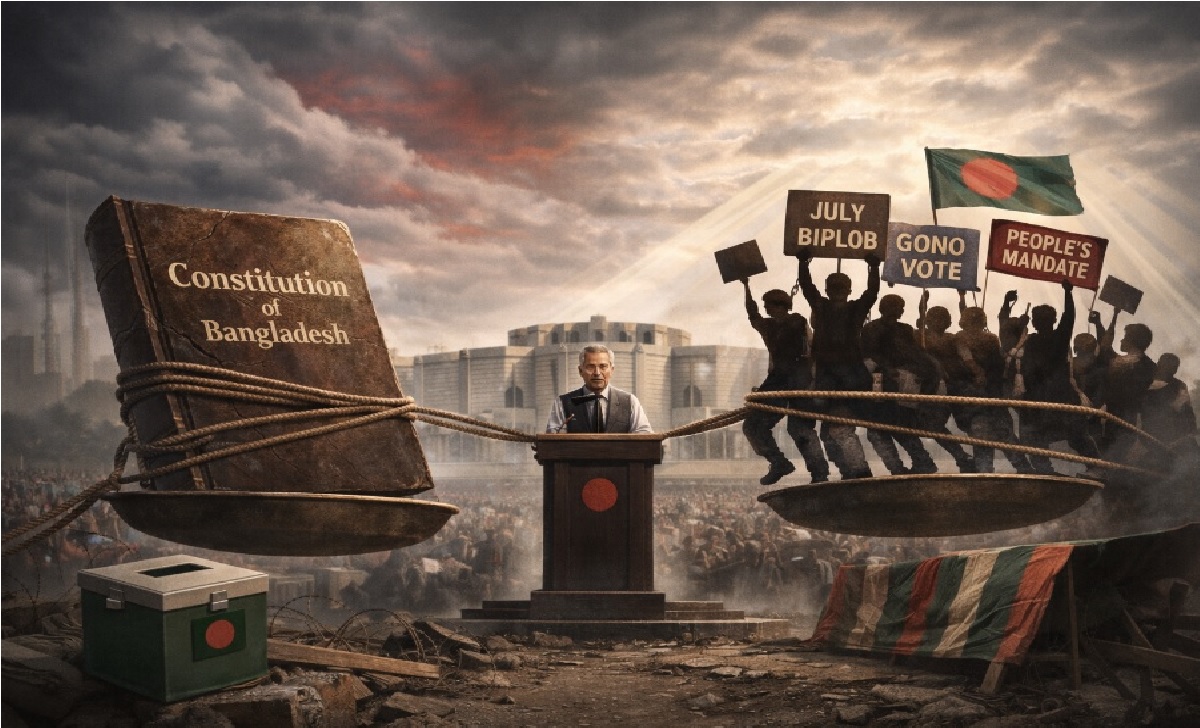
The July movement of 2024, referred to as the “July Biplob,”[4] was an initiative that aimed to look at the notions of political legitimacy from a different light. This line of thinking suggests that people’s activities can influence, and may even change the power relations around them, including the legitimacy of the governing power. This line of reasoning was somewhat exercised during the July Referendum, which is expected to be relevant alongside the Constitution and more so in place of it, should it obtain substantial approval in the process of holding a “Gono vote” across the country to speak out the will of the people in favour of implementing the July Referendum. In other words, the power of the constitution as the unique and overriding source of the power of the state would be diminished.
In such a scenario, the consequences for electoral politics would become significant. In this understanding, elections will no longer be the ultimate arbiter of political power; rather, they will take place in a situation that is characterised by legal and political uncertainties. Elections will no longer offer any definitive answers to the question of political power; rather, they will most likely re-map the sites of political power, while the overall trajectory of politics will be shaped by continuous bargaining between institutional and non-institutional actors whose power is based on street-level legitimacy. In this understanding, any likely future government, whether Bangladesh Nationalist party (BNP)-led or otherwise, will most likely exercise only conditional power.
The Structural Weaknesses of BNP
If the BNP succeeds in assuming power, the government that it leads will be more dependent on external factors than autonomous, regardless of whether it assumes power as a result of a contested or uncontested election. The BNP’s political ascendancy is inescapably tied to the National Citizens Party (NCP), whose power is directly based on its control over the organisational and moral capital of the July movement. In this political conjuncture, Jamaat has the quiet upper hand, not because it seeks power per se, but because it understands how power actually operates in uncertain systems. Its intention is not to govern, but to influence: to delay decisions, to apply pressure at strategic points, and to shape outcomes from the margins, all while avoiding direct responsibility.
A BNP-led government would almost inevitably create the space for this. Courts would tread carefully, ministries would pull in different directions, the bureaucracy would wait and watch, and security agencies would look for cues from more than one centre of authority. The machinery of the state would continue to run, but without real momentum. Decisions would be provisional, always open to revision, always subject to negotiation. What would follow is not chaos in the dramatic sense, but something quieter and more corrosive, a prolonged drift, a condition of managed uncertainty in which authority is never fully settled, and governance becomes a matter of constant bargaining rather than decisive action.
In this way, the return of the BNP would signify the subordination of formal electoral success to the operational logic of mass legitimacy and the transformation of governance itself from a decisive command to a landscape of continuous mediation.
The Strategic Consequences of the Awami League’s Exclusion
Keeping the Awami League out of the current political arrangement quietly alters how politics works at a very fundamental level. For a long time, it was the only party that could claim nationwide acceptance through institutions rather than through constant mobilisation. When that presence is removed, something essential is lost, and the system begins to adjust to that absence.
In this new setting, legitimacy no longer comes mainly from the vote. It comes from whoever can apply pressure, which can slow things down, or disrupt governance at key moments. Protests and agitation are no longer merely reactions; they are now part of politics itself. Elections still take place, but instead of settling disputes and allowing the system to move forward, they serve to hold things together temporarily without resolving anything. Power gradually slips away from Parliament. Decisions are shaped elsewhere, through informal understandings and negotiations with actors who are not answerable to voters. The state continues to function, albeit carefully, without confidence or direction. Every decision feels provisional, as if it could be undone tomorrow.
Over time, this form of governance becomes normalised. The July phenomenon, without any moral claim attached works simply as leverage. Institutions find themselves constantly negotiating with the street, not because it represents society as a whole, but because it has the capacity to disrupt. Without the Awami League in the picture, elections end up marking a balance that is already unstable rather than creating authority. This also changes how power is held inside government. No leader can act alone. Coalition partners matter more, pressure groups become unavoidable, and governance turns into a process of constant adjustment. Politics ceases to be about finding solutions and becomes about managing tension. Stability feels temporary, and legitimacy remains unsettled.
As the Awami League is pushed to the margins, power stays in motion, and the BNP becomes increasingly dependent on the July-era mobilisation to sustain itself. Governance stretches beyond elections and formal offices, shaped by negotiations, street pressure, and competing centres of influence.
India’s Position: Influence Without Ownership
Building trust has been a shared objective between Bangladesh and India since the Liberation War of 1971. India has consistently stood by Bangladesh and is likely to continue doing so. However, such support cannot come at the expense of India’s own national security. This places India in a careful balancing position. On one hand, it seeks stability and responsible governance in Bangladesh. On the other, it must remain attentive to developments along its eastern border.
In South Asia, foreign policy is largely shaped by the need to prevent instability in neighbouring countries. For India, this means encouraging peaceful political processes, reducing security risks, and ensuring that unrest does not spill across borders. At the same time, outcomes in neighbouring states depend heavily on the ideology and decisions of those in power. India today appears more focused on maintaining peace and internal stability in Bangladesh than on influencing who governs it. Trying to determine political outcomes would likely be counterproductive. Instead, India’s influence operates through steady engagement, dialogue, and carefully calibrated messaging rather than overt pressure.
Tarique Rahman’s long years in exile, following earlier legal and political controversies, may have given him time and experience that shaped his political outlook. It is possible that such a period brought reflection and learning. However, regardless of how much his perspective may have evolved, his statements and positions on India need to be treated carefully. Given the sensitivities involved in regional politics, his stance should be read with caution and attention to its wider implications.
On the other hand, the Awami League faces its own set of challenges. Its long-term strength depends on domestic legitimacy. When opponents portray legal or diplomatic actions, particularly those linked to India, as signs of foreign interference, it can fuel suspicion and weaken public trust. Whether accurate or not, such perceptions can harm the party’s credibility even when the party has been pushed to exile. Strengthening internal unity of the party members and reducing the appearance of external dependence might be required for Awami League to remain politically relevant in the future.
In the end, Bangladesh’s internal politics will continue to intersect with broader strategic considerations. In such a sensitive environment, restraint, steady engagement, and respect for Bangladesh’s internal processes remain essential for preserving stability and mutual confidence.
Jamaat’s Long Game and India’s Margin of Control
Jamaat-e-Islami is not openly trying to take control of the government. Its approach is quieter and more gradual. Instead of seeking attention or immediate political power, the party appears to focus on working within the existing system. Rather than engaging in highly visible and controversial issues, it concentrates on less dramatic but influential areas such as administration, finance, education, and the judiciary. By doing this, it avoids direct confrontation and public criticism, while slowly strengthening its presence in important institutions.
The organisation presents itself as patient and long-term in its thinking. It does not depend solely on winning elections to make an impact. Instead, it aims to build influence steadily over time. Its strategy seems designed to outlast individual governments and political cycles. In short, Jamaat’s approach is gradual and structural. It focuses on shaping institutions and systems over the long term rather than pursuing short-term electoral victories.
Within this framework, external engagement can play an indirect role. In certain circumstances, interactions with Western countries, through diplomatic recognition, financial assistance, or institutional support, may unintentionally facilitate this gradual integration. While such engagement is often intended to serve Western strategic interests, it can also confer legitimacy or access that strengthens domestic actors in ways not fully anticipated over the long term. Rather than engaging in highly visible and controversial issues, it concentrates on less dramatic but influential areas such as administration, finance, education, and the judiciary. By doing this, it avoids direct confrontation and public criticism, while slowly strengthening its presence in important institutions.
At the same time, many academic and policy studies do not give enough attention to another important aspect of Jamaat’s political thinking: its continued unease about what it sees as India’s growing strategic influence in the region. Jamaat’s political stance has often shown caution, and sometimes resistance, toward Indian policies and initiatives. This concern about India plays a significant role in shaping its overall strategy, yet it remains largely underexamined in existing research.[5] It is noted that in many instances, the Jamaat has been known to voice against India, in particular bearing in mind the issue of Kashmir, or the war on terrorism conducted inside Pakistan that affects India, either directly or indirectly, or from time to time in the context of India’s place in its near and broader region.[6]
Even when disguised with terms of “rights” or “justice,” the story beneath has often tended to portray India as the sole problem and Islamist politics as the only resolution. India’s influence in this space is largely indirect rather than direct. This becomes important when Jamaat’s narratives are gradually absorbed within institutions and society. Once these ideas move beyond party politics, they can begin to influence policy decisions, administrative attitudes, and public opinion. India’s role in this space may be indirect, but the long-term effects of such ideological shifts can still be significant.
For this reason, even subtle signals within coalition politics, especially at levels below the top leadership, deserve attention. The tension is often not open confrontation with India. Instead, it lies in the gradual normalization of views within institutions that are uncomfortable with India’s regional role. The risk is not a sudden rupture in relations. It is a slow drift. Over time, if Jamaat’s anti-India narratives gain greater acceptance within the system, the state may become less resistant to ideological influence, gradually reshaping its strategic posture.
In conclusion, Bangladesh is at a delicate turning point, as it stands at a moment of structural rupture rather than routine political change. The exclusion of a major political force from the electoral process has weakened the representative character of the system and shifted legitimacy away from purely electoral settlement toward negotiated and mobilised authority. Elections may continue, but their ability to produce clear and uncontested power has been diminished.
For India, the challenge is to remain steady, patient, and clear-eyed. The objective is not to determine outcomes in Dhaka, but to safeguard long-term strategic interests while preserving stability. The real question is whether Bangladesh’s institutions can regain inclusivity and confidence, or whether governance will continue under conditions of fragmented legitimacy. The answer will shape not only Bangladesh’s future, but the strategic balance of the eastern subcontinent.
*****
CLICK TO VIEW THE PDF
Notes:
[1] “Bangladesh: Prime Minister Hasina Resigns Amid Mass Protests,” Human Rights Watch, August 06, 2024, https://www.hrw.org/news/2024/08/06/bangladesh-prime-minister-hasina-resigns-amid-mass-protests. Accessed on January 06, 2026.
[2] “Bangladeshi Parties Sign ‘July Charter’ for Political Reforms,” Anadolu Agency, October 18, 2025, https://www.anews.com.tr/world/2025/10/18/bangladeshi-parties-sign-historic-july-charter-for-political-reforms-ahead-of-general-election. Accessed on January 06, 2026.
[3] Shafi Md Mostofa, “The July Charter: A New Beginning for Bangladesh’s Democratic Future,” The Diplomat, October 27, 2025, https://thediplomat.com/2025/10/the-july-charter-a-new-beginning-for-bangladeshs-democratic-future/. Accessed on January 06, 2026.
[4] “Rizvi: BNP views signing of ‘July Charter’ positively,” Dhaka Tribune, October 10, 2025, https://www.dhakatribune.com/bangladesh/politics/393638/rizvi-bnp-views-signing-of-july-charter. Accessed on January 06, 2026.
[5] Sohini Bose and Vivek Mishra, “Jamaat‑e‑Islami in Bangladesh Elections: Diverging Perceptions of India and the US,” Expert Speak Raisina Debates, Observer Research Foundation, October 04, 2023, https://www.orfonline.org/expert‑speak/jamaat‑e‑islami‑in‑bangladesh‑elections‑diverging‑perceptions‑of‑india‑and‑the‑us. Accessed on January 07, 2026.
[6] Ibid.