Author: Gp Capt VP Naik VM, Senior Fellow, Centre for Aerospace Power and Strategic Studies
Keywords: Operation Epic Fury, Operation Roaring Lion, Air Defence, Iran, Khamenei
This article is a continuation of a previously published article on the US-Israel war with Iran (Operation Rising Lion and Operation Midnight Hammer), Air Power Musings: Silence of the SAMs, published as an ‘In Focus’ article on the CAPSS website. https://capssindia.org/air-power-musings-silence-of-the-sams/ Published on July 01, 2025. The movie Hannibal (2001) was a sequel to The Silence of the Lambs (1991); similarly, this article is a sequel to The Silence of the SAMs.
Introduction
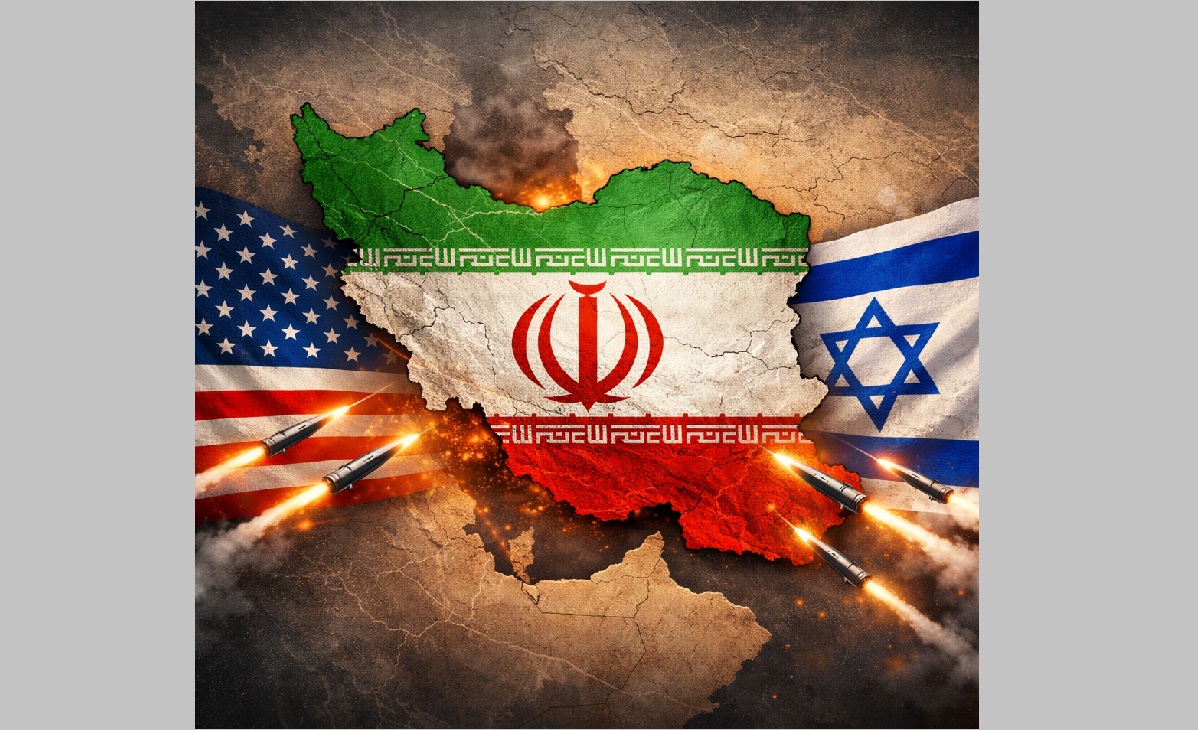
On February 28, 2026, at 0945 Local Time, Tehran, the United States of America (USA) and Israel launched large-scale joint military strikes against Iran after failed nuclear negotiations. Named as Operation Epic Fury in the USA and Operation Roaring Lion in Israel, the joint strikes were aimed at targeting Iran’s Supreme Leader Ayatollah Ali Hosseini Khamenei. Later that day, the Supreme Leader of Iran was killed in an accurate missile strike, and on March 01, 2026, Iranian state television confirmed his death. In the Pentagon’s Press Briefing on February 02, 2026, the US Defence Secretary Pete Hegseth laid down the strategic aim of the operation as follows: “The mission of Operation Epic Fury is to destroy Iranian Offensive missiles and their production, destroy Iranian Navy and other security infrastructure and ensure Iran never has nuclear weapons.” He also mentioned that, though regime change was not the aim of the operation, regime change had already started because of the killing of Ayatollah Khamenei. What can be deduced is that both operations have been undertaken to annihilate Iran’s war-waging potential and simultaneously destroy any existing nuclear capability. From an air power perspective, the relative silence of Iranian Air Defence (AD) or the sheer ineffectiveness of it has allowed the most fiercely protected and secure Centre of Gravity (CoG) of Iran, the Ayatollah to be located and killed on the very first day of the operation.
Inferences
Ineffectiveness of the Iranian AD is not new, and was also clearly visible during Operation Midnight Hammer in July last year. What is surprising is that the Iranians did not learn anything from Operation Midnight Hammer. The ineptitude of AD in Iran does not necessarily mean that all its AD assets have been destroyed. Neither does it mean that the entire AD Command and Control (C2) system has collapsed. What it does bring to the table is the ability of American and Israeli combined might to systematically degrade Iranian AD and make it functionally unusable. It is immaterial whether it was done using kinetic means or by non-kinetic methods; what is important is that air power, when used effectively, can provide a lethal blow on the very first day of the war, directly impact the decision-making ability of the adversary and simultaneously, by way of a tactical action, create strategic effects.
What can also be construed is that the Americans and Israelis were able to severely degrade the rudimentary, yet effective, AD system of Iran using a combination of Electronic Warfare to blind and confuse the Iranians, targeting leadership at the operational and strategic level to cripple the Iranian Observe-Orientate-Decide-Act (OODA) loop and create decision dilemmas. US experience with Ukrainian S-300s helped them understand the system and devise effective tactics to stay out of the SAM lethal envelope. Use of a combination of Tomahawk Land Attack Cruise Missiles, stand-off, air-launched precision weapons, and unmanned systems enabled the American and Israeli forces to carry out effective Suppression/Destruction of Enemy Air Defences (SEAD/DEAD).
The Writing is Clear
Both the US and Israeli armed forces have extensive experience in SEAD/DEAD operations. When coupled with good Intelligence, Surveillance and Reconnaissance (ISR) operations as a prelude to all offensive action, they were able to systematically degrade Iranian AD. The use of stealth platforms and unmanned kamikaze drones enabled them to specifically target early-warning radars, communication nodes, and fire-control radars. This resulted in a crippled and fragmented AD incapable of putting up any prohibitive resistance. What the Iranians did not do is a long list worth analysing and examining. Some salient aspects of that are elaborated below for further analysis.
(a) After Midnight Hammer, the Iranians should have learnt their lessons. Surprisingly, they did not, and the same mistakes are being repeated. Had their AD survived and been able to target even a few American and Israeli aircraft, the narrative would have been totally different.
(b) The S-300 is a fairly potent system, and when integrated well, the system cannot easily be put out of action. The system is highly capable of undertaking independent operations in a denied environment; however, the Iranians failed to utilise that advantage. They should have been forward positioned, taken off the network and used when most needed. The world had seen the attack coming; why couldn’t the Iranian leadership?
(c) The Arman Long-Range Air Defence System, the Azarakhsh Low-Altitude Air Defence System, the Khordad-15 Air Defence System, the Bavar 373 Missile Defence System and the S-300 Missile Defence System create a layered AD architecture.[i] The integrated AD system is capable of detecting targets as far out as 1000 km (Ghadir and Sepher radars) [ii] and tracking them from 300 km down to very close ranges. Yet they all failed. A possible course correction and redesigning the tactical level architecture after Operation Midnight Hammer would have significantly enhanced AD effectiveness.
(d) The Iranian AD is controlled centrally by the Khatam al-Anbia Air Defense Head Quarters (KADHQ), an independent branch within the Iranian national armed forces that looks after all AD activities of the nation. [iii] An independent AD organisation only creates yet another silo, which prevents integrated and joint war fighting. In modern warfare, AD is an inalienable aspect of offensive operations, and the development of offensive air defence further highlights the need for AD operations to be integrated.
(e) Balakot, Op-Sindoor and Operation Midnight Hammer amply bring out the fact that a traditionally continental mindset focused on purely land warfare tends to keep air defence as a separate adjunct and precludes effective employment. Both Pakistan and Iran have a separate AD Command and operate independently, so do the Iranian and Pakistani Air Forces. As a result, when AD is placed under the command of a surface force- commander, it tends to become linear and sequential, focused only on the Tactical Battle Area (TBA) where troops are in contact. Air Defence is far bigger; it encompasses the entire airspace above the battlefield. There are no air littorals there, nor can air space ever be divided. Just like action by surface forces cannot be divided into TBA and beyond TBA, just like sub-surface and surface elements are a contiguous part of larger Naval operations, air space cannot and should not be vertically separated. One must not fall into the trap of new jargon and colloquialisms and ignore strategic realities. Do so at your own peril!
(f) The importance of stand-off precision capability should not be ignored. The Americans and Israelis have managed to stay out of the lethal boundaries of all AD weapon systems of Iran, yet have managed to inflict severe damage to critical infrastructure. What emerges is the need for coordinated employment of manned and unmanned weapons to target CsOG at the tactical, operational and strategic levels. That is something only air power can accomplish. What must be remembered is that it is ‘air power’ being exercised and not necessarily the Air Force, which highlights the fact that ownership of assets is not important. It’s the desired effect that can be created, which will be decisive. The US exercises air power from carrier and land-based platforms, and Iran exercises air power through medium and short-range missiles. Unmanned aerial platforms augment air power, and the combined effect is debilitating. Fragment this capability and effectiveness will reduce exponentially.
(g) From available coverage of the war, it appears that the Iranian AD is primarily set up for peacetime operations and not necessarily for modern warfare. The Iranian AD has primary radar pick up on all aircraft entering its Air Defence Identification Zone (ADIZ) well before the aircraft physically enters its boundaries. However, operations under electronic jamming and in network denied environments are not something envisaged and trained for. While the equipment Iran possesses covers a large spectrum of engagement ranges, a largely defensive mindset precludes its offensive use.
(h) As the American long-range standoff weapons reduce in numbers with each passing day, there will be a time when conventional weapons like Laser Guided Bombs (LGBs) with range extension kits will be used. This will force the American aircraft to come closer to Iranian airspace and make them more vulnerable to the Iranian AD.
(j) For most armed forces arrayed for linear, two-dimensional warfare, Operation Absolute Resolve (Venezuela), Operation Midnight Hammer (Iran) and the Russia-Ukraine war provide both good and bad examples of how AD will determine survival. During Operations Absolute Resolve and Midnight Hammer, the AD of Venezuela and Iran was rendered ineffective. Venezuela and Iran both had effective weapons in their AD arsenal; however, their employment philosophy was not quite in tune with the needs of the modern battlefield. The Americans were quick to capitalise on a weak employment philosophy. On the other hand, in the Russia-Ukraine war, AD on both sides has remained effective and, not surprisingly, it has turned out to be a battle of attrition.
(k) In the modern battlespace, tactical silence to preserve strategic survivability will prove to be the key to multi-domain resilience. Keeping some systems ‘off the network’ will give additional response options. Iran knew where attacks would emerge from, yet it failed to adapt. Combat adaptiveness and flexibility will be key to comprehensive defence and coordinated offence.
(l) In the event of AD collapse, it will no longer be just about fighter aircraft versus fighter aircraft. It will be the sheer dominating effect of air power that will come into play. Boots on the ground and ships in the seas will remain vital and will be able to roll in with minimal resistance. But, if the AD remains effective, the same is not true!!
(m) The larger lesson for Air Defence is that it is not just about hardware. Integration, realistic training, Electromagnetic (EM) spectrum dominance, C2 resilience, functional redundancy and ability to operate in environments of denial will prove decisive. The system must not collapse if any one of these elements fails.
(n) In modern wars, leadership can and will be targeted. How much are we thinking on those lines? Strategic, operational and tactical leadership will be threatened, and therefore, there is a need to protect them. The basic premise of good C2 is continuity of command. If that breaks down, C2 will break down.
Parting Shots
Some questions that emerge are worth hovering on. Are Iranian AD systems still capable of being employed? Are the S-300 and Bavar systems active around strategic nuclear sites? Is there some semblance of an AD response mechanism still available? If the answer to any of these questions is ‘yes’, Iran will do well to exercise them now, and the US forces will do well to analyse them. A likely scenario that emerges is that the AD system may not be fully destroyed. It may be heavily degraded, emission-restricted and capable of localised defence. The right use of the appropriate weapon at the right time can always help retain national pride, because other than that, Iran really doesn’t seem to have much of a choice. Given the USA’s abhorrence of body bags, will there be American ‘boots on the ground’ in Iran? It is something we must wait and watch. History is replete with examples of American boots on the ground leading to strategic failures…We must all wait and watch if Operation Epic Fury will be an ‘Epicurean Success’ or yet another ‘Epic failure’. The jury is out!!!
*****
CLICK TO VIEW THE PDF
Notes:
[1] VP Naik, “Air Power Musings: The Silence of the SAMs,” Centre for Aerospace Power and Strategic Studies (CAPSS), July 01, 2025, https://capssindia.org/air-power-musings-silence-of-the-sams/, Accessed on March 04, 2026.
[2] Ibid. Accessed on March 04, 2026.
[3] Farzin Nadimi, “The Counterintuitive Role of Air Defense in Iran’s Anti-Status Quo Regional Strategy,” The Washington Institute for Near East Policy, January 11, 2017, https://www.washingtoninstitute.org/policy-analysis/counterintuitive-role-air-defense-irans-anti-status-quo-regional-strategy. Accessed on March 04, 2026.
(Disclaimer: The views and opinions expressed in this article are those of the author and do not necessarily reflect the position of the Centre for Aerospace Power and Strategic Studies [CAPSS])