Author: Wg Cdr A Pichipoo Raja, Senior Fellow, Centre for Aerospace Power and Strategic Studies
Keywords: Decapitation, Iran, Israel, Epic Fury, Indian Air Force
Introduction
On February 28, 2026, the United States (US) and Israel jointly targeted the Iranian leadership, wiping out a large number of top leaders. Soon, the media started giving out details of how the operation was meticulously planned and executed. Militaries, at times, blow out of proportion the details of any operations. The media carried several such stories of exceptional intelligence and tactical brilliance. To put things in perspective, Ayatollah Ali Khamenei was the head of a state. Unlike heads of terrorist organisations like Osama Bin Laden or Mullah Omar, who needed to hide for a living, Khamenei wasn’t hiding. He wasn’t targeted in any secret bunker, but at his regular office. The reason that the entire buildings had to be reduced to rubble also possibly hints at a lack of real-time intelligence regarding the exact position of the target. Otherwise, there is no reason why the entire complex was targeted, resulting in the death of his family members as well. Therefore, the claims that this was some superior intelligence-led operation are highly exaggerated.
More importantly, the success of any operation depends on the achievement of desired objectives. There have been constant changes in the stated objectives of this conflict. While the tactical success of dropping the weapons on target has been achieved, the constant shifting of objectives makes any estimate of success difficult. Therefore, a quick detour to history is useful at this moment to learn from the wisdom of the past.
Till the twentieth century, targeting the political leadership of an adversary was seldom considered a viable military option. The political leadership was far from the battlefield. It was air power that made it possible to directly reach for the political leadership, bypassing the entire fielded forces.[1] It will be interesting to note that India carried out the world’s first air attack on a political leadership.[2]
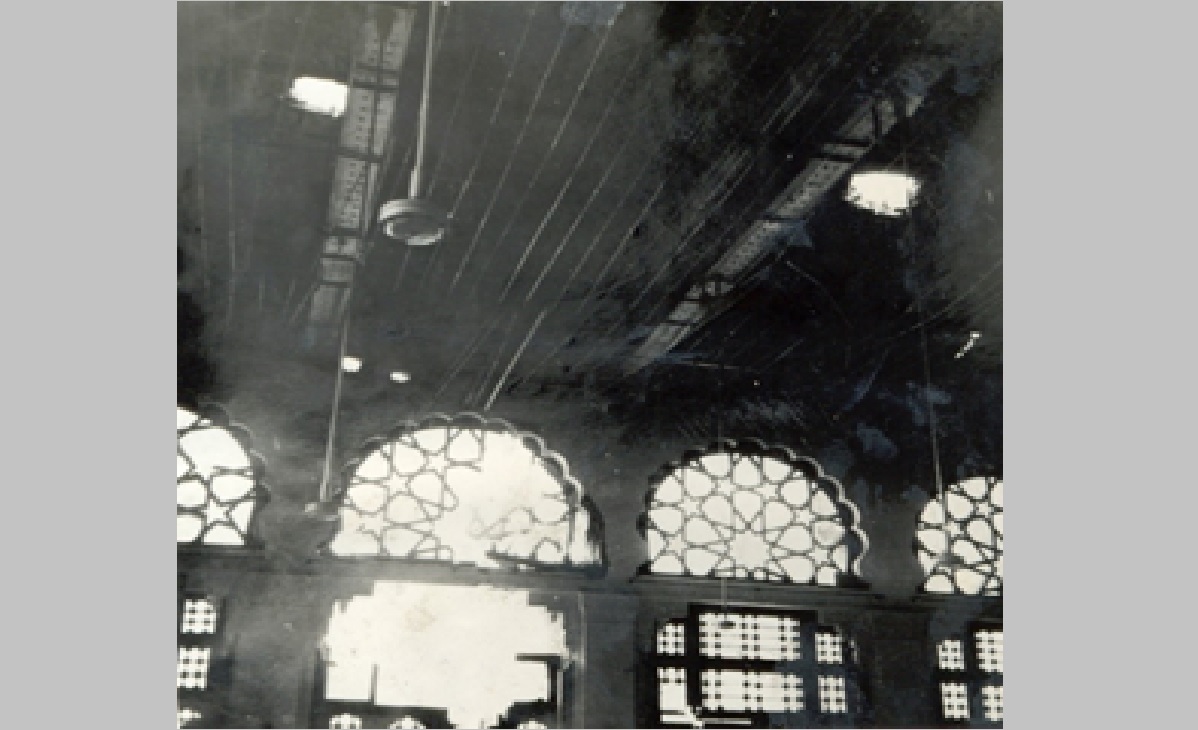
In February 1919, the new Emir of Afghanistan, Amanullah Khan, declared full independence, and this led to the Third Afghan War. Nasrullah Khan, brother of the former Emir, sent an envoy to the Government of India. He wrote that he was the rightful heir to the throne, and would remain loyal to the British. He suggested that India should bomb Amanullah Khan’s palace to achieve a decisive surrender.
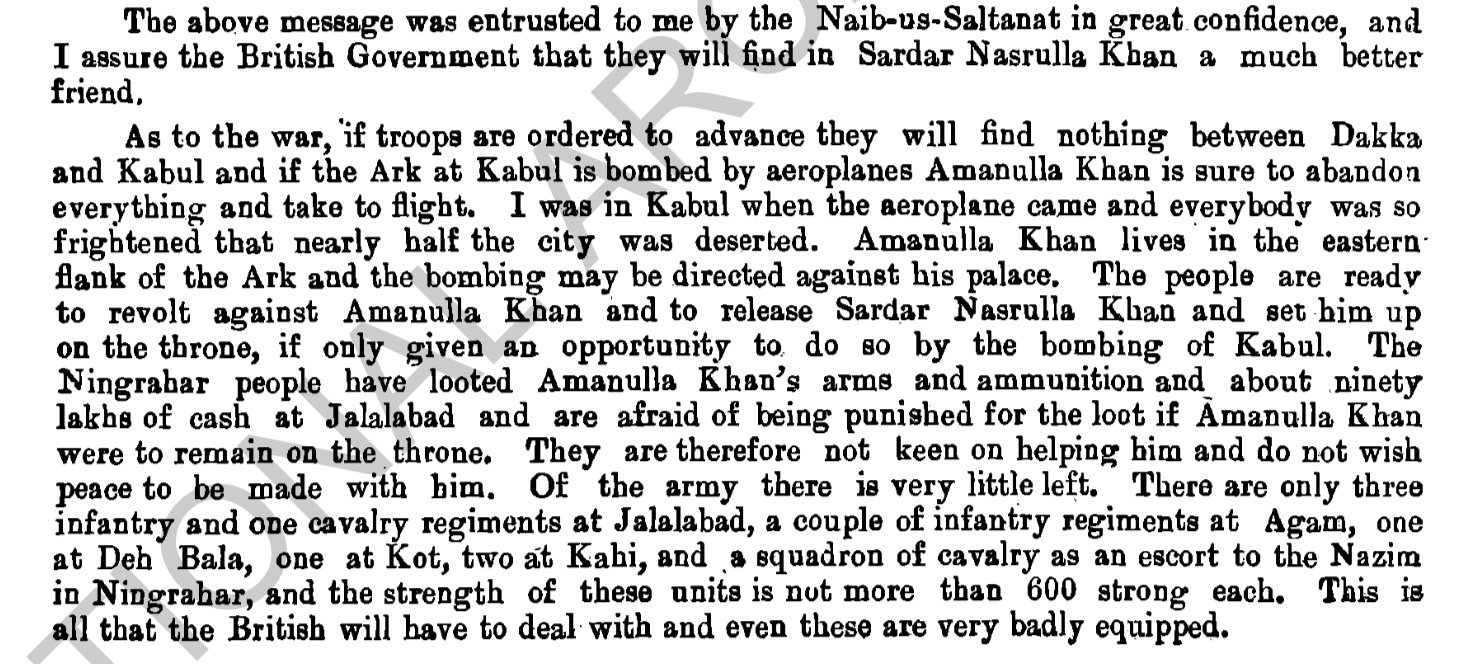
Credit: Government of India, Foreign and Political Department, Secret Frontier, Proceedings, September 1919, Nos. 6 – 195. The National Archives
On May 24, 1919, a single aircraft, a Handley Page heavy bomber, bombed Amanullah Khan’s palace in Kabul. It didn’t reduce the place to rubble. The bombing proved instrumental in making Amanullah call for a ceasefire on June 03, 1919.
While this could be treated as the first instance of a strike against the political leadership, the most successful globally was the strike on the Government House in Dacca by the IAF during the 1971 war. On December 14, 1971, a MiG-21 formation of four aircraft from 28 Squadron IAF, led by Wing Commander Bhupendra Kumar Bishnoi, was tasked to strike the Government House at Dhaka at the precise time when a high-level meeting was taking place.[3] This was to be followed by another package of 02 X MiG-21s and 02 x Hunters. They were deliberately armed with rockets and not bombs, as the objective was psychological and not physical destruction. Starting at 1255 hrs, the first four aircraft hit the target. An UN Official who was present in the meeting noted that Mr AM Malik, the Governor, scrambled for a piece of paper and wrote his resignation just before the second wave of weapons hit. The whole cabinet resigned immediately. Within two days, the war ended with the largest surrender of troops.
Several aspects of this 1971 mission are relevant to the ongoing Op Epic Fury. Firstly, the intelligence was timely and accurate. The location of the meeting was changed when the aircraft were taxing out, and the target was updated accordingly. Secondly, the reader should imagine how exceptionally the intelligence apparatus was functioning, that, over fifty years ago, such real-time updates were possible in enemy territory. There were no satellites, mobile phones, datalinks, internet, CCTV, etc. Thirdly, the desired outcome was achieved with minimal loss of life. A noteworthy aspect was that IAF enjoyed air superiority after wiping out the entire PAF in East Pakistan in the initial days of the war. Yet the targeting was never reckless and was intended to cause as little loss of enemy life as the ends of military necessity demanded. There was no shortage of ammunition. Only the previous day, IAF had dropped 40 tonnes of bombs at a single target – Joydebpur Ordnance Factory[4]. Lastly, in spite of the absence of precision-guided munitions, direct hits were achieved on the target. No debates in the media, including India, seem to have compared both these operations despite their similar objectives and employment. This aligns with the arguments in a recent article about the limited knowledge of Indian Military History despite its richness.
Success in any war is not measured in tonnes of bombs dropped, numbers of ships sank or numbers of enemy killed. It is in the achievement of objectives. At this moment, it is worth reproducing a conversation between Colonel Harry G. Summers, Jr., US Army, and Colonel Tu, North Vietnamese Army, Hanoi, on April 1975 following the US defeat in the Vietnam War.
American: “You know you never defeated us on the battlefield”
Vietnamese: “That may be so”….” But it is also irrelevant”
*****
CLICK TO VIEW THE PDF
Notes:-
[1] Though clandestine assassinations were still planned and executed in the past as well.
[2] 08 Squadrons of the RAF were based in India at this time and were under the authority of the Government of India and paid from the Indian budget.
[3] P. C. Lal, My Years with the IAF (New Delhi: Lancer International, 1986) pp 205 – 206
[4] History Division, Ministry of Defence, Government of India, Official History of the 1971 War: pp 364 – 366