Authors: Wg Cdr Vikas Kalyani & Prof (Dr) Vijay Khare
Keywords: Military Diplomacy, Indian Air Force, Indo-Pacific, Aerospace Power, Exercise Pitch Black.
Introduction
The Indian Ocean Region (IOR) has long been a crucible of civilisations, trade and strategic competition. In an era where the Indo-Pacific is recognised as a global common, India’s foreign and security policy increasingly relies on the armed forces to project goodwill, build partnerships, and ensure regional stability. Among the three services, the Indian Air Force (IAF) has emerged as a critical instrument of military diplomacy, particularly across the Indian and Pacific Oceans. Its unique characteristics of speed, reach, flexibility and precision make air power exceptionally suited for diplomatic signalling, humanitarian assistance and disaster relief (HADR), and multinational interoperability without the political footprint of “boots on the ground.”[1]
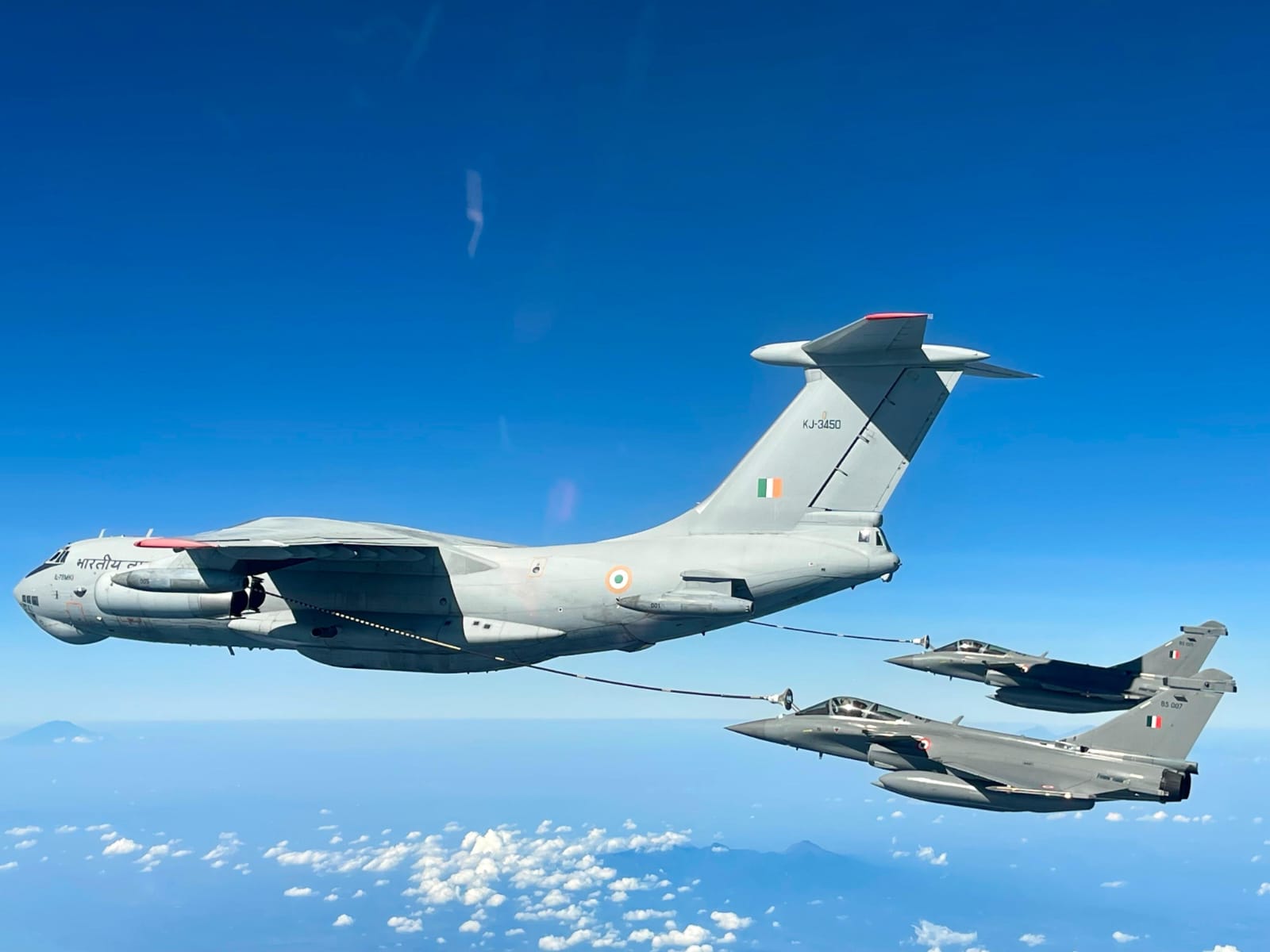
The IAF’s recent participation in Exercise Pitch Black 2026, a biennial multinational air combat exercise hosted by the Royal Australian Air Force (RAAF), provides a timely and analytically rich case study. This marks the IAF’s fourth participation (after 2018, 2022, and 2024) in this exercise from July 20 to August 07, 2026, with a contingent of four Rafale fighters, two C-17 strategic airlifters, and over 120 personnel.[2] The transit via Indonesia, which involved mid-air refuelling by an IL-78 operating from Juanda Airport in Surabaya, further underscores the IAF’s overseas operational capacity and diplomatic engagement with key IOR partners.[3]
This article argues that the IAF’s role in enhancing Indian military diplomacy across oceans is both doctrinally strengthened and operationally demonstrated through exercises, HADR missions, and strategic airlift operations. Using Pitch Black 2026 as a contemporary anchor, the analysis situates the IAF’s maritime diplomacy within a broader historical and theoretical framework, drawing on the IAF’s latest doctrine, historical precedents like Operation Cactus (1988) and recent HADR missions and multinational exercises.[4]
India’s Military Diplomacy: Conceptual and Strategic Context
What is Military Diplomacy?
Military diplomacy refers to the use of armed forces to achieve diplomatic objectives without kinetic engagement, encompassing defence dialogues, joint exercises, capacity-building, and HADR operations.[5] Within this framework, air power diplomacy is a subset that leverages aerospace assets to build interoperability, shape defence relations and signal strategic intent.[6] Scholars of coercive diplomacy, such as Robert Pape, have long recognised the utility of air power in signalling resolve and capability without direct conflict.[7] The concept of ‘shaping operations’ in the No War, No Peace (NWNP) environment has been articulated in the IAF’s revised doctrine (2022), which explicitly identifies air diplomacy as a key function of aerospace power.[8]
India’s Strategic Outlook in the IOR and Indo-Pacific
India’s strategic stance has evolved from a pure continental focus to a balanced maritime and extended-range operational posture, aligned with the MAHASAGAR (Mutual and Holistic Advancement for Security and Growth Across Regions) and the broader Indo-Pacific vision.[9] The IOR is recognised as a critical global common, through which over 80 per cent of India’s trade by volume and 90 per cent by value passes.[10] In this context, the armed forces, particularly the Navy and Air Force, have become instruments of neighbourhood-first policy, regional stability and Comprehensive National Power (CNP) projection.
The Indian government has increased engagement in the IOR and Indo-Pacific bilaterally and multilaterally, with a focus on capacity building and capability enhancement of neighbouring countries. The IAF has actively engaged with IOR countries like Australia, Indonesia, Malaysia, Oman, South Africa, Singapore, Thailand, and the United Arab Emirates (UAE), and there are plans to engage with more countries in this region and beyond.[11]
IAF: Doctrinal Foundations of Maritime Diplomacy
The IAF’s doctrinal evolution reflects a shift from continental defence to long-range operational capabilities. The 2012 ‘Basic Doctrine of the IAF’ laid the groundwork for understanding aerospace power’s role in national security, while the 2022 revision expanded this to include network-centric warfare, multi-domain operations and air force engagements in NWNP scenarios.[12] The revised doctrine emphasises three key functions relevant to military diplomacy:
1. Shaping behaviour: Demonstrating capability and intent to deter or reassure partners.
2. Air diplomacy: Building trust and interoperability through joint exercises, training exchanges and HADR missions.
3. Capability demonstration: Showcasing indigenous platforms and operational competence in multinational environments.[13]
Characteristics of Air Power for Military Diplomacy
The IAF’s utility in maritime military diplomacy stems from several inherent characteristics:
-
-
Speed and reach: Strategic airlift (C-17) and air-to-air refuelling (IL-78) enable rapid deployment across vast distances, as seen in the induction phase for Ex Pitch Black, which involved transit via Indonesia.[14]
-
Flexibility: Ability to transition from combat support operations to HADR, evacuation operations or logistical support with minimal reconfiguration.[15]
-
Precision: Fighter patrol operations and maritime patrol assets (like P-8I of the Indian Navy as well as RAAF) allow for targeted signalling and domain awareness without escalation.[16]
-
Low political footprint: Unlike naval deployments or ground troop presence, air assets can engage and withdraw with minimal diplomatic friction.[17]
-
These characteristics make the IAF particularly suited for military diplomacy, where the goal is to demonstrate strategic reach, build partnerships and ensure regional stability without the permanence of forward bases or the visibility of large troop concentrations.
Exercise Pitch Black 2026: A Contemporary Case Study
Background
Exercise Pitch Black is a biennial multinational air combat exercise hosted by the RAAF at Darwin, Northern Territory. First held in 1981, it has grown into one of the world’s largest aerial wargaming exercises, focusing on large-scale force employment, night flying and multinational interoperability.[18] The 2026 edition was conducted from July 20 to August 07, with participation from over 20 nations, including India’s Quad partners (US, Japan and Australia) and other Indo-Pacific stakeholders.[19]
IAF’s Participation: Fourth Iteration
The IAF’s participation in Pitch Black 2026 marks its fourth appearance reflecting a deepening engagement with Australia and the broader Indo-Pacific. The 2026 contingent included:
-
-
Four Rafale fighter jets: India’s most advanced multirole fighters, capable of long-range strikes and air superiority missions.
-
Two C-17 Globemaster: Strategic airlift aircraft known for enabling logistics, personnel transport and HADR capability.
-
Over 120 personnel: Pilots, ground crew and selected representatives of various branches to observe and enhance multi-disciplinary engagements.[20]
-
Transit via Indonesia: Diplomatic and Logistical Significance
A notable feature of the 2026 deployment was the mid-air refuelling of Rafales by an IL-78 tanker operating from Juanda Airbase in Indonesia. This operation had multiple diplomatic and operational implications:
-
-
India-Indonesia defence cooperation: The use of Indonesian airspace and facilities underscores the growing strategic partnership, complementing recent agreements such as the BrahMos and Astra missile deal.[21]
-
Long-range operational capability: The transit demonstrated the IAF’s ability to project air power over 4000 km from the subcontinent, supported by in-flight refuelling and forward logistics.[22]
-
Regional signalling: The operation signalled India’s commitment to a free, open, and rules-based Indo-Pacific, aligning with Australia’s and Indonesia’s strategic outlooks.
-
Diplomatic Utility of Participation in Ex Pitch Black
The IAF’s participation in Pitch Black 2026 serves several diplomatic objectives:
1. Interoperability: Flying alongside 20 nations, including Quad partners, enhances tactical integration, mutual trust and operational familiarity.
2. Strategic signalling: Demonstrates India’s commitment to Indo-Pacific security, countering perceptions of regional retrenchment or over-reliance on continental defence.
3. Defence partnerships: Strengthens India-Australia and India-Indonesia ties, complementing broader agreements (e.g. Mutual Logistics Support Agreement with Australia and defence export deal with Indonesia).
4. Operational lessons: Maritime air operations over long distances test logistical endurance, command-and-control quality and adaptability in a multinational environment.[23]
Historical and Contemporary Precedents: IAF’s Maritime Diplomacy
Operation Cactus (1988): Rapid Intervention in the Indian Ocean
On November 03, 1988, the IAF’s IL-76 transport aircraft airlifted the 50th Independent Parachute Brigade (Special Forces) from Agra to the Maldivian capital of Male, in a rapid intervention to thwart a coup attempt by the People’s Liberation Organisation of Tamil Eelam (PLOTE).[24] Operation Cactus demonstrated:
-
-
Speed and reach: The IAF’s ability to deploy forces over 2500 km across the Indian Ocean within hours.
-
Diplomatic impact: Cemented India’s role as a reliable security partner in the IOR, though subsequent geopolitical shifts (for example, the Maldives’ 2023 request for Indian troop withdrawal) illustrate the limits of military diplomacy when domestic politics change.[25]
-
HADR Operations: Humanitarian Diplomacy
The IAF’s HADR missions have been a cornerstone of India’s soft power projection and neighbourhood-first policy. Recent notable examples include:
-
-
Operation Amistad (2026, Venezuela): Marking an unprecedented transcontinental milestone, the IAF dispatched two C-17 Globemaster III aircraft to Caracas following a series of catastrophic earthquakes. The aircraft transported 36 tonnes of relief supplies and vital medicines, successfully executing a massive long-haul logistics flight across hemispheres.[26]
-
Operation Brahma (2025, Myanmar): Following a devastating 7.7 magnitude earthquake, the IAF spearheaded a rapid strategic response by mobilising six heavy-lift aircraft to deliver immediate assistance. Operating seamlessly alongside naval assets, the IAF transported heavy engineering tools, disaster-response personnel, and massive relief loads to the affected regions. The mission successfully deployed an advanced 60-bed Indian Army field hospital that provided life-saving emergency medical aid to over 2500 victims.[27]
-
Operation Samudra Maitri (2018, Indonesia): Launched in the immediate aftermath of a dual earthquake and tsunami disaster, this mission highlighted the IAF’s capability to project humanitarian aid across the Indian Ocean. The C-130J carried a medical team, tents, and equipment to set up a field hospital. In addition, the C-17 aircraft carried medicines, generators, tents, and water to provide immediate assistance.[28]
-
These operations project soft power, build goodwill and position India as a first responder in the IOR and beyond.
Multinational Exercises: Increasing Engagement of IAF in IOR
The IAF’s participation in multinational exercises has expanded significantly since 2012, with a focus on interoperability, capability demonstration and partnership building. Key examples other than the 2018, 2022 and 2024 versions of Exercise Pitch Black include:
-
-
Tactical Leadership Programme (Egypt, 2022): With participation of Su-30 MKIs, this exercise involved the IAF and the Egyptian Air Force focusing on instructor-level combat training.[29]
-
Eastern Bridge (Oman, 2024): IAF’s Jaguars and MiG-29s flew missions with Royal Air Force of Oman (RAFO) F-16s and Hawk aircraft, enhancing bilateral ties. IAF has been participating in Exercise Eastern Bridge since October 2009.[30]
-
Exercise Tarang Shakti (India, 2024): the largest ever multinational air combat exercise hosted by the IAF. The event saw active participation from 11 nations with nearly 150 aircraft alongside 18 other observer countries, to foster global interoperability and tactics. A major highlight of the exercise was the prominent display of India’s indigenous defence prowess, featuring advanced platforms such as the LCA (Tejas) and LCH (Prachand).[31]
-
UK Carrier Strike Group exercise (2025): In this engagement, the IAF acted as an attacking and testing force, deploying 12 fighter jets and AWACS to engage in high-end mock dogfights and air defence exercises against the Royal Navy’s F-35B stealth fighters over the Arabian Sea and Indian Ocean.[32]
-
Conclusion
The enhanced professional reputation of the IAF in multinational exercises is evident by the increasing number of invitations. Participation in Exercise Pitch Black four times in a row exemplifies its evolving role as a critical instrument of Indian military diplomacy across oceans. From the rapid intervention in Operation Cactus (1988) to the humanitarian missions of Operation Amistad (2026) and the trans-oceanic deployments for Ex Pitch Black (2018–2026), the IAF has consistently demonstrated its ability to project strategic reach, build partnerships and assure regional stability.
The IAF’s unique characteristics—speed, reach, flexibility, and precision—make it uniquely suited for oceanic diplomacy, where the goal is to shape behaviour, signal intent and build interoperability without the political footprint of forward bases or large troop deployments.
(Disclaimer: The views and opinions expressed in this article are those of the author and do not necessarily reflect the position of the Centre for Aerospace Power and Strategic Studies [CAPSS])
Authors Biography
Wing Commander Vikas Kalyani was commissioned in the fighter stream of the Indian Air Force in December 2003. He is a Qualified Flying Instructor (QFI) and graduate of 71st Staff Course at Defence Services Staff College (DSSC), Wellington. He is presently pursuing Ph. D. from Pune University from Department of Defence and Strategic Studies. His area of interest is Geo-politics in the IOR, Defence and Foreign Affairs (DFA) in the Indo Pacific and he has also authored a book – ‘Vision SAGAR : IAF in the Indian Ocean. Wg Cdr Vikas Kalyani is presently a Senior research fellow at Centre for Aerospace Power and Strategic Studies (CAPSS)
Prof (Dr) Vijay Khare is the Dean, Faculty of Humanities. He is a senior professor and HoD at the Department of Defence and Strategic Studies (DDSS) at Savitribai Phule Pune University.
*****
CLICK TO VIEW THE PDF
Notes:-
[1] Vikas Kalyani, “Air Power for High Seas – IAF in the IOR,” Vivekananda International Foundation, December 02, 2024, https://www.vifindia.org/article/2024/december/02/Air-Power-or-High-Seas-IAF-in-the-IOR. Accessed on August 04, 2026.
[2] Surendra Singh, “IAF deploys Rafale jets for Exercise Pitch Black 2026 in Australia,” Times of India, July 19, 2026, https://timesofindia.indiatimes.com/defence/news/iaf-deploys-rafale-jets-for-exercise-pitch-black-2026-in-australia/articleshow/132491387.cms. Accessed on August 04, 2026.
[3] Indian Air Force, “Principles of War and the nature of Air Defence,” in Basic Doctrine of the Indian Air Force (New Delhi: Air Headquarters, 2012), pp. 13-24.
[4] Indian Air Force, “Principles of War and the nature of Air Defence,” in Basic Doctrine of the Indian Air Force (New Delhi: Air Headquarters, 2012), pp. 13-24.
[5] Amrita Nayak Dutta, “IAF Revises Doctrine, Lays Out Its Role in a ‘No War, No Peace’ Setting,” The Indian Express, February 05, 2023, https://indianexpress.com/article/india/iaf-revises-doctrine-lays-out-its-role-in-a-no-war-no-peace-setting-8424561/. Accessed on August 04, 2026.
[6] Kishore Kumar Khera, “International Military Exercises: An Indian Perspective,” Journal of Defence Studies vol. 11, no. 3, July–September 2017,pp. 17–40, https://idsa.in/publisher/journal-of-defence-studies/international-military-exercises-an-indian-perspective. Accessed on August 04, 2026.
[7] Swaim Prakash Singh, “Indian Air Power Diplomacy Overseas,” Centre for Air Power Studies (CAPS), July 15, 2022, https://capsindia.org/indian-air-power-diplomacy-overseas/. Accessed on August 04, 2026.
[8] Robert A. Pape, Coercive Air Power: Why It Works (Cambridge, MA: Harvard University Press, 1996), pp 45–67.
[9] Press Information Bureau, Government of India, “SAGAR: Security and Growth for All in the Region,” June 15, 2015, , https://pib.gov.in/Pressreleaseshare.aspx?PRID=1324567. Accessed on August 04, 2026.
[10] Ministry of Defence, Government of India, Annual Report 2022–23 (New Delhi: Ministry of Defence, 2023), pp. 12–15, https://mod.gov.in/annual-report-2022-23. Accessed on August 04, 2026.
[11] Kalyani, n. 1.
[12] Indian Air Force, “Air Power in the Indian Context,” in Basic Doctrine of the Indian Air Force (New Delhi: Air Headquarters, 2012), pp. 3-12.
[13] Ibid, pp 40-41.
[14] Indian Embassy Jakarta, n. 3.
[15] Singh, n. 7.
[16] Kalyani, n. 1.
[17] Pape, n. 8, pp 78-92.
[18] Singh, n. 2.
[19] “IAF Rafales Arrive in Australia for Pitch Black 2026,” The Hindu, July 17, 2026, https://thehindu.com/news/national/iaf-rafales-australia-pitch-black-2026/article67890123.ece. Accessed on August 05, 2026.
[20] Ibid.
[21] Indian Embassy Jakarta, n. 3.
[22] “IAF’s Significant Global Air Reach,” SP’s Aviation, February 02, 2026, https://spaviation.com/iaf-significant-global-air-reach-2026/. Accessed on August 05, 2026.
[23] “IAF Rafales At Australia’s Exercise Pitch Black 2026: Multinational Air Combat Drill Starts Tomorrow,” EurAsian Times, July 19, 2026, https://eurasiantimes.com/iaf-rafales-pitch-black-2026/. Accessed on August 05, 2026.
[24] “Operation Cactus: When India Rescued Maldives,” The Print, November 20, 2026, https://theprint.in/defence/operation-cactus-india-maldives-1988/1234567/. Accessed on August 05, 2026.
[25] “35 Years After Indian Troops Saved Maldivian Govt, ‘China-Pumped’ Male Asks Indian Military to Leave,” The Wire, November 10, 2026. https://thewire.in/defence/maldives-india-troops-withdrawal-2023. Accessed on August 05, 2026.
[26] “India’s Operation Amistad wins praise in Venezuela for professionalism, quality of services,” DD India, July 03, 2026, https://ddindia.co.in/2026/07/indias-operation-amistad-wins-praise-in-venezuela-for-professionalism-quality-of-services/. Accessed on August 05, 2026.
[27] “Myanmar Earthquake: Death toll rises to 2719; Rescue Op Brahma in full swing,” Akashwani News, April 01, 2025, https://newsonair.gov.in/myanmar-earthquake-death-toll-rises-to-2719-rescue-op-brahma-in-full-swing/. Accessed on August 05, 2026.
[28] Ministry of External Affairs, Government of India, “Operation Samudra Maitri: Indias Assistance to Earthquake and Tsunami affected areas in Indonesia,” October 03, 2026, https://www.mea.gov.in/press-releases?dtl/30461/Operation_Samudra_Maitri_Indias_Assistance_to_Earthquake_and_Tsunami_affected_areas_in_Indonesia. Accessed on August 05, 2026.
[29] Press Information Bureau, Government of India, “IAF Participation in Tactical Leadership Programme in Egypt,,” July 08, 2022, https://www.pib.gov.in/PressReleasePage.aspx?PRID=1840177®=48&lang=2. Accessed on August 05, 2026.
[30] Press Information Bureau, Government of India, “IAF Aircraft Set Course for Exercise Eastern Bridge VII at Oman,” September 11, 2024, https://www.pib.gov.in/PressReleasePage.aspx?PRID=2053702®=48&lang=2. Accessed on August 05, 2026.
[31] Anil Chopra, “Exercise Tarang Shakti – Largest Multilateral Air Exercise in India,” Indian Aerospace and Defence Bulletin, September 05, 2024, September 05, 2024, https://www.iadb.in/2024/09/05/exercise-tarang-shakti-largest-multilateral-air-exercise-in-india/. Accessed on August 05, 2026.
[32] “IAF Conducts Joint Exercise with U.K.’s Carrier Strike Group in Indian Ocean,” The Hindu, October 15, 2025, https://www.thehindu.com/news/national/iaf-conducts-joint-exercise-with-uks-carrier-strike-group-in-indian-ocean/article70165516.ece, Accessed on August 05, 2026.