Author: Mr Aayush Parekh, Research Intern, Centre for Aerospace Power and Strategic Studies
Keywords: Bharat Forge, Flying Whales, MoU, LCA60T, Heavy-Lift Airship
Introduction
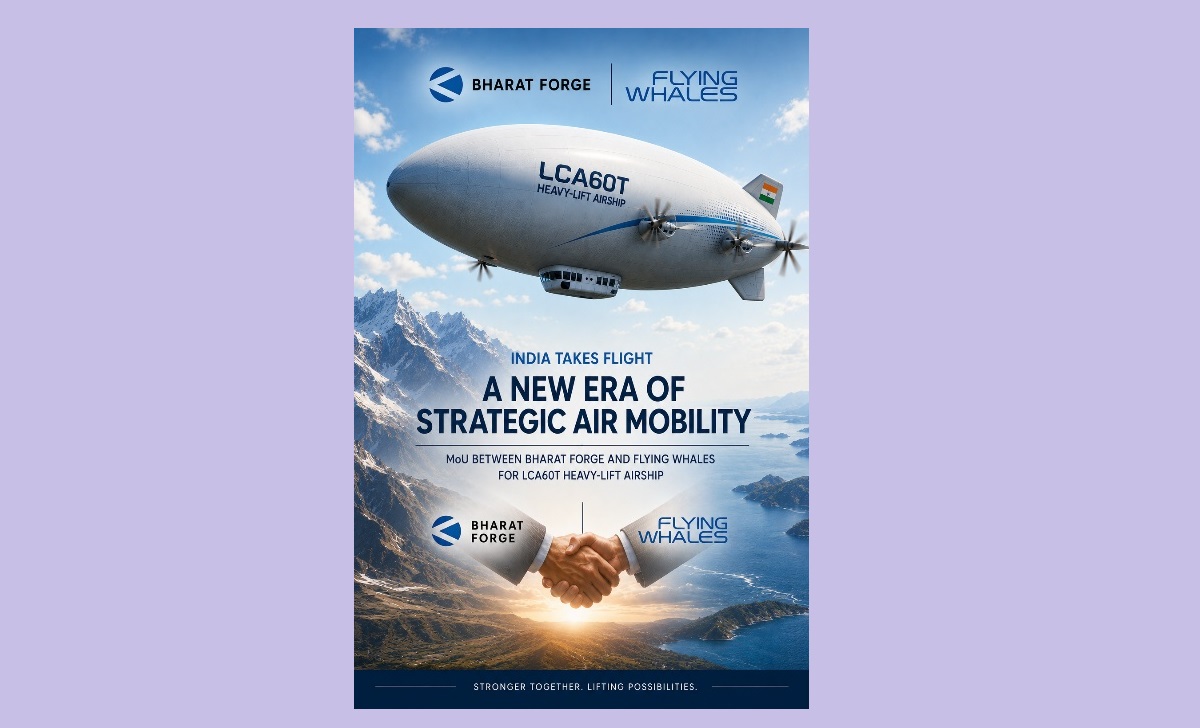
What if the Indian Air Force (IAF) and the Indian Army could airlift tons of supplies and weaponry to remote, high-altitude outposts without a runway? Now it seems possible after India’s Bharat Forge signed a Memorandum of Understanding (MoU) with the French-Canadian aerospace joint venture Flying Whales. The MoU was signed during the Farnborough International Air Show 2026 in the United Kingdom (UK) on July 22, 2026, and both parties have agreed to jointly develop and manufacture advanced heavy-lift airships in India. Such giant aircraft could transform Indian defence logistics and mobility.[1]
This paper addresses the capability gap in India’s defence logistics architecture: the absence of a heavy-lift platform capable of delivering oversized and heavy payloads to mountainous, border, and disaster-affected areas without dependence on runways or extensive ground infrastructure. The collaboration between Bharat Forge and Flying Whales represents a decisive step toward building an indigenous airship ecosystem in India, aligned with the Government of India’s Make in India initiative.
About the Deal
The MoU was signed between Mr Guru Biswal, CEO, Aerospace, Bharat Forge and Mr Sébastien Bougon, President, Flying Whales. At the core of this deal is the LCA60T platform.[2] It is the Flying Whales’ next-generation, heavy-lift airship capable of transporting up to 60 tons of cargo with vertical take-off and landing capability, minimal ground infrastructure requirements and hybrid-electric propulsion. It is designed for point-to-point operations in challenging and remote environments.[3] Mr Amit Kalyani, Vice Chairman & Joint Managing Director, Bharat Forge, said, “Airships will redefine how nations move, supply and sustain their forces, and India will lead that change. This strategic partnership places India among a select group of nations with the capability to design, build and field heavy-lift airships, bringing together Flying Whales’ pioneering technology and Bharat Forge’s six decades of advanced engineering strength and deep understanding of India’s defence needs. Aligned to the spirit of Aatmanirbhar Bharat, we are creating a sovereign capability, a new industrial ecosystem and an entirely new dimension of strategic mobility for the nation.”[4]
The collaboration aims to establish manufacturing integration and a long-term aerospace ecosystem inside India, on which Mr Tanguy Lestienne, CEO, Flying Whales, said, “The LCA60T was conceived to reach the world’s most remote and demanding locations, and that promise finds its fullest expression in India, with its vast geography, challenging terrain and extraordinary ambition. We are delighted to partner with Bharat Forge, whose engineering depth; defence expertise and shared vision make this a true strategic alliance to take the programme to scale. Together, we will build in India, for India and for the world, laying the foundations of an airship industry that will serve this region for generations.”[5]
Neither Bharat Forge nor Flying Whales has mentioned IAF’s Expression of Interest (EoI), and nothing has been published so far that directly connects this partnership, but the assumption on open-source platforms is that the IAF has signaled real demand for domestically built military airships.[6] The EoI has been stipulated for an unmanned airship staying aloft for 10 days at full payload (with 30 days preferred). Currently, this could be a tall order for the Flying Whales airship since its default configuration is not unmanned, but calls for a minimum of two crew: a pilot and a load-exchange officer. Conversely, other requirements such as a minimum of 5,000 kg cargo capacity are within reach.[7]
Architecture of LCA60T
The LCA60T is a semi-rigid, heavy-lift airship, roughly 200 meters long and 50 meters in diameter. Its internal cargo bay, about 96 meters long, 8 meters high, and 7 meters wide, can accommodate payloads up to 60 tons. Primarily, lift is provided by 180,000 cubic meters of non-pressurised helium, allowing operations at altitudes up to 3,000 meters (10,000 feet) even when fully loaded. Propulsion comes from 32 electric motor-driven units producing up to 4,000 kW (5,360 hp), enabling a maximum speed of 100 km/h and a typical mission range of 200-500 km from base.[8]
A defining feature of the LCA60T is its ability to hover steadily at approximately 100 meters above ground level to facilitate load transfer, removing the need for landing gear or prepared runways. It achieves vertical take-off and landing by modulating dynamic lift through its distributed propulsion systems, then transitions to forward flight with the payload suspended beneath the gondola. This Helicopter-like hover and vertical take-off and landing capability allows the airship to operate from austere sites such as mountain plateaus, forest clearings, and disaster zones.[9]
The platform is expected to support renewable energy initiatives, including transportation of wind turbine blades and transmission towers, alongside applications in construction, defence, humanitarian relief, mobile medical units, and remote freight operations.[10]
How is LCA60T different from Heavy Lift Helicopters?
The question is: if the IAF has heavy-lift helicopters like the CH-47 Chinook and Mil Mi-26, then why should India acquire a heavy-lift airship like LCA60T?
Both the LCA60T airship and helicopters like the CH-47 Chinook are heavy-lift aerial vehicles but possess distinct logistics abilities and problems. The airship has lower operating costs, much larger single-lift payloads, and the ability to operate from unprepared sites without runways, whereas the Chinook has high speed, manoeuvrability, and all-weather responsiveness.
Table 1: Key distinctions between LCA60T and Heavy-lift Helicopters
Key distinctions |
LCA60T |
Heavy-lift helicopters |
Air-lift |
The airship derives its primary lift from non-pressurised helium and distributed electric propulsion; hence, very little fuel is spent just to stay aloft. |
The helicopters lift with their rotors; most fuel goes into generating the lift and keeping it stationary while aloft. |
Payload capacity |
The airship can carry up to 60 tons in a 96m x 8m x 7m internal cargo. |
Heavy-lift helicopters such as the Mil MI-26 are designed to carry up to 20 tons.[11] |
Reaction time and reach |
The airship has a maximum speed of 100 km/h and a typical mission range up to 500 km from base. |
The heavy-lift helicopters such as the Ch-47 Chinook, has a maximum speed of 302 km/h with a cruise speed of 291 km/h and a mission radius up to 306 km.[12] |
Responsiveness in harsh weather conditions. |
Airships of such large size are more sensitive to strong winds/storms, and slow speed makes it less suitable for high-threat and fast-maneuver missions. |
Comparatively, the heavy lift helicopters perform better in adverse weather conditions because their high maneuverability, cruising speed, and ability to operate in tighter spaces. |
Note: The data has been complied by the Author through various sources.
The acquisition of the LCA60T will add a different kind of capability to optimise the IAF’s heavy-lift abilities. This airship fills a gap that other heavy-lift helicopters and cargo planes do not, such as low cost, large capacity, runway independence, and sustained logistics in difficult terrain.
Limitations of LCA60T
The LCA60T airship delivers various advantages through runway-independent operations and sustained hover capability, but its practical deployment faces a range of constraints. The following points outline key limitations of the LCA60T, underscoring factors that must be tackled to ensure the platform’s effectiveness and survivability in real-world operational environments.
1. While the airship is designed in such a way that it does not require a runway or a landing spot due to its ability to hover, for loading and offloading its payload, it will require some ground infrastructure in order to have a safe delivery.
2. If the jet stream speed is 100 km/h or more, the airship, with a speed limit of 100 km/h, will not be capable enough to outrun such strong winds.
3. Airships, unlike helicopters, cannot easily pass through tight spaces; hence, providing logistical support in the narrow mountain passes such as in Kashmir will be quite difficult.
4. The LCA60T is fueled by Helium. As per reports of Helium production by countries worldwide in 2025, the US and Qatar are the largest producers, contributing around 75.8 per cent to total production.[13] If in future any conflict arises across West Asia, it might get difficult for India to access Helium.
5. In future, if the airship has been deployed to deliver required items at the border region, such a large airship cannot go undetected. With Surface-to-Air-Missile (SAM) systems and their ranges reaching up to 400 kms and more, the airship will be in a vulnerable spot and become an easy target.
Imperatives of LCA60T to India
The following imperatives of LCA60T outline the rationale for adopting the airship within India’s defence logistics framework and its ability to deliver heavy and oversized loads to infrastructure-denied areas, enhancing India’s crisis response capabilities.
1. Owing to high altitude, severe weather, and sparse road networks that are often shut by snow or landslides, vast sections of the Himalayan frontier remain hard to reach by either air or road. The LCA60T’s ability to perform vertical take-off and landing without a runway, combined with its capacity to lift payloads far exceeding those of helicopters, provides the Indian armed forces with a logistics solution that neither fixed-wing transports nor rotary aircraft can fully match.
2. Based on the information available in open sources, there are no publicly available announcements regarding transfer of technology; however, the deal has explicitly mentioned development and manufacturing of LCA60T in India.[14] This programme aligns with the government of India’s ‘Make in India’ initiative and falls under the ‘Buy (Global) and Manufacture in India’ acquisition category of draft Defence Acquisition Procedure (DAP) 2026 of the Ministry of Defence released in February 2026.[15] Hence, leveraging Bharat Forge’s six decades of advanced engineering strength, alongside Flying Whales’ pioneering airship technology will foster indigenous aerospace expertise and industrial base. Additionally, the project is expected to create more than 300 high-skilled aeronautics jobs in India.[16] Thereby expanding India’s role in the global aerospace and defence supply chain.
3. By establishing production units within the country, India will position itself not only as a consumer but also as a potential exporter of such heavy-lift airship technology. The LCA60T’s distinctive capabilities, notably its minimal land infrastructure requirements for take-off, have worldwide applications for remote logistics, resource extraction and disaster response. Export opportunities to diversify income sources would make India less vulnerable to supply disruptions caused by geopolitical events.
4. Beyond its military applications, the LCA60T holds transformative potential for humanitarian assistance and disaster relief (HADR) operations. When floods, earthquakes, or landslides wipe out roads and bridges, this airship can deliver heavy equipment, medical supplies, and relief materials directly to hard-hit areas. Since the IAF’s helicopter fleets have a ceiling with heavier loads, the LCA60T fills a critical gap, making the partnership a far stronger investment on both military and civil fronts.
Recommendations
To fully leverage the benefits of this partnership, the following recommendations may be considered:
1. The Ministry of Defence ought to establish defined acquisition schedules for the LCA60T, tying them directly into broader military modernisation goals.
2. Bharat Forge and Flying Whales should focus on thorough technology sharing, specifically covering design authority, certification expertise, and maintenance, repair, and overhaul (MRO) infrastructure setups, to foster genuine indigenous production.
3. The government should support the development of secure helium supply chains, potentially through strategic reserves or investment in helium recovery technologies, to mitigate lifecycle cost and supply risks.
4. In parallel, partners should map out an export plan tailored to nations dealing with harsh terrain and remote logistics hurdles.
Conclusion
As India pushes forward with advanced aerospace technology, joint ventures like this can speed up innovations, boost export opportunities, and position a country as a major hub for next-generation manufacturing. Producing the LCA60T heavy-lift airship locally gives India a game-changing logistical tool, which can deliver 60-tonne payloads to austere, runway-less locations. This partnership not only strengthens indigenous aerospace expertise, creates skilled employment, and opens up export avenues, but also solves persistent supply challenges in broader regions and in disaster zones. Bringing this program to fruition will take dedicated effort from both public and private sectors, but the long-term payoff is substantial.
*****
CLICK TO VIEW THE PDF
Notes:
[1] “Bharat Forge and Flying Whales Sign Strategic MoU to Develop and Manufacture Heavy-Lift Airships for Sovereign Applications in India,” Bharat Forge, July 22, 2026, https://www.bharatforge.com/media/press-release/bharat-forge-and-flying-whales-sign-strategic-mou-to-develop-and-manufacture-hea. Accessed on August 06, 2026.
[2] Ibid.
[3] Ibid.
[4] Ibid.
[5] Ibid.
[6] Kirk McGinnis, “Flying Whales Signs MoU with India’s Bharat Forge,” Airship Advocate, July 22, 2026, https://airshipadvocate.com/flying-whales-signs-mou-with-indias-bharat-forge/?srsltid=AfmBOoo-COfKOxhgK2gRvJ1o5UvUC945sY3U9UtEwW_8A8B_7i8PnOxi. Accessed on August 06, 2026.
[7] Ibid.
[8] “Our solution for air cargo transport,” Flying Whales, https://www.flying-whales.com/en/the-lca60t/. Accessed on August 06, 2026.
[9] Ibid.
[10] “Flying Whales to establish third airship facility in India: French-backed company expands heavy-lift airship project globally,” Bhaskar English, April 2026, https://www.bhaskarenglish.in/utility/news/flying-whales-airship-project-india-global-expansion-137593850.html Accessed on August 06, 2026.
[11] “Mi-26 HALO,” GlobalSecurity.org, https://www.globalsecurity.org/military/world/russia/mi-26.htm. Accessed on August 11, 2026.
[12] “H-47 Chinook,” Boeing, https://www.boeing.com/defense/military-rotorcraft/h-47-chinook Accessed on August 11, 2026.
[13] Niccolo Conte, “Charted: Helium Production by country,” Elements, April 27, 2026, https://elements.visualcapitalist.com/charted-helium-production-by-country/. Accessed on August 09, 2026.
[14] Bharat Forge, n. 1.
[15] Nitin A. Gokhale (@nitingokhale), “The draft of the Defence Acquisition Procedure 2026 is out. Many aspects to study but this is my first observation. Categories for capital acquisition…,” X, February 10, 2026, https://x.com/nitingokhale/status/2021248578942079072?lang=en
[16] Bhaskar English, n. 10.