Author: Dr Priyanka Yadav, Research Associate, Centre for Aerospace Power and Strategic Studies
Keywords: BRICS, Quad, China, Strait of Hormuz, Indo-Pacific
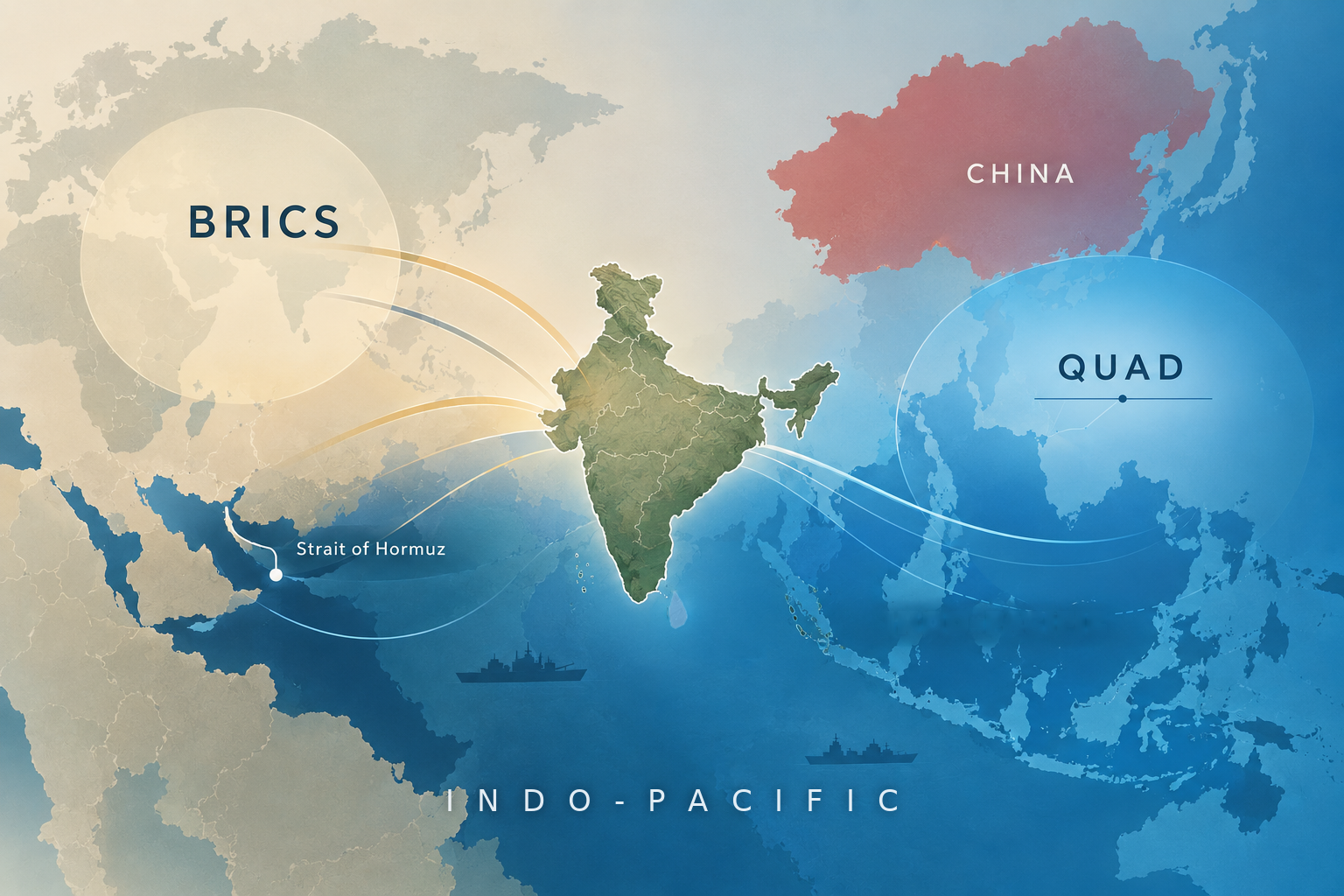
India, at the helm of the BRICS chairmanship, hosted the 18th BRICS Summit from September 12 to 13, 2026, in New Delhi. This year’s summit came against the backdrop of the West fighting wars in West Asia and Europe, United States (US) President Trump’s imposition of harsh unilateral trade tariffs against nations, and more broadly, the visible rupture of the international order that the US had led for decades. Western narratives have often portrayed the BRICS grouping as an anti-Western bloc1 due to the deep ideological and security divide between Western nations, notably the US, and non-Western nations such as China and Russia. However, India’s interests in BRICS go beyond bloc politics, particularly as new security and economic challenges emerge. These include China’s control over critical minerals, emerging vulnerabilities in strategic chokepoints such as the Strait of Hormuz, and the growing role of artificial intelligence (AI) in political, economic, and security domains. Most of these pressures originate from the grouping itself, which makes India’s position peculiar: it continues to occupy a significant middle ground, embedded in US-led regional groupings such as the Quadrilateral Security Dialogue (Quad), while shaping and influencing non-Western-led institutions like BRICS from its chair.
This article examines whether India’s engagement with BRICS may shape or alter its long-term strategic objectives in the Indo-Pacific. It also examines how India balances its participation in BRICS with its commitments to the Quad and its broader Indo-Pacific interests, without compromising its foreign policy principle of strategic autonomy.
India and the Quad
India’s Indo-Pacific objectives are centred on protecting its maritime security, securing vital sea lanes and energy routes, and maintaining a stable regional balance in the Indo-Pacific. India holds a significant position in the Quad grouping with the other three major powers, the US, Japan, and Australia, to strengthen its defence and strategic partnerships. For instance, in May 2026, India hosted the Quad Foreign Ministers’ meeting in New Delhi, where the member nations jointly launched the USD 20 billion ‘Quad Minerals Initiative Framework.2 Alongside this, it anchored India as a strategic processing and recycling hub, securing the high-tech supply chains essential to the clean energy and defence systems of all the Quad nations. India’s defence agreements with Japan3 and Australia4 in mid-2026 also centred on boosting defence cooperation with naval co-development, enhancing maritime domain awareness and interoperability to build a better, more resilient Indo-Pacific architecture. It indicates that India’s Indo-Pacific security commitments are growing as defence ties among these nations deepen. Thus, India’s position in the Quad is not at the expense of the Western powers but primarily to ensure its own interests in the Indo-Pacific theatre, including the Indian Ocean.
The Indian Ocean lies in India’s backyard and holds substantial significance of its own because it comprises a multitude of shipping lanes, along with notable India-led initiatives such as Look East (strengthening cooperation with Southeast and East Asian nations), SAGAR (Security and Growth for all), and MAHASAGAR (Mutual and Holistic Advancement for Security and Growth Across Regions), strengthening defence ties with Southeast Asian nations5 (notably the Philippines, Indonesia, and Vietnam), and conducting regular joint military exercises and patrols to preserve the existing regional order. Through these initiatives, India indirectly seeks to monitor China’s coercive tactics against smaller nations in the region and to counter China’s aggressive naval buildup, investments in maritime infrastructure, and alternative connectivity corridors under the Belt and Road Initiative (BRI). India’s geography aligns more closely with the Indo-Pacific; therefore, outcomes in the Indian Ocean and the broader Indo-Pacific directly affect India’s territorial and maritime security, energy supply routes, and its regional standing.
India’s Position in BRICS
While India’s objectives in BRICS differ from its security objectives in the Indo-Pacific. This year, hosting the BRICS Summit, New Delhi provided a platform for defence and diplomacy among nations, strengthened economic cooperation, bolstered the Global South’s voice in global governance, and collectively shaped decision-making. This also aligns with India’s principle of strategic autonomy and non-alignment, which allows it to work with Western nations while securing a platform for consensus with major powers such as Russia and China within BRICS.
India has been wary of rigid geopolitical alignments, and it demonstrated this by abstaining from the BRICS-linked naval exercise “Will for Peace” in South Africa, clearly dismissing China’s intent to develop BRICS maritime cooperation into a securitised framework among member nations.6 Prior to the BRICS Summit, in July 2026, India also hosted the BRICS Seafarers’ Forum in Mumbai, issuing the Mumbai Declaration 2026, which focused on seafarer safety in conflict zones, addressed crew abandonment, and emphasised maritime sovereignty.7
Additionally, India has also maintained distance from any understanding of a common BRICS currency and de-dollarisation8 efforts in the near term, which has often been a source of worry and angst for US President Trump regarding the BRICS grouping. Instead, India kept the focus on a technocratic approach involving interoperable payment systems, settlements in local currencies, and maintaining cooperation based on national priorities.
It is essential to note that the BRICS agenda spans a range of issues, including terrorism, global governance, agriculture, technology, climate, health, education, culture, and finance, making it a strategic convergence mechanism for all participating nations rather than merely another security bloc. The nations of this grouping do not share a similar regional threat perception; thus, it does not directly serve as a basis for a security-led alternative mechanism.
Here, India also has an advantage in BRICS due to Pakistan’s absence, as it provides more room for close cooperation among member nations on issues such as terrorism, which directly hinders India’s sovereign interests. The BRICS New Delhi Declaration,9 signed on September 12, 2026, by all nations, including China, which often portrays its relations with Pakistan as an ‘all-weather friend,’ condemned the April 2025 Pahalgam attack. Such attempts have repeatedly been obstructed by Pakistan on other international platforms, which remains a perennial security concern for India, emanating from cross-border terrorism. Despite the ongoing conflict and divergences in West Asia, New Delhi also managed to bring Iran and the UAE to a single consensus text at this year’s BRICS Summit. At the same time, Chinese President Xi Jinping’s visit to India for the BRICS summit added strategic weight, given the strained relations between the two nations since the 2020 border crisis. 10
For India, BRICS serves as a platform to engage with China in a multilateral setting, while other non-Western economies pursue objectives that broaden the scope of the international order and deepen cooperation on a range of issues such as supply chain resilience, digital systems, climate adaptation, health, and food security.
India’s Choices
India’s strategic choices are shaped by a multidimensional China challenge: a competitor to its interests in the Indo-Pacific, a dominant force in BRICS owing to its technological and manufacturing edge, and an adversary along the contested Himalayan frontier, where border skirmishes continue to strain ties.
Although India’s BRICS and Indo-Pacific objectives are not inherently contradictory, tensions can arise between them. The main concern is China. India seeks to engage China through BRICS while strengthening Indo-Pacific partnerships to respond to China’s growing regional presence. A stronger security role for BRICS could work against India’s interests, as pressure for bloc solidarity may force it into positions that strain its strategic partnerships and limit its room to counter China along the Line of Actual Control (LAC).
Navigating its choices across different platforms also gives India institutional leverage, room for strategic manoeuvring on a range of issues, and more negotiating ground to build bridges with China in a multilateral setting. It also leaves enough room for India to participate in Western-led forums such as the G7 and G-20 without friction. Weakening international forums such as BRICS could undermine a platform that can echo the concerns of developing nations from a vantage point.
The New Delhi Declaration notes that the outcome stems from practical cooperation among member nations, despite their different positions on the international stage. The 2026 BRICS Summit was not about who gets to write the rules, but who is represented when the rules are being written. The Quad’s concerns centre on ensuring maritime security and effectively balancing China by building robust multilateral partnerships within the Indo-Pacific. India’s challenge will be to ensure that cooperation within BRICS does not develop into bloc-based security commitments that restrict its long-term strategic choices. As long as India retains this flexibility, its growing role in BRICS is more likely to strengthen its strategic autonomy than dilute its long-term Indo-Pacific objectives.
Notes: