Author: Gp Capt VP Naik VM, Senior Fellow, Centre for Aerospace Power and Strategic Studies
Keywords: One Nation-One Theatre, Strategic Coherence, Whole-of-Nation Approach, Modern Warfighting, Theatre Commands
In continuation of a series of articles on Higher Defence reforms, this article sheds light on the need for India-specific structures for modern war fighting. The first article was about whether Theatre Commands were required or not. Air Power Musings: Theatre Commands – To Be or Not to Be (published in CAPSS Journal, Defence and Diplomacy, https://capssindia.org/wp-content/uploads/2025/09/7-VP-Naik.pdf. The second article primarily explained the differences between Theatres and fronts and brought out the employment philosophy of the India Air Force. Air Power Musings: Theatre Commands Redux (Published on CAPSS website, In Focus, https://capssindia.org/air-power-musings-theatre-commands-redux/). The third article carried out a joint AI and human analysis of the need for reforms and what was wrong with the way India plans to fight, and articulated a problem statement. The fourth article recommended possible structures for the reforms and brought out certain lacunae at the apex level. India’s Higher Defence Reforms: Tactical Brilliance or Strategic Coherence, https://capssindia.org/indias-higher-defence-reforms-tactical-brilliance-or-strategic-coherence/ published as an Expert View article on CAPSS’ website. The fifth article brought out certain facts about modern war fighting and how the theatre construct was already an old concept. Air Power Musings: When Structure Lags Strategy, The Theatre Command Fallacy, https://capssindia.org/air-power-musings-when-structure-lags-strategy-the-theatre-command-fallacy. The aim of the series was to build a coherent argument towards higher defence reforms in India and bring out possible actionable options in the national security construct.
Introduction
India’s unique geostrategic problem of having two contiguous adversaries, who may act simultaneously, makes the threat manifest as a single entity on multiple fronts. The emerging geopolitical landscape in Myanmar and Bangladesh also merits strategic considerations, however, does it mean that India will need to create additional theatres to cater for Bangladesh and Myanmar?
The problem lies not in the number of threats, which would vary, but in how to handle the manifesting threat. The Iran imbroglio has further reinforced the need for a unified command. The United States (US) and Israeli forces operate under their own, independent commands, where plans are made and executed. However, for the ongoing Iran operation, in spite of being a joint operation, there have been instances of bombing by Israel which the Americans were not aware of.[1] This brings out the need for unity of command to ensure integrated execution of operations. The Iranians, on the other hand, have a single unified command structure; however, execution is decentralised and left to the 31 autonomous provincial commands without any systemic coherence. The Islamic Revolutionary Guards Corps (IRGC) and the Artesh (the Islamic Republic of Iran Army) are two parallel and independent armed entities of Iran operating within the same geography and with their own forces. The Artesh has its integral Army, Navy, Air Force and Air Defence (AD) Force, while the IRGC has its own Ground Force, Navy, Aerospace Force (missiles and drones), Quds Force (supporting the axis of resistance and associated militia) and the Basij Organisation (Information Warfare). These are two forces fighting independently and without strategic guidance.
India is uniquely placed because its threats are geographically contiguous and strategically intertwined. China’s Western Theatre Command (WTC) independently deals with India. Pakistan does not have a separate Theatre Command (TC) to handle contingencies in its West and East. However, the Indian thought process, seemingly in the final stages of reforms, is still looking at the creation of TCs to enhance war-fighting capability. While there is no denying the fact that reforms are required in India’s Higher Defence Organisation (HDO), the solutions being discussed appear to be in a desperate search for a problem. This article argues that the threat faced by India is singular in nature and could manifest either simultaneously or sequentially, forcing India to fight a two-front war within the same battle-space continuum. Thus, dividing the country into TCs based on a happy compromise of threat and geography risks fragmenting strategic planning for what is essentially one strategic problem.
Creating Artificial Boundaries
The concept of Theatres originated before the Second World War, when forces had to be allocated and operated on separate continental fronts and across vast oceans. Geography forced these structures because that was what was required in those times. In India, we are trying to force geography, and that can prove detrimental in the long run. Gujarat, Rajasthan, Punjab, Jammu and Kashmir, Ladakh, Uttarakhand, Sikkim and Arunachal Pradesh are contiguous and operationally connected, having a direct impact on each other. If dealt with by separate theatres, strategic prioritisation will become a major problem and be contested. A single national TC construct preserves the principle of Unity of Command and permits decentralised execution. More on that later. Thus, the need of the hour is to use geography to one’s advantage rather than making it an excuse for fragmenting forces. We should not create artificial boundaries and further complicate the issue.
Two Front Contingency
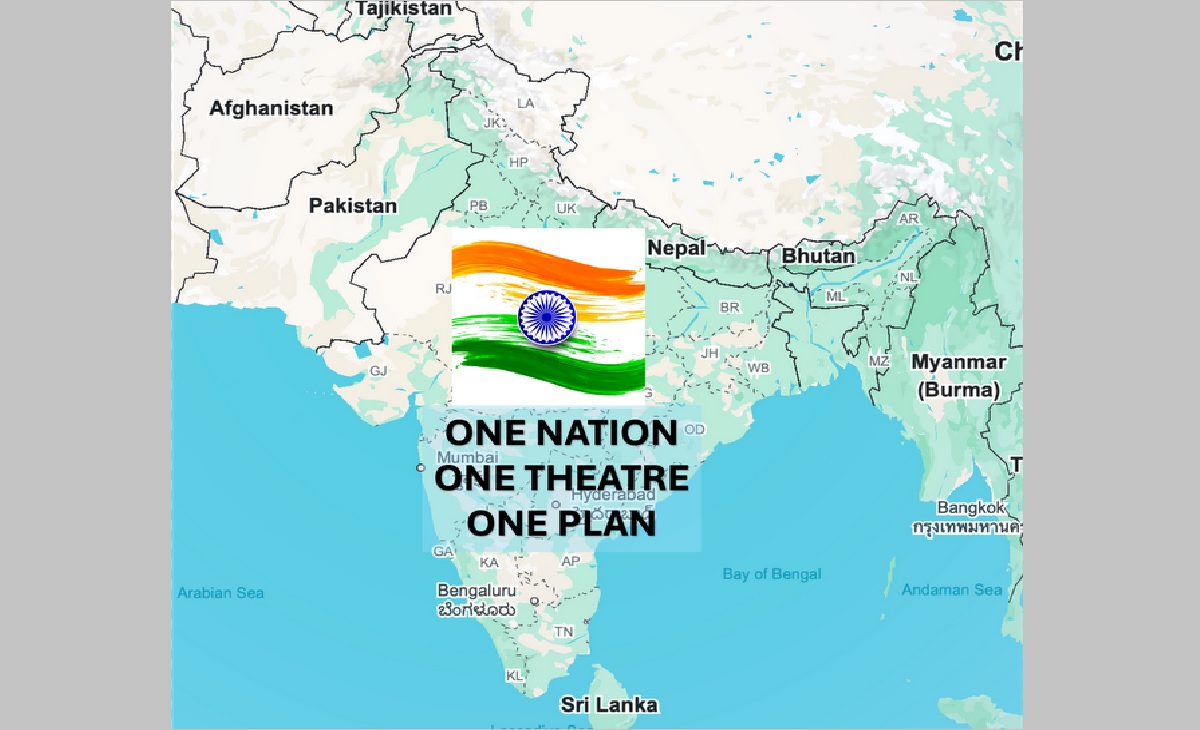
India is one contiguous Theatre of War. Contingencies may arise with any of its neighbours, and each would constitute a separate front. We should not confuse Theatres of War with fronts and Theatres of Operations. Therefore, the opening of a front does not require an independent force structure to be activated. Additionally, India cannot assume that conflicts with either China or Pakistan will remain geographically isolated. Threats could very rapidly become national conflicts rather than remaining regional campaigns. This further reinforces the need for a single, integrated operational theatre of war.
Multi Domain Operations (MDO) involving land, sea, air, space, and cyber forces will require synchronisation and will be carried out across the entire country simultaneously, because MDO transcend conventional domain-specific war-fighting. If cyber, space and information campaigns are all pervasive and scarce resources like force multipliers remain centrally controlled, why then should war fighting become fragmented? Fragmenting would only create parallel systems, undermining effective Command and Control (C2). A single theatre construct would instead better align with modern warfare, enabling a system-of-systems approach to war-fighting.
Theatre Commands are a purely military reform, and rather than addressing the elephant in the room and appreciating the situation, India is trying to situate the appreciation. Modern war fighting will not purely be a military construct. Russia-Ukraine, Israel-Hamas and US-Israel versus Iran show that national resilience, resolve, and most importantly, capability will differentiate between the victor and the vanquished. It is easy to say that the armed forces need to be reformed, but very difficult to say that the problems are systemic and at the apex level. To develop a comprehensive capability, reforms in HDO must first take place at the highest level.
India’s Legacy HDO: The Need for Apex-Level Joint Planning
India’s current C2 architecture is a legacy inheritance still being retained. What India needs is force-reconfiguration rather than force restructuring because the problem is not about how we fight, it is about how we plan. In India’s past wars, when have the Army and the Navy been used to gain control of the air? Traditionally, the Air Force has been providing air support and shaping the battlefield for the Army and Navy; however, have the land forces ever been used to take on air force tasks like radar busting, artillery and rocket fires on airfields, and destruction of C2 nodes by their special forces? Control of the air is a prerequisite for advancing the land offensive and must be achieved jointly. Op Sindoor, the Ukraine-Russia war and the US-Israel war with Iran have shown the importance of gaining requisite control of air for the furtherance of all operations. Therefore, gaining and retaining control of the air becomes a national imperative to be achieved jointly, requiring centralised planning. Two or three independent theatres are not likely to achieve strategic coherence because their operational imperatives would significantly differ.
MDO requires a ‘Whole-of-Nation’ approach to war-fighting, and that ‘whole’ cannot further be broken down into western theatre, northern theatre or a maritime theatre. Selection and Maintenance of Aim is one of the most enduring Principles of War. Having multiple aims at the grand strategic or the military strategic level will go against the principle. Russia did not adhere to it in the early days of the war, and the result is there for everyone to see. In addition, modern weapons have trans-geography reach. What if an adversary’s weapon hits a target in a different Theatre Command which has not been activated? Will that theatre now respond, or will only the theatre that is supposed to deal with that particular threat respond to the event? For example, in a conflict with Pakistan, Vishakapatnam is targeted, so who will respond to it and how? The unfolding problems are myriad, and the cascading effects will be counterproductive. These issues complicate effective decision-making and further add to the confusion, and in MDO, if decision-making is compromised, the battle will be lost. To take the argument further, Distributed Denial of Services (DDoS) attacks on critical infrastructure will happen across the nation and call for a mix of kinetic and non-kinetic responses. Space, the ultimate high ground, does not distinguish between theatres, and more importantly, India’s adversaries also consider India one theatre of operations. Then Why should India not respond as one integrated entity?
Realigning Operational Regional Commands
If planning needs to be done centrally at the apex level, the same is also true at the operational level of execution. The Indian Army has seven regional Commands; the Navy has three, and the Air Force has seven. A total of 17 Commands are spread across the entire country. If India were to operate as one integrated command, the existing regional commands would need to be merged and, more importantly, co-located, keeping geography and threats in mind. Strategic guidance must lead to operational coherence; therefore, we need to change the process of execution of kinetic operations at the operational level, and that is what is meant by force reconfiguration. This can be done by creating Joint Forces Commands (JFC) based on geography, which would exercise C2 at the operational level. Merger of regional commands would enable unity of command and permit decentralised execution. These JFCs would remain operationally subordinate to a single national Theatre and an associated Joint Forces Head Quarters (JFHQ) in order to remain strategically coherent.[2]
In 2016, China realigned its forces from seven Military Regions to five Theatre Commands, each dealing with a specific threat. China’s threat landscape differs from that of India because it has geographically dispersed threats and a mix of continental as well as maritime domains. The Central Theatre Command (CTC) of China defends Beijing and acts as a strategic reserve for other commands. India’s strategic landscape is more concentrated and geographically contiguous, making a single integrated theatre construct more suitable.
The Single Point Advice of Matters Military
Establishing the post of Chief of Defence Staff (CDS) and creating the Department of Military Affairs (DMA) is a step in the right direction. The issue causing dissonance is that war fighting and Raise, Train and Sustain (RTS) functions have been merged, thereby creating additional reform hurdles. Clearly mandated Allocation of Business (AoB) rules by the Government of India must thus become the first reform. Subject Matter Experts must be able to render ‘single point advice’ to the Government of India (GoI) on all matters related to the armed forces. This advice is single-point and not necessarily single-person. A single person makes the chain linear and susceptible to disruptions, and the same has been seen during Op-Epic Fury, where the death of the Supreme Leader of Iran adversely affected its apex decision-making ability.
With increased offensive capability to address strategic Centres of Gravity (CoG), targeting leadership across all levels has now become fair game. In the present construct, the Chiefs of Staff Committee (COSC) is an efficient organisation, functionally effective and brings about strategic coherence. The single point advice, therefore, must be a collegiate function by the CDS and the three Service Chiefs (experts in their respective domains). War fighting and RTS functions, both must remain the mandate of COSC, performed by the JFHQ (war fighting) and HQ Integrated Defence Staff (IDS) for RTS functions headed by the Chief of Integrated Defence Staff and Secretary to the Chairman COSC (CISC) heading the DMA.
The Future of Warfare
In modern wars, kill chains have evolved into kill webs. There are no independent operations ,and cyber and space are overarching capabilities capable of affecting all other domains. These form the bedrock of Multi-Domain Operations and are therefore not just the mandate of the armed forces. A national ‘nervous system’ is therefore the best way forward. The ability of a nation to demonstrate and adopt a ‘whole-of-nation’ approach will prove decisive in the future. The vision document, ‘The Defence Forces Vision 2047: A Roadmap for a Future-ready Indian Military’, unveiled by the Honourable Raksha Mantri (RM) on March 10, 2026, also speaks of the need for integrating military strength with diplomatic, technological and economic power to ensure national security. [iii] The writing on the wall is clear; it is not just about the armed forces. The armed forces are an important cog in the wheel of a nation, but they are not the only cog. All cogs need to work together to strengthen and support the wheel and serve their own distinct purposes. The armed forces function best when C2 is simple, clear and unified. The soldier on the battlefield, the sailor in a submarine and the pilot in the cockpit of an aircraft require clarity of instruction to enable correct tactical actions. A One Nation-One Theatre approach would align India’s strategy with geography, reduce bureaucratic lethargy, enhance jointness and most importantly, translate synergy into a coherent strategy for integrated operations.
India’s security challenges demand a fundamental rethink of the existing C2 structures. We must embrace our geopolitical landscape and geographical context to adopt a framework specifically tailored to India’s strategic reality. Given the possibility of simultaneous pressure from both China and Pakistan, multiple theatres will only fragment war-fighting capability. A One Nation-One Theatre architecture, supported by streamlined regional commands and an integrated network for MDO, would enable India to reduce the teeth-to-tail ratio, preserve national character and strengthen national response in arising contingencies.
*****
CLICK TO VIEW THE PDF
Notes:
[1] “White House Sent ‘WTF’ Message to Israel After Iran Oil Field Strike: US Report,” NDTV, March 09, 2026, https://www.ndtv.com/world-news/iran-israel-war-us-wtf-message-israel-attacks-iran-oil-fields-oil-prices-rise-brent-crude-price-today-11188848, Accessed on March 11, 2026.
[2] VP Naik, “India’s Higher Defence Reforms: Tactical Brilliance or Strategic Coherence,” Centre for Aerospace Power and Strategic Studies (CAPSS), November 29, 2025, https://capssindia.org/indias-higher-defence-reforms-tactical-brilliance-or-strategic-coherence/. Accessed on March 11, 2026.
[3] Surendra Singh, “Rajnath Singh Unveils Vision Document to build Future-Ready Military Force,” The Times of India, March 11, 2026, https://timesofindia.indiatimes.com/defence/news/rajnath-singh-unveils-vision-document-to-build-future-ready-military-force/articleshow/129420609.cms, Accessed on March 11, 2026.
(Disclaimer: The views and opinions expressed in this article are those of the author and do not necessarily reflect the position of the Centre for Aerospace Power and Strategic Studies [CAPSS])