Author: Mr Arjun Prakash Iyer, Research Scholar, Unni Kartha Chair of Excellence
Keywords: Indian Defence Manufacturing, Aatmanirbhar Bharat, Unmanned Aerial Systems, Manned Unmanned Teaming (MUM-T), Defence Industry Perspectives
What is Bharat Aero?
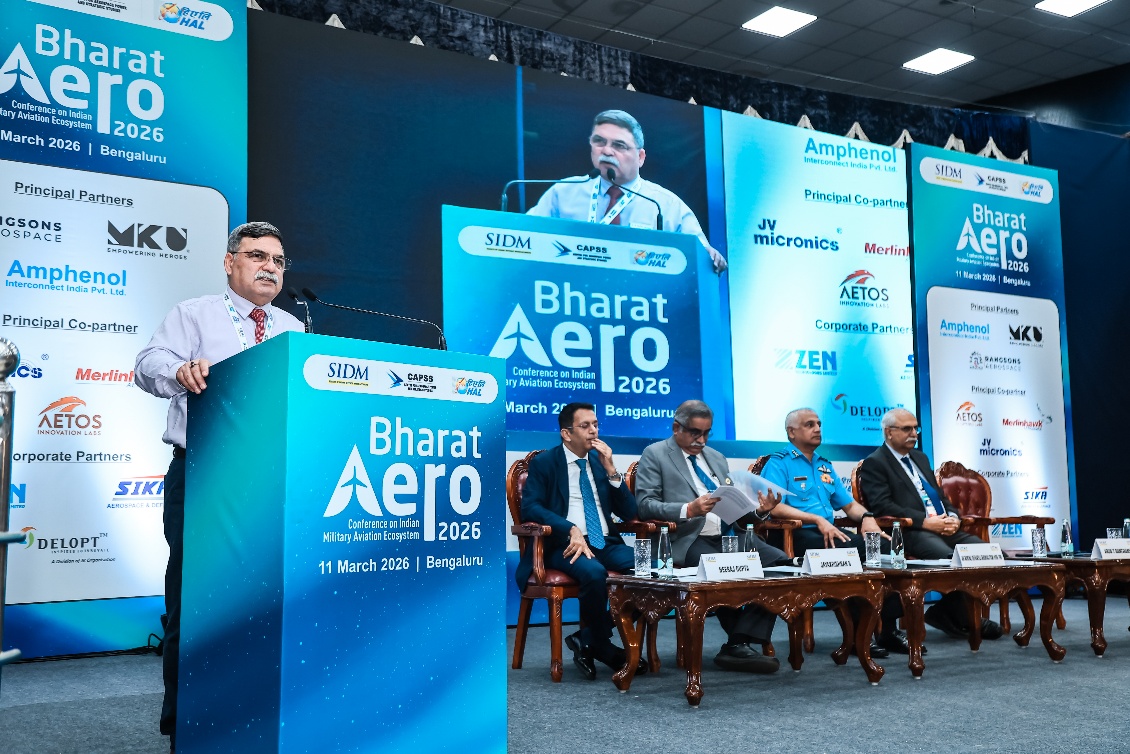
Bharat Aero 2026 is a premier defence and aerospace conference co-organised by Centre for Aerospace Power & Strategic Studies (CAPSS), Society of Indian Defence Manufacturers (SIDM) and Hindustan Aeronautics Limited (HAL). It was held at V.N. Ghatge Auditorium in Bengaluru on Wednesday, March 11, 2026. The conference was a high-level summit dedicated to advancing India’s military aviation ecosystem by building strong collaboration amongst the defence manufacturing industry and developing an understanding between the industry and the end users (the Indian Army, Navy, and Air Force). The event consisted of a series of panel discussions featuring insightful contributions from armed forces leadership, defence industry executives, and government agencies regarding the pursuit of strategic autonomy and technological self-reliance.
Key themes of the conference included the transition from licensed production (“Make in India”) to indigenous design (“Design in India”), modernisation of the combat aircraft fleet through the induction of platforms like the LCA Tejas Mk.1A/MK.2, AMCA and TEDBF, and integration of artificial intelligence and unmanned combat systems.
The panellists highlighted the critical need for collaborative Research & Development, streamlined Quality Assurance certification processes, and increased private sector participation to address not just the contemporary operational gaps, but also ‘future-proof’ India’s war-making and fighting capabilities. The event aims to create a national roadmap intended to transform India into a global hub for aerospace manufacturing and innovation by 2047.
Events of the Day
The welcome address was delivered by Air Vice Marshal Anil Golani (Retd.), DG-CAPSS, who highlighted how Air Power has been playing a leading role in the recent and ongoing conflicts across the globe, and why it is necessary for India to indigenise its defence manufacturing complex. This was followed by the inaugural address by the guest of honour, Air Marshal Seethepalli Shrinivas, PVSM, AVSM, VSM, AOC-in-C, HQ Training Command, IAF, who reemphasised the IAF’s commitment to indigenisation and advocated for a “whole-of-nation approach” towards technology-intensive warfare. He also stated that indigenisation is not a luxury, but a ‘national imperative’.
The first session also included addresses by Mr Arun T. Ramchandani, President of SIDM, who delivered the opening remarks, Mr Jayakrishnan S, Chief Executive Officer, HAL (Bangalore Complex), who delivered the keynote address, and the Vote of Thanks, delivered by Mr Neeraj Gupta, Vice President of SIDM and Managing Director of MKU Limited.
Following the high tea, the Industry Exhibition was inaugurated by the guest of honour. This was followed by the second session of the day, which focused on the IAF’s Fixed Wing Aircraft Manufacturing and Upgrades Ecosystem. The session was moderated by Air Marshal Anil Chopra, PVSM, AVSM, VM, VSM (Retd.), former DG-CAPSS and Advisor (Aerospace), SIDM. The session started with the moderator emphasising India’s need to shift toward indigenous design and intellectual property ownership. Air Marshal Chopra highlighted the critical shortage of aircraft in the IAF, currently operating at 29 squadrons, and emphasised the need for surge production capabilities.
Air Vice Marshal Tejpal Singh, AVSM, VM, provided a user-perspective on how defence manufacturers can augment the IAF’s multi-pronged strategy to address current and future challenges in induction, indigenisation, and innovation. Mr A.P.V.S. Prasad, representing CEMILAC (Centre for Military Airworthiness & Certification), and Mr Nagaraja RB, representing DGAQA (Directorate General of Aeronautical Quality Assurance), in separate speeches, addressed various procedural changes brought about in Quality Assurance and Certification procedures over the past years, and highlighted measures that manufacturers could take to overcome these hurdles
Dr Amitabh Saras, Program Director, ADA, DRDO (Aeronautical Development Agency, Defence Research & Development Organisation), set the ground for the expectations in the percentage of indigenous components on the upcoming Tejas Mk.2 and AMCA platforms, and revealed plans to involve a private-sector Lead System Integrator (LSI) to work alongside HAL, creating a more robust domestic manufacturing ecosystem. Dr Naresh Palta, Former Chair SIDM, Karnataka State Chapter, touched upon India’s gap in indigenous design competencies for critical components such as aeroengines and avionics. His address covered the industry perspective and advocated for a ‘collaborative’ outlook between Foreign OEMs (Original Equipment Manufacturers) and Indian manufacturers, rather than a ‘competitive’ outlook.
At the end of the session, Mr Jeetendra Gavankar, CEO of Safran India, provided the perspective of foreign OEMs in the Indian manufacturing domain, particularly in the years following the adoption of the “Make in India” policy. He stated that the policy has enabled the growth of the Indian defence manufacturing industry. He also stated that such developments would make it easy for collaboration between foreign and Indian firms in both R&D and manufacturing.
Helicopters, UAS, and Counter-UAS Systems
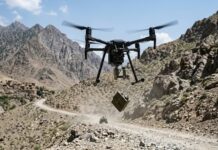
The next session was centred around the induction and integration of new technology in the domain of Helicopters and Unmanned Aerial Systems. This session was moderated by Air Chief Marshal Rakesh Kumar Singh Bhadauria, PVSM, AVSM, VM (Retd.), former Chief of Air Staff of the IAF and an experienced test pilot. The first two addresses were made by officers from the IAF, Air Vice Marshal Ashish Singh, VM, VSM [ACAS Ops (Remote) and Air Vice Marshal Sanjeev Vashishth, VM [ACAS Ops (T&H)], who, in detail, laid out the expectations of the IAF from the manufacturing sector regarding the capabilities of Unmanned Aerial Systems (UAS) and Manned-Unmanned Teaming (MUM-T).
Group Captain Harsh Vardhan Thakur (Retd.), HAL Test Pilot, made a presentation on various UCAV and MUM-T systems that HAL is currently pursuing, and provided an idea of how the Public Sector Undertaking aims to meet the IAF’s expectations. Mr Sameer Joshi and Colonel Aravind Mulimani (Retd.) provided an industry perspective regarding employment of UAS and Counter UAS systems, and how private defence manufacturers would meet the IAF’s requirements. They also reassured that the private sector is adequately prepared to meet any challenges/requirements posed by the armed forces of India.
The final address of the session was by Mr GVS Bhaskar, who provided perspectives on Helicopter MRO (Maintenance, Repair, and Overhaul) and insisted that the User, OEMs, and third-party suppliers must align their goals to foresee MRO requirements beforehand and meet the requirements accordingly.
Maintenance of Legacy Fleets
The final session of the day was chaired by Air Marshal Vikram Singh and covered user and industry perspectives on maintaining the IAF’s legacy fleets, such as the Chetak helicopters and SEPECAT Jaguar fighter aircraft. Representing the IAF’s perspectives were Air Commodore Jino George (Commodore Maintenance Planning) and Air Commodore Ashutosh Shrivastava (Commodore Eng H). This was followed by an address by Air Vice Marshal K Sundaramani on the maintenance of legacy Air Defence systems of the IAF. The industry perspective was provided by Mr S Balasubramani. The discussion covered issues related to the operation of said fleets and how the IAF and Industry Manufacturers could work together to sustain them through streamlined supply chain efforts and maintenance planning.
The closing address for the event was delivered by Air Marshal Anil Chopra, which was followed by B2G Discussions between CAPSS, SIDM and the various attending organisations.
*****