Author: Ms Bantirani Patro, Research Associate, Centre for Aerospace Power and Strategic Studies
Keywords: Drones, TTP, Pakistan, ISKP
Introduction
The age of modern technology has eluded not even the Pakistani Taliban, which is increasingly integrating social media platforms, artificial intelligence (AI), and drones into its operations, with these tools becoming hallmarks of the group’s resurgence following the Afghan Taliban’s seizure of power in August 2021. The 2025 Global Terrorism Index identifies the Tehreek-e-Taliban Pakistan (TTP), formed in 2007, as having emerged as the fastest-growing terrorist group globally.[1] The scale of its revival can arguably be attributed to the TTP’s willingness to adapt to contemporary realities and absorb the concomitant technologies to enhance its tactical efficacy. Remarkably, such developments are occurring at a time when states themselves are exploring not only how emerging technologies can advance their national security objectives, but are also increasingly concerned about the risks posed by their diffusion to violent non-state actors (VNSAs). In light of this, the use of sophisticated techniques such as drones – once exclusively and legitimately regarded as being under the jurisdiction of a ‘state’ – by the TTP and its affiliates warrants closer analysis, specifically as it accords them an aerial presence that mirrors a makeshift air force of their own.
Nascent Adoption of Drones
As opposed to other conflict-prone regions, militant groups in the Afghanistan-Pakistan theatre have been rather slow to adopt new and emerging technologies for operational purposes, owing to three conceivable reasons. First, they have traditionally relied on cost-effective, easily accessible, and highly lethal methods such as Improvised Explosive Devices (IEDs) and suicide bombers. Second, the predominantly rural and open terrain of the Af-Pak region makes drones easier to detect and therefore more vulnerable to being shot down contrary to urban spaces.[2] Third, a dearth of technical know-how, as well as the absence of foreign fighters facilitating the acquisition and use of drone technology, may also have contributed to this trend. This, however, is beginning to change.[3]
This pivot in the TTP’s case can be attributed in large part to its emir, Mufti Noor Wali Mehsud, whose efforts to unify the group’s previously fragmented modus operandi have resulted in more calculated strategies. For instance, the TTP dispensed with the policy of attacking non-combatants, instead focusing on targeted attacks against government personnel, and has abandoned any transnational jihadi agenda in favour of localised operations confined solely to Pakistan. Moreover, the TTP in its present form has expanded its media operations, circulating propaganda in multiple languages to reach diverse ethnic groups within Pakistan, and at times, leveraging AI tools to translate content into regional languages, which is subsequently disseminated across various social media platforms, particularly Telegram.[4] The nascent use of drones, then, is emblematic of the TTP’s trajectory, reflecting its increasing familiarity with, and adaptation to, modern technologies.
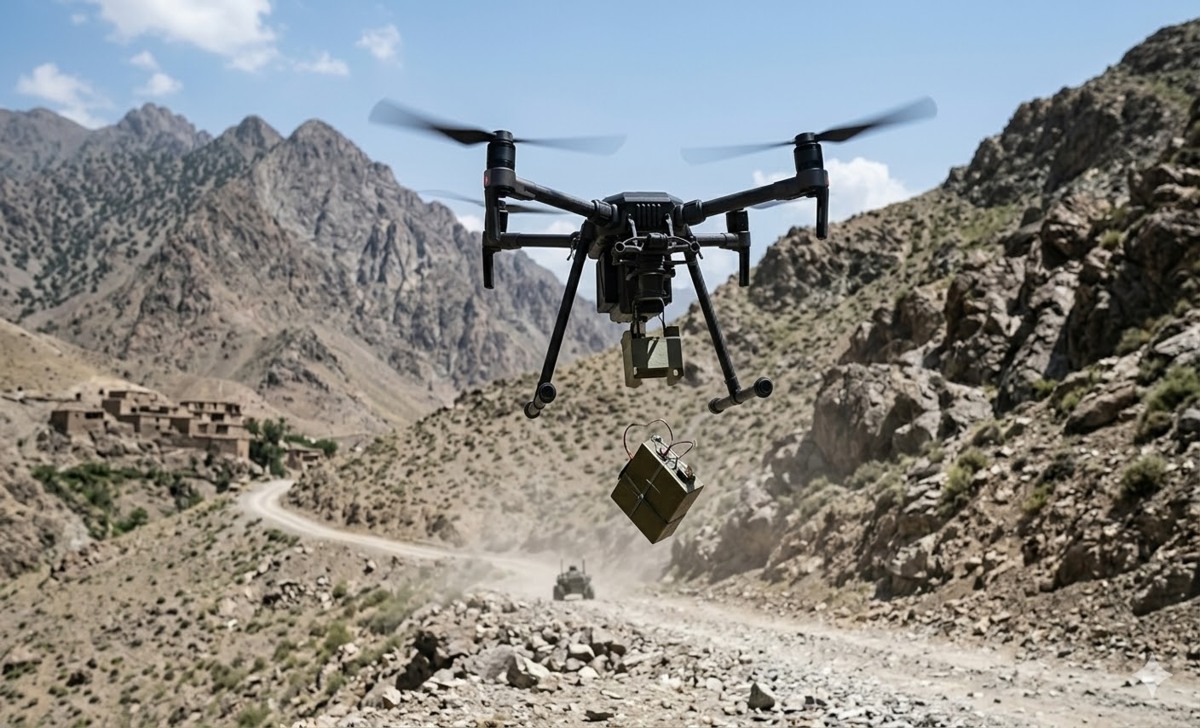
While the TTP had already acquired sophisticated weaponry left behind in Afghanistan by the United States, its use of drones for both attacks against security forces and Intelligence, Surveillance, and Reconnaissance (ISR) highlights its evolving repertoire of tactics. One such drone variant identified is the relatively low-tech, Chinese-manufactured, DJI Matrice.[5] The ready availability of commercial quadcopter drones has enabled not just the TTP, but also its affiliates, such as the Hafiz Gul Bahadur (HGB) Group and Lashkar-e-Islam to deploy them. For instance, the HGB Group was suspected to have used drones six times between July and September 2024, primarily in Khyber Pakhtunkhwa’s North Waziristan district.[6]
In July 2025, Reuters was among the first to report on Islamist militants in Pakistan beginning to use “commercially acquired quadcopter drones to drop bombs on security forces”, citing several incidents in Khyber Pakhtunkhwa’s Bannu district.[7] Indeed, this was corroborated through an investigative report by Pakistan’s leading newspaper, Dawn, in November 2025, which spotlighted the growing use of drones by militants in Bannu. With over 200 attacks involving the use of commercial, low-cost drones since June, one senior police officer quipped that the police now have “one eye on the barrel of the gun and another on the sky”.[8] The report further revealed the kind of munitions fitted in these quadcopters: improvised explosives, mostly GP-25 grenade launchers and small calibre mortar rounds.[9] Some quadcopters are even reported to be equipped with thermal cameras, enabling night-time surveillance and attacks, with militants trying to stay ahead of security forces by frequently changing drone frequencies, so as to evade jamming systems.[10]
Both Militants and the Military Turn to Drones
However worrying, the use of drones by militants has not only given them an edge over the Pakistan military, or at the very least narrowed the gap, but has also introduced new layers of ambiguity for locals. Because the military also uses drones for ISR, locals cannot identify whether drones sighted in the sky belong to the militants or the military.[11] In May 2025, for instance, a suspected quadcopter strike in Mir Ali tehsil of KP’s North Waziristan district killed four children and injured several others, precipitating a weeklong sit-in protest, with thousands of locals, who condemned the strike as a transgression of human rights, demanding transparency and accountability.[12] As no militant group claimed responsibility, aspersions cast on the Pakistani authorities were promptly repudiated by the Inter-Services Public Relations (ISPR), the military’s media wing, which said that the security forces had been “falsely implicated” and that the TTP had carried out the attack.[13] Similar unclaimed drone strikes occurred in 2025, injuring over dozens and prompting Amnesty International to exhort Pakistani authorities to conduct investigations and provide appropriate compensation.[14]
Now that drones have become a part of militants’ arsenal, the Pakistan Army’s own use of unmanned aerial vehicles in counterterrorism operations is likely to become more complicated. For residents of KP’s tribal areas, drones already have a disquiet historical precedence, since they were subjected to deadly American drone strikes during the height of U.S. Global War on Terror and in the years that followed. Resultantly, the political sensitivity surrounding drone strikes has led the Pakistan government to not officially acknowledge the role of drones in its current counterinsurgency toolkit. In June 2025, The New York Times reported precisely on this, with a piercing headline, highlighting a striking irony: the very tactic that Pakistani officials used to censure America for is now being embraced as part of the country’s counterinsurgency strategy.[15]
That said, the government has begun adapting to this developing threat. In some regions, the KP police has successfully used anti-drone guns against the machinations of militants. And this appears to have had an effect insofar as the number of drone attacks and night-time attacks has declined in areas where militants know the police possess counter-drone and night vision technologies.[16] Yet still, the KP police remain over-stretched and under-equipped to deal with the changing nature of militancy. Security analysts have flagged the possibility of more lethal and frequent drone attacks as militants continue to experiment and improve their drone capabilities, and with the fusion of AI into drone technology, these concerns are likely to deepen. In the future, the likelihood of the Pakistani Taliban staging drone swarms cannot be ruled out; this looming threat remains true for many VNSAs,[17] necessitating governments to invest significant capital in counter unmanned aerial systems (C-UAS).
How Drones Could Destabilise the Region
Given that the Af-Pak theatre’s militant landscape is competitive, the Pakistani Taliban’s reliance on drones could drive others like the Islamic State Khorasan Province (ISKP) and Baloch insurgents to incorporate drones into their attacks to prove their credentials. That terrorists and militants have historically sought to emulate one another’s best practices, especially when new methods prove to be effective in terms of both cost and impact, further bolsters this possibility. In this regard, pertinent examples of drone diffusion are instructive: several African states have seized manuals on drone use, indicating knowledge transfer among African non-state armed groups as well as from the Middle East to Africa.[18]
ISKP’s expressed intent in weaponising drones is noteworthy, as evidenced by Islamic State-affiliated channels having circulated manuals, outlining how commercially available drones can be morphed into tools for terrorism.[19] Parallelly, there are preliminary reports of Baloch insurgent groups using drones for ISR, albeit evidence remains, at best, limited; nonetheless, this has raised the spectre of them eventually employing drones for offensive operations.[20] There is a past pattern of tactical adaptation. Baloch militants, once opposed to suicide bombing, have now embraced the tactic, likely drawing inspiration from the TTP, leading analysts to believe that their adoption of drone attacks may be less a question of if than when. Although militant drone warfare in Pakistan remains in its rudimentary stages, its implications could make a dent in the region’s stability. The likes of the TTP, ISKP or Baloch militant organisations are unlikely to deploy drones with the sophistication seen among other VNSAs, such as Hamas, the Houthis and Hezbollah, which benefit from a large degree of state sponsorship. While there is some speculation that the Afghan Taliban or al-Qaeda may be facilitating access to drone technologies for the Pakistani Taliban, such support would doubtfully match the level of assistance that groups like Hezbollah receive from benefactors like Iran.
Nevertheless, this marks a critical juncture in Pakistan’s threat landscape. To guard against spill over effects and avoid the further erosion of trust between locals and the state, the Pakistani government would have to ensure that dual-use technologies like commercial drones are properly regulated, and that the smuggling of drones into Pakistan is reined in. This is especially critical given that drone technologies are progressing more rapidly than CUAS systems. However, Pakistan’s patchy record of implementing basic but critical counterextremism policies calls into question the state’s ability to respond decisively to this emerging, advanced-level threat. How Islamabad manages the spread of militant drone capabilities remains to be seen and will go on to shape the broader trajectory of militant adoption of emerging technologies.
*****
CLICK TO VIEW THE PDF
Notes:-
[1] 2025 Global Terrorism Index, https://www.visionofhumanity.org/maps/global-terrorism-index/#/.
[2] Abdul Basit and Rueben Dass, “Tech and Terror: Why Have Drones Not Penetrated the Afghanistan-Pakistan Militant Landscape?,” Global Network on Extremism and Technology, April 29, 2024, https://gnet-research.org/2024/04/29/tech-and-terror-why-have-drones-not-penetrated-the-afghanistan-pakistan-militant-landscape/. Accessed on February 3, 2026.
[3] Ibid.
[4] Abdul Basit, “Evolution, Expansion and Diversification: Tehreek-e-Taliban Pakistan’s Umar Media,” Global Network on Extremism and Technology, September 15, 2025, https://gnet-research.org/2025/09/15/evolution-expansion-and-diversification-tehreek-e-taliban-pakistans-umar-media/. Accessed on February 3, 2026.
[5] Rueben Dass and Abdul Basit, “Nascent Adoption: Emerging Tech Trends by Terrorists in Afghanistan and Pakistan”, Global Network on Extremism and Technology, June 18, 2025, https://gnet-research.org/2025/06/18/nascent-adoption-emerging-tech-trends-by-terrorists-in-afghanistan-and-pakistan/#. Accessed on February 3, 2026.
[6] Ibid.
[7] Mushtaq Ali and Asif Shahzad, “Pakistani Islamist militants use drones to target security forces, officials say,” Reuters, July 21, 2025, https://www.reuters.com/world/asia-pacific/pakistani-islamist-militants-use-drones-target-security-forces-officials-say-2025-07-21/#:~:text=PESHAWAR%2C%20Pakistan%2C%20July%2021%20%28,development%20in%20the%20volatile%20region. Accessed on February 16, 2026.
[8] Ismail Khan, “‘One eye on the barrel, the other on the sky’: How police in Bannu are dealing with evolving militant tactics,” Dawn, November 26, 2025, https://www.dawn.com/news/1957290. Accessed on January 25, 2026.
[9] Ibid.
[10] Ibid.
[11] Muhammad Amir Rana, “The drone challenge,” Dawn, August 10, 2025, https://www.dawn.com/news/1929884/the-drone-challenge. Accessed on February 17, 2026.
[12] Tahir Khan, “Mir Ali sit-in over alleged drone strike comes to an end as agreement reached,” Dawn, May 27, 2025, https://www.dawn.com/news/1913645. Accessed on February 17, 2026.
[13] Ibid.
[14] “Pakistan: Recurrent drone strikes in Khyber Pakhtunkhwa signal alarming disregard for civilian life,” Amnesty International, June 24, 2025, https://www.amnesty.org/en/latest/news/2025/06/pakistan-recurrent-drone-strikes-in-khyber-pakhtunkhwa-signal-alarming-disregard-for-civilian-life/. Accessed on February 17, 2026.
[15] Zia ur-Rehman, “Quietly, Pakistan Wages a Deadly Drone Campaign Inside Its Own Borders,” The New York Times, June 19, 2025, https://www.nytimes.com/2025/06/19/world/asia/pakistan-drones-militants.html. Accessed on February 13, 2026.
[16] Khan, n. 8.
[17] For more information on how VNSAs may weaponise drones, see: Jake Dullugan et al., “The Rising Threat of Non-State Actor Commercial Drone Use: Emerging Capabilities and Threats,” CTC Sentinel, Volume 18, Issue 3, March 2025, https://ctc.westpoint.edu/the-rising-threat-of-non-state-actor-commercial-drone-use-emerging-capabilities-and-threats/.
[18] Maria-Louise Clausen, “Non-state armed groups in the sky,” Danish Institute for International Studies, https://www.diis.dk/en/research/non-state-armed-groups-in-the-sky. Accessed on January 18, 2026.
[19] Dass and Basit, n. 5.
[20] Abdul Basit and Rueben Dass, “Why Have Baloch Separatists Not Weaponized Drones Yet?,” The Diplomat, November 20, 2025, https://thediplomat.com/2025/11/why-have-baloch-separatists-not-weaponized-drones-yet/. Accessed on January 20, 2026.