Author: Wg Cdr A Pichipoo Raja, Senior Fellow, Centre for Aerospace Power and Strategic Studies
Keywords: Military History, Official History, Indian Armed Forces, Naravane
Introduction
The recent controversy around the unpublished memoir of General MM Naravane (Retd) offers valuable lessons for the military. Looking beyond the controversy, it reveals a larger systemic failure of not letting one’s own public/armed forces know the details of the Indian military operations. The result: despite the publisher’s appeal stating that any circulation in any form is an infringement of copyright, the book’s contents were openly discussed on TV debates. When official versions of important national security events don’t exist, such TV debates are the only source to satisfy people’s curiosity. This article attempts to offer a view on the different aspects of the issue and their relation to military effectiveness.
How Important is Operational History to the Military?
Jim Mattis, the former United States (US) Secretary of Defense, wrote, “We have been fighting on this planet for 5,000 years, and we should take advantage of their experience.” This email went viral. He highlighted a practice of the US Marine Corps wherein, before every combat, they read specific books about the expected combat. He wrote, “Going into Kuwait 12 years ago, I read (and reread) Rommel’s Papers (remember “Kampstaffel”?), Montgomery’s book (“Eyes Officers”…), “Grant Takes Command” (need for commanders to get along, “commanders’ relationships” being more important than “command relationships”), and some others. As a result, the enemy has paid when I had the opportunity to go against them, and I believe that many of my young guys lived because I didn’t waste their lives.” This relationship of reading as a path to saving lives on the battlefield seldom receives the attention it deserves in India.
What Happens When Combatants Don’t Read Military History?
Colonel PK Gautam cites an example during the Kargil War. The Indian Army operations during Kargil in 1999 were named ‘Op Vijay’, even though the Liberation of Goa in 1961 was already named ‘Op Vijay’. This he cites as evidence of a complete lack of knowledge of their own military history amongst the entire planning staff in 1999. Likewise, there are several accounts that claimed that Op Safed Sagar was the first time offensive air power was employed at high altitudes, forgetting entirely the First Indo-Pak War of 1947-48, especially the employment of aircraft at Zoji la and Skardu.
Today, even if one wants to read the Indian Military’s operational history, can they get an accurate account?
Where are the Indian Operational Histories?
The last official history of any Indian military operation that has been published is that of the 1971 war. Government policy on the issue mentions that the operational history is to be declassified as early as possible and not later than 25 years from the date of compilation. Yet, the official history of Indian military operations such as Op Falcon (1986), Op Cactus (1988), Op Meghdoot (1984), Op Pawan (1987), Op Vijay (Kargil 1999), Op Khukri (2000) etc., hasn’t been published. Since 1971, several governments have been in power. Thus, it is neither a recent phenomenon nor linked to any particular government. It is a wider structural issue.
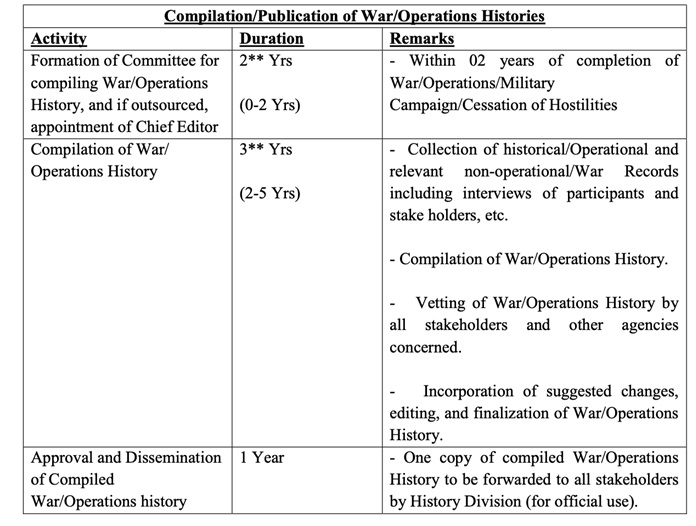
Timeline For Publication of Operations Histories