

Author: Group Captain VP Naik VM, Senior Fellow, Centre for Aerospace Power and Strategic Studies
Keywords: Strategic Coherence, OODA Loop, Op Sindoor, Higher Defence Organisation, Modern Warfighting
Introduction
Reforms in the Higher Defence Organisation (HDO) of India have been an ongoing process for many years, yet nothing substantial has come its way. In 2019, after many years of procrastination, the Department of Military Affairs (DMA) under the Ministry of Defence (MoD) was established, and a post of Chief of Defence Staff (CDS) was sanctioned. The CDS was to serve as the single-point adviser to the Government of India (GoI) on all military matters. While revolutionary, these reforms have not quite reaped the benefits that should have accrued with such path-breaking changes. Both these steps are welcome measures and are in the right direction; however, India’s Higher Defence Organisation (HDO) continues to run in independent silos without any significant cross-domain interaction. These reforms have not brought about any meaningful measures to enhance integration of the armed forces; civil-military relations have not quite improved, and jointness in war fighting has still not materialised. These inadequacies have arisen primarily due to ambiguity in the laid-down charter, leading to structural paralysis.
The Allocation of Business (AoB) Rules of MoD spell out the charter for both the Department of Defence (DoD), headed by the Defence Secretary and the DMA, headed by the CDS. A closer look at the charter reveals several interesting observations. The first rule in the DoD charter is, “Defence of India and every part thereof including defence policy and preparation for defence and all such acts as may be conducive in times of war to its prosecution and after its termination to effective demobilisation.”[1] The DoD is responsible for the entire gamut of military operations, starting from mobilisation, to the conduct of operations, followed by demobilisation. The DoD is also responsible for all matters concerning defence policy, preparation for defence, Research and Development (R&D), and all capital procurement. The moot question that arises is, “Why was the DMA created when everything pertaining to India’s defence was to be handled by DoD?” The Allocation of Business Rules pertaining to DMA appears to be more like ‘Terms of Reference’ for a ‘Board of Officers’ rather than articulating responsibilities for the defence of the nation.[2] One cannot help but think that the DMA was created in haste, without giving much thought to the actual charter and how the DMA (as part of MoD) should have been the department entrusted with the defence of India and all substantial matters pertaining to operations. Further scrutiny of the AoB rules also brings out the fact that the setting up of Theatre Commands, in quick time, appeared to be one of the main aims and mandates of DMA.
The aim of this paper is to elucidate the problem statement, examine India’s defence priorities and recommend a possible HDO structure to plan and fight future wars.
Harnessing Artificial Intelligence: What is Wrong with the Way the Indian Armed Forces Fight?
There are many papers and scholarly articles on jointmanship, the need for integrated application of combat power, Multi-domain Operations (MDO), a ‘whole of nation’ approach towards national security and transformation of the Indian Armed Forces. Having gone through a substantial number of such writings, when dealing with the modernisation of the Indian Armed Forces (IAF), it was felt that Artificial Intelligence (AI) should also have a say to identify problem areas, bring out key criticisms of the Indian Armed Forces’ approach to combat and find out what was wrong with the way the Indian Armed Forces fought? Two independent questions were posed to AI chatbots, Grok and ChatGPT. The question presented to Grok was ‘Identify key criticisms of the Indian Armed Forces’ approach to combat’ and ChatGPT was asked ‘What is wrong with the way the Indian Armed Forces fight?’ The AI-generated responses (bulleted) have been collated below to provide additional inputs when arriving at the all-important ‘problem statement’.
Grok processed the inputs and brought out the following problem areas, drawing on expert assessment and historical analyses: –
(a) Outdated and Rigid Doctrine Skewed Towards Large-Scale Conventional Offensives.
(i) Emphasis on massive, autonomous ground formations for deep incursions and territorial gains to impose post-war leverage.
(ii) Orthodox approach, ill-suited for modern wars.
(iii) Calls for support by other arms if and when considered necessary.
(iv) Unwieldy and large formations attempting high-speed manoeuvre warfare in obstacle-ridden terrain.
(v) Tactics prioritising mass mobilisation and firepower over precision and agility, leaving the forces vulnerable.
(b) Chronic Lack of Jointness and Inter-Service Coordination.
(i) Services operating in silos due to historical rivalries and a lack of a unified command structure at the apex level.
(ii) Disjointed responses highlighted during recent conflicts like Balakot operations, Galwan clash, Doklam imbroglio and Eastern Ladakh contingency.
(iii) Lack of a common Command, Control, Communication, Computers, Intelligence, Surveillance and Reconnaissance (C4ISR) grid encompassing both the HDO set-up as well as the fighting forces.
(iv) Resort to static infantry heavy defences against drones, Precision Guided Munitions (PGMs) and hybrid threats.
(v) Political micro-management and bureaucratic inertia risking irrelevance against agile forces.
(c) Intelligence and Surveillance Failures.
(i) Repeated lapses in human and electronic intelligence, allowing surprise incursions like Kargil and Galwan.
(ii) Without adequate early warning and battlefield transparency, troops end up fighting reactively rather than adopting a pro-active strategy.
(d) Equipment Shortages, Outdated Arsenal and Procurement Inefficiencies.
(i) A bloated manpower focus starves modernisation, resulting in reduced ammunition stockpiles, obsolete equipment and platforms and chronic delays in induction of modern equipment.
(ii) Forces compensate for quality by quantity, leading to high attrition tactics being adopted, which is unsuitable for modern conflicts. The Navy and Air Force severely lag in capability and technological upgrades.
(e) Limited High-Intensity Combat Experience and Training Gaps.
(i) No major wars since 1971, experience skewed towards Counter Insurgency (COIN) operations.
(ii) Doctrinal Mismatch and emphasis on defensive holding over fluid manoeuvres.
(iii) Fostering a ‘promotion over performance’ culture, making the organisation resistant to innovation.
ChatGPT looked at it from another angle by analysing how the Indian Armed Forces fought wars (operational art, doctrines and command structures) vis-à-vis how they were prepared to fight (institutional structures, procurement mechanisms and integration of the three services) to arrive at a candid assessment often echoed by military thinkers, veterans and strategic scholars: –
(a) Fragmented Warfighting and Lack of Jointness.
(i) Siloed planning and conduct of operations by the three services leading to fragmented warfighting.
(ii) Joint targeting and ISR integration are severely lacking.
(b) Doctrine-Technology Gap.
(i) Reactive doctrines, especially for land warfare, leading to large-scale attrition.
(ii) Limited infusion and exploitation of technology in the actual conduct of operations.
(iii) Very little focus on enabling technology.
(c) Centralised Decision Making and Lack of Flexibility.
(i) Culture of close control by senior leadership resulting in a lack of latitude for junior commanders.
(ii) Minimal decision-making at the junior leadership level affecting flexibility in the tactical environment.
(iii) Both close control and lack of latitude to junior leadership resulting in slower tempo, reduced initiative, and difficulty in adapting to fluid battlefield dynamics, especially in hybrid or grey-zone scenarios.
(d) Overemphasis on Manpower, Underemphasis on Capability.
(i) Land Power-centric mindset rendering naval and air assets as support providers rather than independent sources of firepower.
(ii) Neglect of air and naval modernisation is crucial for strategic deterrence and power projection.
(e) Bureaucratic and Procurement Bottlenecks.
(i) Civil-Military divide in MoD, with service headquarters having limited autonomy in procurement and planning.
(ii) Delayed modernisation and capability enhancement.
(iii) Lack of accountability of the Defence Public Sector Undertakings (DPSUs) leading to lethargic indigenisation, delayed R&D, deferred manufacturing and wastage of precious funds.
(f) Weak Integration of Strategy, Policy and Operations.
(i) No clarity on ‘Theory of Victory’. No articulation of how military means achieve political ends. This leads to wars being fought for limited tactical gains without strategic clarity.
(ii) Civil-Military disconnect wherein political leadership does not involve military leadership for advice on integrated national security frameworks combining diplomacy, economy and defence.
(g) Training and Simulation Deficits.
(i) Limited realism in training with more emphasis on drills rather than realistic combat simulation and joint exercises in multi-domain warfare environments.
(ii) Very few large-scale tri-services war games simulating high-intensity combat against a peer adversary in a multi-domain setting.
(h) Adaptation to the Changing Character of War.
(i) Slow in the information domain: China’s concept of intelligentised warfare, combining AI, cyber, EW, and space, has no equivalent Indian concept.
(ii) India’s response to low-intensity conflicts is reactive rather than pro-active or pre-emptive.
(iii) Severe shortage of ‘informatisation’ within the armed forces, especially the Army, affecting flexibility at the tactical level.
(iv) Lack of technological expertise for hybrid and grey zone situations.
(j) Limited Learning Culture.
(i) Indian armed forces have a weak after-action analysis ethos. There is a lack of an open culture of institutional introspection and bringing out doctrinal lessons.
(ii) Western militaries conduct extensive after-action reviews and bring out strategic, operational and tactical lessons. The Indian system tends to keep failures under wraps by giving high security classifications, thereby preventing effective scrutiny and analysis.
ChatGPT further added that the ‘Indian armed forces do not fight badly, they fight bravely, but neither jointly, efficiently or strategically. Their character of fighting is professional but their system of fighting is structurally inefficient. The challenge therefore is not courage or competence; it is integration and innovation with strategic clarity.’
Key Takeaways
Artificial Intelligence has provided certain inputs that resonate with inputs from scholarly articles, newspaper reports and academic discourse in various seminars and for national defence. Certain significant issues and associated inferences from them are being collated below for ease of comprehension: –
(a) Outdated and rigid doctrines skewed towards large-scale conventional action.
(i) Strategy prioritising mass mobilisation and conventional war fighting.
(ii) More stress on individual service capability and less on integration.
(iii) Infantry heavy defences are ineffective against drones, PGMs and swarms.
(iv) Fragmented war fighting.
(b) Chronic lack of integration and operations in silos.
(i) Inter-service rivalries.
(ii) Lack of unified command and control structures.
(c) Repeated failures of intelligence and surveillance, creating large gaps in battlefield awareness.
(d) High attrition tactics focusing on mass rather than a healthy mix of technology and mass.
(e) Limited combat experience in modern conventional operations. Significant focus on Counter Insurgency (CI) and Counter Terrorism (CT) operations.
(f) Equipment shortages, outdated arsenal and procurement inefficiencies.
(g) Weak integration of strategy, policy and operations with a focus on limited tactical gains without strategic coherence.
(i) Very high bureaucratic inertia.
(ii) A missing whole-of-nation approach to war fighting.
(h) Reactive strategy primarily responding to situations rather than preempting/anticipating developments due to limited battlefield transparency and situational awareness.
(j) Over-emphasis on manpower and under-emphasis on capability.
(k) More stress on ownership of assets and less stress on collective war-fighting capability.
(l) Doctrine-technology gap. The vision exists, but capability development lags far behind.
(m) Lack of common communication protocols further promoting operations in silos.
(n) Limited learning culture with very little after-action review.
The points listed above are just a few pointers and by no means exhaustive; however, they do bring out certain inadequacies and deficiencies that need to be addressed. These issues, though deliberated in various defence forums, do not gain the necessary traction at the apex level and thus remain unaddressed. Capability development plans lack the required budgetary support, and in India’s quest for self-reliance, many times, existing capability gaps go unnoticed and ignored.
Continental and Maritime Powers
Before discussing the problem statement, it would be interesting to understand where the dominant threat to India would emerge from. Between the end of the Civil War in the USA and the Spanish-American War of 1898, the American economy quietly chugged along with high annual growth rates.[4] Consequently, as America traded more with the outside world, it developed, for the first time, complex economic and strategic interests in far-flung places that led to, among military actions, Navy and Marine landings in South America and the Pacific.[iv] Another factor that allowed America to focus outwards was its consolidation and stabilisation of internal issues. As a result, the USA embarked on the development of a large Navy along with a Marine Force to project power far away from its shores. Over the next century, the USA became a dominant maritime power, able to traverse the world’s oceans and dominate from the seas. An interesting supposition is that the continental USA faced no external threats for over two centuries, allowing the USA to develop its Navy and exercise military might all across the world. Post World War II and during the Cold War, Russia emerged as a threat to American hegemony and also posed an existential threat to the continental USA through long-range bombers and ballistic missiles. After the disintegration of the USSR, the USA again became the sole super-power and continued its forays across the world, especially in West Asia and Western Pacific regions, including the South China Sea. The US Navy became stronger with the advent of supercarriers and nuclear submarines. American strategic interests continue to lie far from its own shores, physically isolating the country from any threat, Black Swan events like 9/11 being more of an exception rather than a norm. Therefore, it would be appropriate to tag the USA as a dominant maritime power with global aspirations.
China, on the other hand, has primarily been a Continental Power with regional aspirations. Having consolidated its land borders (barring a few), it has now begun to focus outwards. The People’s Liberation Army (PLA) is the largest standing Army in the world, while the PLA Navy (PLAN) and the PLA Air Force (PLAAF) are still slowly expanding their strength and capability. Having dominated the region on land, what drives China beyond its official borders is its core national interest, economic survival and growth.[5] China has also begun expanding its presence across the world in search of oil, minerals and proximity to Sea Lanes of Communication (SLOCs) to safeguard its energy needs. China is also blessed with an extensive coastline and is the largest littoral nation on the Western Pacific Coast. The East and South China Seas are China’s backyard and the USA’s playground. Herein lies the contest where we can see Chinese land power pitted against American sea power, with Taiwan and the Korean Peninsula as the main focal points.[6] Therefore, we see Chinese strategies such as Anti-Access and Area Denial (A2AD) being played out to safeguard continental China and also prevent incursions by the USA into the First Island Chain. For decades, China was preoccupied with land, where America, particularly since its misadventure in Vietnam, has no appetite to go. America, even today, has no such appetite in Asia, especially after its ordeals in Iraq and Afghanistan.[7] China is in the early stages of transforming from a predominantly continental power to an aspiring maritime power, and that is the biggest change occurring in the Asia-Pacific region.
From the preceding paragraphs, it is clear that the USA is a dominant Maritime Power with global aspirations, and China remains a dominant Continental Power with maritime ambitions. Where does that leave India? Is India a continental power or a maritime power? Such questions are better answered after seeing how geography plays a significant role in determining India’s priorities.
The Stopping Power of Water and India’s Options
John J. Mearsheimer, in his book The Tragedy of Great Power Politics, speaks of the stopping power of water and how it serves as an effective barrier. He further adds that, “When great powers are separated by large bodies of water, they usually do not have much offensive capability against each other, regardless of the relative size of their armies. Large bodies of water are formidable obstacles that pose significant power projection problems for attacking armies. For example, the stopping power of water helps to explain why the United States has never been invaded by another great power. It also explains why the USA has never tried to conquer territory in Europe or North East Asia. Great powers located on the same land mass are in a much better position to attack and conquer each other. That is especially true of states that share a common border. Therefore, great powers separated by water are likely to fear each other less than great powers that can get at each other over land.”[8] One may say that the Britishers and other colonial forces came from the seas and occupied India; true as it is, the fact that India in those times was not united but rather fragmented under various rulers and kingdoms, making it vulnerable to external influence and subjugation. Today’s India is a far cry from that, unified and centrally controlled.
What emerges is an interesting fact that Indian policymakers may wish to dwell on further. The geography of India is such that the Arabian Sea, Indian Ocean and the Bay of Bengal give India the inherent safety provided by the stopping power of water and also give valuable access to some of the most important SLOCs in the world. The seas and oceans not only provide dividends and bounty but also protect the Indian subcontinent from external aggression. However, juxtaposing what Mearsheimer said, the larger threat emerges from the continental borders to India’s west and north. Traditionally, India has been a continental power and has developed capabilities and capacities to safeguard itself against land-based external aggression. Therefore, the predominant threat to India continues to be from Pakistan and China in the continental battlespace. China’s growing naval power is primarily aimed at countering the USA in the South China Sea and at safeguarding its maritime trade and energy supplies. Similarly, while it needs to maintain strong and capable forces to thwart threats emanating from the land borders, it must also develop a credible naval capability to be able to project military power from the maritime domain to affect the battle on land significantly. As an adjunct to this theory, India must develop both the Andaman and Nicobar Islands and the Lakshadweep and Minicoy Islands to serve as credible military outposts and first lines of defence against any threat emanating from the maritime domain. However, it is important to note that the main threat to Indian sovereignty will continue to be from the continental domain, and the armed forces of India need to be prepared, equipped and trained for fighting in this domain as a primary front. Growth and capability enhancement of the Navy must continue, but definitely not at the cost of the land and air forces.
The Problem Statement
There are multiple issues that need to be addressed when it comes to the Indian Armed Forces and their fighting methods. Op Sindoor has provided India with an opportunity to introspect and arrive at tangible solutions. There is a lot of banter going on about how many aircraft India shot down and how many Pakistan shot down. Modern warfare is not just about targeting individual aircraft, tanks and ships; it is about crippling the war machinery of the adversary, which in today’s parlance amounts to targeting and destroying C2 nodes and communication centres to achieve information and decision dominance. One must be able to affect the adversary’s Observe, Orient, Decide and Act (OODA) loop to gain the upper hand. Unlike yesteryears, in a highly connected and networked battlespace, decision-making takes place further and further away from the actual battle. The inherent safety that distance from the battlefield provided earlier is no longer available today. Modern weapons permit precision targeting from large distances, and leadership can be threatened from the word go. The aim is to destroy the enemy’s will and ability to fight. It is the ability to cripple the enemy’s war-waging potential that will prove to be decisive, and aircraft, tanks and ships are the means to get to the ends, not an end by themselves. Without going into the bean count, suffices to say, Pakistan was forced to stop kinetic action in just four days because India managed to target important communication nodes and affect their C2 capability. Additionally, targeting runways like Sargodha and Chaklala and destroying early warning radars sent a clear message to the Pakistan leadership of possible repercussions, directly affecting their will to fight. Some key takeaways from Op Sindoor are as follows: –
(a) A whole-of-nation approach to war fighting is essential. The entire weight of Comprehensive National Power (CNP) must be brought to bear on an adversary for decisive victory.
(b) Centralised planning, distributed control and decentralised execution.
(c) Need for a joint planning establishment at the apex level.
(d) Need for integrated application of combat power, without worrying about ownership of assets.
(e) Importance of networking air defence assets for ensuring a comprehensive and coherent response.
(f) Future wars may not necessarily be long drawn out like what is being seen between Russia and Ukraine. They could also be very short, swift and intense, giving very little time for conventional response mechanisms to activate. Wars could be over well before the completion of mobilisation by conventional land forces.
(g) Primary threat to Indian sovereignty will continue to be continental, and therefore India needs to be prepared for the same.
(h) Air Power as an instrument of choice proved to be decisive. India cannot afford to let its air power capability diminish. While indigenous programmes need impetus and support, the war-waging capability of the country cannot be held to ransom for want of indigenous products. It is not about acquiring 42 squadrons or three aircraft carriers. It is about retaining an edge over India’s adversaries because, as of now, with respect to Pakistan, that gap is rapidly reducing.
(j) Modern technologies like AI, drones, Counter Unmanned Aerial Systems (CUAS), and smart Air Defence philosophy need to be invested in to retain effectiveness.
(k) Modern combat is all about systems and ‘system of systems’. Networking and ‘informatisation’ are key enablers and must become a priority for all planners. Akashteer of the Army, Trigun of the Navy and the Integrated Air Command and Control System (IACCS) of the Air Force need to have a handshake at appropriate levels to ensure decision dominance.
(l) Importance of operational logistics, robust and secure supply chains cannot be over-emphasised.
(m) Hybrid wars and multi-domain operations (MDO) are the way forward, and capability development plans must factor these requirements.
(n) Large unwieldy force structures need to be replaced with agile, networked and adaptive force structures. There is a need to remove silos and create structures more suitable for fighting in multiple domains.
(o) Information warfare and the battle of narratives are as important as kinetic action and must be embedded as part of the overall strategy.
(p) One must develop technology and weapons to target an adversary’s critical infrastructure while simultaneously ensuring the protection of one’s own critical infrastructure.
(q) The adversary will not always respond in the way it has previously done. There will never be any precedence to template own plans. This calls for agile forces, effective ISR, swift decision making and most importantly, a changed mindset.
(r) The importance of long-range, precision stand-off weapons cannot be ignored. The ability to hit the enemy well inside his territory with precision can win wars.
(s) While the West may have done away with concepts like Effects-Based Operations (EBO) and Centre of Gravity (CoG) targeting, in the Indian context, their relevance will always remain.
(t) To be able to deliver decisive firepower in a short time is the rasion-de-etre of contemporary forces. See first and see the farthest; reach first and reach the fastest; hit first and hit the hardest will continue to be the ‘mantra’ of success.
Op Sindoor showed that the Indian Armed Forces have the capability to demonstrate tactical brilliance and arrive at strategic coherence. This was not the case in previous wars and conflicts, where tactical brilliance often outshone strategic coherence. For once, India demonstrated a whole-of-nation approach to war fighting, and it worked! Silos were forgotten, planning was undertaken jointly, and the three Service Chiefs were given a clear mandate with adequate freedom to prosecute the war. Clarity in the political aim and a well-articulated Conflict Termination Criteria (CTC) made things easier for the armed forces. In a nutshell, the problem is not joint fighting; it is joint planning. If joint planning is done meticulously, the Indian armed forces have the capability and wherewithal to prosecute modern wars.
Another problem that emerges is the ‘informatisation’ of the armed forces. In modern wars, adequate ‘informatisation’ at the tactical and operational level is a pre-requisite. The air and ground situation in modern wars is very fluid, and there will be situations when tactical and operational commanders will have to undertake time-sensitive targeting to gain immediate advantage and waiting for a decision from higher headquarters may be too late. Therefore, there is a need to create specialised, agile, adaptive and all-arms forces to deliver when and where it counts. The Indian borders continue to be hostile and hot. Post Op Sindoor, India has drawn its red lines, which, if crossed or transgressed, would lead to punitive action by India. Therefore, India does not have the luxury of going through the long-drawn process of force restructuring while still retaining the capability to respond to threats and win wars. In such a situation, force reconfiguration becomes a viable option.[9]
The problem statement, therefore, needs to take into account the need for joint planning at the apex level, a whole-of-nation approach to war fighting, force reconfiguration rather than restructuring and most importantly, integrated application of combat power.[10] Interestingly, none of these issues classically requires the setting up of Theatre Commands.
Having examined inputs from AI, considering the nuances of geography and blending them with political constraints and looking at the likely threats to Indian sovereignty, a suggested problem statement is as follows. “In the future, the Indian Armed Forces will be faced with high-intensity, hybrid and multi-domain threats in the region. There is a need to operationalise an Indian Concept of War Fighting, which fuses sound doctrine with dynamic leadership, joint planning with decentralised execution, modern technology with capability-driven acquisition programmes, mission-specific operational logistics with robust and redundant supply chains and adaptive C2 with a changed mindset to prosecute and win future wars.”
Recommended Structures at the Apex Level
Success in combat largely depends on sound leadership, adaptive decision-making and effective C2. In the Indian context, most problems have emanated not at the tactical or operational level but at the apex level. As Clausewitz famously said, war is a continuation of politics by other means; therefore, in order to align military strategy with national objectives, the armed forces must be part of the national decision-making process. Strategic guidance cannot be over-emphasised, and therefore, there is a need for the creation of joint apex structures in India’s Higher Defence Organisation (HDO) to bring about tactical and operational coherence. For force reconfiguration, it would be prudent to have a ‘top-down’ approach rather than a ‘bottom-up’ approach. India’s service-specific planning structures are a relic of the industrial age. In the information age, unity of effort, speed and interoperability will determine success or failure.
At the apex level, under the MoD, a new vertical, the Joint Forces Headquarters (JFHQ), is needed for joint planning. For a ‘whole-of-nation’ approach to warfighting, all essential functionaries of relevant ministries and organisations must have representatives in the JFHQ. To ensure the JFHQ is sufficiently armed, it is proposed that representatives from various ministries and organisations be at the level of Additional Secretaries (AS), with essential staff placed under them. It is important to create a fresh mandate for DoD, DMA and the proposed JFHQ, clearly allocating responsibilities, roles and tasks without ambiguity. While the DoD would continue to operate under the Defence Minister, the DMA and the JFHQ are recommended to be placed under the COSC to have coherence between RTS functions and war fighting.
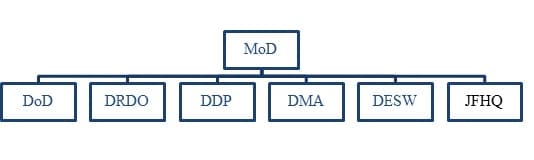
Figure 1.
For a ‘whole-of-nation’ approach, there is a need for the CDS and three Service Chiefs to be a permanent part of the Cabinet Committee on Security (CCS) and not on an invitational basis. The CDS and the Chiefs of Staff Committee (COSC) must continue to remain the single point of advice on defence matters to the Defence Minister. For Comprehensive National Power (CNP) to be exercised, representatives from all elements must form a part of CCS.
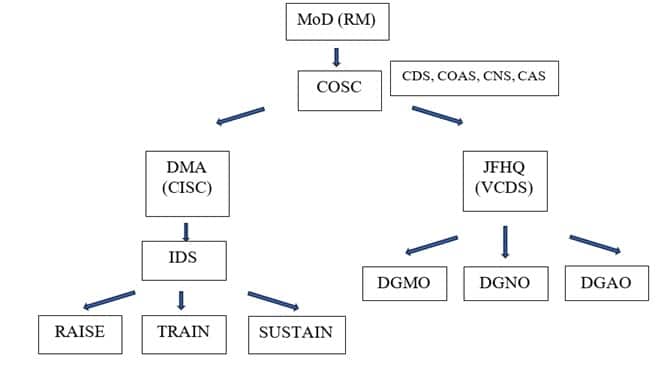
Figure 2.
It is recommended that the COSC have two verticals placed under it. The first would be the Department of Military Affairs (DMA), recommended to be headed by the Chief of Integrated Defence Staff and Secretary to the Chiefs of Staff Committee (CISC). It is recommended that the present system of dual-hatting by the CDS as Chairman COSC and Secretary DMA be discontinued to ensure equivalence in protocol with other Secretaries in various ministries. Integrated Defence Staff (IDS) would continue to be placed under the CISC. The current role of IDS includes managing policy, doctrine and procurement, facilitating joint training with special focus on modernising defence by integrating emerging technologies which would further be divided into three verticals, namely Raise. Train and Sustain (RTS). As Secretary to COSC, the CISC would have the essential know-how on all operational plans and contingencies, based on which tri-service functions of RTS would be undertaken.
The other vertical under COSC is proposed to be the Joint Forces Headquarters (JFHQ) for apex-level planning of operations. The existing dichotomy of responsibility for war fighting must be addressed on priority. The DoD’s mandate for warfighting must be withdrawn and handed over to the COSC and the JFHQ. [11] The JFHQ must have representatives from all elements concerned with military operations, including those from relevant ministries and organisations involved in national security. It would be prudent to have representation from the National Critical Information Infrastructure Protection Centre (NCIIPC), the National Disaster Management Authority (NDMA) and the Indian Space Research Organisation (ISRO) as part of the JFHQ for the conduct of hybrid and multi-domain operations.
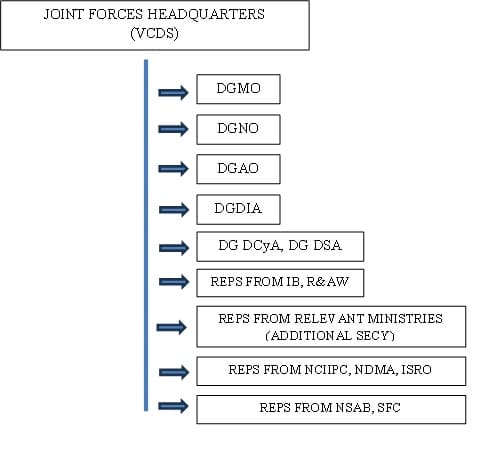
Figure 3.
The Indian Army has seven regional Commands; the Navy has three, and the Air Force has seven. A total of 17 Commands, spread across the entire country, handle various contingencies and safeguard the territorial integrity of India. Joint planning organisations will need to be created not only at the apex level but also at the level of Command HQs. For effective C2, it is proposed that India be divided into two threat zones/fronts, i.e., Western Front (threat from Pakistan) and Northern Front (threat from China) and be named Joint Forces Command (West) and Joint Forces Command (North), respectively. It is also proposed that for retaining unity of command, a Regional JFHQ be created in each of the two threat zones [JFHQ(W) and JFHQ(N)], headed by a three-star officer. Below the Regional JFHQs, two options are possible: either merge all relevant regional commands or let the regional commands remain. The main aim is to synergise operations at the combatant command level to ensure strategic and operational coherence.
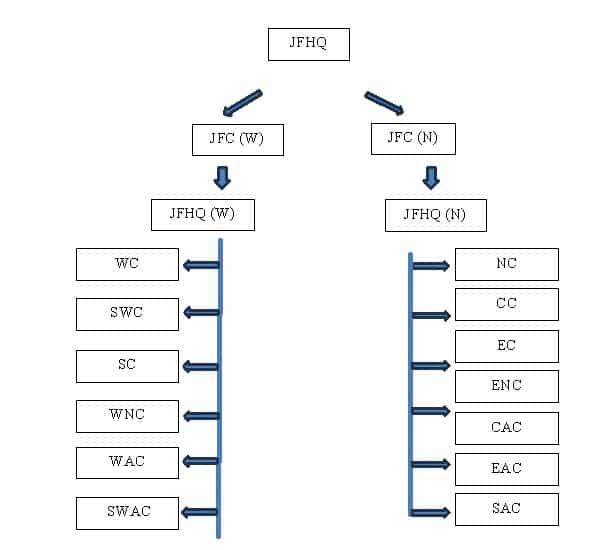
Figure 4.
In both the regional JFHQs, there is a need for representation from all elements involved in MDO, including the cyber and space domains. The focus of the regional JFHQ would primarily be warfighting. The process of modernisation of the armed forces is a slow and long-drawn process, and it may not be practically possible to make all elements of the armed forces fully ‘intelligentised and informatised’. Therefore, it is essential to create specialised battle groups which are fully modernised and trained for MDO. The Indian Army has been in the process of creating Integrated Battle Groups (IBGs) for some time now. Rather than a service-specific battle group, it is recommended to create Joint Task Forces (JTFs) on the lines of the IBGs, consisting of all arms and services, to ensure effective application of combat power. The JTFs created could be specialised battle groups equipped and trained for specific tasks and roles. They could be either terrain-specific or role-specific. But it is essential that they are highly ‘informatised’ and consist of all three services (wherever applicable). The main task of JTFs would be to synergistically undertake multi-domain operations in an ‘intelligentised and informatised’ environment and act as force multipliers, augmenting the rest of the conventional forces.
The Training Commands of the three services [Army Training Command (ARTRAC) of the Army, Southern Naval Command (SNC) of the Navy and Training Command (TC) of the IAF] are recommended to be placed under HQ IDS as part of the RTS effort and ensure joint training for the armed forces, optimising resources and training effort. The role of the Maintenance Command of the IAF could be merged with the role of the Air Officer-in-charge Maintenance (AOM) branch at the level of the Air HQ, with parallel representation at the regional JFHQs.
Parting Shots
The Indian Armed Forces have demonstrated brilliant tactical acumen in every war India has fought since independence. As first responders, the armed forces of India have also distinguished themselves during Humanitarian Assistance and Disaster Relief (HADR) operations within India and around the world. Their professional acumen, patriotism, perseverance and courage are, without doubt, of a very high order, and the armed forces are looked up to by all Indians. However, tactical and operational brilliance must be backed up by strategic coherence, and this is where gaping voids have emerged. From Kargil to Galwan and from Uri to Balakot, there have been instances of intelligence failures, a lack of understanding of operational philosophies of other services, and inter-service turf wars that have affected the conduct of operations. This paper has adopted a blended approach by amalgamating various scholarly articles with AI inputs to arrive at a problem statement to address key issues that impact the effective employment of the armed forces.
The geo-political situation in India is quite different from what we can see across the world, and therefore, lessons from current conflicts cannot be directly implemented in the Indian context. Force reconfiguration or restructuring cannot be templated from other countries, nor can reforms be directly replicated. Concepts and ideas from across the world must be studied in detail, but what is essential is that India develops a nuanced, well-thought-out Indian Concept of War Fighting. The absence of a suitable joint planning mechanism at the apex level has emerged as a major lacuna in the Indian context and must be addressed as a priority. Op Sindoor has given a glimpse of what India is capable of when an optimal process for the employment of CNP is undertaken. Clarity of political objective, well laid down rules of engagement, operational freedom and clear conflict termination criteria make employment of the armed forces more coherent and in-sync with the political aim. The starting point for this to happen is the setting up of an apex joint planning organisation comprising all elements of CNP. Other issues like service-specific silos, procurement inadequacies, civil-military divide, lack of clear political directions and most importantly, integrated application of combat power will all fall into place.
Another major issue identified in this paper is the limited learning culture prevailing in India. India must develop an open culture of institutional introspection by conducting extensive after-action reviews. These reviews must be conveyed to all concerned to ensure mistakes made earlier are not repeated, and gaps/voids are suitably plugged. There is a great deal of talk about reducing the strength of the armed forces, primarily focused on being able to cut down on the revenue budget. In the Indian context, it must be understood that mass has its own inherent advantages. Against both Pakistan and China, mass has a very important role to play, and the same needs to be respected. Even in the Russia-Ukraine war, along with modern technology, mass has played a crucial role. While technology offers tremendous advantages, it cannot completely replace mass, and attempts to do so may jeopardise both offensive as well as defensive capabilities. India must endeavour to balance quality with quantity to arrive at optimal force structures without compromising either.
The way India’s Armed Forces fight is a product of history, institutional customs and traditions, and a strategic culture deeply rooted in India’s colonial past. There is a need to take a leaf out of our pre-colonial past to revive India’s original strategic culture and thinking. India has always prioritised territorial defence over developing an ability to project power, which has resulted in outdated structures, organisations and doctrines. India needs to shed these inadequacies and transition from attrition warfare to warfare that is agile, multi-domain, adaptive and most importantly, joint, so that military potential can be converted into decisive strategic outcomes.
*****
CLICK TO VIEW THE PDF
Notes:
[1] Ministry of Defence, Government of India, “Allocation of Business Rules,” https://mod.gov.in/sites/default/files/DODall141220.pdf. Accessed on November 12, 2025.
(2) Ministry of Defence, Government of India, “Allocation of Business Rules,” https://mod.gov.in/sites/default/files/DMAall141220.pdf. Accessed on November 12, 2025.
[3] Robert D. Kaplan, The Revenge of Geography (Gurugram: 2013 Random House Publication), pp. 198-199.
[4] Ibid., p. 198.
[5] Ibid., p. 199.
[6] Ibid., pp. 213-214.
[7] Ibid., p. 214.
[8] John J. Mearsheimer, The Tragedy of Great Power Politics (New York: 2003, Norton Paperback), p 44.
[9] V P Naik, “Air Power Musings: Theatre Commands- To be or not to be?,” Defence and Diplomacy Journal, Vol 14, No. 2, 2025 (January to March), pp. 77-86, https://capssindia.org/wp-content/uploads/2025/09/7-VP-Naik.pdf. Accessed on November 13, 2025.
[10] Ibid., pp. 81-82.
[11] Ministry of Defence, n. 1.
(Disclaimer: The views and opinions expressed in this article are those of the author and do not necessarily reflect the position of the Centre for Aerospace Power and Strategic Studies [CAPSS])
| This article is a continuation of the series of papers on theatre commands published earlier. Air Power Musings: Theatre Commands – To Be or Not to Be (published in CAPSS Journal, Defence and Diplomacy, https://capssindia.org/wp-content/uploads/2025/09/7-VP-Naik.pdf) and Air Power Musings: Theatre Commands Redux (Published on CAPSS website, In Focus, https://capssindia.org/air-power-musings-theatre-commands-redux/) brought out certain issues that need to be addressed before embarking on key reforms directed at war fighting. |






of India have been an ongoing process for many years,yet nothing substantial has come its way.)