Author: Wing Commander A Pichipoo Raja, Senior Fellow, Centre for Aerospace Power and Strategic Studies
Keywords: Theatre Commands, Force Reconfiguration, Warfighting, Joint War Fighting
Introduction
Operation Sindoor was the first significant armed conflict after the establishment of the Department of Military Affairs (DMA) and the appointment of the Chief of Defence Staff (CDS) in August 2019. Since the establishment of CDS, there has been a consistent focus on jointness and shedding of single-service interests. Thus, over time, it has become almost sacrilegious to speak of individual service interests. Jointness is now the accepted convention. While the actions of the Indian Air Force (IAF) during Op Sindoor resulted in spectacular outcomes, many of which were caught on camera, there have been no attempts by the IAF to boast about their achievements. Likewise, considering the damage observed on the Indian border villages inflicted by Pakistan, it would be safe to assume that the Indian Army’s response would have been far more devastating on Pakistan. Similarly, no attempts were made to showcase them either. The tri-service press briefs have been well-coordinated and included the actions of the Navy, which were out of public sight. Another key aspect is the visible synergistic action of the Ministries of External Affairs (MEA) and Defence (MoD). In 2019, the initial press brief, following the Balakot strikes, was delivered by the Foreign Secretary with no MoD representation. Whereas in Op Sindoor, both MEA and MoD representatives participated in all press briefings. Thus, this operation could be studied in future as a textbook case of synergy in national security.
The concept of ‘theaterisation’ has been popularised as a solution to a perceived lack of jointness in the Indian Armed Forces. Various authors have proposed several models. However, in the absence of theatre commands, what explains the synergy during Op Sindoor? I attempt an explanation.
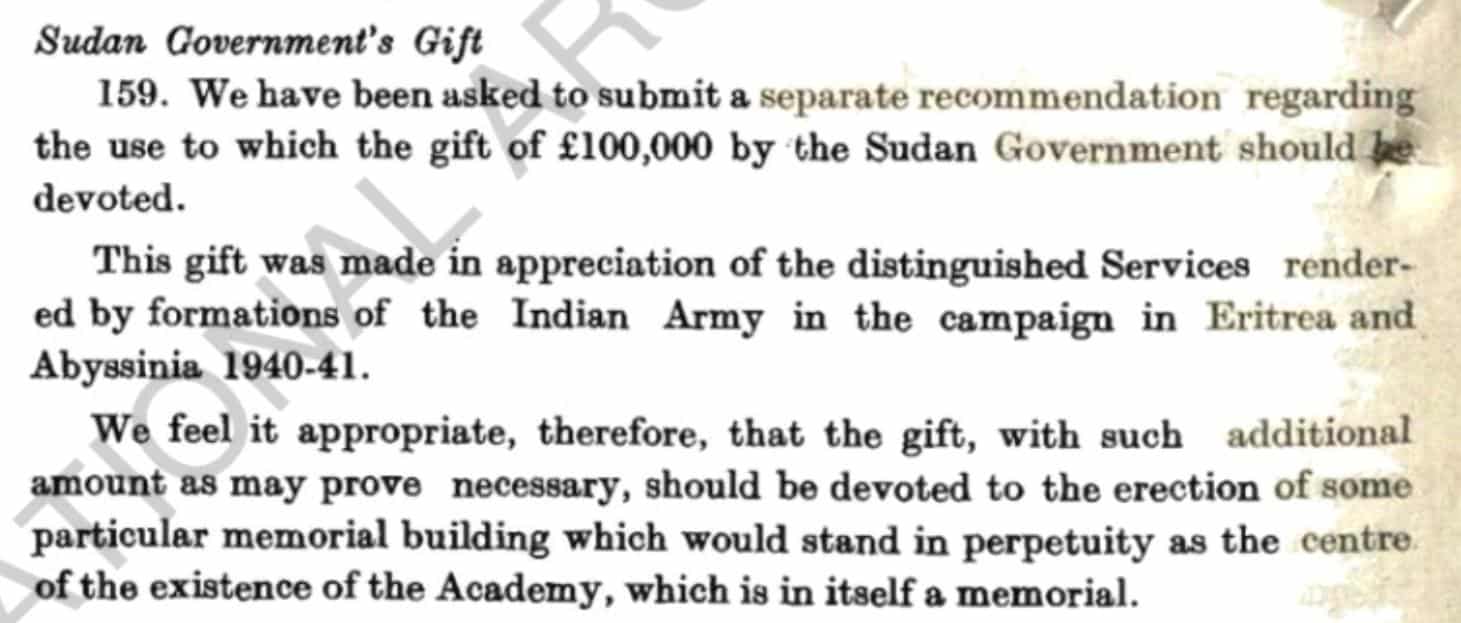
The results for this synergy can be traced back to 1944, when the original seeds of jointness were planted in India. The Government of Sudan, recognising the valour and sacrifice of Indians in the Second World War in the defence of Sudan, gifted an amount of £ 1,00,000 for the construction of an Indian national war memorial. The Indian National War Memorial Committee of Council was constituted.
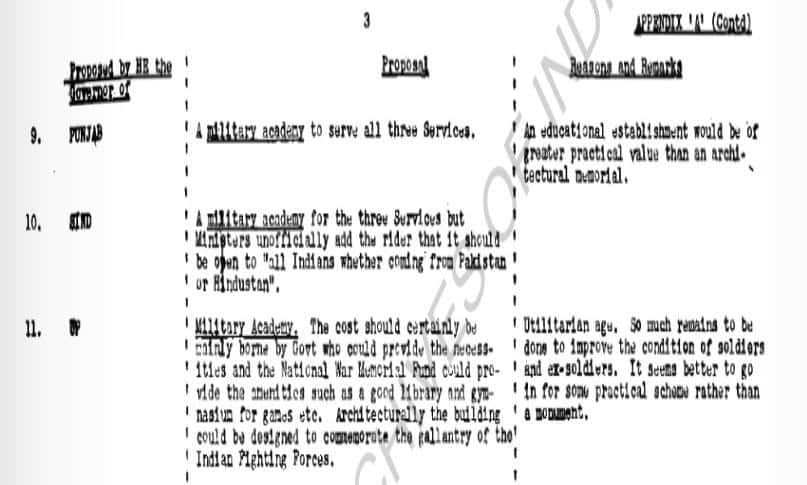
This committee, after a thorough debate, recommended the construction of a tri-services military academy as the most suitable form of a war memorial.
Following this decision, another subcommittee was formed to study and make recommendations for the Indian Military Academy. The Subcommittee thus recommended the creation of what is now known as the National Defence Academy (NDA) with the iconic Sudan Block as its central structure.
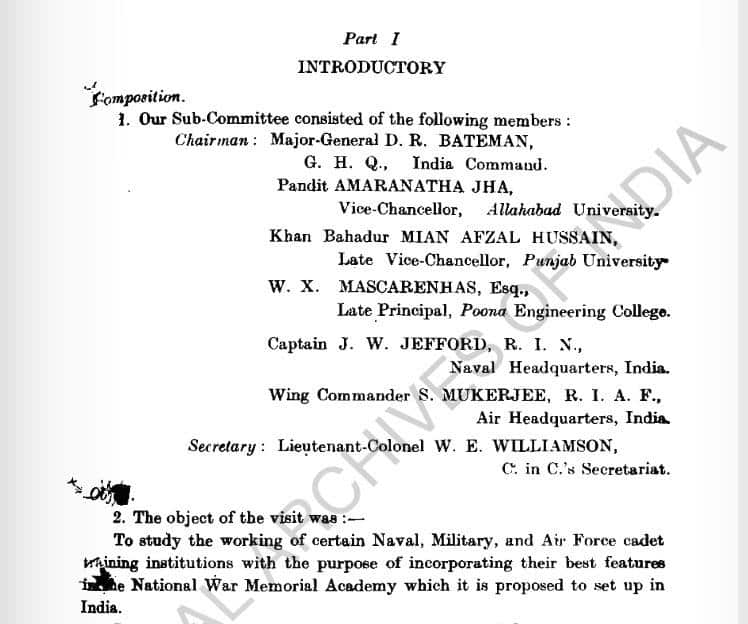
The Subcommittee included Vice-Chancellors from universities, the principal of a school, and members of all three services, including then-Wing Commander Subroto Mukerjee, who later became the Air Chief. They toured eleven military academies across the United States (US), the United Kingdom (UK), and Canada, studying in detail the training, syllabus, moral code of conduct, general orientation, and other aspects
Indian Armed Forces officers, fresh from the experience of the Second World War, understood the significance of integration. None of the countries across the world then had a joint military academy. Thus, their proposal for a joint academy was novel.
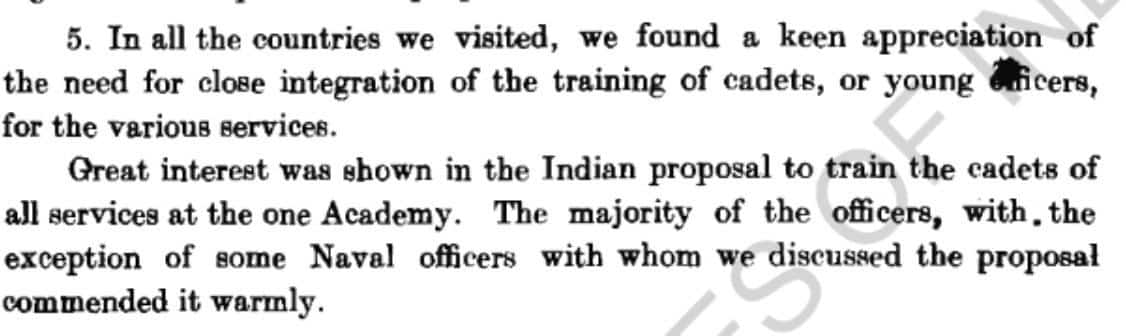
In terms of integration, considerable thought and discussion went into the design of the training. To date, NDA follows this model of common training for all three services in the first two years, followed by the introduction of service-specific training in the third year.
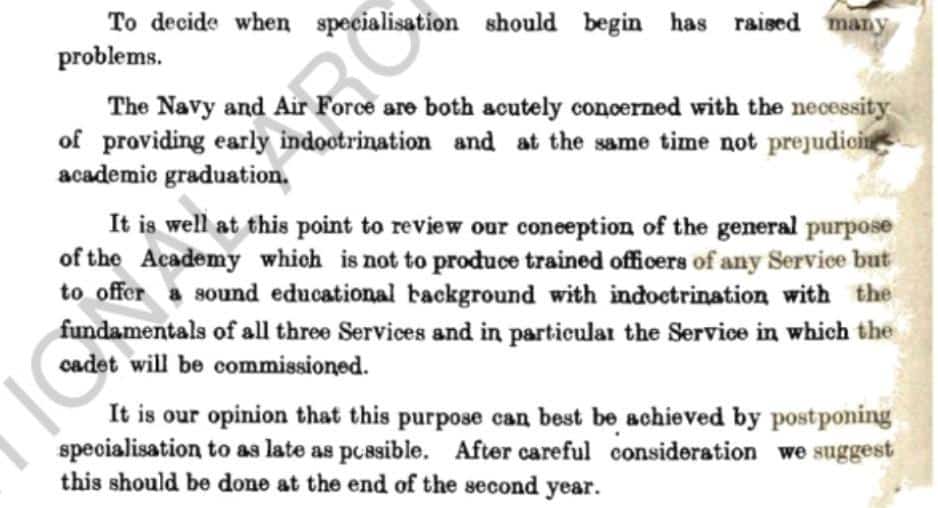
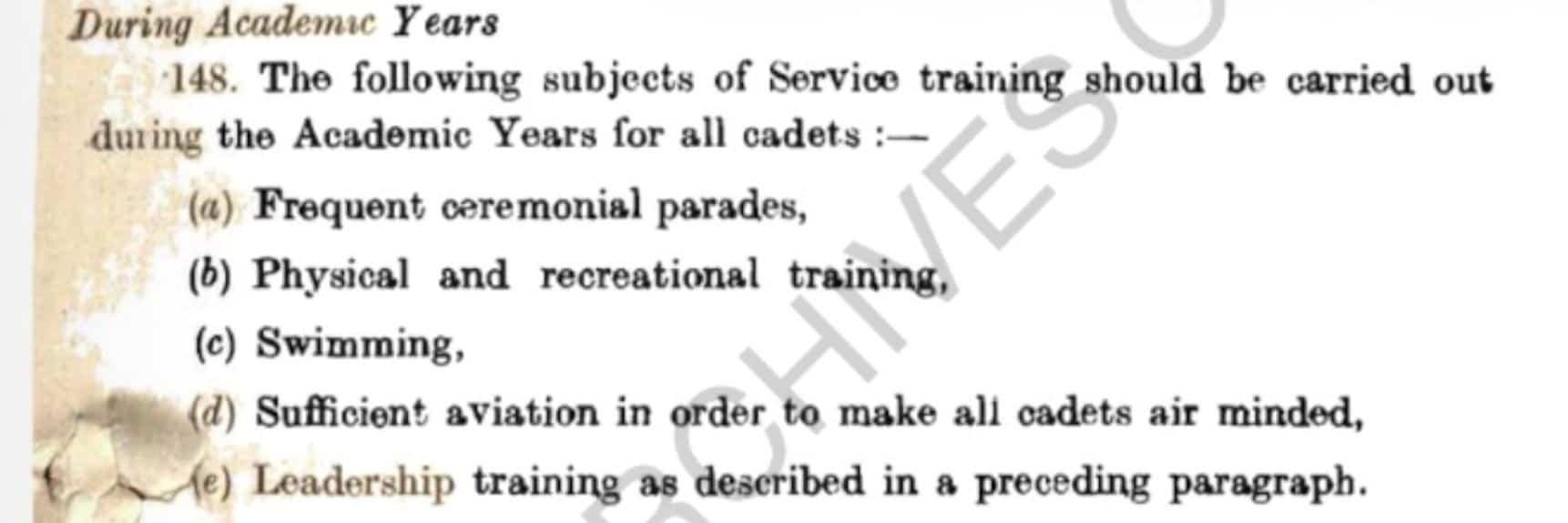
The training was also designed to foster a deeper appreciation of each other’s perspectives. All cadets were supposed to have sufficient exposure to aviation to make them ‘air-minded’. A lack of air-mindedness is often cited as the key cause by proponents of air power when issues of jointness are argued. Unfortunately, paragraph 148(d) is no longer part of the NDA training. It is perhaps worth revisiting this recommendation from 1945. The formation of the National Defence Academy (NDA) laid the groundwork for jointness among the Indian Armed Forces (the first seed of jointness).
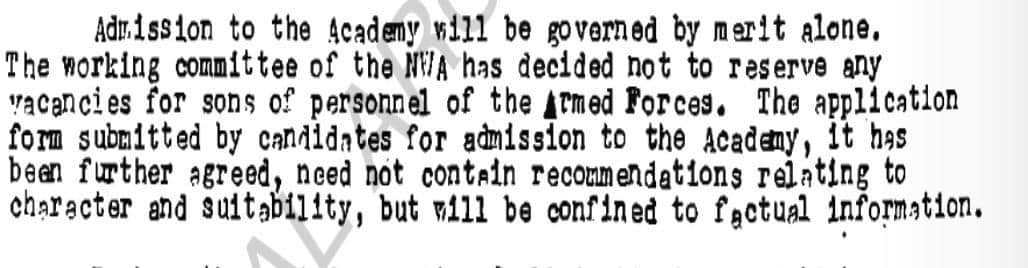
Admission into NDA was to be purely based on merit and devoid of any form of reservation, including that for the wards of ex-servicemen.
This gave rise to a new problem: How could independent India generate a pool of suitable candidates to meet the annual requirement of an intake of 700 officer cadets from across the country’s diverse locations and varying income statuses when the educational setup in India was inferior? This led to the creation of Feeder institutes. Thus, the second seed for jointness — the feeder institutes was planted. These institutes offer joint military training right from class six onwards. The students go on to occupy leadership positions across various fields beyond the military as well.
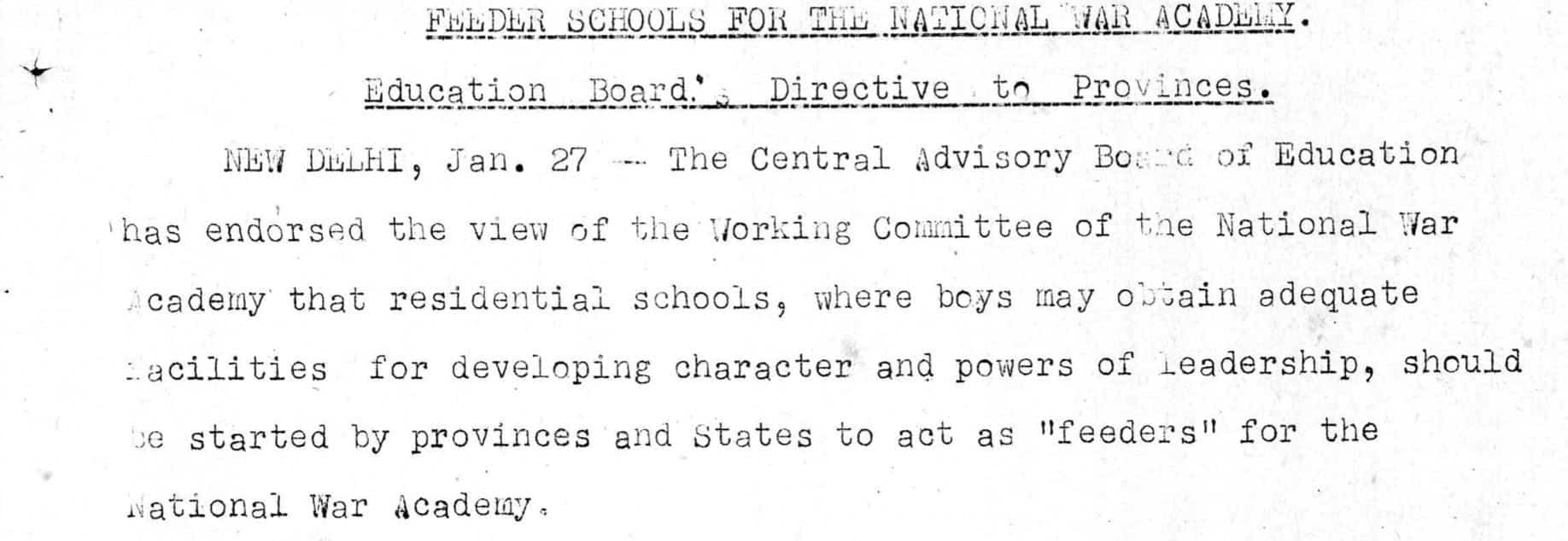
Returning to the key question of this article, what explains the synergy during Op Sindoor? The answer lies in the bonhomie between the service chiefs. Army and Navy chiefs are classmates from Sainik School Rewa, and the Air Chief and the Army Chief are course mates from NDA.[2] These are lifelong relationships with the equivalent of a family-level bond characterised by depth and strength. People go to great lengths for each other. Both feeder institutes (schools) and NDA are Indian investments in jointness, even before independence and were pathbreaking in the world at the time of their inception. To put it differently, India has been a pioneer of jointness in the world. Therefore, if any shortcomings in jointness are perceived, it would be prudent to examine the training, staffing and culture at NDA and similar institutes as the source. Deviations from the core founding principles of any institution are possible as it evolves over time.
Finally, Colin Gray wrote, “Joint, which is to say multi-service, doctrine should express a judicious melding of beliefs among culturally distinct institutions, but often it comprises more of a brute force stapling together of unlike elements than a coherent whole. So-called joint military plans and performance similarly can have the character of a shotgun marriage than of anything resembling harmony.”[3] Neglecting one’s own history and pursuing solutions from foreign models can lead to a stapled model of jointness or a ‘shotgun marriage’. It is worthwhile to revisit the history of jointness in India, in depth, to avoid such a situation.
*****
CLICK TO VIEW THE PDF
Notes
[1] Press Information Bureau, Government of India, “Feeder Schools for the National War Academy,” January 27, 1947, https://archive.pib.gov.in/archive/ArchiveSecondPhase/DEFENCE/1947-JULY-DEC-MIN-OF-DEFENCE/PDF/DEF-1947-01-27_030.pdf . Accessed on September 24, 2025.
[2] “Two Coursemates, Two Classmates, Will Now Head Three Armed Force Services,” The Economic Times, September 21, 2024,https://economictimes.indiatimes.com/news/defence/two-coursemates-two-classmates-will-now-head-three-armed-force-services/articleshow/113552033.cms. Accessed on September 24, 2025.
[3] Colin S. Gray, The Strategy Bridge: Theory for Practice(Oxford: Oxford University Press, 2010) p. 77.