

Author: Mr Arjun Prakash Iyer and Mr Shwetabh Singh, Research Scholars, Unni Kartha Chair of Excellence
Keywords: Ejection, MiG-23MF, MiG-29, Radar, Aircrafts, IAF, Operation, Lazur-M, RSBN
“People did not understand the value of that airplane’s generation jump even when it was there with us… We were blind enough during the tenure of that aircraft to not learn from it”
– Wg Cdr BB Misra (Retd), VSM
The 1980s ushered the Indian Air Force into a whirlwind of modernization, leaping almost two generations of combat capability with the induction of six new fighter types, namely the Jaguar (1979), the variable geometry MiG 23BN and MiG 23MF (1981-82), the much celebrated, first truly-multirole Mirage 2000 (1985), the more advanced iteration of the MiG-23BN, the MiG 27ML (1985-86) and finally the then state-of-the-art air defence interceptor, the MiG-29 (1987). During this rapid transition from the Second Generation fighter aircraft to Fourth Generation, of all the aircraft types procured, the MiG-23MF was born and left service in a largely ‘silent’ fashion.
Acquired in 1982 as a direct counter to the Pakistan’s F-16s, the Soviet-built swing-wing interceptor arrived with ground-breaking systems — variable-geometry wings, a high-powered Beyond Visible Range (BVR) missile with Track While Scanning (TWS) radar, and blistering speed. But its story in India diverged sharply from its global prominence. Limited to just 40 airframes, perhaps the smallest procurement of all the fighter types, the MiG-23MF operated in the starkest contrasts: defending the rarified Himalayan skies to patrolling the Thar Desert’s scorching expanse, and even towing banners over Gujarat’s coast.
Designed as a dedicated air-defence interceptor, it was thrust into other roles during its service. Overshadowed by the multirole Mirage-2000 and the agile MiG-29, the MiG-23MF quietly quit service, its legacy eclipsed by peers but etched in the IAF’s gritty adaptation to varied roles with diligence and innovation. It embodied an era of rapid, uneven modernization and capability jumps — a brief, uncelebrated chapter in India’s aerial deterrence saga.
How would it have felt to have flown this aircraft? To answer these questions, researchers Arjun Prakash Iyer and Shwetabh Singh reached out to Wing Commander Biswa Bihari Misra, a qualified experimental test pilot and a stalwart on the MiG-23MF.
About the Interviewee
Wing Commander Biswa Bihari Misra (Retd), was commissioned into the Indian Air Force in 1978 into the fighter stream (122 Pilots’ Course). He flew the HAL HJT-16 Kiran, Hawker Hunters, MiG-21 Bis and the MiG-23MF, before completing the Test Pilot’s Course. He made immense contributions towards the LCA (Light Combat Aircraft) Programme as well as test flying modifications/upgrades across various platforms, such as the Mirage 2000.
A vastly misunderstood aircraft
“From an historical perspective, from an archival perspective and, from an enthusiastic perspective, people did not understand the value of that aircraft even when it was there with us (the Indian Air Force). It is comparable to having a child that is growing up, and being blind to the good (qualities) of the child… not seeing what good things he can do, to make the family life better, to make his life better, to make more money, to make more name and fame, whatever it is. The same was the case with this aircraft. We were blind during the tenure of that aircraft of its strengths and to learn from them … The point I am making is: irrespective of how my baby is, I must make an effort to understand him/her, to learn from the baby, to nurture the baby and to extract the maximum from the baby”
Could you give us an example to elucidate how ‘less-understood’ was the aircraft?
“I’m a systems’ man. So basically anything which is systems-oriented excites me and I try poking into it. I try to use it more than it is designed for. So most of the radar and electronics queries and training roles, exposure of senior officers who came to our base, telling them about the aircraft, giving them an in-flight exposure invariably used to be nominated to me.”
Wing Commander Misra was awarded with the Vishisht Seva Medal (VSM) in 1993 for being actively involved in the retrieval and rehabilitation of a very sophisticated computerised equipment called Electro-Optical Tracking and Computing system (EOTAC). This vital equipment is utilised for trajectory analysis of aircraft and weapons. Restoring the EOTAC to a usable state was a multi-disciplinary task and lack of manufacturer’s support had made it even more difficult, considering that it was a domain that was not originally a part of his domain expertise of flying. He undertook the task and successfully found indigenous components to rectify the snags, thereby making the EOTAC equipment serviceable and available for his real task of integrating a high value weapon on a high value platform. His innovation and expertise saved several crores of rupees in foreign exchange, during a period when India was recovering from a terrible financial crisis.[1]
“I happened to go to Pune for an assignment. Pune was the base for the MiG-29s. (No. 28 Squadron ‘First Supersonics’) So when I went there I happened to meet my coursemate who was a pilot in the squadron [1993-94]. And when I landed up in the squadron, he was prompt enough to say, “Hey Mish (his nickname), can you talk to the squadron about the radar”? I said, “What? MiG-29’s radar?, I don’t know. I have never flown your aircraft”. “No, no, we understand that it’s similar to the Sapfir on MiG-23MF, but they have questions of why some things are there, why some things are not there, why some things are happening”, he responded, and I said, “Okay, fine. Can you give me the Pilot Notes? I’ll quickly glance through”.
“Pilot’s Notes” is a British terminology for the Flight Manual. “Flight Manual” is an official document provided by the aircraft manufacturer containing detailed operating procedures and limitations specific to that aircraft model, considered essential for safe flight operation. The Russian Manuals were usually broken down into “Pilots’ Operating Instructions” and “Combat Employment Manual”.
“So he gave me the pilot notes, which was about one fourth of that of the MiG-23 MF’s pilot notes. Typically a pilot’s notes and manual is about more than an inch thick, and hardbound. What they showed me was a sort of Rexine bound booklet, looking much smaller, something as thick as a novel. I asked, “Are you sure this is the flight manual”? He responded, “Yes, this is the flight manual”. I said, “It’s a MiG-29. You have more electronics than the MiG-23MF”. “No, no, this is what it is”, he responded. And the moment I opened it, I realized that nothing much had been written into it. They had written about very fundamental information on display symbologies, on how the radar operated. Very fundamental. I mean, if you didn’t know them, you wouldn’t be able to use the equipment to their fullest potential. Also certainly very rudimentary features which they had not been told about, which were already a part of the MiG-23MF. It took two and a half years. Two and a half years for me to make a chance visit to a MiG 29 station and tell them and familiarise them with the systems. What I’m trying to imply here is that most Soviet aircraft have very similar equipment. Of course there would be certain differences, however if there is one issue that happens on one of these equipment, the knowledge should be disseminated enough that if that issue repeats in the other type, their pilots and crew should not be left without knowledge. That is how I find the MiG-23MF to be ‘less-understood’ by the rest of the fleet.”
Could you explain what unique capabilities did the MiG-23MF provide the IAF with?
“Well, the ability to fire a BVR (Beyond Visual Range) missile is one of its integral weapons capabilities. It had the ‘look-up’ and ‘look-down’ modes which we had never seen before in the IAF. It also had a ‘look-left’ and ‘look-right’ capability, which allowed the whole scan of the radar to be slewed left or right. It had something which was a good introduction to ‘track-while-scan’ capability, which aerial radars never had before in the IAF at least. Another innovative piece of equipment was the TP-23 IRST (Infrared Search and Tracking). We perhaps were the first country in this region of the world to have an IRST. This was perhaps the first aircraft which influenced AD tactics significantly”.
The TP-23 refers to the IRST (Infrared Search and Tracking) subsystem on the MiG-23MF. The need for an IRST came about with the Soviet philosophy to include a backup search-and-track capability in the event that their Cold War enemy decided to use Electronic Warfare (EW) to jam radar and communications.[2] Tactics dictated that during a Ground Controlled Intercept (CGI), the IRST could be used for two purposes: to continue a ‘Quasi-Scan’ whilst following GCI commands, and also to lock onto the target with the thermal/Infrared Homing R-23T missile.[3]
It is also interesting to note that all Soviet built aircraft had an in-built Identification Friend or Foe (IFF), which aimed to reduce the margin of errors during interception. The IFF allows the interceptor to determine whether another aircraft is a ‘Friend’ or a ‘Foe’, without requiring to visually inspect it. This is how an IFF works:
(a) All Soviet aircrafts, both civilian and military, had an in-built IFF transponder. However, the latter class of aircraft also have a transmitter that could ping a particular code. Considering that only Soviet aircraft were fitted with a standardised IFF, there was a specific code that the transponder on that target aircraft could ping.
(b) During an interception, all the interceptor had to do was to fly to a certain distance from the target, from where the on-board radar could detect the target. Once within range, the pilot would ‘ping’ the target using his IFF. If the target was on the same frequency and responded with a code that it is a ‘Friend’, based on the orders, the interceptor would either escort it away or call off the intercept.
(c) However, if the target did not respond to the ping, then it was determined that the target was an enemy and its flight path would be terminated.[4]
Speaking about the radar itself, could you tell us how the radar worked aboard this aircraft?
“First let’s understand how a radar works. When you perform a ‘scan’, The dish tilts, performing the scan ‘line by line’ (starting from one of the top corners, moving horizontally towards the opposite corner, then a tad bit vertically, following which it horizontally moves towards the other side, gradually covering from top to bottom). In this case, it’s a four line scan, meaning the radar dish travels four lines from top-bottom, left-right to complete a single scan. However, I can also tilt this scan. So, I can horizontally rotate the radar dish so that I can focus my scan towards one particular direction. Now it also scans in range. It has X-axis,Y-axis and range. Ok. That is how it knows where the target is. X, Y and Z axis, which correspond to azimuth, elevation and range. These parameters will determine a point in space for you. Once you detect and lock on to it, the typical radar will now point only at that aircraft. And keep getting range.”
The MiG-23MF’s Sapfir-D-III (RP-23) radar was a Soviet-era pulse-doppler system that introduced the Indian Air Force to track-while-scan (TWS) capability. TWS allows a radar to simultaneously track multiple targets (e.g., enemy aircraft) while continuing to scan the surrounding airspace for new threats—unlike older “Single Target Track” radars that got fixated on one target, blinding the pilot to others. The Sapfir’s TWS mode worked by sweeping its radar beam across a predefined sector, updating the positions of detected targets on the pilot’s display while maintaining their tracks[5]. This lets the pilots monitor several contacts at once, prioritize threats, and engage with Beyond Visual Range (BVR) missiles like the R-23R. However, the Sapfir’s TWS was rudimentary by modern standards: it could only track a handful of targets and lacked advanced automation, requiring pilots to manually designate which contacts to engage[6]. Despite its limitations, this system marked a leap in situational awareness for the IAF, enabling multi-target intercepts that older MiG-21s could not perform.
Did the MiG-23MF have ‘Track While Scanning’ capability? If so, how would that work?
“Once you detect an aircraft and you lock on to that aircraft, the typical radar will now point only at that aircraft. And keep calculating the range. So on a rudimentary setup, the radar would stop scanning at this point, and only focus on the targeted aircraft alone. To best explain, let’s take the example of a flashlight. Imagine that you are standing in a dark room and I hand you a flashlight and ask you to search for Person X in that room. You would start looking around with the flashlight beam, until the beam falls on that person, right? Now that is what is a scan: your flash beam looking around for a person, and when you find that person, you focus your beam on that person, and that’s what is ‘tracking’. However, if your beam is focused on Person X, but there’s also Person Y standing on the other side of the room, you won’t be able to see him, because your beam is focused only on Person X, right? This is the problem with continuous tracking. I will see my target well but I will not see anything else. In that case, I’ll have to turn my beam towards Person Y to see him. However, with the MiG-23 MF’s radar, you could keep your eye on the target as well as its surroundings to see if any other contacts were also there in the surroundings. Like how they say ‘track ten targets and engage two of them’ (as an example). So when you say so, it means that I can do the tracking of ten targets and I can engage two targets, which means I can simultaneously fire two missiles on two targets and I can still continue scanning everywhere. This aircraft was the IAF’s first introduction to track while scanning. It had a very rudimentary track while in scan mode, but it had that mode”.
Circling back to your previous point regarding AD Tactics, could you elaborate on how did the MiG-23MF influence them in the IAF? Did the IAF utilise the Lasur-M Ground Control Intercept (GCI) system?
“RSBN (referring to a Soviet origin short range radio-based navigation system on board MiG 23MF, RSBN 6S) and PRMG (which is the ILS component of the RSBN) and combined together had everything in that. We had things in the aircraft we never used because we didn’t even know that we had purchased them in the first place! It was part of the RSBN- PRMG There were two points in the history of the MiG-23MF where we tried them. The first one was when the aircraft came with Russian trained pilots. Initially. First couple of months. So when that lot came, they had got exposure to these equipment, bits and pieces of this equipment in Russia. When they came here, they played with it for a little while. However, it was soon realised that we had to set these beacons somewhere, set up power supply for them, calibrate them, then train crews to maintain them and guard them. Then it was decided that we would not be able to use them because of resource constraints. The other time we even thought of using this was when there was a need for us to perform (tensions with Pakistan in the mid-late 1980s). We flew high endurance missions over the Northern borders of our country, and many times, we had to come down with bare minimum fuel for a landing. Adampur was prone to bad weather during winters, so even the approaches to the runway were made difficult, notwithstanding the added bird activity and the increased risk of bird strikes. That was the other time when we used these systems, however, a vast portion of them had since witnessed degraded performance due to weathering and lack of maintenance. Some of us used to ask for the PRMG approach just for fun, once in a while, to try something unique and test our skill.
The Lasur-M was capable of guiding the pilot without any radio communications whatsoever, using display symbology on the HUD (Heads Up Display) and a combination of lights inside the cockpit. The GCI (Ground Control Intercept) could also manipulate a few controls remotely, however it was mostly a guidance system without any voice radio communications. All the instruments had one extra needle on the bezel. So the GCI would remotely instruct the pilot by moving the second handle to the desired position and then the pilot had to match the same parameter. In terms of manoeuvring, there were lights and symbols that popped up, say ‘Turn Right/Left’ was indicated by a right/left arrow and so on.”
The Lazur-M (or Lasur-M) was a Soviet secure data link system designed for Ground Control Intercept (GCI) coordination. It enabled ground controllers to transmit encrypted steering instructions (e.g., turn directives, altitude and velocity adjustments) directly to the MiG-23MF’s cockpit instruments, minimizing voice communication or Radio Transmissions and the interceptor aircraft’s radar usage during intercepts. This aligned with the USSR’s centralized air defence doctrine, where ground operators—not pilots—dictated intercept paths via pre-planned routes. Lazur-M automated this process: ground radar data was relayed to the pilot’s HUD/HSI as directional cues, enabling radar-silent guidance until final target acquisition with the aircraft’s RP-23 Sapfir radar. Conversely, the aircraft’s onboard systems could relay essential flight parameters, such as fuel availability and range from the target, back to the GCI Station so that it can be used for further decision making.[7] [8]
RSBN-6S used ground-based UHF beacons could be used to provide azimuth/distance navigation for route following and non-combat approaches (e.g., returning to base). Pilots manually tuned beacon channels to update position data on the HSI. PRMG functioned as an ILS-like system, aligning the aircraft with runway centerlines via localizer/glide slope radio beams during instrument approaches (which was useful during making approaches during bad weather or night-time)[9][10][11].
While contemporary NATO doctrine emphasized pilot autonomy, the Soviet air defence doctrine emphasised on a very regimented approach, wherein the key decisions of interception were carried out not by the pilot, but in-fact the ground controller. Systems like Lazur-M were critical to this philosophy, but exporting them without the USSR’s infrastructure (as India experienced) rendered them half-functional. Furthermore, Lazur-M and RSBN required extensive infrastructure requirements (pre-surveyed areas to position beacons and ground radar networks). Countries like India, lacking this ecosystem, found the systems partially functional, as shown by the MiG-23MF’s reliance on manual RSBN channel tuning and limited GCI integration. Moreover, it is to be noted that the IAF’s stratagem did not necessitate the requirement for an automated GCI system.[12]
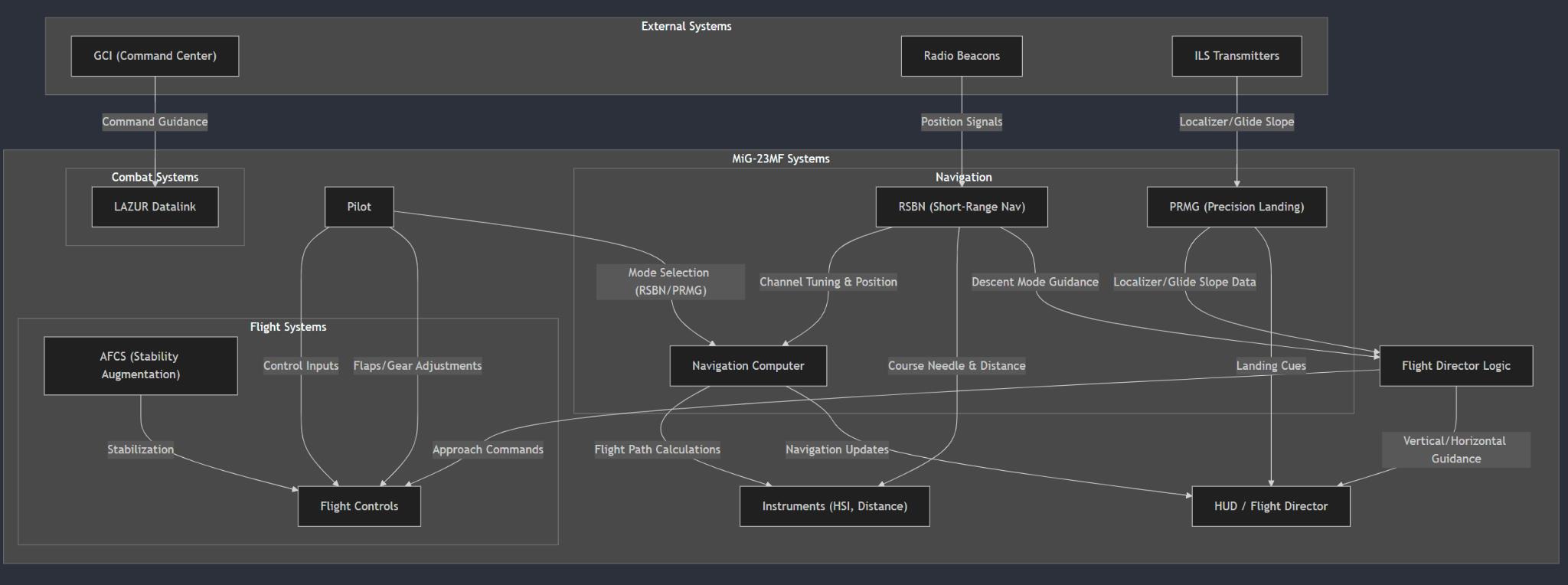
Image Credit: Shwetabh Singh
Could you kindly hint at how different the procurement of the MiG-23MF is from the other procurements that we made?
“So, let me explain this to you with the example of the MiG-23BN. When we procured the MiG-23BN, we had a team of Indian and Soviet planners sit together and decide what would be included as a part of the package and what would be omitted. Discussions would also be held in terms of the training of pilots in the USSR, translation of flying and technical manuals etc. However, in the case of the MiG-23MF, owing to the urgency of the requirement, no such proper negotiations could be conducted, and we received equipment aboard that aircraft that we never had the intent of buying, such as the Lasur-M system. Some of the equipment was left on-board as it was more expensive to remove them. So, despite the decision taken to not buy the relevant ground equipment for the Lasur-M Datalink, the aircraft still had the corresponding systems onboard (the data transmitter antennae and the various guidance indicators). So when we got the aircraft, most of the labels (if not all) were in Russian. I used to have a transfer. So it’s like a sticker sheet. It has things written on it, which you can put on any surface and rub it, and when you rub it, that gets transferred to the other surface. I opened up at least two to four aircraft in the squadron, by removing the metal sheet and identified important switches and components that had to be translated into English. There was a vendor in Calcutta (now Kolkata) who used to sell these to hobbyists. So I used to get it from there and write all the switches. So I did it for about a dozen aircraft. We never really had such problems with the MiG-23UBs, because they were rotated amongst the MiG-23BN and MiG-23MF (and eventually the MiG-27) squadrons, so they had been already translated into English on a priority basis.”
To be continued in Part 2…
CLICK TO VIEW THE PDF
Notes:
[1] Bharat Rakshak, “Service Record for Wing Commander Biswa Bihari Misra 15548 F(P),” Indian Air Force Database, accessed April 12, 2025, https://www.bharat-rakshak.com/indianairforce/database/15548.
[2] https://x.com/Kubojd/status/1899499631928623283
[3] Ibid., n.2
[4] “Wings of Russia Documentary. Issue 4 of 18. Fighters – A Struggle for Superiority,” YouTube video, 18:37, posted by Modelgrad.com, December 2012, https://youtu.be/lU2YO4BiHZg?t=1117.
[5] Greg Goebel, “Fighter Floggers,” AirVectors, June 1, 2024, https://www.airvectors.net/avmig23_1.html.Wikipedia
[6] Alexander Mladenov, Soviet Cold War Fighters (United Kingdom: Fonthill Media, 2016).
[7] Gordon, Yefim. MiG-23/27 Flogger: Soviet Swing-Wing Fighter/Strike Aircraft. Midland Publishing, 2005.
[8] Web Archive, History of GCI and IADS, pp.12-14.
[9] Web Archive, FCI Technology Investigations: L band Compatibility Criteria and Interference Scenarios Study Deliverables C6 and S6: Compatibility Criteria (C6) and Interference Scenarios (S6) for RSBN, pp.6-16.
https://www.eurocontrol.int/sites/default/files/2019-05/24082009-lcis-c6s6-rsbn-v10.pdf Accessed on Feb 25, 2025
[10] IADS, History of Electro Optical Guidance
[11] R. A. Mason, Soviet Air Power: Capabilities and Prospects (Santa Monica, CA: RAND Corporation, 1977), https://apps.dtic.mil/sti/tr/pdf/ADA044697.pdf.
[12] Ibid., n.11


)