
Author: Air Vice Marshal Prashant Mohan VM (Retd), Additional Director General, CAPSS
Keywords: Memorandum of Understanding, US-Iran Ceasefire Diplomacy, Strait of Hormuz, War Powers Resolution
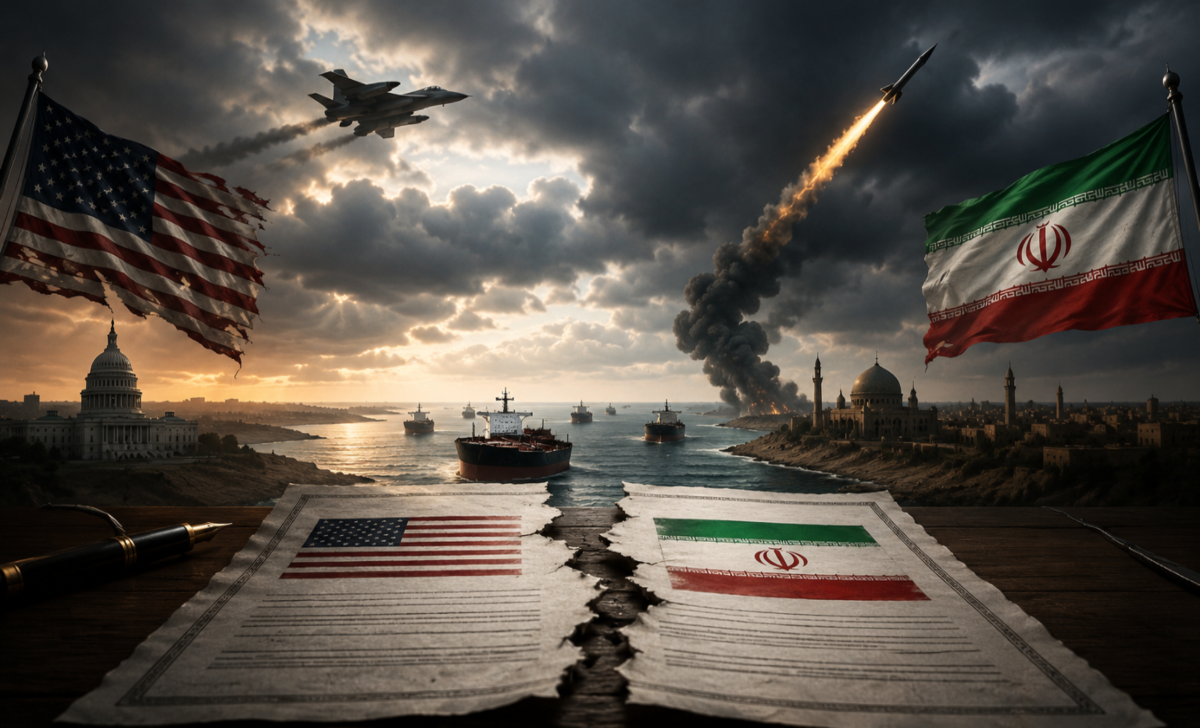
When Pakistan’s Prime Minister Shehbaz Sharif announced on June 15, 2026 that Washington and Tehran had reached a final text to end the war convulsing the Gulf since February 28, 2026, the conflict’s most dangerous phase appeared to be closing. Two days later, a signing almost theatrical—President Donald Trump put pen to paper at the Palace of Versailles while President Masoud Pezeshkian countersigned from Tehran. This brought the so-called Islamabad Memorandum of Understanding (MoU) formally into force.[1] Within approximately twenty days of signing the MoU, Iran had struck a commercial vessel transiting the Strait of Hormuz. Iran did not read the strike as a violation of the MoU it signed—it read the MoU’s own deliberately vague language as licensing[2] exactly this kind of assertion of control, and the Islamic Revolutionary Guard Corps (IRGC) had told the world that was coming days beforehand.[3] Within weeks, Tehran had declared the agreement suspended and the United States (US) Central Command struck Iranian territory for seven consecutive nights.[4] By early August, the two governments could not even agree on whether bilateral talks were under way. This paper asks why an agreement signed with such ceremony unravelled so quickly, and argues that the answer lies less in bad faith on either side than in the document’s own architecture—a text built, deliberately or not, to be contested.
A Text Built to Be Contested
The MoU in question was never intended as a peace treaty because it was an interim mechanism—a fourteen-point document meant to buy sixty days within which a substantive final settlement could be negotiated.[5] Several of its clauses carried the ambiguity typical of documents drafted at speed by parties still exchanging fire. Clause 1 declared the “immediate and permanent termination of military operations on all fronts,” a formulation whose finality sat uneasily against the document’s broader architecture, which repeatedly deferred the harder questions to a future final deal rather than resolving them.[6] Clause 5 proved to be the fault line on which the agreement eventually broke. Iran committed only to “best efforts” for the safe, toll-free passage of commercial vessels through the Strait for sixty days, language that left open both a return to charging fees thereafter and Iran’s underlying claim to a supervisory role over Strait traffic—a claim the United States never accepted.[7] Clause 9 froze the status quo pending the final deal. Iran’s nuclear programme unchanged, no new American sanctions, no additional US force deployment to the region—a formulation that asked both sides to hold their breath for two months without touching the dispute that had caused the war in the first place.[8] Clause 13 made the sequencing explicit, providing that substantive negotiation on the genuinely difficult issues—sanctions architecture, enrichment levels, the Lebanon front—would begin only once the initial measures, including blockade removal and Hormuz passage, were already being implemented.[9] Read as a whole, the document was less a settlement than a controlled pause with a built-in trigger for renewed dispute the moment either side judged the other’s compliance with the initial measures inadequate. “This is not a defect unique to the Islamabad text. A near-identical sequencing deadlock has since surfaced in Washington’s parallel Gaza diplomacy. The Trump administration’s fifteen-point plan calls for phased Israeli withdrawal alongside Hamas disarmament. Still, Hamas insists disarmament follows a full Israeli withdrawal, while Israel insists the reverse—no withdrawal until Hamas is “genuinely disarmed.”[10] Two different theatres, the same underlying design flaw: an agreement that defers the hardest question to a sequence neither side agrees on.
Post MoU–The Kinetic Confrontation
The sequence of events since 17 June bears out that reading. Iranian drone strike against a vessel in the Strait of Hormuz was treated by the US as a ceasefire violation and answered with contained retaliatory strikes. A pattern thus established was Iran targeting shipping or contesting Strait control, the United States responding with limited strikes, and Iran retaliating in turn against Gulf states hosting American forces.[11] That pattern hardened into open confrontation in July. The Central Command (CENTCOM) conducted seven consecutive night strikes on Iranian targets, striking command centres, drone storage facilities and coastal surveillance sites. Iran reported at least fifty killed and more than five hundred injured from the strikes, including damage to a desalination plant that left ten thousand people without water.[12] Iran’s Deputy Foreign Minister, Kazem Gharibabadi, declared the so-called MoU effectively suspended, accusing Washington of having “effectively trampled on and halted all of its commitments.”[13] American casualties mounted in parallel. By late July the US had lost seventeen service members in the renewed fighting, three of them in an Iranian strike on an airbase in Jordan.[14] On July 25, after roughly two weeks of sustained bombing, President Trump paused the strikes—not, as the following section argues, because the dispute had been resolved, but because the campaign had run out of things to hit.
Military Logic, Not Political Resolution
The decision to pause is worth examining closely, because the reasoning behind it undercuts any reading of the episode as a negotiated de-escalation. CENTCOM commander Admiral Brad Cooper told the Pentagon, the Joint Chiefs of Staff and the White House that the designated target set around the Strait had been largely exhausted, and that continuing the campaign at its existing scale offered little further value.[15] Admiral Cooper reportedly estimated that very limited original targets remained unstruck, and hitting them meaningfully would require a different order of military commitment.[16] Compounding the calculation, American interceptor stocks were reported at troubling levels. By early August, the US military had reportedly expended close to 80 per cent of its Terminal High Altitude Area Defence (THAAD) interceptor inventory and roughly half its Patriot stocks since the war began on February 28, with senior commanders describing munitions levels as dangerously low.[17] The pause, in short, reflected the exhaustion of a target list and a munitions inventory—not the resolution of the underlying dispute over who controls the Strait of Hormuz.
The War Powers Shadow
A parallel, largely domestic story helps explain why Washington had a structural incentive to present the MoU, and the lulls that followed it, as more durable than the battlefield evidence warranted. Operations against Iran had begun on February 28, 2026, which meant the sixty-day clock under the War Powers Resolution was due to expire around May 01—the point at which a president conducting unauthorised hostilities must secure congressional authorisation or begin winding operations down.[18] The administration’s response was to argue, in a letter to Congress, that the clock had effectively paused or reset because hostilities had “terminated” with an earlier ceasefire. [19] Critics at the Brookings Institution and Just Security both judged this contention to rest on a strained definition of “hostilities,” given that strikes, blockade operations, and a substantial regional troop presence continued regardless.[20] Six separate congressional attempts to force a withdrawal or require fresh authorisation had failed by the time the said MoU was signed.[21] Viewed against this backdrop, the political value of a signed, internationally witnessed memorandum—regardless of how quickly its substance eroded—becomes easier to understand. It offered Washington a durable-looking peace to point to at precisely the moment its legal authority to keep fighting was under the sharpest domestic challenge.
Who Broke It?
The available evidence resists a simple, one-sided account of blame. Iran’s early strike on commercial shipping was arguably the first material breach, but Washington’s own conduct complicated any claim to have honoured the MoU in good faith. Roughly three weeks after signing, speaking at a North Atlantic Treaty Organisation (NATO) summit in Ankara, President Trump publicly declared the agreement over, with US forces launching a fresh wave of strikes at almost the same moment that Washington revoked Iran’s temporary authorisation to export oil—a unilateral escalation not obviously tied to any specific Iranian provocation that week.[22] Nor were the two signatories the only interested parties: reporting at the time of signing noted that the deal committed Israel to terms it had not itself endorsed and which Israeli officials publicly opposed, especially given that it had no seat at the table.[23] The more defensible conclusion is that the agreement’s design is defective—a genuinely contested question is deferred, and the single most operationally sensitive clause had been left vague. Washington’s credibility as a guarantor has weakened further since. Within days of President Trump touting a breakthrough Gaza disarmament deal, Israel—a formal US ally—publicly rejected its core mechanism, with Prime Minister Netanyahu declaring Israel would “stand our ground even against our best friends when necessary.”[24] If a close ally will not honour a so-called brokered framework, Tehran has every reason to conclude that the arrangement binds no one.
Implications for India
This episode carries lessons that extend beyond the Gulf. Ceasefires, interim or otherwise, that are negotiated under battlefield duress, without addressing the core dispute and with dollops of ambiguous language, are unlikely to hold, especially when one party judges continued restraint more costly than resumption. The case of this MoU suggests that the ambiguity introduced to secure a quick signature had become the very seam along which the agreement eventually tore.[25] India’s continued dependence on Gulf hydrocarbon flows through the Strait of Hormuz, through which some twenty per cent of global oil supply passes, means that sustained contestation over Strait control carries direct economic consequence for India regardless of its non-involvement in the underlying US-Iran dispute.[26] A further lesson concerns the US’s domestic political economy of ceasefires. The US government’s incentive to declare a conflict over is driven substantially by legislative or legal pressure at home rather than by genuine resolution of the dispute abroad. The resulting agreement is likely to be more fragile than its formal signing ceremony suggests.
Conclusion
As of early August 2026, the situation remains unresolved and, in important respects, murkier than at any point since the MoU was signed. Iran’s Foreign Ministry insists it has no negotiations under way with Washington at all, pointing instead to bilateral talks with Oman over a prospective interim traffic-management arrangement for the Strait. [27] Even as President Trump has spoken of both progress toward a deal and the possibility of renewed strikes “at levels not seen since World War II.”[28] Whatever the immediate outcome, the analytical lesson of the Memorandum’s brief life is unlikely to change. An agreement that defers every hard question, freezes an unstable status quo, and leaves its most consequential clause deliberately unresolved is not a peace so much as a pause with an expiry date built into its own text. For a document that both sides genuinely wished to succeed, the eventual verdict on the MoU may be less that it was violated than that it was, from the outset, unusually well designed to be.
*****
CLICK TO VIEW THE PDF
(Disclaimer: The views and opinions expressed in this article are those of the author and do not necessarily reflect the position of the Centre for Aerospace Power and Strategic Studies [CAPSS])
Notes:-
[1] Nick Duffy, Henry Austin, Abigail Williams, and Gabe Gutierrez, “Trump and Iran’s President Sign Initial Deal to End War, Open Strait of Hormuz and Ease Sanctions,” NBC News, June 17, 2026, https://www.nbcnews.com/world/iran/strait-hormuz-reopen-us-lift-iran-sanctions-14-point-deal-seeking-end-rcna350513. Accessed on August 05, 2026.
[2] Jason Chuah, “Safe passage: The fatal ambiguity at the heart of the Hormuz MoU,” Al Jazeera, July 16, 2026, https://www.aljazeera.com/opinions/2026/7/16/safe-passage-the-fatal-ambiguity-at-the-heart-of-the-hormuz-mou. Accessed on August 14, 2026.
[3] Iran International, “A Fragile Compact: Ambiguities That Could Undermine US-Iran MoU,” June 19, 2026, https://www.iranintl.com/en/202606196095. Accessed on August 14, 2026.
[4] Elise Spenner and Chris Boccia, “How the US-Iran Ceasefire and MOU Broke Down — A Timeline,” ABC News, July 10, 2026, https://abcnews.com/Politics/us-iran-ceasefire-mou-broke-timeline/story?id=134622392. Accessed on August 05, 2026.
[5]“US Releases Full Text of 14-Point Iran Memorandum Ahead of Formal Signing,” Middle East Outlook, June 19, 2026, https://middleeastoutlook.com/2026/06/19/full-text-of-the-islamabad-memorandum-of-understanding-between-the-united-states-and-iran/. Accessed on August 05, 2026.
[6] Tanya Noury, “Read the 14-Point Memorandum of Understanding Between the United States and Iran,” Military Times, June 17, 2026, https://www.militarytimes.com/news/pentagon-congress/2026/06/17/read-the-14-point-memorandum-of-understanding-between-the-united-states-and-iran/. Accessed on August 05, 2026.
[7] Nik Popli and Tiago Ventura, “Read the Full Text of the 14-Point Agreement Between the U.S. and Iran,” TIME, June 17, 2026, https://time.com/article/2026/06/17/us-iran-peace-deal-agreement-leaked-draft-text/. Accessed on August 06, 2026.
[8]“Memorandum of Understanding Between the United States of America and the Islamic Republic of Iran,” Arab Center Washington DC, June 17, 2026, https://arabcenterdc.org/resource/memorandum-of-understanding-between-the-united-states-of-america-and-the-islamic-republic-of-iran/. Accessed on August 05, 2026.
[9]“Inside US-Iran Islamabad Agreement: Full Text of the 14-Point MoU,” South Asian Herald, June 18, 2026, https://southasianherald.com/inside-us-iran-islamabad-agreement-full-text-of-the-14-point-mou/. Accessed on August 05, 2026.
[10] Mithil Aggarwal, “Israel Rejects Trump’s 15-Point Plan for Gaza, Netanyahu Says,” NBC News, August 09, 2026, https://www.nbcnews.com/world/israel/israel-rejects-trumps-15-point-plan-gaza-pm-benjamin-netanyahu-says-rcna591555. Accessed on August 09, 2026.
[11] Spenner and Boccia, n. 2.
[12]“Iran Suggests MoU ‘Suspended’ as 50 Killed in US Strikes in July,” Al Jazeera, July 18, 2026, https://www.aljazeera.com/news/2026/7/18/iran-accuses-us-of-striking-critical-infrastructure-as-war-intensifies. Accessed on August 05, 2026.
[13] “Iran Has Ceased Implementing Islamabad MoU over US Violations, Deputy FM Says,” Tasnim News Agency, July 18, 2026, https://www.tasnimnews.ir/en/news/2026/07/18/3650270/iran-has-ceased-implementing-islamabad-mou-over-us-violations-deputy-fm-says. Accessed on August 06, 2026.
[14]“Since Islamabad MoU: What’s Changed for the US, Iran and the Gulf?,” Al Jazeera, July 20, 2026, https://www.aljazeera.com/features/2026/7/20/since-islamabad-mou-whats-changed-for-the-us-iran-and-the-gulf. Accessed on August 06, 2026.
[15]Barak Ravid, “CENTCOM Chief Urged Trump to Halt Hormuz Strikes,” Axios, July 26, 2026, https://www.axios.com/2026/07/26/hormuz-bombing-pause-trump-iran. Accessed on August 06, 2026.
[16]Brian Freeman, “CENTCOM Chief Urged Iran Strike Halt,” Yahoo News, July 27, 2026, https://www.yahoo.com/news/politics/articles/centcom-chief-urged-iran-strike-213225379.html. Accessed on August 06, 2026.
[17] “Iran War 2026—Day 159 Update—05 August 2026,” GlobalSecurity.org, https://www.globalsecurity.org/military/ops/iran-war-oprep.htm. Accessed on August 06, 2026.
[18] Jasmine Farrier, “Why the 60-Day War Powers Resolution Deadline Doesn’t Actually Constrain Presidents,” The Conversation, May 01, 2026, https://theconversation.com/why-the-60-day-war-powers-resolution-deadline-doesnt-actually-constrain-presidents-281724. Accessed on August 06, 2026.
[19]“The Iran War and the War Powers Resolution,” Brookings Institution, July 14, 2026, https://www.brookings.edu/articles/the-iran-war-and-the-war-powers-resolution/. Accessed on August 06, 2026.
[20] Oona Hathaway et al., “Ongoing Iran War Reveals Necessary War Powers Reforms,” Just Security, May 05, 2026, https://www.justsecurity.org/137977/iran-hostilities-war-powers-restart-clock/. Accessed on August 07, 2026.
[21]Darius Radzius, “Iran War Heads Toward Legal Showdown as May 1 Deadline Nears,” Military.com, April 28, 2026, https://www.military.com/daily-news/headlines/2026/04/28/Iran-War-Heads-Toward-Legal-Showdown-as-May-1-Deadline-Nears. Accessed on August 07, 2026.
[22]“US MoU Commitments Broken the Moment They Were Spoken,” Press TV, August 02, 2026, https://www.presstv.co.uk/Detail/2026/08/02/773563/US-MoU-commitments-broken-the-moment-they-were-spoken. Accessed on August 07, 2026.
[23] “War-Ending Deal Is Signed by US and Iran, Takes Effect; Commits Israel to Terms It Opposes,” The Times of Israel, June 18, 2026, https://www.timesofisrael.com/us-iran-sign-war-ending-deal-which-enters-into-effect-2-days-earlier-than-planned/. Accessed on August 07, 2026.
[24] Tim Lister, Eugenia Yosef and Ibrahim Dahman, “Israel Rejects Trump’s Gaza Peace Plan, Saying No Withdrawal Until Hamas Disarms,” CNN, August 09, 2026, https://www.cnn.com/2026/08/09/middleeast/israel-gaza-trump-netanyahu-plan-intl. Accessed on August 09, 2026.
[25] Popli and Ventura, n. 5.
[26]“August 04, 2026—Iran Continues Hormuz Talks with Oman, US Signals Optimism on Deal,” CNN, August 04, 2026, https://www.cnn.com/2026/08/04/world/live-news/iran-war-trump. Accessed on August 07, 2026.
[27]“August 01, 2026—US-Iran War; State Department Warns US Citizens Across the Middle East,” CNN, August 01, 2026, https://www.cnn.com/2026/08/01/world/live-news/iran-war-trump. Accessed on August 07, 2026.
[28] “Aug 2-3, 2026—Trump Calls Iranian Leadership ‘Unbelievably Duplicitous’ After Tehran Denies Talks Resumed,” CNN, August 3, 2026, https://www.cnn.com/2026/08/02/world/live-news/iran-war-trump. Accessed on August 07, 2026.