Author: Gp Capt RK Kashyap, Senior Fellow, CAPSS
Keywords: Makkah Alliance, OIC, Shuja Nawaj, Trucial States, EDA
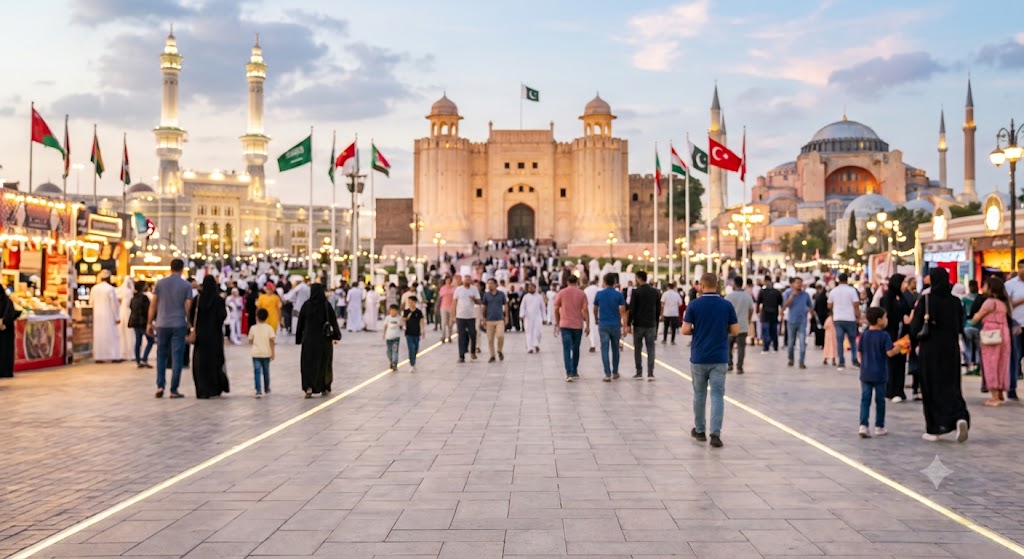
The recent Makkah pact between Turkey, Saudi Arabia, and Pakistan signed on August 07, 2026, builds on the earlier strategic mutual defence alliance signed on September 17, 2025, between Saudi Arabia and Pakistan. Also, another agreement, the ‘Badr’ project agreement, was signed in the Qatari capital, Doha, between Qatar, Indonesia, Pakistan, and Turkey on October 21, 2026. Turkey is the new entrant, and its imperial past in the region is being glossed over, mainly due to the de-secularisation of Turkey over the last 15 years during Erdogan’s rule. The Makkah agreement allows for other Organisation of Islamic Cooperation (OIC) countries to join later, while the Badr agreement calls for technology sharing through joint production, technology transfers and integrated supply chains.
An alliance is an agreement between two people, groups or countries to work towards a common goal or mutual benefit. Since its inception, Pakistan has been in alliance with patrons in order to advance its foreign affairs and seek security from its eastern neighbour. Shuja Nawaj, in his book Crossed Swords, stated that the Pakistan “… army regards itself as the heir to the martial traditions going back centuries to the days of early Islam. Indeed, the generals who commanded the British Indian army often referred to their Muslim soldiers as being a martial race.” Field Marshal Ayub Khan, Pakistan’s first military ruler, often thought of his country as the Prussia of the subcontinent.
John J. Mearsheimer has stated that military power is a projection of a nation’s economic heft, population and geography. However, each country distils its wealth into military power at varying levels of efficiency. He also states that “defeated states usually do not conclude that war is a futile enterprise, but instead strive to make sure that they do not repeat the mistakes in the next war.’’ While Pakistan is a laggard country, ranking 168th in the Human Development Index by UNDP, it is classified as a lower middle-income country with a GDP of 407 billion dollars. GDP of Turkey, Indonesia, Saudi Arabia, and Bangladesh, in that order, is more than that of Pakistan when only Islamic countries are considered.
Pakistan is a country which considers itself to be a hegemon of martial traditions, has had a quasi-military government for most of the years of its existence with a ruined economic story, having run to the International Monetary Fund (IMF) since 1958 for 24 to 25 IMF programmes/bailouts, making it one of the fund’s most frequent borrowers. Therefore, the theory of self-created wealth through national hard work and thereafter distilled into military power clearly does not apply to Pakistan. But what it lacks in wealth, it makes do with running a rentier, client-state form of system with countries willing to help to prop up its economy and military, which it is able to regularly arm with grants, soft loans by China/United States of America (USA) and Excess Defence Article (EDA) Sales by the USA in search of notional parity with its eastern neighbour. It is this quest for glory which has made it a security supplier to its co-religionist countries of West Asia. In the 1970s, when Britain made its intention known in 1968 to shed its security umbrella for the Trucial States, Turkey was not seen as a replacement security provider at that time by the Arab states due to the historic animosity of Ottoman imperial rule over the Arabian Peninsula. Pakistan filled in this gap that was created. This, along with the differences that Saudi Arabia had in its security arrangement with the USA, cemented Pakistan’s role in the security architecture in West Asia. This became further robust with the acquisition of Nuclear Weapons with Chinese and US connivance by 1984. A look at the symbiotic relationship of Pakistan with West Asian countries over the years: –
| Year/s | Country | Stationed Military personnel | Treaty/Purpose/Remarks | ||
| Army | Air Force | ||||
| 1970-80s | Saudi Arabia | 15,000 | |||
| 1990 | 1,600 additional | 1982 security protocol | |||
| 2018-2026 | 1,000 additional | 1x JF-17 Sqn | Present deployment includes HQ-9 Air defence System | ||
| 1990 | Kuwait | 700 | ~ | ||
| 2018 | Qatar | 647 | |||
| 2022 | 4,500 | FIFA World Cup | |||
| Since 1970s- | UAE | Helped start the armour and commando school | First 5 CASs of UAE, Gp Capt DCAS’s | UAEAF is a mini PAF. In 2004, PAF had 55 flying instructors. | |
| 1967 | Jordan | ~ | ~ 10 | PAF pilots participated in the 6-day War; Brig Zia-ul-Haq on deputation helped fight Black September group of the PLO | |
~ exact figures unknown
Data Source: Wikipedia, www.defence.link Bahrain, made by authour
One may ask, why do the oil-rich Arab countries require a foreign security provider? Especially when they have the national wealth to create their own army with the latest weaponry that money and the West can provide. It may be because of the fear that a professional army comprising native soldiers will invariably take over the country after a period of time, just as it has happened in Egypt, Iraq, Libya and Pakistan itself. Therefore, it is safer to have non-natives, guns for hire, like mamluks or janissaries of olden times, and this is where Pakistan fits in with aplomb.
In the words of Turkey’s Foreign Minister, the Makkah defence alliance under its Article 2 calls for collective defence and mutual assistance and is akin to the North Atlantic Treaty Organisation’s (NATO) Article 5 collective defence clause. It is the first military pact in West Asia post-1945, World War II. All three nations have close defence relations with the USA but have different hostile neighbours and are also not land contiguous. The modelling of the alliance calls for a permanent secretariat in Saudi Arabia, a six-monthly meeting modelled on the NATO lines. There is also a commonality of US military hardware, making cross-training easier for the involved countries, though Pakistan is now increasingly dependent on Chinese weapons. The use of Chinese hardware may become a contentious issue if the USA does not agree to the deployment and training of Chinese-origin weapons by Pakistan alongside US-origin military hardware in Saudi Arabia.
The Badr agreement provides a fertile market for Turkish military hardware and, specifically, its drone technology to Pakistan, Qatar, and Indonesia in view of Iran’s Shaheed Drone harassment of Qatar. Here, Indonesia is the outlier country and, along with Pakistan, will aim to gain from investments and low cost of production for mass-produced drones, with Qatar providing the financial muscle. Turkey is already co-producing four warships for Pakistan and a Tank with Indonesia. This agreement provides for co-production, co-development and enlargement of Pakistan’s industrial relationship to other similarly minded Islamic countries.
While Iran and Houthis are adversaries of Saudi Arabia, Turkey has inimical interests with Cyprus, Greece, Israel, and India. Pakistan has Iran as its western neighbour and will have to walk a tightrope in managing the adversarial situation with Iran should it come to pass. It is assumed that Turkey will look forward to selling its technology to the cash-rich House of Saud, while Pakistan will fill the physical security gap with its foot soldiers. It may be early to comment, but the aims of this alliance are modest to begin with and may remain so in the foreseeable future unless the situation gravitates towards total hostility with Iran or Israel and any of the alliance countries. It is also pertinent to note that Egypt and the United Arab Emirates (UAE) are not part of this group, while Egypt is the only Arab country having cold-peace diplomatic relations with Israel; the UAE (most of the original Trucial countries) is also an important Arab member state.
The real test of such alliance/s will eventually be in the implementation of their agreements and when the articles are invoked under probable conditions of aggression, especially in wartime. The periodic escalation by Houthis in the Red Sea against Saudi Arabia will be of equal interest to evaluate the alliance’s reaction. In the present circumstances, there is a fair amount of uncertainty around the US and Israel’s actions towards the Iran war and how it will be brought to a close. If peace reigns, the alliance may remain largely on paper in the near future, while darker days may become beneficial for Pakistan in being able to milk the Saudi Arabs and other Gulf States to pay for its military services as security deployment costs, besides also forcing them to be the financier of last resort to its perennially failing economy.
(Disclaimer: The views and opinions expressed in this article are those of the author and do not necessarily reflect the position of the Centre for Aerospace Power and Strategic Studies [CAPSS])