Author: Dr Javed Alam, Associate Fellow, Centre for Aerospace Power and Strategic Studies
Keywords: SSN, Non-proliferation, South Korea, Nuclear
A rare news item on nuclear non-proliferation has emerged from South Korea (ROK) regarding its nuclear-powered submarines (SSNs), an ambition which the country has been working towards for many years and has seen considerable debate both within and outside of South Korea. This article analyses this new development in South Korea vis-à-vis nuclear proliferation concerns.
The Announcement
On July 28, 2026, it was reported that South Korea is moving ahead to “prohibit nuclear fuel intended to power submarines from being diverted to nuclear weapons.” The announcement was made by the Ministry of National Defence, which stated that “The ministry is establishing the legal and institutional foundation needed to ensure the stable implementation of the nuclear-powered submarine program.” The announcement comes at a time of an ongoing debate in the country with regard to the future of its nuclear weapon programme. The possible intent of this could be to silence the voices raising proliferation concerns. The bill, if it becomes a law, would become South Korea’s first explicit statutory prohibition on using nuclear material for the development, production, or possession of nuclear weapons.
SSNs in the South Korean Defence Strategy
On May 26, 2026, South Korea’s Ministry of National Defence released what is known as the ‘Basic Plan for the Development of the Republic of Korea Nuclear-Powered Submarine.’ Under the programme, the country plans to launch its first submarine in the mid-2030s. The plan comes on the heels of the United States (US) support for South Korea’s decision to build nuclear-powered attack submarines. Over the years, the changing dynamics of threats posed by its neighbours, particularly by North Korea, have led South Korea to seek SSNs. The threat from North Korea has become more potent once it unveiled its new nuclear-powered submarine in December 2025.
The Basic Plan is also important to South Korea’s Offensive Military Doctrine, which it outlined in the 2022 defence white paper. It is colloquially known as the ‘three-axis system.’ This comprises the development of the SSNs, the so-called ‘kill-chain platform,’ which could undertake preemptive strikes against North Korea’s nuclear and missile facilities. The same intention was referred to by Korea’s Ministry of Defence when it unveiled the plans to build the SSNs, as it stated, “the submarines will provide extended endurance for tracking North Korean naval activity, and also form part of an underwater “kill chain” capable of supporting precision strike operations in the event of conflict.
Two other important factors have led to the announcement of the SSNs. The first relates to the Australia, United Kingdom, and United States (AUKUS) programme. As AUKUS has allowed Australia to build a closer relationship with the US, the Basic Plan will help South Korea build a similar relationship with the US. The second reason is more domestic in nature, as South Korea has been witnessing a renewed public debate regarding the production of nuclear weapons: an SSN programme can help “present a valid alternative to nuclear armaments.”
Why the Announcement is Important
Under the Basic Plan, South Korea seeks to build the Jang Bogo-N class of SSNs, which will utilise low-enriched uranium fuel, which would be less than 20 per cent enriched uranium-235. This poses less of a proliferation risk. One might recall that on January 11, 2023, the then South Korean President Yoon Suk Yeol sparked a major controversy by suggesting that South Korea might acquire nuclear weapons “if North Korean threats [become] more serious.” One may interpret the former President’s statement as a political gimmick, but public opinion data over the years has shown growing support for South Korea’s nuclear option. The Asan Institute for Policy Studies, which has been conducting public opinion surveys in South Korea since 2010, has recorded “76.2 percent of South Koreans now [2025] favour developing an independent nuclear arsenal.” In fact, since 2010, public opinion regarding indigenous development of nuclear weapons has never gone below 54.8 per cent.
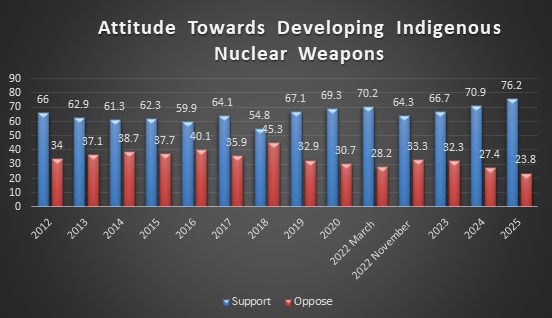
Source: Image compiled by the author from South Koreans and their neighbours 2025, https://www.asaninst.org/data/file/s3_4_2_eng/f15af67c43af11afd7a990dc4f32fd2b_ClhtB9a5_9eca2136ce8acf9c485de1d452d2d82fd7e2abdc.pdf.
In order to effectively communicate that South Korea does not seek to build sovereign strategic deterrence capabilities, Cho Hyun, Minister of Foreign Affairs of the Republic of Korea, in an opinion piece published on April 01, 2026, categorically stated that “From a security perspective, nuclear armament [of South Korea] would introduce uncertainty, not strength.” The foreign affairs minister further made it clear that the arrangements under the extended deterrence posture with the US are currently the best deterrence posture for South Korea and pursuing a path towards nuclearisation would “trigger a chain reaction of proliferation in the region, ultimately undermining the Republic of Korea’s security interests.”
With regard to its SSNs and proliferation concerns, South Korea’s submarine plan has ensured working with the International Atomic Energy Agency (IAEA) to “establish a safeguards system applicable to nuclear-powered submarines in cooperation.” In this context, the June 08, 2026 statement by the IAEA Director-General Rafael Mariano Grossi noted that South Korea’s commitments towards “fulfilling its non-proliferation obligations,” and “[South Korea’s] intention to work with the Agency on safety, security and safeguards measures applicable to nuclear-powered submarines.” More importantly, South Korea ratified the IAEA Additional Protocol to its Safeguards Agreement in 2004, which gives the IAEA expanded access and short-notice inspections. Since under the Basic Plan, South Korea seeks to use low-enriched uranium procured from the US, a nuclear cooperation provision was discussed during Presidents Donald Trump and Lee Jae Myung’s summit in Gyeongju in November 2025. Given that the Trump-Lee summit in November 2025 did not clarify the provisions under which the US would help South Korea procure low-enriched uranium and subsequently help avoid proliferation concerns, the July 28, 2026 announcement fills this gap by allaying the proliferation concerns.
Given that South Korea seeks to develop at least three nuclear-powered submarines displacing about 8,000 metric tons each, with the lead vessel planned to be launched by the mid-2030s, provisions on fuel supply and concerns about fuel diversion are legitimate questions. However, with the legislation announced by South Korea, it has tried to address these concerns.
Meanwhile, there is another angle which might not allow South Korea to pursue a nuclear-weapon programme. The bilateral 123 Agreement signed between the US and South Korea supports the ROK’s civil enrichment and spent fuel reprocessing initiatives for peaceful purposes, but it is contingent on South Korea’s nuclear non-proliferation commitments. In terms of nuclear power generation, South Korea ranks fifth in the world and has capabilities in the construction, operation, and export of nuclear power plants. Any divergence from power generation to a proliferation path would bring sanctions on South Korea, and as stated by President Lee Jae Myung on December 02, 2025, “the South Korean economy could not withstand such sanctions; and that no South Korean citizen would want to live like North Koreans.”
The nuclear world order is witnessing too many upheavals rarely witnessed since the dawn of the nuclear age. The war between the Russian Federation, a nuclear weapon Non-Proliferation Treaty (NPT) member and Ukraine, a non-nuclear weapon NPT member state, is yet to find a negotiated resolution. The war in West Asia involves one NPT founding member (the US), one NPT member and non-nuclear weapon state (Iran), and one nuclear weapon state outside of the NPT (Israel). Understanding these dynamics is essential for meaningful dialogue. Simultaneously, the US has recently signed a deal with Saudi Arabia, an NPT member, to provide American nuclear reactors and perhaps also the right to enrich uranium. The North Atlantic Treaty Organization (NATO), on the other hand, is looking for an expansion of its nuclear capabilities by examining the options to position American nuclear capabilities across Europe, particularly in Poland, Finland, and Lithuania. In South-East Asia, as China continues to modernise and increase its nuclear capabilities, a debate in Japan is going on about what role nuclear weapons can play in the country’s defence. Amid all these concerns, the news from South Korea certainly provides a bit of relief for proliferation pessimists and appears to align with South Korea’s agenda for “peace first.”
*****