Authors: Gp Capt VP Naik VM, & Ms Radhey Tambi
Keywords: Maritime Domain Awareness, Multi-Domain Awareness, Indian Ocean Region, Decision Dominance.
Introduction
The Indian Ocean has emerged as a fulcrum of global trade, technological competition, and the projection of military and economic power. Its security environment is becoming increasingly congested, contested, and competitive, with developments in the Persian Gulf and Red Sea, the Western Indian Ocean, and the Bay of Bengal interacting. At the same time, the character of maritime competition is changing. Activities at sea are increasingly enabled, shaped or constrained by capabilities in the air, space, cyber, and electromagnetic domains, while information operations and strategic narratives influence perceptions and decision-making before a conventional maritime threat becomes visible.
This changing environment does not diminish the importance of Maritime Domain Awareness (MDA). On the contrary, MDA remains an indispensable foundation for understanding activity at sea. The challenge is that a maritime picture, however comprehensive, cannot by itself explain the forces, networks, intentions, and enabling activities that produce events in the maritime domain. The operational problem, therefore, is not to replace MDA, but to place it within a wider framework of Multi-Domain Awareness (MuDA).
For India, this transition is particularly relevant. India sits astride the principal sea lines of communication (SLOCs) linking West Asia, Africa, South Asia, and Southeast Asia, and its economic and strategic interests are deeply connected to the ocean. India’s growing network of maritime partnerships, island diplomacy, surveillance systems, and information-sharing arrangements provides a strong base for the next step: an Indian Ocean Region Multi-Domain Awareness (IOR-MuDA) architecture that fuses information across domains and converts it into decision dominance.
Maritime Domain Awareness: The Foundation
The International Maritime Organisation (IMO) defines Maritime Domain Awareness as the effective understanding of anything associated with the maritime domain that could impact security, safety, the economy, or the marine environment. The IMO identifies three key components: Maritime Situational Awareness, Maritime Threat Awareness, and Maritime Response Awareness. Together, these provide the foundation for gathering information, identifying potential threats and understanding the resources available to respond.[1]
In operational terms, MDA supports the detection and tracking of surface and subsurface vessels, monitoring of merchant and fishing traffic, identification of suspicious activity, protection of SLOCs, coastal surveillance, port security, and preparedness for humanitarian assistance, disaster relief and casualty evacuation. It also provides the information base for cooperation among navies, coast guards, maritime law-enforcement agencies, commercial actors and regional partners.
For India, MDA has become a central pillar of maritime security. Coastal radar networks, long-range maritime patrol aircraft, unmanned systems, white-shipping information exchanges and the Information Fusion Centre–Indian Ocean Region (IFC-IOR) have progressively expanded the country’s ability to build and share a maritime picture. India’s engagement with Indian Ocean littorals has also extended the geographic reach of this effort through information sharing, coordinated patrols, capacity building, hydrographic cooperation and humanitarian assistance.
This regional approach aligns with the evolution of India’s maritime policy from Security and Growth for All in the Region (SAGAR) to MAHASAGAR—Mutual and Holistic Advancement for Security and Growth Across Regions. Recent Indian Navy initiatives such as Indian Ocean Ship (IOS) SAGAR illustrate the emphasis on partnerships, interoperability, information sharing and collective maritime security.[2] Island countries and territories are especially important to this architecture. Their geographic location along major SLOCs and near strategic maritime spaces can contribute to surveillance, logistics, search and rescue and wider regional resilience. India’s engagement with island partners therefore has both security and developmental dimensions.
The upgrading of the airstrip on Agalega in Mauritius illustrates this strategic interdependence. Beyond improving connectivity and supporting search-and-rescue (SAR) and Humanitarian Assistance and Disaster Relief (HADR) activities, the facility expands India’s operational outreach in the Western Indian Ocean. India has similarly supported Seychelles’ maritime security capabilities, while infrastructure and military developments in India’s own Lakshadweep and Andaman and Nicobar Islands strengthen its ability to monitor and operate across the wider Indian Ocean.
The Limits of Maritime Domain Awareness
The success of MDA can create an unintended analytical trap where the maritime picture appears complete even when it captures only the visible manifestation of a wider activity. A vessel may be detected at sea, but the surveillance track alone may not reveal why it is there, what supported its movement, what information enabled it, or what other-domain activity preceded it. As maritime competition becomes increasingly networked, these questions become as important as the vessel’s location and identity.
The principal limitation of domain-specific awareness mechanisms is therefore not a lack of sensors, but the separation of the information they generate. A maritime sensor may detect anomalous behaviour; an air sensor may observe supporting activity; a satellite may reveal temporal changes; a cyber-monitoring system may identify network activity; and an electromagnetic sensor may detect unusual emissions. If these observations remain within separate organisational or technological silos, the decision-maker receives several partial pictures rather than one coherent explanation.
-
-
Domain Confinement: MDA is designed primarily to understand activity associated with the maritime domain. It can therefore miss enabling or preparatory activity occurring elsewhere.
-
Reactive Bias: Traditional surveillance often begins when an object becomes observable in the monitored domain. This can compress warning time when the actual preparation has occurred earlier in another domain.
-
Siloed Information: Data held by different military services, government agencies and partner organisations may not be available in a common, interoperable architecture.
-
Different Temporal and Spatial Pictures: Satellites, aircraft, ships, cyber systems and electromagnetic sensors observe the environment at different times, scales, and levels of fidelity. Without fusion, correlation is difficult.
-
Intent Remains Elusive: Tracking an object provides location and behaviour, but understanding intent may require information about communications, logistics, military preparation, political signalling, and information activity.
-
Data Overload Without Sufficient Fusion: The expansion of sensors and commercially available information can produce more data than decision-makers can meaningfully process. More collection does not automatically produce better awareness.
-
Fragmented Response: Awareness that is not connected to decision authorities and response resources can create a common picture without a shared understanding of what to do.
-
These limitations do not make MDA obsolete; rather, they establish its boundary. MDA remains the maritime layer of a larger operational picture. The requirement is to fuse that layer with the information from other domains to create a composite operating picture (COP).
From MDA to Multi-Domain Awareness (MuDA)
The Indian Ocean’s evolving security environment therefore calls for a transition from Maritime Domain Awareness to Multi-Domain Awareness. MuDA should be understood not as a new sensor programme or yet another typically military jargon, but as an approach to understanding the operational environment as an interconnected system.
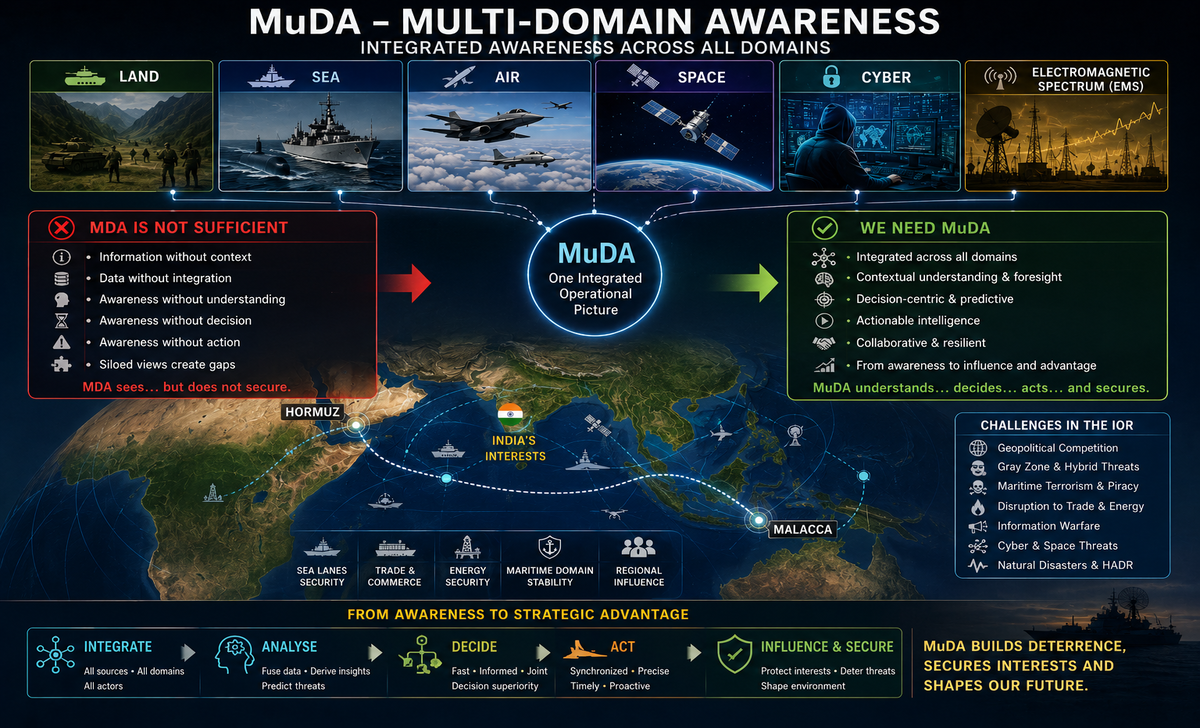
At its core, MuDA integrates awareness across six principal operational domains: land, maritime, air, space, cyber and electromagnetic. Information and cognitive effects are important cross-cutting dimensions because they connect and influence several of these domains. The objective is not simply to display more information on a larger screen. It is to correlate apparently separate observations so decision-makers can understand relationships, identify patterns, assess intent, and make timely, correct decisions.
MDA is therefore best understood as a subset of MuDA. The two concepts are complementary, not mutually exclusive. MDA provides the detailed maritime picture required for safe navigation, security, and maritime operations. MuDA places that picture in context by asking what is happening in other domains, how those activities interact, and what they imply for the maritime environment.
What Multi-Domain Awareness Adds
MuDA changes the analytical sequence from detection to correlation and anticipation. Instead of waiting for an activity to become visible at sea and then seeking an explanation, a multi-domain architecture can identify indicators across domains and build an assessment before the maritime manifestation occurs.
Consider the deployment of a Chinese carrier strike group (CSG) into the Indian Ocean. From an MDA perspective, the immediate requirement is to detect, classify and track the group once it enters the region. A MuDA approach would examine the broader chain of activity: space-based surveillance and satellite-enabled communications and navigation; electromagnetic activity associated with radars, communications and electronic warfare; cyber activity against relevant networks; air movements and long-range Intelligence, Surveillance, and Reconnaissance (ISR); logistics and port activity; undersea infrastructure and seabed conditions; and information or diplomatic signalling. The carrier group is then understood not as an isolated maritime event but as one component of a larger operational system.
The cognitive and information dimensions are equally important. Strategic narratives, influence campaigns, diplomatic signalling, and disinformation can shape perceptions and constrain decision-making well before kinetic activity becomes apparent. These effects may not be captured by a maritime surveillance system, yet they can materially influence the strategic environment in which maritime forces operate. MuDA therefore seeks to move awareness from simple visibility towards understanding. It enables multiple streams of information to be correlated into a Common Operating Picture, while analytics and artificial intelligence can help identify anomalies, relationships, and patterns. The human decision-maker remains central; technology should reduce cognitive burden and improve the speed and quality of decisions rather than substitute for judgement.
Components of Multi-Domain Awareness
A practical MuDA architecture for the Indian Ocean should integrate information from the six principal domains while maintaining the ability to incorporate cross-cutting information.
-
-
Land Domain: Military infrastructure, ports, logistics nodes, airfields, missile and sensor sites, transport networks, and other land-based activity that can enable maritime operations.
-
Maritime Domain: Surface combatants, submarines, merchant shipping, fishing fleets, offshore installations, coastal activity, and maritime traffic patterns.
-
Air Domain: Combat aircraft, AEW&C platforms, maritime patrol aircraft, unmanned aerial systems, high-altitude ISR platforms, and long-range aviation.
-
Space Domain: ISR satellites, navigation systems, satellite communications, commercial constellations, space situational awareness, and counterspace activity.
-
Cyber Domain: Network intrusions, port and logistics systems, shipping-management networks, financial infrastructure, and other digital systems supporting maritime activity.
-
Electromagnetic Domain: Radar and communications emissions, Communication Intelligence (COMINT), Electronic Intelligence (ELINT), electronic warfare (EW) signatures, spectrum mapping and navigation interference.
-
Two further dimensions cut across these domains. The information and cognitive dimension includes influence operations, strategic narratives, social-media manipulation, diplomatic signalling and disinformation. The subsea dimension includes fibre-optic cables, energy pipelines, autonomous underwater vehicles, seabed sensors, and other critical underwater infrastructure. Treating these as connected layers prevents the operational picture from becoming artificially divided along organisational boundaries.
MuDA’s true value therefore lies in complete fusion. A satellite image, radar track, Automatic Identification System (AIS) transmission, cyber alert, and electromagnetic emission may be ambiguous on their own. Correlated in time and geography, however, they may reveal a pattern. This is where data becomes awareness, and awareness becomes an overwhelming decision advantage. Modern Technologies like Artificial Intelligence (AI) and big data handling can further enable faster data sifting and present purified information to decision-making bodies.
Why MuDA Matters for India and the Indian Ocean
India’s dependence on the sea makes the quality of its maritime and wider domain awareness a national-security imperative. Recent Government of India sources put the share of India’s trade handled through maritime routes at about 90–95 per cent by volume, underscoring the centrality of maritime connectivity to the national economy.[3] The country’s location between the Strait of Hormuz and Bab el-Mandeb in the west and the Strait of Malacca in the east further reinforces the strategic importance of the Indian Ocean and its principal chokepoints.
The security challenge is also changing. Piracy, illegal and unregulated fishing, contraband smuggling, and other non-traditional threats increasingly exploit technology, commercial connectivity and information networks. Unmanned systems, artificial intelligence, cyber tools and influence operations can be employed alongside conventional maritime activity. Consequently, warning indicators of a maritime problem may first appear in another domain.
China’s expanding presence in the Indian Ocean illustrates why this broader approach is necessary. The growth of the PLA Navy’s deployments is accompanied by developments in long-range aviation, satellite and navigation systems, cyber capabilities, information operations and dual-use infrastructure. Research by the China Aerospace Studies Institute has highlighted Chinese ambitions for resilient, integrated systems capable of linking space, air, sea, and ground assets.[4] China’s survey and research-vessel fleet is another example of activity that can have implications beyond conventional maritime surveillance. Research into bathymetry, hydrography and the marine environment can support scientific purposes while also generating information relevant to submarine navigation, anti-submarine warfare and undersea infrastructure monitoring. CSIS’s Hidden Reach project has documented the extensive scale and dual-use character of Chinese research-vessel activity in the Indian Ocean.[5]
The operational consequence is the emergence of multiple, simultaneous Observe-Orient-Decide-Act (OODA) loops. Actions in space, cyber, electromagnetic, air, land and maritime domains may unfold at different speeds, yet influence one another. The challenge is therefore not only to observe more, but to correlate these activities quickly enough to preserve decision advantage. India’s parliamentary scrutiny of the changing naval balance in the Indian Ocean reinforces the need for proactive measures.[6]
Enabling an Indian Ocean MuDA Architecture
India is well placed to lead the development of an Indian Ocean Multi-Domain Awareness (IOR MuDA) architecture. It already possesses substantial maritime surveillance capabilities, space assets, airborne ISR, information-fusion mechanisms, island infrastructure and a growing network of regional partnerships. The next step is to connect these capabilities through a common information architecture and a shared operational philosophy. An IOR MuDA architecture should integrate space-based surveillance, airborne ISR, maritime patrol aircraft, unmanned systems, coastal radar chains, underwater sensor networks, cyber monitoring, electromagnetic-spectrum awareness, information-operations monitoring and AI-enabled data fusion. It should also incorporate relevant commercial and open-source data where appropriate, subject to security, reliability and legal considerations.
The central objective should be a Common Operating Picture that is more than a visual display. It should provide a common data environment in which information from the Indian Navy, Indian Air Force, Indian Army, Indian Coast Guard and relevant national agencies can be correlated, assessed and disseminated according to the needs of different decision-makers. The existing institutional ecosystem provides building blocks for such an architecture. These include the National Technical Research Organisation (NTRO), Indian Space Research Organisation (ISRO), Defence Research and Development Organisation (DRDO), National Maritime Domain Awareness (NMDA) Centre, Information Management and Analysis Centre (IMAC), Information Fusion Centre–Indian Ocean Region (IFC-IOR) and other national security and disaster-management agencies. The objective should not be to abolish specialised centres, but to make them interoperable and able to contribute to a shared decision-support ecosystem.
Regional partnerships are equally important. India’s island diplomacy, information-sharing arrangements and maritime-security partnerships can extend the sensor and response network beyond national territory. The aim should be to build trusted, secure and interoperable information pathways with willing Indian Ocean partners, while protecting sensitive sources and methods. Finally, MuDA should be developed as a decision-support concept rather than merely a technology project. Common standards, data governance, classification rules, interoperability, trained analysts, cross-domain liaison and institutional ownership are as important as sensors and computing power. The ultimate measure of success should be whether the system gives commanders and policymakers more time, better context and greater confidence to decide.
Parting Shots
MDA has transformed maritime security by making vessel movements, threats, and maritime activity more visible. India has invested substantially in this capability and has extended it through partnerships, information sharing, surveillance networks and regional institutions. Therefore, the focus should be on strengthening that foundation, not discarding it.
The next challenge is to recognise that maritime events increasingly reflect activity occurring across multiple domains. A ship’s movement may be enabled by space-based systems, supported by cyber and electromagnetic activity, facilitated by logistics and supply chains, provided air cover by aerial assets and accompanied by information operations. A purely maritime picture can therefore, at best, identify the object but cannot fully explain the operation.
MuDA offers a conceptual and operational bridge between these fragments. By integrating land, maritime, air, space, cyber and electromagnetic awareness, and by incorporating the information and cognitive dimensions as cross-cutting layers, it can provide a more persistent, context-rich and predictive understanding of the Indian Ocean security environment.
For India, the objective should be clear: move from knowing what is happening at sea to understanding what is happening across the region that may affect all other domains. The transition from MDA to MuDA is therefore not a change in terminology. It shifts from domain-specific visibility to integrated operational understanding and, more importantly, from reaction to anticipation.
*****
Authors Biography
Group Captain VP Naik was commissioned in the Indian Air Force in June 1999 in the fighter stream. He is an alumnus of the National Defence Academy, Defence Services Staff College, Wellington and College of Air Warfare, Secunderabad. In a career spanning more than two and a half decades, the officer has flown Mig 21 Type 77, 75, Mig 29, Avro and Embraer 135/145 aircraft. He has commanded a frontline, newly inducted weapon system squadron and has held various command and staff appointments during his career. The officer holds an MSc in Defence and Strategic Studies from Madras University and an MPhil from Osmania University, Hyderabad. His MPhil research topic for dissertation was titled ‘Strategy and Geo-politics, Impact of Information Warfare’. He has also served as Directing Staff at the prestigious College of Air Warfare. The Officer is a recipient of Vayu Sena Medal (VM) and has been commended by the Chief of the Air Staff, Indian Air Force. His areas of research include air power, modern combat, geo-politics and international relations. He has authored several articles and chapters in journals and online forums and is presently posted as a Senior Fellow at the Centre for Aerospace Power and Strategic Studies. |
Radhey Tambi is a research associate (Indo-Pacific Group) at the Centre for Aerospace Power and Strategic Studies (CAPSS), New Delhi. Her areas of research interest include U.S. foreign policy towards Indo-Pacific region, Indo-U.S. relations, India-China-U.S. in the Indo-Pacific region, emerging trends in the Indian Foreign Policy and South Asian geopolitics and geoeconomics.Currently, she is undertaking a research study on “Leveraging India’s interest through island nations in the Indian Ocean Region’ for her book proposal. She has completed her post-graduation in Geopolitics and International Relations from Manipal Academy of Higher Education (MAHE). |
CLICK TO VIEW THE PDF
(Disclaimer: The views and opinions expressed in this article are those of the author and do not necessarily reflect the position of the Centre for Aerospace Power and Strategic Studies [CAPSS])
Notes:-
[1]“Maritime Domain Awareness,” International Maritime Organization, https://www.imo.org/en/ourwork/security/pages/maritime-domain-awareness.aspx. Accessed on August 16, 2026.
[2] Press Information Bureau, Ministry of Defence, Government of India, “Indian Navy’s Maiden Initiatives of Indian Ocean Ship SAGAR (IOS SAGAR) and Africa India Key Maritime Engagement (AIKEYME),” March 24, 2025, https://www.pib.gov.in/PressReleaseIframePage.aspx?PRID=2114491®=48&lang=2, Accessed on August 12, 2026.
[3] Press Information Bureau, Ministry of Defence, Government of India, “Maritime India: From Vision 2030 to Amrit Kaal 2047,” October 26, 2025, https://www.pib.gov.in/PressReleasePage.aspx?PRID=2182563®=48&lang=2, Accessed on August 12, 2026.
[4] Meia Nouwens, “China’s Dual-Use Space Sector Goes Global,” International Institute for Strategic Studies, July 17, 2025, https://www.iiss.org/online-analysis/charting-china/2025/07/chinas-dual-use-space-sector-goes-global/. Accessed on August 10, 2026.
[5] Matthew P. Funaiole, Brian Hart, and Aidan Powers-Riggs, “Surveying the Seas: China’s Dual-Use Research Operations in the Indian Ocean,” Center for Strategic and International Studies, January 10, 2024, https://features.csis.org/hiddenreach/china-indian-ocean-research-vessels/. Accessed on August 10, 2026.
[6] “India Must Remain Proactive in Countering Combined Naval Threat from China, Pakistan: Parliamentary Panel,” The Hindu, August 12, 2025, https://www.thehindu.com/news/national/india-must-remain-proactive-in-countering-combined-naval-threat-from-china-pakistan-parliamentary-panel/article69922708.ece. Accessed on August 16, 2026.