Author: Gp Capt RK Kashyap, Senior Fellow, CAPSS
Keywords: Kusha, XRSAM, Sudarshan Chakra, THAAD, IACCS
Project Kusha is derived from the Sanskrit word ‘Kush’, which means ‘scared grass’. It is the acronym given to the Extended Range Air Defence System (ERADS) programme. This project was conceptualised and initiated on the requirement of the Indian Air Force (IAF). As per details available in the open forum, the XRSAM-IAF (eXtra Long-Range Surface-to-Air Missile) is being developed by the Defence Research and Development Organisation (DRDO) and is referred to as the XRSAM. The planned induction of the missile system, which will consist of three interceptor variants, is expected between 2028 and 2030. It will supplement the Barak 8 Medium-Range Surface-to-Air Missile (MR-SAM) system, the Russian S-400 and the Indian Ballistic Missile Defence Programme. Once inducted, it will form the Indian core element in Mission Sudarshan Chakra.
The XRSAM surface-to-air missile weapon system is expected to meet the requirement of neutralising Aircraft at Extended Ranges of 250 km, sea-skimming anti-ship missiles, Airborne Warning and Control System (AWACS) at ranges of 350 km, stealth fighters and ballistic missiles in the terminal stage. The weapon system will be a canister-based, transportable truck-based launcher system, as mobility is a necessary prerequisite for its survivability. The missile will be integrated with a ground-based long-range detection and tracking radar system and will have the autonomous capability for ‘terminal guidance’ in the last 30 to 40 km.
Development
The project was cleared for development by the Cabinet Committee on Security in May 2022, and was granted Acceptance of Necessity (AoN) by the Ministry of Defence in September 2023 for procuring five squadrons for the IAF for INR 21,700 crore. This system will provide the area defence range between the MR-SAM (80 km) and S-400 (400 km) systems. The naval version of these missile systems may supplement the LR-SAM missile in the Indian Navy.
The missile system has three variants of interceptor missiles designated as M1, M2, and M3, with ranges of 150 km (93 mi), 250 km (160 mi), and 350 to 400 km (220 to 250 mi), respectively. While all the variants will share the same kill vehicle, they will have different boosters to meet different ranges. This system will also have advanced long-range surveillance and fire-control radars to detect and destroy enemy air assets like cruise missiles, stealth fighter jets, and drones. The design is modelled on the Russian S-400 system, which also has different interceptor missiles for various ranges.
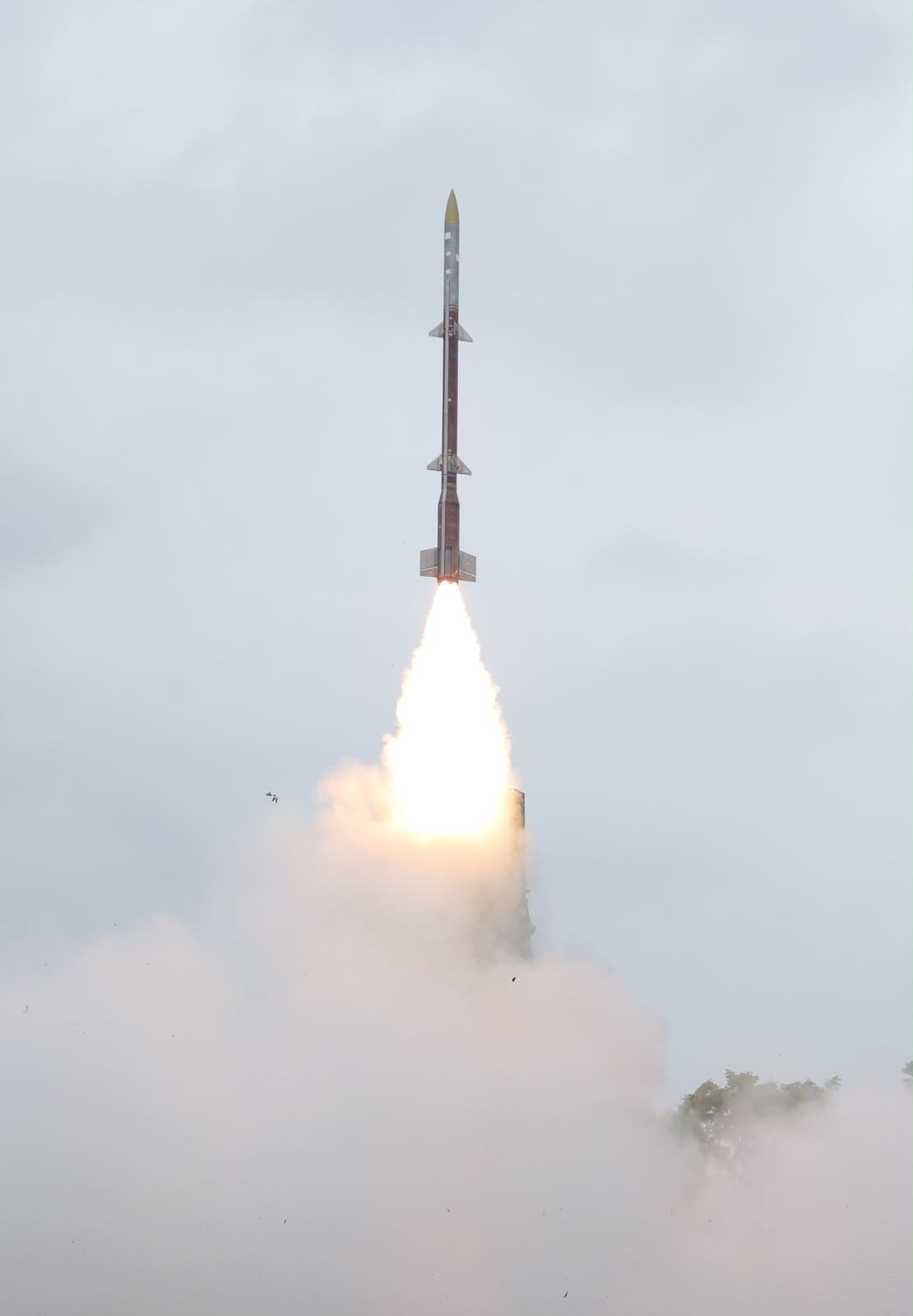
In August 2024, DRDO initiated the fabrication process of 5 M1 missiles (range of 150 km) by placing an order for 20 sets of airframes, 20 sets of rocket motors, 50 sets of kill vehicles (warheads), on-board and ground transceivers for telemetry. In May 2025, Bharat Electronics Limited (BEL) commenced manufacturing the missile system prototype (to be completed in 18 months), followed by user trials for around 36 months. Finally, the first launch took place on July 23, 2026, against the planned timeline of early 2025. The launch details have been cryptic and do not specify operational data other than successfully confirming the test.
The first trial for the M1 missile has been done, and more will be in the pipeline; the trials of the missiles M2 and M3 may happen in 2027 and 2028, respectively. The phased induction of all three missiles may likely happen by 2030, keeping in mind the testing delays, even though DRDO has been requested by the IAF, post Operation Sindoor, to fast-track the development of this missile system.
Project Kusha is India’s attempt to build an indigenous air defence system which is comparable to the US Terminal High Altitude Area Defense (THAAD), Russian S-400 Triumf, and the Chinese HQ-9 system. The Russian and US systems have matured over 30 to 40 years and are designed to protect critical assets over an area from aircraft, missiles, and drones, while the HQ-9 is a successful Chinese copy of the Russian S-300 system with similar performance. Their development origins, operational philosophy, design level, and usage have matured over time. The Indian Kusha system aims to replicate the S-400 system, with an inventory of three classes of interceptor missiles. The Kusha radar surveillance and guidance system will also enable the Kusha missile batteries to “interact” and cooperate with the Integrated Air Command and Control System (IACCS) operated by the Indian Air Force.
Path Ahead
The first trial has initiated the development and consolidation phase, with more tests of the M1 missile and trials of the other M2 and M3 interceptor missiles over the next 3 to 4 years. The priority will be to complete development by 2030 and commence induction. The timelines are delayed, but if it holds true even with a delay of 2 to 3 years, then it has the potential to fructify as the backbone of India’s air defence architecture well into the 2030s. Further, it will mark the entry of an indigenous, Indian-designed integrated area defence system and an important milestone in India’s journey towards self-reliance in high-end defence systems. As aerial threats evolve, from stealth aircraft and drones to hypersonic missiles to swarm drones, the effectiveness of the Kusha system will depend not only on the ability of the interceptor missile to kinetically intercept under battle conditions but also on the robustness of the integrated radars and the air defence shield it will aim to provide. In that sense, the Kusha is much more than the interceptor missile programme; it is a small step to test India’s ability to design, integrate, and operationalise an indigenous air defence ecosystem which is comparable to its peers around the world.
(Disclaimer: The views and opinions expressed in this article are those of the author and do not necessarily reflect the position of the Centre for Aerospace Power and Strategic Studies [CAPSS])