Author: Air Vice Marshal GK Mohan, AVSM (Retd)
Keywords: Drone Warfare, Air-Mindedness, Distributed Air Power, Joint Doctrine, Integrated Air Defence
Introduction
A cheap, expendable aircraft is no longer a contradiction in terms. In February 2024, six small Ukrainian uncrewed surface vessels sank the Russian missile corvette Ivanovets in the Black Sea.1 No sailor risked capture. No pilot risked a shoot-down. A platform costing a fraction of its target achieved an effect once reserved for a submarine or an air strike. This is not an isolated curiosity. It is the leading edge of a broader shift: drones are becoming, in effect, Special Forces industrialised, and every service that owns one is quietly acquiring a sliver of air power, whether it says so or not.
That claim needs unpacking before it can be tested. It is not an argument that drones have replaced Special Forces, or that they have replaced manned aircraft. It is narrower and more useful: a drone that infiltrates contested space, observes, deceives, or strikes is performing a Special Forces-type mission using an air-power toolkit, at industrial rather than boutique scale. Understanding that toolkit, not simply buying the airframe, is what decides whether the mission succeeds.
The Special Forces Analogy, Tested
Special Forces earn their reputation through scarcity: exceptional selection, years of training, and a readiness to accept extreme personal risk for a disproportionate effect. Drones borrow the effect without the scarcity. In the 2020 Nagorno-Karabakh war, Azerbaijan’s Bayraktar TB2 drones and Israeli-made loitering munitions destroyed more than one hundred Armenian main battle tanks, degraded Armenian air defences, and fed live imagery into unguided artillery fire, on a defence budget under two billion dollars.2 No Special Forces operation in that conflict produced comparable effect, at that price, without a single soldier crossing the line of contact.
The Russia-Ukraine war has pushed the logic further. Ukraine manufactured an estimated 1.2 million first-person-view drones in 2024 alone, at a unit cost as low as a few hundred dollars, against artillery and armoured systems worth millions.3 Independent analysis attributes roughly two-thirds of destroyed or damaged Russian equipment to drone strikes rather than conventional artillery or armour.4 Production has climbed further since, with think-tank estimates suggesting Ukrainian output could approach five million drones in 2025.5 That is not a boutique capability. It is an industrial one, and it behaves like one: attritable, replaceable, improvable between production batches rather than between generations.
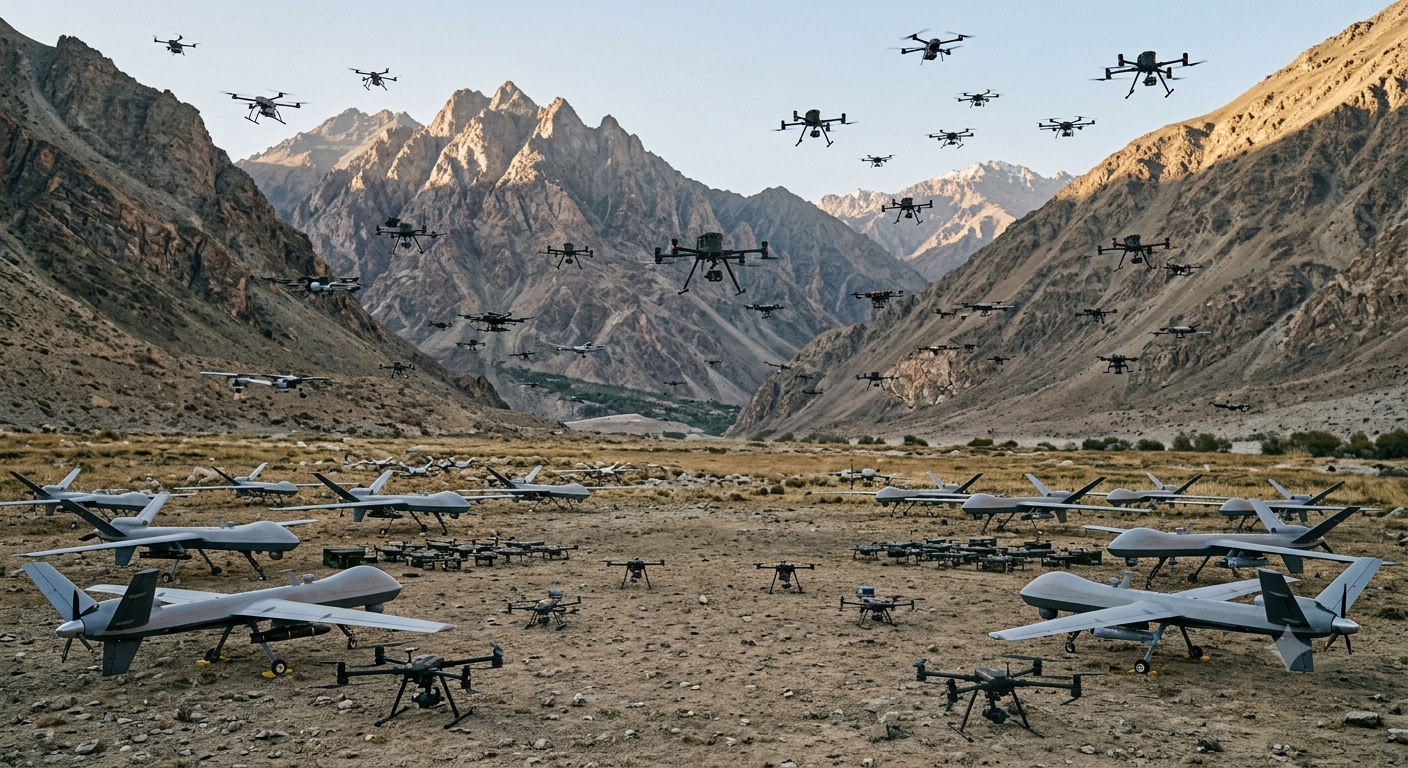
Two features distinguish this from ordinary attrition. First, ambiguity: a drone lost over contested territory rarely triggers the diplomatic and domestic costs of a captured or killed operator. Second, reach across every domain at once. Houthi forces in the Red Sea have deployed aerial, surface and, since February 2024, underwater drones against shipping and naval escorts, forcing navies to defend against a threat that can approach from above, alongside and beneath the waterline simultaneously.6 A Special Forces team cannot occupy three domains at once. A distributed drone force, in principle, can.
A System, Not a Gadget
None of this works if a drone is treated as an isolated object. Its intelligence, target data, navigation, communications, and electronic-warfare support all come from somewhere else, and that somewhere else is the wider air-power architecture: sensors, networks, mission planning, manufacturing and, increasingly, software updates pushed to platforms already in the field. Strip that architecture away and a drone reverts to what critics have long feared it would become: expensive, disconnected flying artillery.
The United States Air Force’s Skyborg programme made this logic explicit. Rather than build an exquisite platform meant to last decades, it designed uncrewed aircraft with lifespans measured in months, deliberately accepting attrition in exchange for lower cost and faster iteration, feeding directly into the Collaborative Combat Aircraft programme, which now targets more than a thousand such aircraft.7 The value was never the airframe. It was the willingness to lose the airframe without losing the capability it represented.8
Air power has a cultural habit that reinforces this logic, and it predates drones by decades: the debrief. After every mission, fighter pilots gather to interrogate what happened, why it happened and how to fix it, holding themselves to what one former fighter pilot has called “tenacious honesty, not against each other, but against themselves.”9 Ukraine’s drone units have, in effect, industrialised that habit, iterating designs and tactics between production batches faster than an adversary can adapt to any single version. Loss becomes data, not merely damage.
The Doctrinal Test: Air-Mindedness
Buying an airframe is easy. Employing it as part of a system is not. Analysts tracking India’s own drone build-up have flagged exactly this gap: fragmented command arrangements across services, and the absence of a single, unified doctrine for how uncrewed systems should be fought rather than merely fielded.10 A tri-service issue brief published in early 2026 went further, recommending a dedicated joint procurement and doctrine authority, precisely because current arrangements risk duplicated effort alongside genuine gaps in coordination.11
The risk is not hypothetical. A drone employed without reference to a wider air picture can wander into another formation’s engagement zone, trigger a friendly air-defence system, or duplicate an asset already tasked against the same target. None of these is drone problems as such. They are coordination problems that happen to involve drones, and no amount of platform ownership resolves them on its own.
For India, geography sharpens the stakes. A force that must plan simultaneously against Pakistan and China cannot afford three services independently rediscovering the same coordination failures on two active fronts. A drone doctrine written once and applied consistently across both is cheaper than relearning the lesson under fire on the second front after already paying for it on the first.
India’s Working Precedent
India already has a partial answer, tested under fire rather than worked out in a seminar room. During Operation Sindoor in May 2025, the Indian Air Force’s Integrated Air Command and Control System, the Army’s Akashteer network and the Navy’s Trigun system operated together as, in the government’s own description, “a joint operational backbone,” producing a unified, real-time operational picture that let commanders act quickly while reducing the risk of fratricide.12 The Integrated Air Command and Control System (IACCS) itself fused radar, airborne early-warning and ground-sensor data to track incoming threats and assign them to the appropriate interceptor, compressing a decision cycle that would otherwise have depended on manual coordination between services.13 Akashteer performed the equivalent function for Army air-defence units, integrating radars and weapon systems that had previously operated on separate, slower loops.14
This arrangement worked not because one service subordinated its assets to another. Ownership stayed where it belonged. What changed was that the picture, and the coordination built on top of it, became genuinely shared.15 That distinction, between owning a platform and controlling a campaign, is the one a drone doctrine needs to preserve.
A Tiered Framework for Ownership
Extending that precedent to drones argues for a framework built on three tiers rather than one blanket rule. Tactical drones used for reconnaissance, local protection or immediate precision effects can remain organic to the formation that owns them, so long as their effects stay local and their flight paths stay clear of wider air operations. Missions that cross formation boundaries, enter contested or shared airspace, or need electronic-warfare or suppression support should shift to coordinated employment, in which the owning service still tasks the mission. Still, the air component deconflicts it against everything else flying in that space. Missions whose purpose is air superiority, deep strike, or suppression of an integrated air-defence system belong under aerospace-led employment, where campaign authority, not merely airspace management, sits with the service equipped to orchestrate it.
This is not a hierarchy of prestige. It is a hierarchy of risk and dependency. A quadcopter watching the next ridge line creates almost no risk to anyone else’s operations. A strike package penetrating a defended air corridor creates a great deal, and needs the intelligence, jamming and suppression machinery that only a genuine air campaign can supply.
The Bespoke Exception
Every framework needs room for the operation that breaks its own rules. On June 01, 2025, Ukraine smuggled 117 small drones into Russia concealed inside truck-mounted containers, then launched them near airbases thousands of kilometres from the front line, destroying roughly a third of Russia’s strategic bomber fleet in a single coordinated strike.16 No formation owned that mission in any conventional sense. It was planned, rehearsed and executed as a single bespoke event, exploiting a route and a vulnerability that would not survive a second use.
That is precisely the exception a rigid ownership framework must accommodate, and precisely why it cannot become the template. Once exposed, the smuggling method, the control links and the target set are studied and defended against; Russia has since dispersed and sheltered aircraft that were previously left exposed on open aprons.17 Repeating the effect will require the intelligence, deception and suppression machinery of a sustained campaign, not another improvised route across a border. A tiered doctrine should therefore protect the bespoke raid as a rare instrument of surprise, available to whichever service finds the opportunity, while resisting the temptation to generalise a single success into a standing method of employment.
Escalation Control and Its Limits
Proponents of distributed drone ownership sometimes argue that smaller, cheaper platforms make escalation easier to manage: a lost drone costs less, politically and materially, than a lost pilot so that leaders can act and de-escalate at lower risk. There is real substance to this. Classic analysis of coercive air power identifies the ability to raise costs on an adversary while retaining the ability to pause, calibrate or stand down as central to why air power succeeds as an instrument of pressure rather than blunt destruction.18 A genuinely attritable platform extends that logic further down the escalation ladder than a manned strike aircraft ever could.
The same feature cuts the other way. A lower political cost of employment can also lower the threshold for employment, and an adversary facing swarms of ambiguous, hard-to-attribute drones may find a calibrated response harder, not easier, to judge correctly. Operation Spiderweb illustrates both sides of that coin at once: it demonstrated exceptional control over escalation, since Ukraine chose precisely which aircraft to strike and when, but it also demonstrated to Moscow that no airbase, however distant, could any longer be treated as sanctuary, a lesson that itself invites a harder-to-predict response.19 Nagorno-Karabakh and the Red Sea add further evidence of decisive tactical effect; none of the three cases shows that cheaper platforms make escalation management easier by default. What determines the outcome is still the doctrine governing when, and under whose authority, those platforms are used, not the platforms themselves.
Conclusion
Drones have not displaced air power. They have distributed it, stripped of some of its cost and scarcity while keeping its essential character: reach, precision, networked effect and the ability to concentrate force without staying concentrated. That is a genuine democratisation, and every service is right to want a share.
What determines whether that share becomes a strategic asset or an expensive liability is not who owns the airframe. It is whether the owning service has absorbed the air-mindedness that turns an isolated platform into part of a system: a shared picture, a coordinated airspace, and a doctrine that knows when to hold a drone close and when to hand its employment to the component built to orchestrate an entire campaign. India’s own experience during Operation Sindoor shows this is achievable without collapsing service identity into a single uniform. It has not yet been written into a standing tri-service doctrine for drones specifically, and that, more than any acquisition decision, is the gap that now matters most.
(Disclaimer: The views and opinions expressed in this article are those of the author and do not necessarily reflect the position of the Centre for Aerospace Power and Strategic Studies [CAPSS])
Author Biography:
AVM GK Mohan AVSM (Retd) was commissioned into the fighter stream of IAF in June 1989. He is a Qualified Flying Instructor, and an alumnus of College of Defence Management and NDC Bangladesh. In a career spanning 37 years, he commanded two fighter airbases and one ADDC. His last assignment before hanging up the uniform was as the ADG Acq Tech (Air) in the Acquisition Wing, Ministry of Defence.
Notes: