Author: Gp Capt RK Kashyap, Senior Fellow, CAPSS
Keywords: Operation Epic Fury, GCC, Aerial Policing, Air Control, Richard Armitage
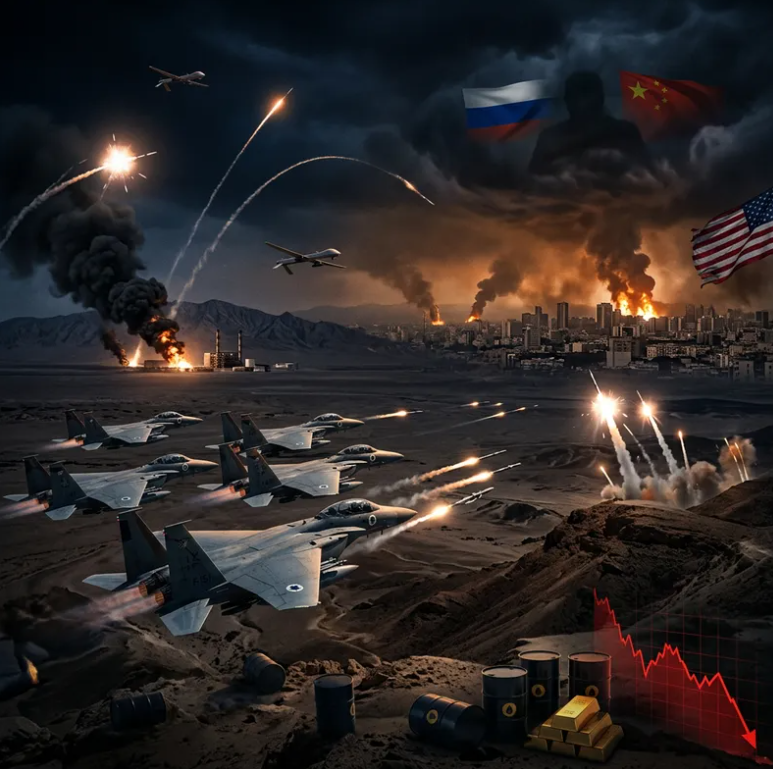
The stated aims of the United States of America (USA) for action on Iran, as defined by its Secretary of War, Peter Hagseth, were: “The mission of Operation Epic Fury is to destroy Iranian offensive missiles, Iranian missile production, destroy their navy and other security infrastructure, and (ensure) they will never have nuclear weapons.” The effect so far has been to neutralise Iran’s Navy and security infrastructure, as well as eliminate air opposition to US forces, which are operating with effective impunity in Iranian airspace. The US Air Force has lost only two manned aircraft due to hostile ground fire in the air, with another eight heavy and transport aircraft damaged or lost on the ground due to missile attacks. The entire stated loss of unmanned aircraft has been 24 MQ-9 Reaper Drones and one MQ-4C Triton long-endurance maritime surveillance drone. These multi-mission surveillance and strike drones have borne the brunt of the losses to the integrated Iranian air defence systems. The Iranian’s have launched approximately 4,500 one-way attack drones and missiles at US forces and its regional allies since the onset of the conflict in late February 2026. The vast majority of these launches (roughly 83 per cent to 90 per cent) targeted Gulf Cooperation Council (GCC) member states, and some hit US military installations in Jordan, Bahrain, Kuwait, and Qatar. It has also damaged international shipping in the Gulf of Hormuz.
Looking back in history at a paper by Admiral Edmond Slade on the Petroleum Situation in the British Empire, one finds it illustrative of the entire Western thought on this subject even today, recalling then Imperial Britain’s wartime aims to obtain possession of all the oil-bearing regions in Mesopotamia and Southern Persia. After World War I, the League of Nations mandate over Iraq was assumed by colonial Britain and its occupation was devoted to harvesting the newly found oil through conscription and heavy taxation, which led to a unified Sunni-Shia uprising sometime in May 1920. As tribal militias besieged British garrisons, even destroying a column near the town of Hilla, Britain responded with overwhelming force. The Royal Air Force (RAF) conducted relentless bombing and machine-gunning of insurgent positions and urban centres, causing approximately 6,000 Iraqi deaths and ultimately quelling the rebellion by late 1920 through Aerial Policing and Chemical Weapons. Despite this, the British found the occupation too costly to sustain, even as it was being funded by revenues drained from colonised India.
At the 1921 Cairo Conference, Winston Churchill, then the United Kingdom’s (UK) Secretary of State for the Colonies, devised a strategy of “Air control.” Under the RAF Iraq Command, the military substituted large ground garrisons with airplanes. Whenever a tribe refused to pay taxes or rebelled against the authorities, aircraft were dispatched to bomb and strafe their encampments and livestock. Historian David Omissi documents that honourable British commanders, including a young Arthur “Bomber” Harris (who would later lead World War II’s Bomber Command), regularly deployed delayed-action bombs and even considered the use of mustard gas to subdue resisting populations.
The world, since then, has moved towards the necessity of avoiding civilian deaths in armed conflicts. The rise of civil media and the spread of representative governments have also given rise to the belief that most democracies do not have the stomach for body bags. In light of this, Western interventions in Asia and Africa in pursuit of their peaceful interests have also, post-World War II, led to the coalescing of European interests in applying the US military sword arm against the so-called recalcitrant unfortunate nation. The US logic “If you are not with us, then you are against us” applies conversely too: when no nation opposes US military actions, it also shows acquiescence to US actions. It is under such circumstances that the ability of the US military power to force this subjugation of Iran has become tottered.
The commentariat is also favourable to the modern David, i.e., Iran, treating any launch of drones and missiles, however minimal the damage to US forces, as a victory against the modern Goliath. The regime change in Iran was never the stated aim of the US (it may have hoped for regime folding like Venezuela), though most of Iran’s military hierarchy along with its political leadership was neutralised in the initial days of war. The American hope has been that the replacement Iranian leadership will be amenable to a grand bargain with the US government and a nuclear-defanged Iran, like a neutered bullock, will be gradually allowed its sovereignty under guardianship with the old game of harvesting its vast oil reserves. This task is ongoing and may still come through with the supine brokership of cohorts like Asim Munir. Munir is the perfect candidate, as some 20 years ago, Richard Armitage had delivered the “Bomb back to stone age” ultimatum to another military ruler of his country and who else can teach the Persians the folly of thinking otherwise, especially after the second and threatened further rounds of kinetic punishment through air targeting of infrastructure and whatever is left there to target in Iran.
Pacification through air is what will happen in further rounds of air strikes on Iran, and more may follow before the recalcitrant behaviour is modified to everyone’s satisfaction. When the founding Supreme Leader of Iran decrees that removing Israel is a religious necessity, then a nuclear Iran is not in the world’s interest of peace. While what is being witnessed is not pleasant, this is how the conduct of warfare has evolved from outright occupation, which has proved to be a costly affair for the occupier in terms of boots on the ground (and associated casualties), against the groundswell of opposition in a dogmatic society where a white man’s burden holds no charm or applause. US has probably learnt from its experience in Iraq, and old friend Britain notwithstanding, what others may pretend to know about it. Meanwhile, more strikes are available at short notice in Trump’s World.
(Disclaimer: The views and opinions expressed in this article are those of the author and do not necessarily reflect the position of the Centre for Aerospace Power and Strategic Studies [CAPSS])