
Author: Ms Sanaa Alvira, Research Associate, Centre for Aerospace Power and Strategic Studies
Keywords: Quantum, Computers, Sensors, Communications, Nuclear Security
Quantum technologies (QT) are set to transform the world. The ideas behind them are not new, and the basic concepts of quantum physics date back to the earliest years of the twentieth century. Over the last century, the transition from a conventional to a quantum view of the physical world was marked by the first quantum revolution, during which scientists discovered that matter and energy behave very differently at the atomic and subatomic scales. Here, light behaves as both a wave and a particle, electrons can exist in multiple locations simultaneously, and two particles can remain mysteriously connected despite the vast distances between them. This marked a significant shift in our everyday understanding of reality.
Understanding these properties gave us lasers, transistors, magnetic resonance imaging, and semiconductors. Now, a new quantum revolution is underway: instead of simply relying on quantum effects, scientists are learning to control them directly by using properties such as superimposition and entanglement to build new kinds of computers, sensors and communication systems.
These advancements are set to transform the way we live and work in a myriad of ways, and and the nuclear field is no exception. In recent years, artificial intelligence (AI) and its nuclear connections have taken centre stage in conversations about emerging technology, and understandably so. There are real concerns surrounding AI, with the rapid pace of its development, the inadequate and slower pace of its governance, and the loss of meaningful human control over nuclear command and control systems being among the most consequential. However, while most (if not all) eyes are on AI, quantum technologies are also gathering pace and could prove to be just as – and possibly more – significant for the nuclear field in the years ahead.
This explainer sets out what quantum technology is and how it is likely to affect the nuclear field.
The Quantum Basics
Although it was once considered to be something out of a sci-fi novel, quantum mechanics is now universally accepted as the most accurate description of the microscopic world. It is the physics of small things: atoms, electrons and photons. Quantum technologies seek to exploit this corner of physics to provide some advantage – whether it’s in computing, or an increased advantage in sensing or an advantage in how information is transmitted.
They achieve this by leveraging two properties that have no equivalent in everyday life: superposition and entanglement. Superposition means that a quantum particle can exist in multiple states simultaneously, rather than just one or the other, and only settles into a single outcome when measured. The common rough analogy is a coin spinning in the air, which is neither heads nor tails until it lands. Entanglement is a form of correlation between particles. Once two particles become entangled, they remain connected even when separated by vast distances, and the state of one cannot be described without reference to the other. Einstein famously described this as “spooky action at a distance,” and the experiments that confirmed it won the 2022 Nobel Prize in Physics.
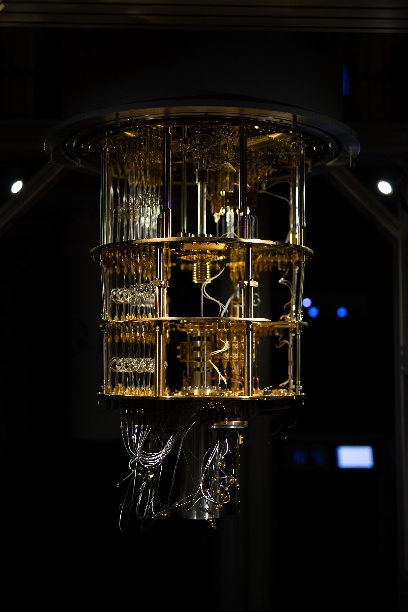
These strange behaviours allow quantum technologies to do things conventional technologies cannot. A classical computer stores information in bits, which is either a 0 or a 1. A quantum computer uses quantum bits, or qubits, which exploit superposition to hold both states at once. This lets it work through an enormous number of possibilities at the same time rather than one after another, and thus allows for quantum computers to easily find the most efficient pathway through multiple destinations. In practice, this could mean breaking a common form of encryption – also known a 2048-bit RSA key – would take a classical computer around 300 trillion years, while a quantum computer could (in theory) do it in under eight hours. This same key protects medical records, financial transactions and national secrets.
Alongside quantum computers, experts believe we’re now at the dawn of an age of widespread quantum sensors. Quantum sensors detect and measure changes in magnetic fields using quantum effects that make the sensor extremely precise and sensitive. These sensors can be used for a whole range of applications, from early warning of earthquakes or volcanic eruptions to next generation brain-imaging that could provide ground-breaking insights for battling dementia. Finally, there is quantum communications, which uses the principles of quantum physics to secure and enhance communication protocols. Here, the challenge is how to protect the information that is being transmitted today from a future in which an attacker has collected encrypted information to decrypt later, in what is called “harvest now, decrypt later.”
The Quantum-Nuclear Nexus
Quantum technologies have now largely moved out of the lab and into the focus of commercial companies and investors. States have collectively committed billions of dollars to quantum research, and analysts expect defense applications to arrive before commercial ones. The importance of treating quantum technology as a strategic asset is already being emphasised, and proposals are being put forward to secure the specialised electronics, cooling equipment and rare materials on which quantum hardware depends. Most recently, in September 2026, the North Atlantic Treaty Organisation (NATO) released a public summary of the quantum technology roadmap its Allies approved in July, setting out how the Alliance intends to understand and integrate quantum computing, communications and sensing. Few fields have more at stake in how this situation develops than the nuclear sector, where these technologies affect deterrence, peaceful applications and verification alike.
It is uncertain as to how soon this becomes a practical problem. No machine capable of breaking today’s encryption exists, and estimates suggest that a cryptographically relevant quantum computer could arrive by the 2030s. It is useful to think about the risks by weighing three periods against each other: how long information must stay secret, how long a migration to new encryption takes, and how long before the threat materialises. This presents a sobering calculation when applied to the nuclear field. As these technologies mature, they present new types of challenges as well as opportunities to the field of nuclear disarmament, arms control and non-proliferation. For example, quantum cyber threats could pose risks to nuclear facility systems, where information confidentiality and authentication are paramount. Future quantum computers could allow adversaries to compromise the encryption used to protect sensitive nuclear information.
Sensing poses a different kind of challenge, and it is closer at hand. In the same way that radar changed air warfare in Europe during World War II, quantum sensors will change air and sea warfare. Quantum magnetometers and gravimeters could “make the ocean transparent” and be used to detect submarines, thereby compromising the survivability of the sea-based deterrent. In fact, these sensors impact all nuclear weapons systems that rely on stealth. It could also locate concealed tunnels and bunkers, and identify nuclear materials. However, it is worth noting that much of the anticipated capability remains theoretical. Current technologies are limited by noise and interference, and evasion techniques are advancing alongside detection capabilities.
There are opportunities too. Quantum-assisted navigation could enable submarines to remain submerged and on course for longer, thereby strengthening sea-based deterrents. Quantum communications, and quantum key distribution in particular, offer new ways to protect sensitive nuclear systems against the very threats that quantum computing creates. Quantum computing itself could accelerate reactor design and the modelling of nuclear materials, work that would benefit civilian energy programmes, including for future fusion reactors. Additionally, quantum sensors – which are much nearer to commercial deployment – could aid non-proliferation and disarmament efforts through strengthened verification efforts.
When, Not If
The question is no longer whether quantum technologies will reach the nuclear field, but when, and on whose terms. Right now, however, there is a gap between promise and practice. This gives the nuclear community something it did not have with AI: time to prepare. Managing the risks will largely fall to governments and national regulators, some of which are already exploring more anticipatory approaches to keep pace with technological change (as NATO’s roadmap shows). Quantum should not be considered in isolation either, since its interaction with AI could compress decision-making timelines and raise the risk of miscalculation in a crisis. Ultimately, a simple principle must be kept in mind: humans must remain the central and final users of such technologies.