
Author: Air Vice Marshal Prashant Mohan VM (Retd), Additional Director General, CAPSS
Keywords: Drone Warfare, Precise Mass, Asymmetric Warfare, Counter-Drone Defence, Swarming and Autonomy
Abstract
Drones are now a feature of almost every conflict. This Expert View examines how conventional militaries use drones to restore precision mass and speed. Production capacity, networked kill chains and rapid adaptation have become sources of combat power, while control of the air has split into layers and rear areas are no longer safe. Weaker states and armed groups such as the Houthis use drones to impose costs, threaten economic targets and erode the enablers of stronger forces. Both exploit the same change: a sharp fall in the price of contesting the air, sea and information space. Yet evidence from Ukraine and Yemen suggests that drones prolong wars rather than decide them. They make war cheaper to fight but no easier to win. For India, the paper draws five lessons, from hardening air bases to faster acquisition and a clear doctrine on airspace control.
Introduction
Twenty years ago, the armed drone belonged to a handful of wealthy states. It flew over insurgents who could not shoot back, and its operators sat on another continent. That era has ended. Drones now appear in every conflict. By October 2025, Ukraine alone was deploying about 9,000 of them a day. Groups with no air force at all, such as the Houthis, have used drones to hit oil plants, air bases and shipping lanes. The pace of change has outrun doctrine.
Two patterns stand out. Conventional militaries are using drones to rebuild mass and speed. Weaker states and armed groups use them to raise the costs for stronger opponents. This Expert View examines both. It asks a simple question: what have drones changed in war, and what have they left untouched? The answer offered here is that drones have made armed conflict far cheaper to fight but no easier to win. They alter its cost and tempo much more than its outcome. That distinction matters for every state, India included, that must prepare for both patterns at once.
The General Archetypes
Precise Mass and the Cost Race
Precision-guided weapons used to be scarce and were expensive. So, it was used sparingly. Ukraine has reversed that logic. Its firms made about 1,200 drones in 2022 and about 1.7 million in 2024. Reported output for 2025 approached four million. Plans for 2026 call for at least seven million. Drone units are said to form about a fifth of Ukraine’s force personnel. Across both armies, drones are now estimated to cause 70 to 80 per cent of daily combat losses. Mass has returned to the battlefield, this time with built-in precision. Production capacity, rather than inventory, is becoming one of the measures of combat power.
Defence against drones has followed the same path. Ukraine reports that interceptor drones costing about USD 1,000 to USD 3,000 now bring down roughly 70 per cent of the Russian one-way attack drones. The idea has travelled. Within about eight days of the 2026 conflict with Iran, the US Army ordered 13,000 interceptor drones of Ukrainian design. Lasers are the next step. In July 2026, the Pentagon awarded USD 86 million for prototype lasers to counter swarms and cruise missiles. New systems in the 20 to 30 kilowatt class are designed to defeat small and medium drones, and a laser is limited by its power supply rather than by a magazine of missiles. The contest, then, is not simply cheap attack against costly defence. It is increasingly a race between two forms of cheap mass, and the side that produces faster gains the advantage.
The Contested Sky
Air power doctrine has long treated air control as a single condition. The drone war has split it into layers. Reconnaissance aircraft operate high, strike drones operate in the middle band, and small first-person-view drones fly just above the ground. A force may own the upper sky and still lose the band beneath it. For air forces built around a high-value aircraft, that is a sobering thought. The loss of a single tanker or an AWACS can be felt across a whole theatre.
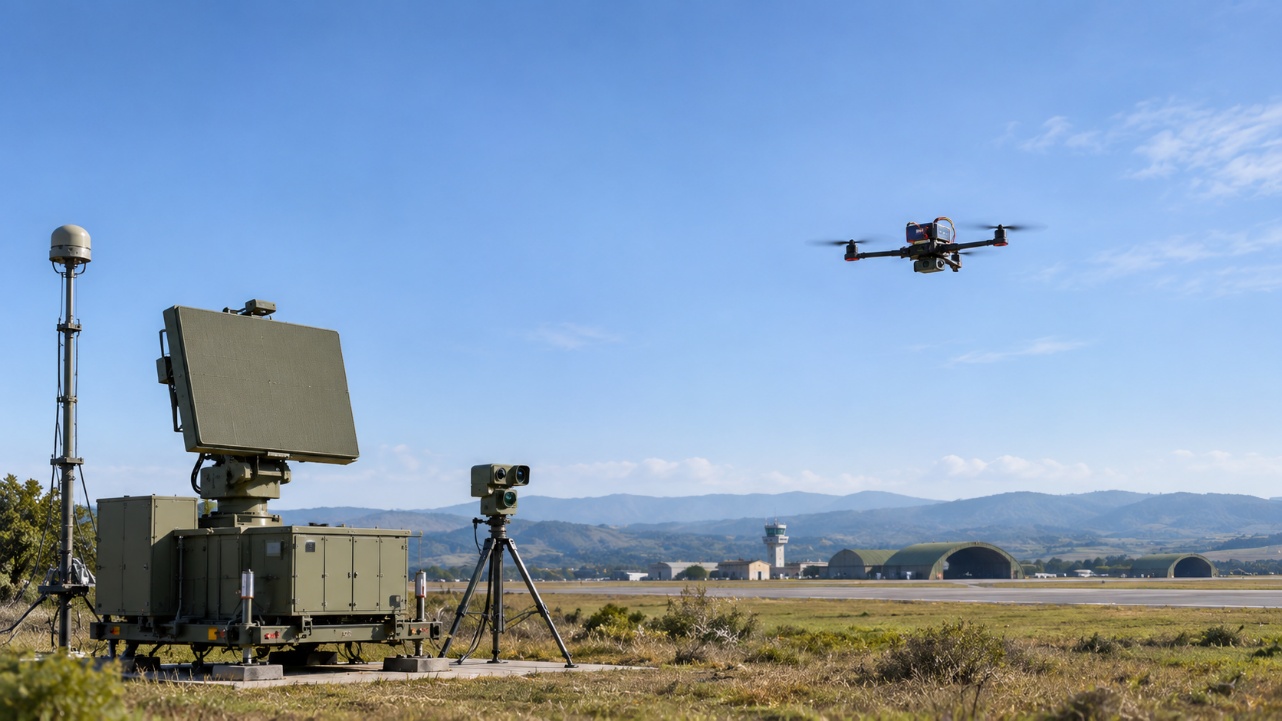
Depth no longer protects either. In June 2025, Ukraine launched drones from trucks inside Russia against four air bases, and its sources claimed hits on more than 40 aircraft. At sea, Ukrainian surface drones and missiles have targeted Russia’s Black Sea Fleet. Aircraft on the ground and ships in harbour are now within reach of systems that cost a few thousand dollars. Passive defence, through shelters, dispersal and decoys, has regained an importance it lost during decades of uncontested air superiority.
Speed, Adaptation, and the Defender’s Edge
Ukraine’s Delta system merges drone video, signals intelligence, satellite imagery and reports from troops, compressing the kill chain. With data moving this way, the gap between detection and strike can shrink to minutes or even seconds. The value now lies in the network behind drone(s). The reverse is also true. A network that can be jammed, spoofed or penetrated may fail all at once, which is why so much of the contest has moved into the electromagnetic spectrum.
Persistent surveillance has also made massed manoeuvre costly. Russian forces have largely abandoned large formations in favour of small assault groups. For now, the weaker may hold the edge, but not if better counter-drone cover and deception could reopen room to manoeuvre.
Adaptation has become a weapon in its own right. Ukraine had seven drone manufacturers in 2022 and at least 500 by 2026. Its makers update software and hardware three or four times a year. Major US acquisition programmes, by comparison, often take around twelve years. It is learning versus buying.
Autonomy and Swarming
Electronic warfare is pushing the next shift. Jamming defeats drones that depend on a radio link. One Ukrainian answer has been the fibre-optic drone, which made up about 32 per cent of its strike drones by April 2026. The longer-term answer is autonomy, in which groups of drone act on a single human instruction. China’s Jiutian, a large unmanned aircraft able to carry six tonnes, first flew in December 2025. Chinese media has shown it releasing swarms, although that role remains unproven. Swarming raises the hardest question in the field: how far targeting decisions can pass from human hands. There is no international consensus. India, for its part, holds that existing international humanitarian law is adequate.
The Asymmetric Models
A different logic applies when the weak use drones against the strong. Winning battles is rarely the aim. The purpose is to raise costs, create risk and narrow an opponent’s choices.
Precision within Reach of the Weak
Commercial drones improve every year in speed, range and endurance. One study of 22 common models found that 20 could lift a load equal to a 40-millimetre grenade. Armed drone attacks by non-state groups have run into the hundreds in peak years. The barrier to precision strike is no longer technology. It is access to parts, intent and training. Such diffusion also complicates export control, since the same airframes are dual purpose. The diffusion is uneven, however. Turning a hobby drone into a dependable weapon still demands testing, spare parts and trained operators, and that is often where state support enters.
Cost Imposition as Strategy
For weaker actors, imposing cost is the strategy itself. The 2019 alleged Houthi strike on Saudi Arabia’s Abqaiq and Khurais facilities briefly halted more than half of the kingdom’s oil output. In the Red Sea, the US Navy fired interceptors costing about USD 2 million at drones worth a fraction of that. A Shahed-type drone costs USD 20,000 or more. Every such exchange favours the attacker, and a defender who relies on costly missiles alone will run short of money or munitions before the attacker runs short of drones.
Reusable drones push the price lower still. After the Houthis introduced them in 2021, their drone attacks inside Yemen rose. Economic targets offer the best return. About three-quarters of Houthi drone attacks on shipping have been intercepted, yet the campaign still disrupted trade through the Red Sea. Interception, in short, does not cancel the economic effect. For a weak actor, the threat to trade can be worth more than any damage to a warship.
States use the same method. In March 2026, Iranian drones and missiles destroyed an E-3 airborne warning aircraft and damaged tankers at a Saudi air base. Analysts described this as a campaign of air denial aimed at the enablers of American air power
Improvisation and Massed Attack
Armed groups have also learnt to combine weapons. Between 2019 and 2021, Houthi attacks pairing drones with missiles on military camps were about three times as lethal as drone attacks alone. The drone finds and fixes the target; the missile delivers the heavier blow. Massed attacks have spread as well. In April 2024, Iran launched about 170 drones in a coordinated barrage against Israel. Defences designed to engage targets one at a time struggle against such volume. Even when a barrage is largely defeated, it consumes interceptors and attention that the defender cannot quickly replace.
Patrons and Limits
The word “asymmetric” needs care. The Houthis and Hezbollah are believed to rely on Iranian designs and know-how, supplemented by Chinese-sourced commercial parts and lessons drawn from Ukraine. Their capability therefore rests partly on a state’s industrial base. Pressure on the patron and its supply lines may achieve more than interception alone.
The limits are equally clear. Years of drone warfare have not brought the Houthis a decisive military victory. Their heavy use of drones in the 2021 Marib offensive did not deliver the city. Drones impose cost and disruption well. They have not replaced the conventional strength needed to win a campaign.
One Shift, Two Faces
These two sets of patterns share a root. Drones have cut the price of contesting the air, the sea and the information space. A state building drones by the million and a militia striking an oil plant are exploiting the same change. Their purposes differ. Strong states use drones for mass, speed and control of escalation. Weaker actors use them to impose cost and shift risk onto their opponents.
The record also points to a shared limit. Ukraine’s drone revolution has not ended its war, and the Houthi campaign has not settled Yemen’s. In both cases, drones have helped one side absorb pressure and raised the price of every advance. On present evidence, they tend to prolong wars rather than decide them. That is the sense in which drones make war cheaper to fight but no easier to win. Evidence from two wars is still a work in progress, and future gains in autonomy may yet shift the balance. For the moment, however, the drone looks more like an amplifier of endurance than an instrument of decision.
Implications
India has already met both faces of this shift. In June 2021, alleged Pakistani drones dropped explosives on the Air Force Station at Jammu. During Operation Sindoor in May 2025, Pakistan sent between 300 and 400 drones towards 36 Indian locations in a single night. India has begun to respond. In June 2025, the Ministry of Defence signed emergency contracts worth INR 1,982 crore covering counter-drone systems, low-level radars, and loitering munitions. Five broader lessons follow.
First, air bases, parked aircraft, and radars need hardening, dispersal, and point defence against cheap drones. Second, counter-drone defence should be judged by cost per kill and also the likely target. If drone(s) are heading towards a high-value target, it has to be brought down irrespective of cost per kill. Third, production capacity and secure supply chains matter as much as the quality of any platform. Fourth, acquisition must move at the speed of adaptation, through short trials and frequent small orders. Fifth, doctrine must settle how much human judgement stays in the loop before autonomy forces the question. For the Indian Air Force in particular, the immediate airspace over its own bases must be defended as deliberately as the upper sky.
Conclusion
None of this makes manned aircraft, armour or artillery obsolete. Drones significantly influence military operations by altering how forces are deployed and safeguarded. However, the most successful states will not necessarily be those with the largest number of drones. Instead, success will depend on their ability to efficiently produce, integrate, and replace drones more swiftly than their adversaries can react. Additionally, these states must be prepared for prolonged conflicts that may extend beyond initial expectations.
*****
(Disclaimer: The views and opinions expressed in this article are those of the author and do not necessarily reflect the position of the Centre for Aerospace Power and Strategic Studies [CAPSS])