Author: Wg Cdr Ashu Saxena
Keywords: Thucydides, Peloponnesian War, Hubris, Iran
Introduction
The “Peloponnesian Wars” is an ancient treatise detailing the events and elucidations that took place two millennia ago. It was written by an Athenian general named Thucydides, during his exile days. His narration covers a period in the Greek world, engulfed by war between the two dominant city-states, Sparta and Athens. His narrative of critically selected events in war was meant to endure through time. It is a well-known document in the realm of international relations and is referred to frequently for understanding various geopolitical events in the contemporary world.
Thucydides quotes “The absence of romance in my history will, I fear, detract somewhat from its interest; but if it be judged useful by those inquirers who desire an exact knowledge of the past as an aid to the understanding of the future, which in the course of human things must resemble if it does not reflect it, I shall be content. In fine, I have written my work, not as an essay which is to win the applause of the moment, but as a possession for all time.” [1] What is the continuity from the past as an aid to understanding which Thucydides is pointing to? As per Thucydides, the nature of human-kind is constant and predictable; it is cyclic and repeats itself in due course of time. He brought about objectivity in history and compiled it as a source of knowledge for future generations as an enduring treatise.
Many contemporary realities can be related to the Peloponnesian War. The rise of Athens and the subsequent expansion of its empire, reaching its greatest heights, which an empire could achieve, its emboldened behaviour and audacious expeditions can be related in great similarity to the United States (US) ambitions. Specific incidents from the Peloponnesian War draw similar parallels in the present-day US behaviour. Thus, revisiting the ancient text would help us relate history to present-day realities and predict future outcomes in this uncertain environment, which has mysteriously engulfed the entire world.
The Athenian empire was characterised by its unique democracy and naval might. It finds its roots in the Delian League, which was a system of tribute-paying nations for common interests in the region. Over time, the league, with Athens at the helm, began expanding its territories. The Hegemonic intentions of Athens transformed the league into a vast empire through its imperialistic ambitions. As Robert Gilpin in his book, War and Change in World Politics states that “A state will attempt to change the international system if the expected benefits exceed the expected costs” (i.e. if there is an expected net gain).”[2] He further states that any development that increases power and enlarges the state’s opportunity to increase its revenues will encourage political or economic expansions. In the case of the Athenians, their expansion was fuelled by highly mobile and agile naval might, which exerted its supremacy in the Mediterranean Sea. Their tactical dominance in naval warfare was unique and a capability possessed by a few. This factor had a great impact in showing their military prowess, controlling economic activities, and establishing an order to dominate and control the region.
The US, in a way, draws an interesting resemblance to ancient Athens. As per Alfred Thayer Mahan, two important requisites for a strong naval power are healthy commerce and a powerful navy. The US possesses both. It also meets what Mahan has identified as six conditions affecting the sea power of a nation, i.e. its geographical position, physical conformation, extent of territory, population, character of people, and character of government.[3]Both nations came to prominence through a unique manifestation of chance. The removal of Spartan general Pausanias and subsequent withdrawal of Spartans from further war efforts against Persia brought Athens to the global stage. The Athenians grabbed the opportunity and emerged as heroes in battles against Persia. The US, on the other hand, emerged as the sole victorious nation capable of influencing and dominating the new world order post-World War II.
Peloponnesian Wars
Megarian Decree (Economic War)
Megara was an ancient Greek city-state placed strategically between Athens and Corinth. It was a key ally of the Spartans and shared frontiers with Athens. In the year 432 BCE, Athens, under the leadership of Pericles, imposed economic sanctions on Megara.[4] For the global public, Megara was punished for cultivating sacred land, killing an Athenian general and supporting Athenian exiles. However, the hidden intentions were to deteriorate Sparta and its allies. This can be counted as one of the earliest instances of economic warfare. This continuity is seen even today, where the US has imposed heavy economic sanctions on countries under the pretext of security concerns with ulterior motives of controlling oil trade in West Asia.
Melos (The Melian Dialogue)
The events which occurred in the year 416 BC and beyond greatly resemble the environment which exists today. During this period in the Peloponnesian Wars, Athens subjugated Melos, and the ensuing debate brought about the hubris of Athens during the epitome of its empire. Athens actions against Melos pointed to early instances of realism that “While strong do what they can and weak must suffer what they must.”[5] This posture by Athens is spelt out by Robert Gilpin, who states that, when a state expands economically and politically, it subsumes willing and unwilling, both of economic value or not. The US has demonstrated similar behaviour recently when it carried out an invasion of Venezuela and put forward intentions of territorial claim on Greenland. Taking over Venezuela not only met its energy needs but also deterred other sanctioned states from supporting the US adversaries.
Sicilian Expedition
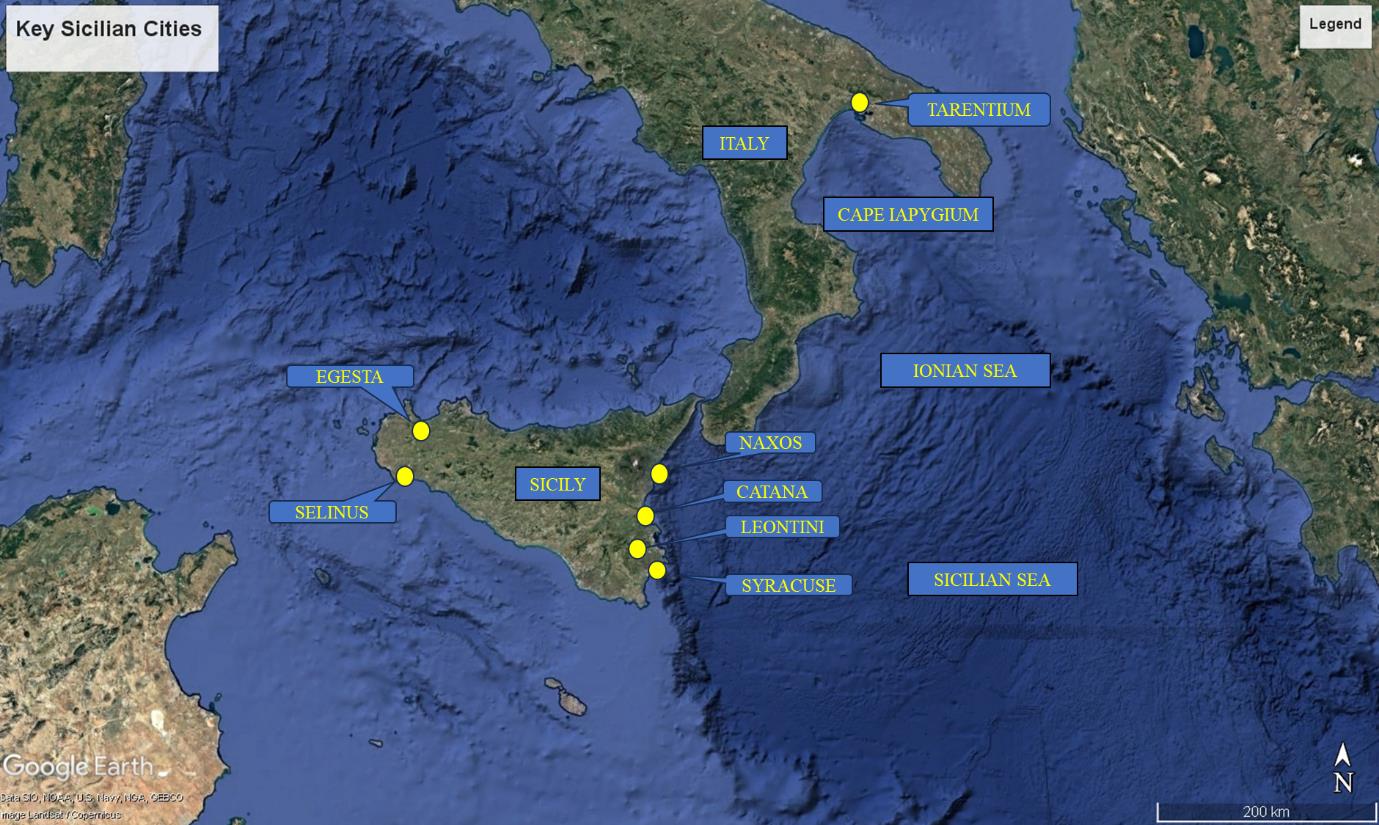
Figure 1. Key Sicilian cities
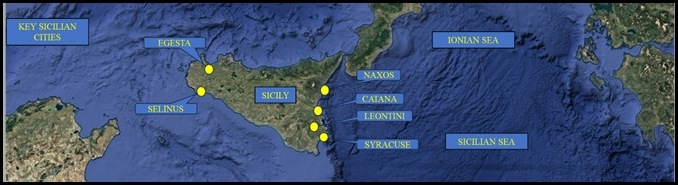
In the same year after conquering Melos, Athens resolved to sail once again to Sicily. This expedition has unique lessons to offer that are highly relevant in the contemporary world. The Egestaeans (Fig 1.) approached Athens for support in their war against the Selinuntines. The Selinuntines entered into an alliance with the Syracusans, a regional power in Sicily. The Egestaeans pitched the Syracusans as a potential threat, given their malicious intent to rule Sicily and their Dorian roots (Peloponnesians), which was a concern for pro Athenian states. The Eegestaeans also promised to furnish money for the war in Sicily. Athen agrees to the proposal post the arrival of envoys who were sent to verify facts on the ground. Although falsified information, Egesta was able to persuade Athens into war, after which a council was assembled to consider the preparations for sailing to Sicily.
Three generals were nominated for the Sicilian expedition. However, among them, Nicias and Alcibiades arguments during the deliberations deserve attention. Nicias proposed a restraint approach, not to enter into others ‘wars. He emphasised that respite from plague and war should be used to consolidate their own state rather than fighting a war for someone else. Refuting Nicia’s proposals, Alcibiades, on the other hand, managed to convince the assembly that the Sicilian expedition would be an easy war, and Athens, with all its might and valour, should sail to Sicily rather than follow Nicias’s passive policy. He stated, “We cannot fix an exact point at which our empire shall stop, we have reached a position in which we must not be content with retaining what we have but must scheme to extend it, for if we cease to rule others, we shall be in danger of being ruled ourselves.”[6] Hearing Alcibiades propositions, requests from Eegestaeans and Leontine’s exile request, Athens prepares for the expedition.
Meanwhile, in Syracuse, Hermocrates advised the council that the Athenian threat would manifest anytime. Their aim was to subjugate Sicily under the pretext of helping the Egestaeans and Leontini. He asked to be aware of this situation, at the same time, not to get afraid, as a common enemy would unite them all. He further stated that the Athenian audacious expedition would face logistical issues in establishing itself in Sicily. He advised sending envoys to Italy and Carthage to join hands against a common enemy. He also advocated for taking support from Corinth and Sparta in terms of military aid and continued to engage Athens in Hellas. He then proposed a plan to meet the Athenians at Tarentum and the Iapygium promontory (Italy). This entailed creating a defensive base at Tarentum and using the positioning to blockade the passage to Sicily.
West Asia Crisis (Sicilian Expedition-II)
This entire episode can be related in a big way to present-day world realities. Nicias and Alcibiades’ personalities parallel those of Republican President Donald Trump and Democratic President Barack Obama. In a recent address to the nation on April 02, 2026, President Trump said, “I want to thank our troops for the masterful job they did in taking the country of Venezuela in a matter of minutes, which was quick, lethal, violent, and respected by everyone all over the world. After rebuilding our military during my first term, we have by far the strongest military anywhere in the world. And now we’re working along with Venezuela and are, in a true sense, a joint venture partner. We’re getting along incredibly well in the production and sale of massive amounts of oil and gas. The second largest reserves on Earth after the United States of America. We’re now totally independent of the Middle East and yet we are there to help. We don’t have to be there. We don’t need their oil. We don’t need anything they have, but we’re there to help our allies.”[7]
The above statement relates to emboldened Athens post recent victories, and especially after taking over Melos. The president justifies his actions for helping his allies in West Asia. Alcibiades had done the same while addressing the assembly, vouching for Athens to expand, secure resources and help its allies. He justifies that, “We did not make take them into alliance to have them help us in Hella, but that they might so annoy our enemies in Sicily as to prevent them from coming over here and attacking us.”[8]
President Donald Trump further in his speech criticised President Barack Obama’s passive policy towards Iran regarding the nuclear deal back in 2015 and stated: “I terminated Barack Hussein Obama’s Iran nuclear deal, a disaster.” The nuclear agreement with Iran, formally known as the Joint Comprehensive Plan of Action (JCPOA), was President Obama’s passive policy against Iran. President Obama, in the address to the nation on July 14, 2015, said, “Today, after two years of negotiations, the United States, together with our international partners, has achieved something that decades of animosity have not. A comprehensive long-term deal with Iran that will prevent it from obtaining a nuclear weapon. This deal demonstrates that American diplomacy can bring about real and meaningful change. Change that makes our country and the world safer and more secure.”[9] This situation is similar to what Alcibiades said while addressing the assembly in Athens about the passive policy of Nicias, which he believed should not be followed. Alcibiades emphasised the true character of Athens in the following statement: “My conviction is that a city not active by nature could not choose a quicker way to ruin itself than by suddenly adopting such a policy, and that the safest rule of life is to take one’s character and institutions for better and for worse and to live up to them as closely one can.”
President Donald Trump, during the same speech, tried to convince the American public that previous wars have been long; however, in the present war’, in a matter of 32 days, US have been able to eviscerate Iran, which is no longer a threat to the world. He states, “This is a true investment in your children and your grandchildren’s future. The whole world is watching, and they can’t believe the power, strength and brilliance. The brilliance of the United States military. Tonight, every American can look forward to a day when we are finally free from the wickedness of Iranian aggression and the spectre of nuclear blackmail. Because of the actions we have taken, we are on the cusp of ending Iran’s sinister threat to America, and when we do, when it’s all over, the United States will be safer, stronger, more prosperous, and greater than it has ever been before.” This statement can be related to Alcibiades’ way of luring Athens into easy war (Sicilian Expedition), he cites that Sicilians are politically weak and divided and won’t stand up to the might of Athens naval power. President Donald Trump, in his continuous rhetoric, has stated many times that the US has achieved its all-military objectives and, in a matter of time, we will exit the war. What both Alcibiades and Trump don’t understand is the trap which has been set up by Syracuse (present-day Iran), which would be difficult to escape.
Figure 2. Cape Iapygium
Hermocrates in Syracuse proposed plans to counter Athens. This plan involved meeting Athens in the Cape of Iapygium (Fig 2.), which in modern-day parallels the Strait of Hormuz. His plans of blockading the cape by establishing a defensive base at Tarentum and creating a blockade in a way create a similar situation in the Strait of Hormuz. Iran’s use of ballistic missiles to deter an enemy at the farthest distance is a continuation of a strategy long thought of in the Greek world. Although Hermocrates’s plan was not accepted, the same stratagem was utilised in the battle which ensued in Great Harbour in Syracuse. The absence of NATO allies and the hesitancy of other nations not actively participating in the ongoing war is a similar scenario which happened with Athens when it set course for the Sicilian expedition. The Athenians were denied entry by most of the city-states primarily for two reasons, firstly, this was not the first time that Athens came to Sicily. In the previous Athenian expedition to Sicily, Hermocrates got all of Sicily together to make them understand that war would divide them and make them vulnerable to being subjugated by others (Athens), and secondly, all city-states understood the outcome of an inconclusive war and devastation, which was caused by internal war, fought earlier. In the present situation in West Asia, the countries are passively supporting the war without any active participation due to the same analogy; they have already seen the devastation caused by earlier wars in the region.
Iran has a civilisational history. It is fighting its battle on its own turf, which it masters. Iran keenly monitored the US’s previous engagements in the region and developed efficient measures to counter the threat to its existence. It has followed Deng Xiaoping’s policy, “Hide your strength, bide your time.”[10] It utilised the interwar period to train and build effective tactics to deter foreign aggression. The same analogy can be seen in the battles that were fought in Syracuse. After the initial offensive, when the Athenians retreated, the interwar period was utilised to train the hoplites in efficient war-fighting skills and build a naval armada with critical capabilities to offset the advantage of the Athenians navy. They carefully chose the battle space in their favour, i.e. in Great Bay, to limit the major advantage of Athens, which was offensive manoeuvres. This draws a strong parallel to what Iran is doing in the Strait of Hormuz today.
Continuity-Factors
Overconfidence (Hubris)
The Peloponnesian Wars are replete with instances where this factor emboldened Athens and subsequently led to its demise. Whether it is the imposition of the Megarian Decree, the Melian Dialogues or the Sicilian Expedition. This factor is time-sensitive, as a single incident cannot be attributed as the reason for failure. A unique perspective is given by Dominic D.P. Jhonson in his book Strategic Instincts- The Adaptive Advantages of Cognitive Biases in International Politics, where he treats overconfidence as a positive illusion and a bias which has positive effects, but even he treats this topic with caution and states that, “A modest amount of overconfidence is adaptive. It evolved to become the norm in the population because it represents an advantageous strategic instinct. It may be that, in the modern world, overconfidence leads to failure more often than in the past, and only a few freakish outliers lead to success.”[11] In the present scenario in West Asia, with the US under hubris, whether it will gain or decline is a matter of debate, which can be judged with time sensitivity. However, it leads to another factor: Imperial Overreach.
Imperial Overreach
The Sicilian expedition marked the beginning of a phase that signalled the decline of the Athenian empire. The expedition can be marked as an event which can be stated as an imperial overreach of Athens. Robert Gilpin states, “Expanding state at first increases its power and control over the system; the power of the state and the expansion of its control reinforce one another with the enhanced flow of resources into the coffers of the state. Eventually, countervailing forces come into play to slow down and finally arrest the expansion of the state.”[12] He further states that these “Countervailing forces, as a state increases its control over an international system, it begins at some point to encounter both increasing costs of further expansion and diminishing returns from further expansion; that is to say, there are decreasing net benefits to be gained from further efforts to transform and control the international system. This change in the returns from expansion imposes a limit on the further expansion of a state.” The argument leads us to examine whether the US has attained the state that Robert Gilpin is trying to describe. Is this the Imperial Overreach of the US? The answer to this question lies only in future. We cannot predict the time when it’s going to happen, but we can only be sure that it will happen.
*****
CLICK TO VIEW THE PDF
Notes:-
[1] Robert B. Strassler, Thucydides A Comprehensive Guide to Peloponnesian War (New York: Free Press, 2008), p. XI.
[2] Robert Gilpin, War and Change in World Politics (United Kingdom: Cambridge University Press, 1981), p. 50.
[3] Kevin D. McCranie, Mahan, Corbett, and the Foundations of Naval Strategic Thought (Annapolis: Naval Institute Press, 2021), p. 22.
[4] Strassler, n. 1, p. 587.
[5] Ibid., p. 352.
[6] Ibid., p. 372.
[7] Fox 2 Detroit, “President Trump’s full Address to the Nation on Iran war,” Youtube, April 02, 2026, https://www.youtube.com/watch?v=JPd8GYxk5Zo.
[8] Strassler, n. 1, p. 372.
[9] The Economic Times, “No Nukes for Tehran: ‘Barack Obama’s 2015 Iran nuclear deal resurfaces in 2026 War Barack Obama, remarks on the Iran Nuclear deal,” YouTube, July 14, 2015, https://www.youtube.com/watch?v=W_RKlMSO1O8&list=LL&index=20.
[10] Liu Mingfu, The China Dream (New York: Beijing Mediatimes Books Co. Ltd., 2015), p. 20.
[11] Dominic D.P. Johnson, Strategic Instincts (New Jersey: Princeton University Press, 2020), p. 78.
[12] Gilpin, n. 2, p. 107.