
Author: Gp Capt (Dr) Dinesh Kumar Pandey (Retd), Visiting Senior Fellow, CAPSS
Keywords: IRST, Passive Sensors, EO/IR
Introduction
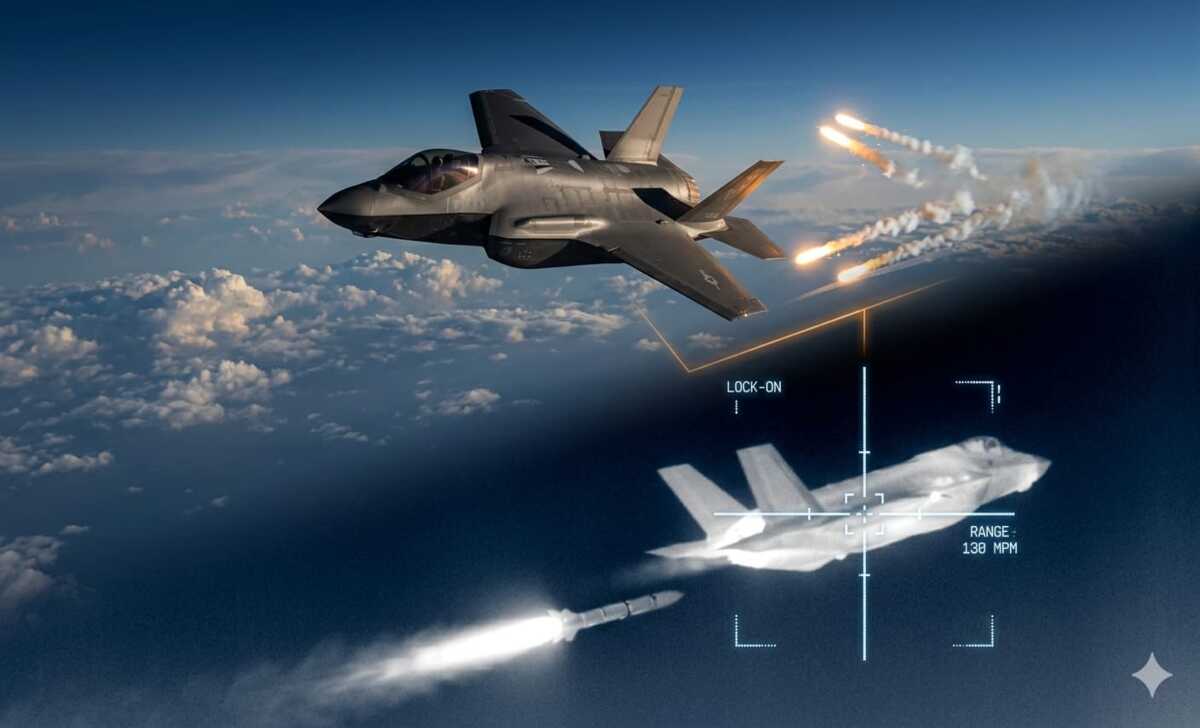
On the night of 19-20 March 2026, the Iranian Air Defence system, using an infrared search-and-track (IRST) based system, was able to track and engage a United States (US). F-35A Lightning stealth jet in a combat mission over Iran. The jet was damaged but managed to recover at a regional US airbase. This was the first time a fifth-generation F-35 fighter aircraft had ever been damaged in combat by an Iranian Air Defence System, and it is proof that stealth jets can be detected by electro-optical and infrared (EO/IR) sensor systems.[1]
What Happened?
An F‑35A, hit by Iranian air‑defence fire, made an emergency landing on a US-controlled airfield in the Middle East, with the pilot reported as being safe though the report mentioned some shrapnel wounds and that he was in stable condition.[2] Iranian and affiliated Islamic Revolutionary Guard Corps (IRGC) media published the thermal imaging video of the F‑35 within the range of an infrared sensor, and then a missile closing in on the plane and exploding.[3]
Iran deployed passive infrared‑guided or electro‑optical/IR air‑defence systems, such as upgraded short‑range point‑defence or anti‑drone missiles like “Product 358” or other 358/359‑series systems, which operate on heat signatures rather than radar, allowing them to track the F‑35 despite its low radar signature.[4]
Techniques and Tactics
The footage also suggests the range was less, maybe a few kilometres, meaning either the F‑35 was low flying, or temporarily in the “infrared kill envelope” of ground-based IR (Infra-Red) guided systems. The IRST-style approach is important because stealth fighters are intended to outsmart radar, but they still emit detectable IR signatures from engine heat skin friction. Iran’s claimed success would represent a move towards multi‑sensor (particularly IR and electro‑optical) threat environments for Western stealth platforms.
The US Central Command spokesman, Navy Captain Tim Hawkins said the incident is being investigated. The F‑35 suffered damage and made an emergency landing during the period of March 19 to 20, but hasn’t made a public statement about the type of weapon that damaged it or if it was solely the IRST’s fault.[5] Independent analysts remind that the evidence is still incomplete and Iran’s claim of a “world first” strike on an F-35 is considered “credible, at least partially successful.[6]
Key Iranian infrared and electro-optical detection and short-range heat-seeking systems are the Misagh-2, Majid, and Herz-9. The Majid air defence system, officially designated AD-08, is an Iranian short-range, low-altitude surface-to-air missile system for point defence against low-flying aircraft, cruise missiles, helicopters and unmanned systems. The missile is 156 millimetres in diameter, 2,670 millimetres in length, weighs about 75 kilograms. It features a passive imaging infrared homing seeker and a proximity fuse, meaning it does not emit radar waves that would warn the targeted aircraft. Detection is performed by electro-optical and infrared sensors out to 15 kilometres, and can be integrated with external radar, such as the Kashef-99 phased-array system, to extend the tracking range to 12 to 30 kilometres and enable simultaneous tracking of multiple targets.[7]
Nevertheless, this marks the first time that Iran’s military has hit one of the USD100 million aircraft since the US. and Israel launched their attack on Iran on February 28, 2026.[8]
IRST Systems
Ground-based IRST systems are special types of electro-optical sensors that are used to detect and track the thermal signature of an aerial target – like an aircraft, helicopter, or cruise missile – without emitting electromagnetic radiation. Ground-based IRST systems are passive and provide high-resolution air defence and situational awareness capabilities without transmitting active radio-frequency pulses, which can be detected or jammed by adversaries.
The use of IRST systems in military systems has grown in recent times, as they are used to counter low-observable (stealth) aircraft and to provide a redundant tracking layer in electronic warfare environments. These systems employ state-of-the-art infrared focal plane arrays to survey the horizon or specific sectors and calculate target coordinates using complex image processing and atmospheric modelling. Although airborne platforms have traditionally been the focus of IRST development, integration into ground-based air defence (GBAD) networks is now a priority for countries seeking to augment their look-up capabilities in response to incoming threats.
The IRST technology has been adopted by multiple countries, with some countries developing their own solutions and others integrating the technology into national security.
France: The Safran Electronics & Defence portfolio, including the Vampire series (e.g. Vampire NG and EONS-NG), is tailored for naval and ground-based surveillance applications, offering long-range detection of both aerial and surface targets.
Netherlands: Thales Nederland manufactures the Sirius IRST system, which is a passive, 360-degree situational awareness system that integrates into land-based defence architectures.
The United States (US): The US military has a number of electro-optical/infrared (EO/IR) systems for ground-based defence in use, such as the AN/AAQ-32 IFTS and specialised versions of the Mark 46/20 Mod 1. Most of these systems are part of point defence installations to augment radar-based missile defence installations.
Many modern air defence batteries are based on distributed aperture principles—a number of infrared sensors are interconnected to provide comprehensive spherical coverage. This approach is comparable to the technology utilised in the AN/AAQ-37 system used on the F-35, but is applied in a stationary or mobile ground installation.
Indian IRST Environment
The IRST technology is primarily being developed on airborne platforms of the Indian Air Force. There is a gap in the Indian air defence architecture in terms of dedicated ground-based IRST units to meet the changing requirements of air defence. The strategic potential of IRST systems may be exploited in their ability to detect targets that are hard to track with radar, including stealth aircraft and those using electronic countermeasures. IRST can improve situational awareness and complement the existing robust air defence layer.
The introduction of IRST could bolster India’s air defence capabilities, complementing existing sensors of multi-layered systems such as the S-400, Akash, SPYDER, and Barak 8, to achieve critical air defence objectives, especially in detecting stealth threats and low-signature targets. Currently, target acquisition and fire control on these platforms are based mainly on active and passive radar arrays, like the Rajendra 3D radar or the EL/M-2084 MMR.[9]
Hindustan Aeronautics Limited (HAL) and Bharat Electronics Limited (BEL), under the ‘Make in India’ programme, inked a contract to co-develop and co-produce a long-range dual-band IRST for Su-30 MKI under the MAKE-II procedure of Defence Acquisition Procedure (DAP) 2020.[10]
The Rafale is equipped with the ‘Optronique Secteur Frontal’ (OSF), also known as ‘Front Sector Optronics’. It is integrated into the airframe’s nose to give the plane a high-resolution, passive, long-range capability to detect. According to well-known aviation literature, the OSF is meant to be a “stealthy” sensor that allows the pilot to detect, track, and identify aerial objects without emitting radiation.[11] The Su-30 MKI employs the ‘Optical Locator System’ (OLS) -30 (or similar variations within the Flanker family), a spherical, ball-mounted IRST sensor situated away from the cockpit centerline.[12]
Implications
IRST systems follow the physics of infrared propagation through the atmosphere. Ground-based systems are sometimes integrated with meteorological sensors. This helps in adaptation of the detection thresholds based on the moisture, dust and cloud content. Passive ground-based sensors are one of the few methods for tracking stealth and/or low radar cross-section (RCS) flying platforms.
The aircraft was not completely destroyed, and the pilot was not injured, but the incident has sparked a worldwide discussion about the survivability of stealth platforms against passive infrared guidance systems, and that the low radar cross-section of the F-35 does not mean it is immune to heat-seeking missiles at close ranges.
The targeting of F-35 would trigger the military equipment designers and developers, and air defence observers to work to balance the technical asymmetry between stealth and air defence, as the threat seems to never end. Secondly, short-range systems designed for point defence can still make a difference in operational events in contested airspace.
Conclusion
Stealth does not mean being invisible but reducing the aircraft’s signature across multiple spectrums – RCS, visual, acoustic and IR/ thermal. In all the spectrums, as passive IR/EO sensors can detect heat without alerting radar-based warnings, which allows “silent” detection and short-range engagements. The survivability of modern air warfare is not just about aircraft technology; it’s also about the density, mobility and integration of opposing air defence networks. Strike Survivability remains under threat; emerging technologies need to address this limitation.
*****
CLICK TO VIEW THE PDF
(Disclaimer: The views and opinions expressed in this article are those of the author and do not necessarily reflect the position of the Centre for Aerospace Power and Strategic Studies [CAPSS])
Notes:-
[1] Alcott Weiin and Seong Hyeon Choi, “Iran detected and damaged a US F-35 stealth jet in combat. Chinese experts map out how,” South China Morning Post, March 20, 2026, https://www.scmp.com/news/china/military/article/3347383/iran-detected-and-damaged-us-f-35-stealth-jet-combat-chinese-experts-map-out-how?utm. Accessed on April 03, 2026.
[2] “US F-35 Stealth Jet Hit: How Iran’s Infrared Systems May have struck the ‘Ghost of the Skies,” Times of India, March 20, 2026, https://timesofindia.indiatimes.com/defence/international/us-f-35-stealth-jet-shot-how-irans-infrared-systems-may-have-struck-the-ghost-of-the-skies/articleshow/129697195.cms. Accessed on April 12, 2026.
[3] Liang Rui and Liu Xuanzun, “Iran says it hit an F-35; Chinese expert analyzes how Iran could have struck it using infrared detection, breaking US stealth myth,” Global Times, March 22, 2026, https://www.globaltimes .cn/page/202603/1357330.shtml. Accessed on April 03, 2026.
[4] “Which Iranian Air Defense System Targeted F-35 and Why russia Was Clearly Involved,” Defense Express, March 20, 2026, https://en.defence-ua.com/news/which_iranian_air_defense_system_targeted_f_35_and_why_ russia_was_ clearly_involved-17891.html. Accessed on April 03, 2026.
[5] Chris Gordon and Stephen Losey, “USAF F-35 Lands After Taking Fire Over Iran; Pilot Stable,” March 19, 2026, https://www.airandspaceforces.com/f-35a-lands-after-taking-fire-over-iran-pilot-stable/. Accessed on April 02, 2026.
[6] Priyanka Shankar, “Has Iran brought down an ‘unkillable’ US F-35 jet?” Al Jazeera, March 23, 2026, https://www.aljazeera.com/news/2026/3/23/has-iran-brought-down-an-unkillable-us-f-35-jet. Accessed on April 07, 2026.
[7] “Iran’s Majid Missile Damages U.S. F-35 in Combat — Heat-Seeking SAM Raises Global Alarm Over Stealth Fighter Vulnerability in Middle East War,” Defence Security Asia, March 21, 2026, https://defencesecurityasia.com/en/iran-majid-missile-f35-hit-stealth-fighter-us-iran-air-defense-2026/. Accessed on April 09, 2026.
[8] “US F-35 hit by suspected Iranian fire, forced to make emergency landing,” South China Morning Post, March 20, 2026, https://www.scmp.com/news/world/middle-east/article/3347217/us-f-35-hit-suspected-iranian-fire-forced-make-emergency-landing?module=inline&pgtype=article. Accessed on April 03, 2026.
[9] Sheershoo Deb, “Full List of India’s Air Defence Systems,” Defence XP, August 23, 2020, https://www.defencexp.com/full-list-of-indian-air-defence-systems/. Accessed on April 03, 2026.
[10] “HAL and BEL to co-develop IRST system for Su-30 MKI,” The Business Standard, April 26, 2022, https://www.business-standard.com/article/news-cm/hal-and-bel-to-co-develop-irst-system-for-su-30-mki-122042600747_1.html. Accessed on April 09, 2026.
[11] Ian Parker, “Resourceful Rafale,” Aviation Tech Today, September 01, 2000, https://www.aviationtoday.com/ 2000/09/01/resourceful-rafale/. Accessed on April 03, 2026.
[12] “Sukhoi (Su) – 30 MKI of Indian Air Force,” Indra Stra, August 31, 2015, https://www.indrastra.com/2015/ 08/ANALYSIS-Sukhoi-Su-30-MKI-of-IAF.html. Accessed on April 03, 2026.