
Author: Ms Smriti Singh Mahajan, Research Scholar, Unni Kartha Chair of Excellence
Keywords: History of IAF Helicopters, Evolution of IAF Helicopters, Mi-4 Gunship, Chetak Weaponisation, IAF Anti-Tank Helicopters, Helicopter Warfare in India, Indo-Pak War 1965 Helicopters, Indian Military Aviation History
Introduction
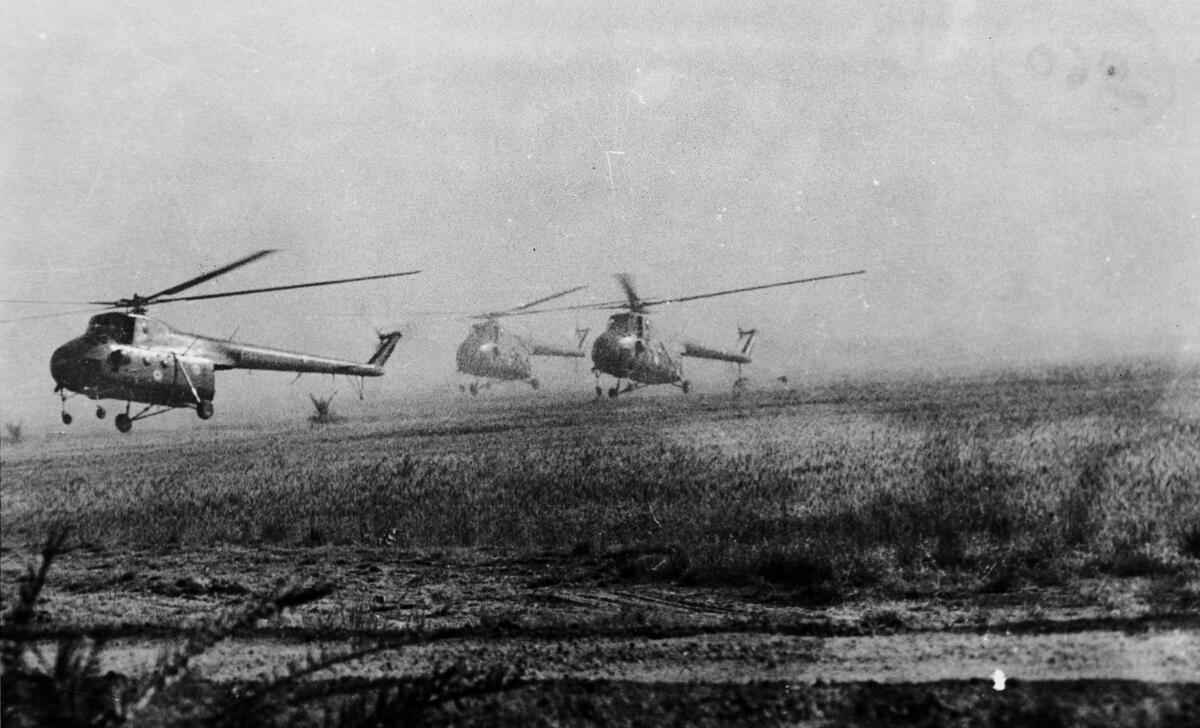
The history of helicopters began like a scene from an old war film—a bulbous, vulnerable craft hovering over a clearing, its rotors scattering dust and grass, a stretcher being pulled aboard as men dive for cover. In the early years, the helicopter was the gentle soul of the battlefield: fragile, vulnerable, expensive, and never meant to kill. Its purpose was mercy, its mission to save.
But history has a dark sense of irony. And on the chessboard of mid-20th-century South Asia, necessity wrote a new script. The machine that started as a rescuer of the wounded, and sometimes be hunted, would within a generation, learn to hunt and return- bristling with rocket pods and guided missiles— transformed by fire, fear, and necessity into one of war’s most versatile predators— descending as combat machines, stalking tanks across the desert.
This is the story of that transformation— of how Sikorsky S-55s and Bell 47s, once known as “friends in distress,” gave way to Alouette-IIIs (Chetaks) armed with anti-tank guided missiles and then to the ultimate war machines like HAL Prachand and Rudra; of the improvised Mi-4 gunships that struck back on battlefields; and of the birth of formal Anti-Tank Guided Missile (ATGM) units within the Indian Air Force. Across the world, others were learning the same hard lessons—in the jungles of Vietnam, the mountains of Algeria, and the deserts beyond. It is a tale of doctrine catching up to combat, of workshops and tireless engineers bending metal and weapons, and of the complex trade-offs in airframe, weight and survivability that turn a rescue craft into an instrument of attack.
I. The Benign Beginnings (1949- 1961): “A Friend in Time of Distress”
When the Joint Planning Sub-Committee first assessed helicopters for the Indian Armed Forces in 1949, the verdict was cautious. Helicopters were mechanically complex and fragile in the eyes of planners, useful primarily for resupplying isolated posts, jungle and mountain rescue, delivering intelligence teams behind enemy lines, and reconnaissance and artillery observation. Their slow, low-level flight profile also made them vulnerable; deployment in forward areas required local air superiority. In short: utility, not combat.[1]
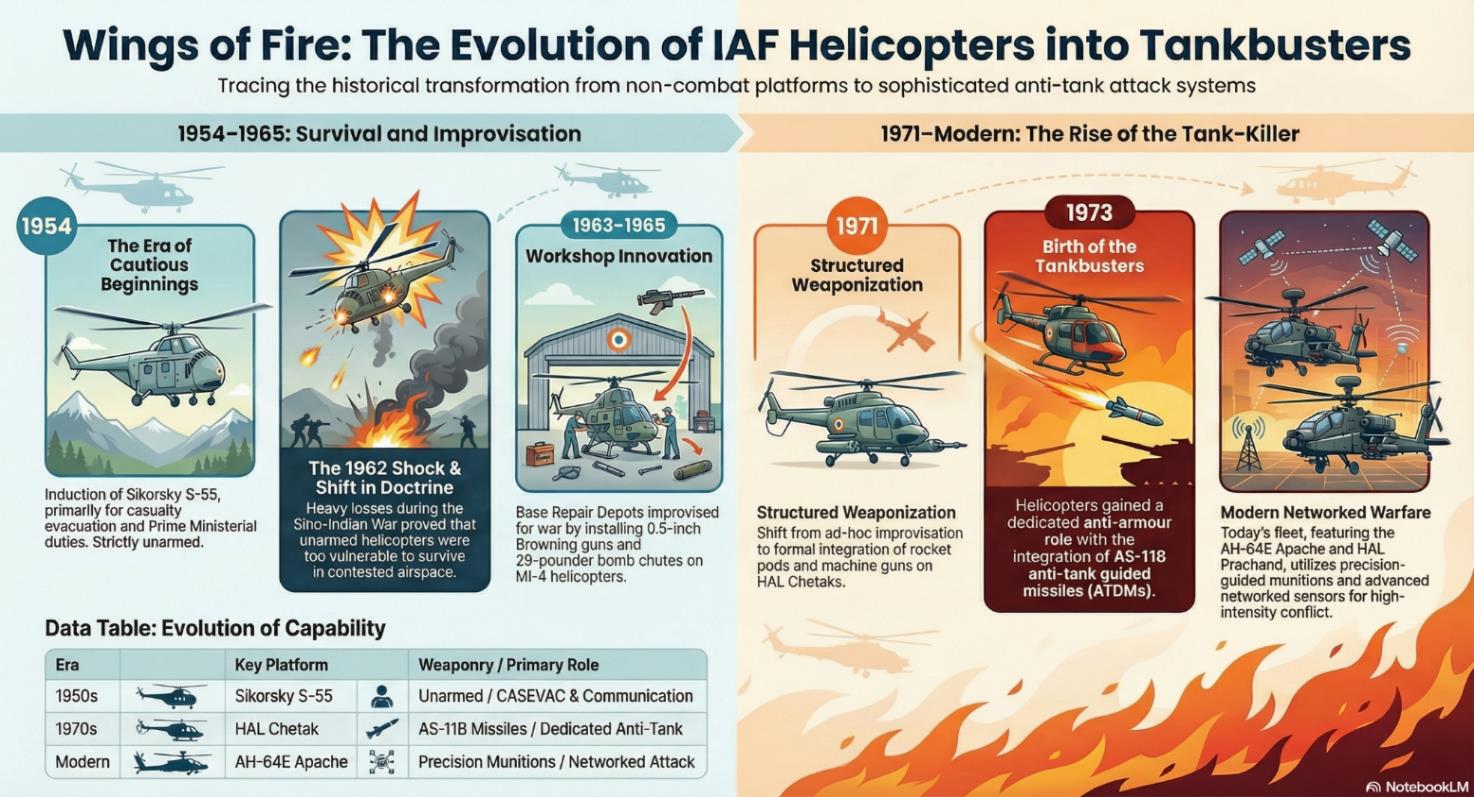
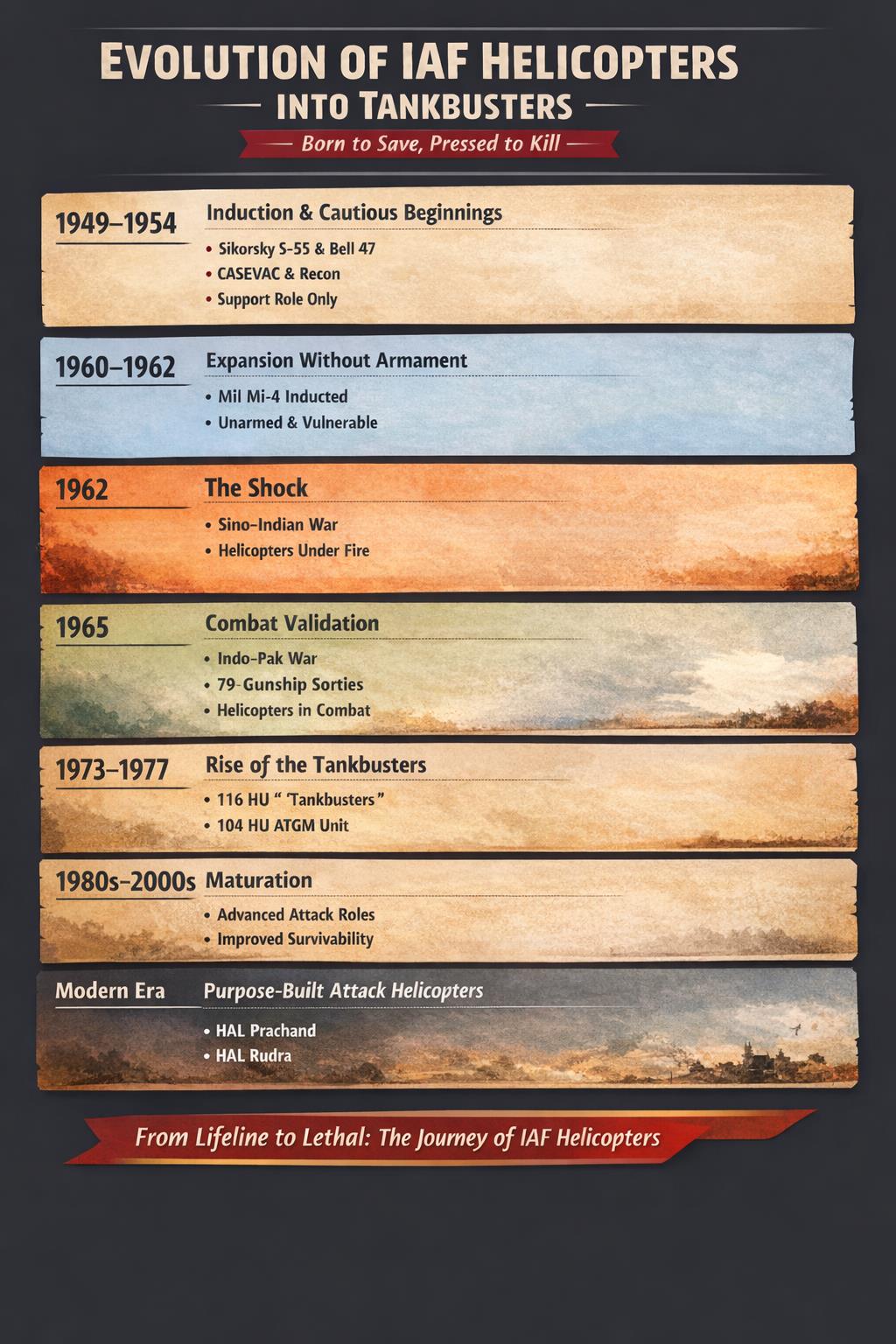
The IAF’s first dedicated rotary wing unit, raised in 1954 as 104 Helicopter Flight, operated Sikorsky S-55s and later Bell 47 G-3s. The unit’s motto and reputation, “Aapatsu Mitram” (friend in time of distress), reflected its original mandate: casualty evacuation, logistics support, communication, and rescue. The Soviet Mi-4, inducted around 1960, expanded its lift capability and range, but it, too, operated as a workhorse in utility roles rather than as a strike aircraft.[2]
The helicopter entered Indian service as a lifeline, literal and doctrinal, not as a predator. But that would change, and quickly.
II. The Shock That Changed Everything: 1962 and the Need to Fight Back
The decisive pivot from “rescue only” to “armed for survival” did not emerge from theory; it was forced by combat experience during the 1962 Sino-Indian War. In forward areas, helicopters- slow, low-flying, and unarmed- became easy targets. Even air ambulances marked with red crosses were fired upon, shattering any lingering assumptions about battlefield immunity.
Aircrews, unarmed and exposed, felt helpless. A lesson unravelled itself for them: survival could no longer depend on markings or mission type. It would require the ability to fight back.
In the years immediately following 1962, this realisation triggered not just a shift, but a profound institutional awakening within the Indian Air Force. What began as a question of survival: how an unarmed helicopter could endure in contested airspace, quickly grew into something far larger. The experiences of that war had exposed a fundamental flaw in existing assumptions: that helicopters could remain. non-offensive assets on a modern battlefield.
This was a turning point. And this set in motion a chain of innovations that would ultimately transform the very character of the IAF’s rotary-wing fleet…
The great wheels started churning not in headquarters, but in workshops. Across the IAF’s network of Base Repair Depots (BRDs), engineers started experimenting with locally engineered solutions. Facilities such as No. 1 Base Repair Depot (Kanpur)[3]– with its legacy of heavy maintenance and wartime salvage dating back to the Second World War- became centres of innovation.
III. 1965: The Birth of a Revolution
By 1965, this culture of improvisation had matured into operational capability. The Mil Mi-4, originally a utility transport, became the platform on which the IAF conducted its first experiments in helicopter armament.
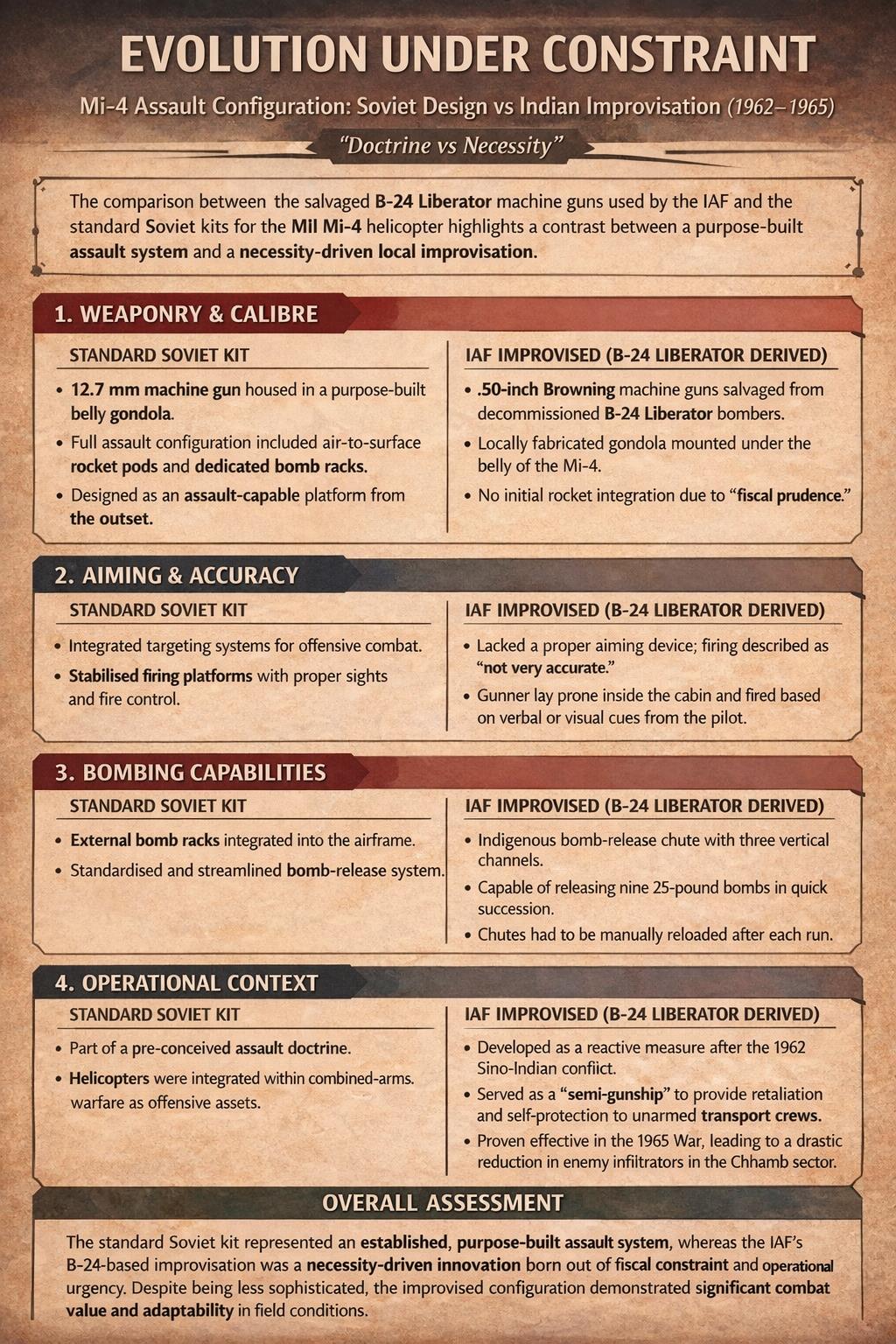
Crucially, these modifications were not the product of a single location. Evidence points to a distributed engineering effort across major technical hubs. No. 1 Base Repair Depot, Kanpur, is widely credited with the successful integration of 0.5-inch Browning machine guns, repurposed from decommissioned B-24 Liberator aircraft[4]– mounted in a belly-mounted gondola. Alongside this, engineers devised a bomb-release mechanism consisting of a chute with three vertical channels, allowing the release of up to nine 25-pound bombs in quick succession. Once the nine bombs were released, the chutes had to be manually reloaded for subsequent passes.
At the same time, unit-level accounts, particularly from No. 104 Helicopter Unit, also state that their helicopters were modified at Chandigarh for offensive roles.[5]
Given that the Mil Mi-4 was available with factory-configured armament options, it is necessary to examine why the Indian Air Force opted for an unarmed transport variant and how this decision shaped the nature of subsequent indigenous modifications.
The answer lies in procurement philosophy and operational context. India inducted the Mi-4 as a pure transport platform, consciously omitting factory-fitted weaponisation packages, largely due to cost considerations and doctrinal assumptions about helicopter roles in the late 1950s. The Soviet Union, by contrast, had already begun conceptualising helicopters as integral battlefield assets, capable of transitioning from logistics to fire support within a unified design philosophy. What followed in India after 1962 was adaptive innovation under constraint. Where the Soviets engineered vertically integrated assault systems, Indian engineers improvised modular, locally fabricated solutions, repurposing legacy systems such as the B-24 Liberator. The result: a “semi-gunship” born out of necessity, decentralised engineering, and battlefield urgency.[6] [7]
Source 1: History of No. 104 HU. Air Force, “Brief History of 104 (H) SQN Formation and First Mission; Wing Commander BS Nijjar, Evolution of IAF Helicopters- I: Inception To 1971 Operations.
The resulting system was crude but effective. The machine gun, fixed under the belly, was fired forward by a gunner inside the cabin, often lying prone, on the pilot’s command. There were no stabilised sights, no fire-control systems, and only rudimentary aiming. Accuracy was limited, and exposure to ground fire remained high, but for the first time, IAF helicopters possessed an offensive capability.
The First Test: War Comes to the Gunship
The true test of these improvised modifications came sooner than expected. In August 1965, as the Indo-Pak War of 1965 escalated, the Indian Air Force found itself confronting a new kind of threat: large-scale infiltration across the Western Front. In response, the IAF assembled a dedicated helicopter task force: drawing aircraft and crews from 107, 109, and 111 HU. Forward-based at Chandigarh, Jammu, and Srinagar, these units were tasked with something unprecedented: using modified Mil Mi-4s not just to support the battlefield, but to shape it… A significant tactical shift, turning previously passive transport assets into offensive “semi-gunships”.[8]
By August 5, the modified helicopters were operational. Within two weeks, on 20 August, they went into action over the Chhamb sector.
A New Way of Fighting: The Multi-Role Gunship
What followed was not a conventional air operation, but a new method of warfare.
Each helicopter sortie blurred the line between combat and support. A Mi-4 would lift off carrying supplies or ammunition for forward troops. En route to or in the vicinity of its destination, it would descend into an attack run, bombing and strafing suspected infiltrator positions or movement routes (using its rudimentary weapons: the belly-mounted 0.5-inch Browning machine gun and the improvised chute that released the 25-pounder bombs)[9]. There were no targeting systems, no stabilised sights, only coordination between pilot and gunner, and the willingness to fly low and exposed.
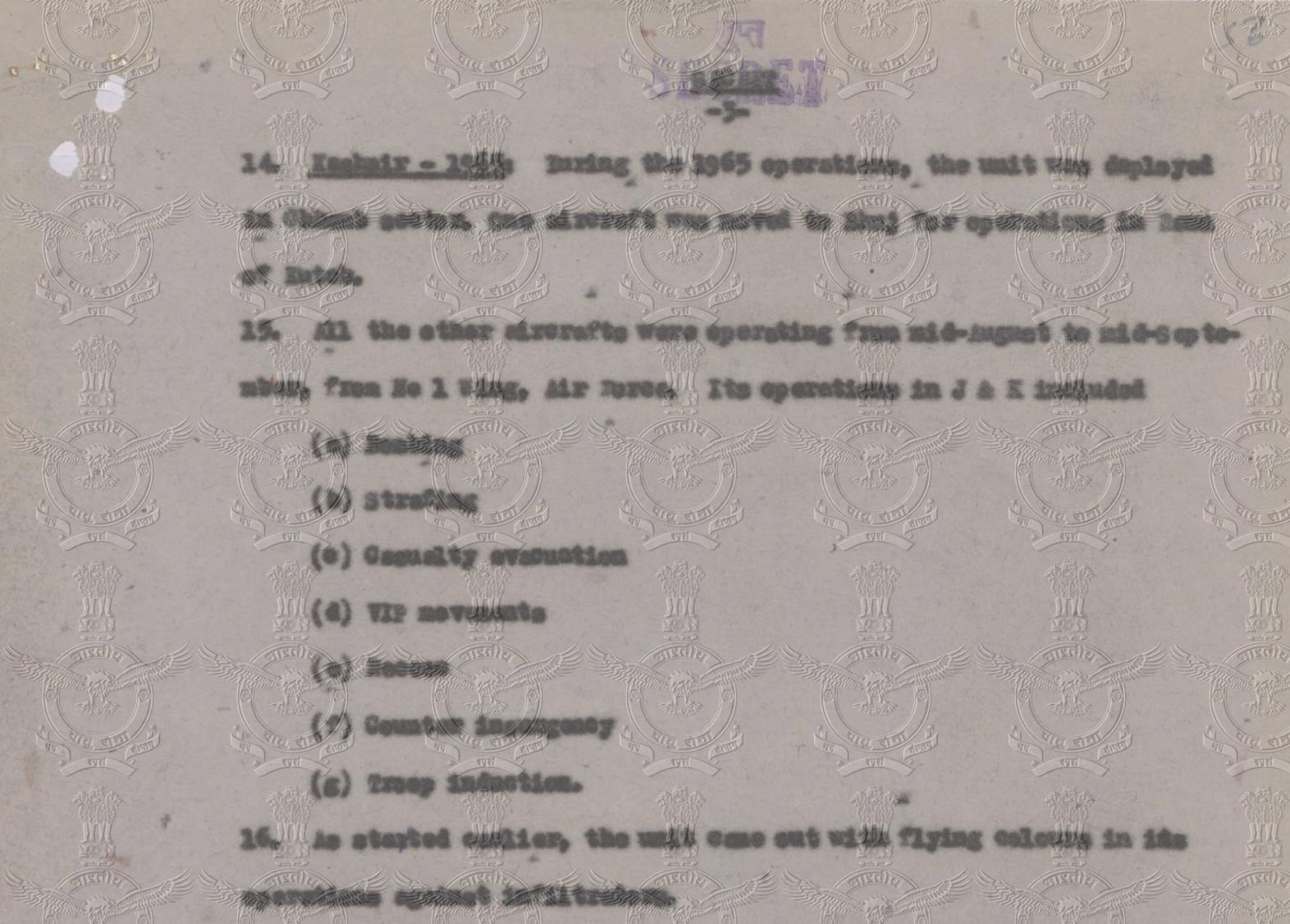
After the attack, the same helicopter would land, often in makeshift clearings barely the size of its rotor span, deliver its supplies, load casualties, and lift out again. Additionally, documents such as the official historical record of 107 HU (compiled under HQ, SWAC) detail the additional tasks the units were executing, including facilitating VIP movements, recce, counter-insurgency ops, and troop induction.[10]
In a single mission, the helicopters had become transport, ambulance and gunship.
Across the campaign, from 20 August until the end of the war, these modified Mi-4 ‘semi-gunships’ carried out 79 offensive sorties in the Chhamb-Jaurian sector, specifically targeting infiltrators with bombing and strafing runs.[11]
Yet, these offensive missions were only one part of a much larger operational picture. Records from No. 109 Helicopter Unit illustrate this vividly: the unit alone flew a total of 225 sorties across all assigned roles during the war (including bombing, strafing, CASEVAC, and supply drops).[12] The IAF helicopters had now evolved into a flexible, multi-role instrument of war.
Measured purely in terms of firepower, the results were modest. Small bombs and machine-gun bursts inflicted limited physical damage. But the psychological and tactical effects were disproportionate. For infiltrators moving across difficult terrain, the sudden appearance of armed helicopters, machines previously associated with evacuation and logistics, introduced immediate disruption and fear. Movements slowed. Routes were abandoned. Reports indicate a marked reduction in infiltration activity in areas where these missions were conducted.[13] [14]
For the IAF, the lesson was even more significant: helicopters could survive in contested airspace and fight.
Source: History of No. 107 HU, AIR FORCE.
This was, by contemporary IAF testimony and reporting, unique: “never before or since then have helicopters of this class been used in this role in the IAF”- a high-risk, high-ingenuity improvisation that forced planners to reckon with new capabilities and vulnerabilities.[15]
However, these operations were not without leadership and courage. Aircrew flew repeated missions under fire, navigating without modern aids, coordinating attacks by instinct and experience. Squadron Leader B. Johnson of 104 HU, who led from the front during this period, was awarded the Vayu Sena Medal for his “incessant efforts.” In 109 HU, Warrant Officer Sansar Singh became the first from his unit to receive the same honour.
In the final assessment, these missions stood apart. They achieved something far greater than their immediate tactical objectives. A foundation was laid here. In 1965, over the dust and heat of Chhamb, a handful of modified machines and determined crews rewrote the role of the helicopter in the future of Indian air power.
IV. The 1970s: From Makeshift to Missiles- Chetaks, Rockets and the First Attack Units
The improvised approach of 1965 demonstrated two things: helicopters could be weaponised, and improvisation was painfully limited. The next step was systematic adaptation- converting light utility helicopters into anti-armour platforms and training whole units in their employment.
1971: Chetaks with Guns and Rockets
By 1971, the IAF’s Aérospatiale Alouette III (locally called Chetak) had become a common light utility helicopter. BRD workshops modified at least one Chetak by fitting a twin-barrel machine gun and rocket pods capable of firing a volley of rockets (reports say seven rockets arranged for paired or salvo firing), an attempt at a compact self-contained striking unit that could operate at night. This was an important precursor to the formal anti-tank mission: the Chetak proved adaptable, small, and agile enough to carry weapons that made a tactical difference.[16]
1973- 1977: The Tankbusters and the Formal ATGM Role
The success of improvised gunships in 1965 and their continued utility into 1971 had already demonstrated that helicopters could survive and influence combat. But by the early 1970s, the IAF recognised another clear tactical requirement: a highly mobile, responsive platform capable of neutralising enemy armour within the Tactical Battle Area (TBA). Fixed-wing aircraft were fast but less flexible; ground forces were powerful but constrained by terrain.
The helicopter offered something different: precision, mobility, and persistence.
And so, 116 HU was chosen to pioneer this role. With that decision, helicopters were no longer an adjunct to combat; they had become part of the fighting arm.
116 Helicopter Unit
If 1965 proved that helicopters could fight, the transformation of 116 HU in the 1970s proved that they could be designed to hunt.
Formed on 27 July 1967 at Air Force Station Sarsawa, 116 HU began its life like most helicopter units of the era- rooted in support roles. Known then as the ‘Whirly Wizards’, it operated the Mi-4 on tasks such as communications, liaison, and casualty evacuation. There was little to distinguish it doctrinally from other units still shaped by the pre-1962 mindset. That would change, decisively.
In December 1973, the unit underwent a transformation that marked one of the most significant inflexion points in the history of rotary-wing aviation in the Indian Air Force. It was re-equipped with the HAL Chetak and, more importantly, assigned a specialised anti-tank role.
In place of the ‘Whirly Wizards’ emerged ‘The Tankbusters’. A name that reflected a new operational purpose and a new kind of confidence in what helicopters could achieve. It was the first IAF unit adapted specifically to fire anti-tank guided missiles from helicopters.[17]
The shift to an anti-armour role was made possible through a carefully engineered integration of guided weaponry onto a light helicopter platform. And for the first time, an IAF helicopter could:
-
-
Stand off from enemy armour
-
Track and guide a precision weapon
-
Deliver a lethal strike without closing into direct fire
-
At the heart of this transformation was the AS-11 missile (SS-11), a wire-guided, command-to-line-of-sight anti-tank missile.
104 Helicopter Unit
In 1977, 104 HU, the oldest IAF helicopter unit, was also re-designated as an ATGM unit. Its Chetaks were modified to carry (the same) four AS-11B (air-launched SS.11/AS.11 family) wire-command guided missiles, providing an effective anti-tank reach of about 3,000 metres.
The AS.11/SS.11 story is worth pausing over. The SS.11 family, developed by France’s Nord Aviation in the 1950s, was one of the earliest widely adopted wire-guided anti-tank missiles. The air-launched AS.11 (sometimes referred to in Indian service variants as AS-11B) came with an air-stable sighting system that made it practical to launch from a helicopter in forward battle conditions; its effective range extended to the order of 3 km, and early warhead variants could penetrate several hundred millimetres of rolled homogeneous armour, sufficient against many Cold War tanks of the era. The family’s adaptability had earlier produced French helicopter-fired ATGM operations in Algeria in the late 1950s and early 1960s- a global precedent India could observe.
But the technology alone was not enough. Pilots underwent intensive training, including dummy and live missile firing, to master guidance techniques, engagement profiles, and battlefield coordination. The units participated in joint Army-Air Force exercises to master tactics for employing these weapons[18]. A new set of tactics was written from scratch because nothing like this had existed in the IAF before.
Other Armament Trials: 119 HU and Display Ranges
Besides those unit conversions, other IAF helicopter units carried out armament trials through the 1970s, experimenting with 57 mm rockets and 75 kg bombs, and integrating rocket and bomb drops into live-fire practices and demonstration events (the IAF’s long-running Fire Power Demonstrations at Tilpat and other ranges were venues where aircraft- fixed and rotary-practised and exhibited armament techniques). The broad pattern of trials, demonstrations and field conversions across units in the 1970s drove doctrine toward formal ATGM wings and greater integration with Army tactics.
V. A Helicopter Becomes a Gunship: Decoding the Changes
You can draw the lineage from a Chetak carrying a handful of rockets to a dedicated attack helicopter like the AH-1 Cobra or a modern Rudra, but the engineering trade-offs are stark and unavoidable. Mounting weapons, pylons or missile rails on a helicopter is not a trivial “bolt-on”: it changes the aircraft’s structure, aerodynamics, flight envelope and survivability.
Airframe and structural work: Hardpoints and rails require reinforced structure where the pylons attach; dynamic loads from rockets and missiles create stress concentrations that utility airframes were not originally designed to handle. Base repair depots that performed early conversions would necessarily evaluate local attachment points, strengthen skin and substructure, and ensure the rotor/drive train would not be overstressed by asymmetric loads. Kanpur’s BRDs, historically the IAF’s major overhaul and repair hubs, were where such modifications were planned and executed.[19]
Weight, balance and flight performance
External pylons increase drag and reduce maximum speed, range and endurance. Payload limits become binding. Adding missile rails and ammunition reduces fuel and troop or casualty capacity and can lower the service ceiling. Pilots and engineers must recompute centre-of-gravity envelopes; an out-of-limits CG can make the helicopter harder to control, particularly at low speed and during hover, when weapons employment is often required. Engineering literature and patents on payload/pylon effects generally show these performance impacts.[20]
Avionics and Sights
A major practical step from improvised guns to guided missiles is the need for stabilised sighting systems. The AS.11 (air variant of SS.11) included a sighting/stabilisation solution enabling a moving helicopter to track a target while guiding the missile along a wire- a huge leap in practical usability compared with an improvised belly gun without proper aiming gear. In short, going from guns to guided missiles requires fire control, sight stabilisation and crew training.
Survivability Modifications
Utility helicopters were notoriously vulnerable to small-arms fire. The US Army and others quickly produced survivability guides in the 1960s–70s that recommended local armour for crew stations, redundancies for critical systems, self-sealing fuel tanks, and tactics that reduced exposure. Many of these lessons are generalisable and would have informed any effort to turn IAF helicopters from evacuation machines into strike platforms- even if the IAF’s early conversions were necessarily minimalistic.
Taken together, weaponising a helicopter is a cascade of changes: from reinforced structure and degraded flight performance to new avionics and a direct need to improve crew protection. Those are engineering realities, not doctrinal choices, and they explain why purpose-designed attack helicopters (or thoroughly rebuilt utility platforms) eventually became the logical endpoint of the ad-hoc path that began in the 1960s.
VI. Global Parallels: India’s Path Followed a Pattern
What happened in India mirrored global lessons. Two parallel strands stand out:
(a) France and the SS.11/AS.11 experiments: French forces experimented with the SS.11 and AS.11 on light Alouette helicopters and small fixed-wing types in the Algerian conflict in the late 1950s and early 1960s- arguably the first use of a guided anti-tank missile fired from aircraft. Those experiments demonstrated the feasibility of mounting relatively heavy anti-tank firepower on light airframes and provided early engineering solutions (sighting stabilisation, wire guidance) that later users adopted. The AS.11 family’s very existence as an air-launched variant was an early template India could study.
(b) The US experience: Huey gunships to the AH-1 Cobra: In Vietnam, the UH-1 “Huey” started as a utility ship that rapidly acquired guns and rocket pods as field improvisations (door gunners, gun-pods and rocket racks) to support ground troops. That combat improvisation drove the development of a dedicated attack helicopter, the Bell AH-1 Cobra (first flown 1965; in service 1967), a narrower fuselage, tandem crew, stub wings for ordnance and a purpose-designed gun turret- the archetype of the modern attack helicopter. The Cobra’s development shows the evolutionary path from field-modified utility helicopters to purpose-built attack platforms.[21]
(c) Soviet Developments: The Soviet Union moved in parallel by adapting transport and assault helicopters with weapons and by eventually fielding purpose-built types (e.g., later the Mi-24 Hind family). The global trend was clear by the late 1960s–1970s: combat conditions had shown both the need for helicopter fire support and the limitations of merely bolting weapons onto utility frames.
India’s story fit into these global contours: early observation and transport roles to field improvisation under fire, to systematic conversions and training, to eventual adoption of missile-armed tactics and later acquisition/development relevant to purpose-built attack rotorcraft.
VII. The Human Element: Workshops, Pilots and the Doctrine Catching Up
Two groups deserve the credit line in any honest account: the technicians who turned theory into hardware and the pilots who trained until the near-impossible became routine.
The IAF’s Base Repair Depots, Kanpur among them, were the sites where real modifications happened: adapting bomb chutes, fabricating mounts, and testing gun pods under operational pressure… The gritty work of skilled maintainers and engineers solving real battlefield problems with what they had.[22]
On the flying side, pilots of early ATGM units, such as 104 HU, trained for months with both dummy and live firings to master the new weapons and the tactics of Army-Air cooperation. The learning curve was steep: missile guidance in a moving, vibrating platform; coordinating with ground forwards; and shaping manoeuvres to expose tanks while minimising vulnerability. The creation of unit identities- the Tankbusters, the Desert Hawks- shows a doctrinal as well as cultural metamorphosis inside IAF squadrons.
VIII. Where the 1970s Left Off. And What Followed
What began as improvisation under fire did not remain improvisation for long. The lessons of 1962 forced a reckoning; the experiments of 1965 revealed a possibility; and the structured developments of the 1970s turned that possibility into doctrine.
By the end of that decade, the Indian Air Force had crossed a decisive threshold. The helicopters were no longer merely a lifeline to the battlefield; they had become a participant in it… Precision platforms that could reach out three kilometres and threaten enemy armour from unexpected axes.
But the deeper story is not about machines. It is about a shift in thinking.
What emerged from those years was a profound realisation: that vulnerability could be engineered out, survivability could be designed in, and that even the most unlikely platform could be reshaped into a weapon system through necessity and ingenuity.
Today, that lineage is visible in indigenous platforms such as the HAL Prachand, India’s first purpose-built combat helicopter, designed for high-altitude warfare and capable of anti-armour and multi-role strike missions, and in the weaponised HAL Rudra, where sensors, guns, rockets and guided missiles are fully integrated into a single combat system. The ongoing integration of indigenous systems such as the HELINA anti-tank guided missiles further underscores how far that journey has progressed.
From the workshops of Kanpur and Chandigarh, to crude gun mounts and hand-released bombs, to pilots flying low over Chhamb, discovering in real time what their aircraft could become, the helicopter in the Indian Air Force was not designed to be a predator.
It was compelled to become one.
And in that compulsion, in that adaptation, lies one of the most consequential and least acknowledged revolutions in Indian air power.
*****
CLICK TO VIEW PDF
Notes:
[1] Indian Air Force, Government of India, “History,” https://afcat.cdac.in/AFCAT/iafHistory. Accessed on October 12, 2025.
[2] “No. 104 Helicopter Unit,” Bharat Rakshak, https://www.bharat-rakshak.com/indianairforce/database/units/104%2BHU. Accessed on November 03, 2025.
[3] “No. 1 Base Repair Depot,” Bharat Rakshak, https://www.bharat-rakshak.com/indianairforce/database/units/1%2BBRD. Accessed on December 09, 2025.
[4] Historical and Air Warrior Studies Cell, College of Air Warfare, Firebirds: 104 Helicopter Sqn, 48 (Secunderabad: HAWS, 2017-18), p. 15.
[5] History of No. 104 HU. AIR FORCE, “BRIEF HISTORY OF 104 (H) SQN (Formation and First Mission),” Official Unit History (221.pdf). Accessed on December 20, 2025.
[6] Ibid.
[7] BS Nijjar, “Evolution of IAF Helicopters- I: Inception To 1971 Operations,” Air Power Journal, vol. 11, no. 3, Monsoon (July-September) 2016.
[8] Arunav Sinha, “Silent but resilient: IAF choppers fought 1965 war,” The Times of India, October 02, 2015, https://timesofindia.indiatimes.com/city/lucknow/silent-but-resilient-iaf-choppers-fought-1965-war/articleshow/49189186.cms. Accessed on October 28, 2025.
[9] History of No. 107 HU. AIR FORCE, “Operations,” History of IAF:107 HU (209.pdf). Accessed on January 28, 2025.
[10] Ibid.
[11] Nijjar, n. 7, p.174.
[12] Historical and Air Warrior Studies Cell, College of Air Warfare, Units of the IAF, vol. 22, 109 HU, Air Force (Secunderabad, Historical and Air Warrior Studies Cell, College of Air Warfare, 2013), p.20.
[13] Ibid.
[14] Sinha, n. 8.
[15] Ibid.
[16] GlobalSecurity.org, “HAL Chetak,” https://www.globalsecurity.org/military/world/india/chetak.htm. Accessed on November 21, 2025.
[17] “No. 116 Helicopter Unit,” Bharat Rakshak, https://www.bharat-rakshak.com/indianairforce/database/units/116%2BHU. Accessed on December 17, 2025.
[18] Bharat Rakshak, n. 2.
[19] Bharat Rakshak, n. 3.
[20] “Helicopter weapon system (CN1628053A),” Google Patents, https://patents.google.com/patent/CN1628053A/en. Accessed on November 08, 2025.
[21] Stephen Joiner, “Birth of the Cobra,” Smithsonian Magazine, August 2017, https://www.smithsonianmag.com/air-space-magazine/13_aug2017-birth-of-the-cobra-180963930/. Accessed on December 03, 2025.
[22] Warbirds India, “Kanpur,” https://www.warbirds.in/uttarpradesh/kanpur. Accessed on October 25, 2025.