Author: Air Marshal Manish Khanna, UYSM, AVSM, VM (Retd)
Keywords: Air Superiority, Windows of Superiority, Counter-Air Campaign, Campaign Design, Suppression of Enemy Air Defences (SEAD)
Control of the air remains fundamental to the effective employment of military power. It gives one’s own forces freedom of action while limiting that available to an adversary. The principle is enduring. What requires examination is how such control may increasingly have to be achieved and exploited between near-peer competitors.
This is not an argument for a new degree of control. Existing doctrine already recognises that control may be limited in time and space. The United States (US) Air Force doctrine[1] notes that the required degree may be local or mission-specific, and that counter-air operations should produce it at the times and places chosen by the commander. North Atlantic Treaty Organization’s (NATO) Joint Air Power Strategy[2] likewise defines control of the air as the degree of freedom needed to exploit the domain, achieved at a certain place and/or time.
The Indian Air Force’s (IAF) Basic Doctrine[3] makes a similar point. It distinguishes air supremacy, air superiority and a favourable air situation (FAS), the last being limited in time and space yet sufficient for specific operations. Its illustrative example is especially relevant: Suppression of Enemy Air Defences (SEAD), airfield attacks and offensive sweeps could create sufficient local control to permit an armoured breakout at the desired time.
The contemporary question, therefore, is not whether local and temporal control is doctrinally valid. It is how campaign design should create, exploit and shift such conditions against a capable opponent.
Windows of Superiority
Modern air forces operate smaller numbers of increasingly capable and expensive combat aircraft. At the same time, surface-to-air missiles (SAMs) and air-to-air missiles (AAMs) have gained range and lethality. Distributed sensors, airborne surveillance, electronic warfare, stand-off weapons, unmanned systems and networked air defences have enlarged the volume of contested airspace. Against such an adversary, maintaining air superiority uniformly across an entire theatre may be prohibitively demanding – and may not always be necessary.
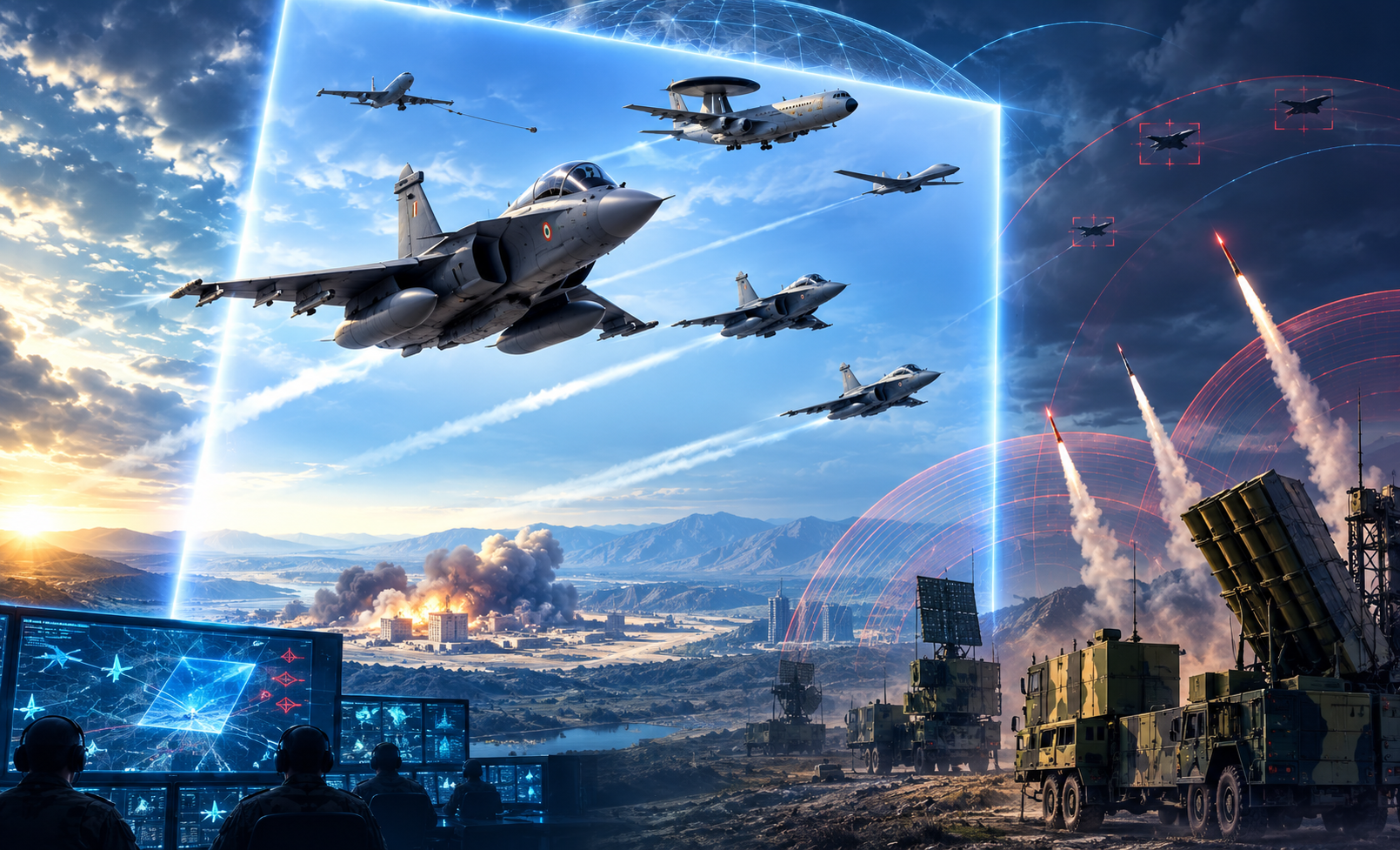
A sustained counter-air campaign remains essential, but effort need not be distributed uniformly. Campaign design should identify the point of decision—the place, time, or operational circumstance where concentrated combat power can produce the greatest effect. There, the air component can seek a window of superiority: a deliberately created and sustained period of sufficient control, within a defined operational space, to give the joint force freedom of action for a particular purpose.
Such a window could enable a ground offensive, permit a deep-strike package to penetrate hostile airspace, facilitate an airborne or maritime operation, or protect a vital centre of gravity.
Campaign design identifies the point of decision. Concentration creates the window. The window creates freedom of action. Freedom of action enables the desired operational effect. That effect must serve the political objective.
‘Windows of superiority’ is used here as an operational construct, not as a proposed doctrinal category. Its value lies in applying established ideas of local and temporal control to the contemporary counter-air campaign.
Creating the Window
Fighters need not create the window alone. Offensive counter-air can attack aircraft, bases and command systems. SEAD can suppress or destroy SAMs and sensors. Electronic warfare can blind or confuse surveillance and engagement networks; cyber operations may disrupt command and information systems. Stand-off weapons can attack critical fixed nodes, while drones and decoys expose radars, saturate defences or consume interceptors.
Nor is destruction always necessary. Suppression, disruption, displacement and deception may produce the required condition for sufficient time. A SAM temporarily suppressed, an Airborne Early Warning and Control (AEW&C) platform displaced, a command network disrupted, or fighter patrols drawn elsewhere may be enough. The point of decision may be local even when the actions required to create superiority there extend across the theatre.
The 1982 Bekaa Valley operations provide a useful historical illustration. Syria had established a substantial SAM, radar and fighter presence covering the valley. Israel concentrated fighters, electronic warfare (EW) and C2 aircraft, unmanned aircraft, helicopters, artillery and other capabilities against the system. The Royal Canadian Air Force’s doctrinal case study[4] records that 17 of 19 SAM installations were destroyed in the initial action and that Israel achieved control of the air over the valley within about two hours.
Bekaa should not be retrospectively relabelled a window of superiority in the contemporary sense; Israel achieved overwhelming local dominance. But the operation demonstrates the underlying logic: identify the operational problem, concentrate diverse capabilities, create the required degree of control and exploit the resulting freedom of action.
Concentration, Fighters, and SAMs
Concentration at one point inevitably creates risk elsewhere. Localisation cannot mean abandonment. Economy of effort and the offence-defence balance therefore matter. Lower-priority sectors may rely predominantly on layered SAMs, surveillance, electronic warfare and counter-Unmanned Aerial Systems (UAS) supported by fighters able to reinforce them. Offensive air power and scarce enablers can then be concentrated at the principal point of decision.
SAMs and fighters, however, offer different forms of combat power. A SAM provides persistence and denial within its engagement footprint, but even a long-range system is geographically anchored. Moving launchers, radars, command elements, communications and logistics between distant sectors takes time.
Fighters provide manoeuvrable combat power. A force concentrated in one sector can rapidly reinforce another hundreds of kilometres away; tankers and airborne command-and-control extend this flexibility. An adversary must enter a SAM’s effective envelope before engagement, whereas an aircraft can move towards the threat, intercept before weapon release or carry the contest into hostile airspace.
SAMs provide persistent local denial; fighters provide manoeuvrable combat power across the theatre.
Joint Planning and Deception
A window has little value unless another element of the campaign is ready to exploit it. Joint planning must therefore begin before it is created. Land, maritime and air components cannot develop independent plans and later negotiate the air effort required. Campaign design must first identify the desired effect and point of decision; component plans should then be built around creating and exploiting the necessary conditions.
Deception may itself help create them. Decoys, false electromagnetic signatures, feints, uncrewed systems and selective attacks may cause an adversary to reposition fighters, activate radars, relocate SAMs or expend interceptors away from the real point of decision. A window may be created not by destroying combat power, but by causing it to be employed at the wrong place or time.
A Progressively Created Window: Israel-Iran-US
The campaign against Iran provides a contemporary, though imperfect, illustration of a window progressively created and exploited. On April 19, 2024, after Iran’s large missile-and-drone attack on Israel, a limited Israeli retaliatory strike damaged the radar associated with an S-300 battery near Isfahan, as later indicated by commercial satellite imagery[5]. When Operation Rising Lion began on June 13, 2025, suppression of Iran’s air-defence architecture formed part of the opening effort alongside attacks on nuclear, missile and command targets.[6] Further attacks struck air-defence systems around Tehran. By June, 14 Israel claimed aerial superiority from western Iran to Tehran[7]. The operational significance was the freedom thereby created for repeated attacks against strategically important targets.
The US strike on Fordow, Natanz, and Isfahan on June 22[8] was a further stage in exploiting this shaped environment. However, it should not be assumed that Israel had created the conditions specifically for a later American operation. The United States also did not rely on those conditions alone. According to the Department of Defense account of Operation Midnight Hammer,[9] deception and decoys supported the B-2 strike force, while fourth- and fifth-generation fighters swept ahead for residual fighter and SAM threats. The sequence shows that a window may be shaped in advance, expanded by continued counter-air action and reinforced locally at the point of decision.
An essential caveat is that Iran was not a symmetrical near-peer air opponent. The case illustrates the mechanism of progressively creating and exploiting freedom of action; it does not show that the same conditions could be created as readily against a genuine peer integrated air-defence system and fighter force. Nor does operational freedom in the air guarantee strategic or political decision. Military effect matters only when it serves an achievable political objective.
Missiles, Aircraft, and Campaign Endurance
Long-range precision missiles raise a legitimate question: why create an air-superiority window if stand-off weapons can achieve the effect? Where they can, there may be no reason to manufacture one unnecessarily. But the calculation cannot end with range and accuracy.
Long-range missiles are finite. Magazine depth, expenditure rates and industrial regeneration become increasingly important as conflict lengthens. A weapon suited to a short punitive exchange may become uneconomical when repeatedly employed in a prolonged campaign.
Aircraft provide a different kind of depth. They are reusable delivery platforms that offer adaptability, persistence, rapid redeployment, and the ability to engage mobile or emerging targets. They also extend the reach of air-launched cruise missiles by moving the launch line forward and permitting attacks from changing axes. Yet creating a window is itself costly: fighters, tankers, AEW&C, EW assets, SEAD weapons and trained crews are also scarce and difficult to regenerate.
The correct question is neither aircraft nor missile, nor offence nor defence. It is which combination produces the required effect with the best campaign-level economy of scarce and difficult-to-regenerate resources. Range and probability of kill describe capability; magazine depth and regeneration help determine campaign utility.
Conclusion
Windows of superiority do not replace established concepts of air control. They offer a way to apply them where sustained theatre-wide dominance against a capable adversary may be difficult, expensive and unnecessary. The counter-air campaign must remain theatre-wide in awareness and readiness, but its combat power need not be distributed uniformly.
Campaign design identifies the point of decision. Air power’s reach, mobility and flexibility allow capabilities to concentrate force there. Surface-based air defence provides persistence and economy of effort elsewhere; fighters redistribute combat power rapidly. Missiles, EW, cyber capabilities, unmanned systems and deception help create the required conditions. The window must then be exploited, expanded, shifted or recreated as the campaign develops.
The enduring requirement for air control has not changed. The contemporary campaign planner’s question may simply need to be more precise:
Where, when, for how long – and for what purpose – must we control it?
*****
Authors Biography
Manish Khanna is a former Air Marshal of the IAF. He was the AOC-in-C of Southern Air Command and has been the Commandant of the College of Air Warfare.
(Disclaimer: The views and opinions expressed in this article are those of the author and do not necessarily reflect the position of the Centre for Aerospace Power and Strategic Studies [CAPSS])
CLICK TO VIEW THE PDF
Notes:-
[1] United States Air Force, United States of America, “Air Force Doctrine Publication 3-0, Operations,” January 22, 2025, https://www.doctrine.af.mil/Portals/61/documents/AFDP_3-0/AFDP3-0Operations.pdf. Accessed on August 28, 2026.
[2] “NATO’s Joint Air Power Strategy,” North Atlantic Treaty Organization, June 26, 2018, https://www.nato.int/en/about-us/official-texts-and-resources/official-texts/2018/06/26/natos-joint-air-power-strategy. Accessed on August 28, 2026.
[3] Indian Air Force, Government of India, “Doctrine of the Indian Air Force, IAP 2000-22,” https://database.cyberpolicyportal.org/api/files/16643773682897k6k8szritq.pdf. Accessed on August 28, 2026.
[4] Royal Canadian Air Force, Government of Canada, “Control of the Air,” Canadian Forces Aerospace Shape Doctrine, https://www.canada.ca/en/air-force/corporate/policies-standards/royal-canadian-air-force-doctrine/ad-b-ga-403-000-fp-001-chapter-2.html. Accessed on August 28, 2026.
[5] “Satellite Image Appears to Show Damaged Iranian Radar Allegedly Struck by Israel,” The Times of Israel, April 21, 2024, https://www.timesofisrael.com/satellite-image-appears-to-show-damaged-iranian-radar-allegedly-struck-by-israel/. Accessed on August 28, 2026.
[6] “Everything We Know About Operation Rising Lion: Israel’s Attack on Iran,” The Aviationist, June 13, 2025, https://theaviationist.com/2025/06/13/operation-rising-lion/. Accessed on August 28, 2026.
[7] Israel Defense Forces, Government of Israel, “Press Briefing by IDF Spokesperson, BG Effie Defrin,” June 14, 2025, https://www.idf.il/en/mini-sites/israel-at-war/briefings-by-idf-spokesperson-bg-effie-defrin/june-25-press-briefings/press-briefing-by-idf-spokesperson-bg-effie-defrin-june-14-2025/. Accessed on August 28, 2026.
[8] “Pentagon Reveals How B-2 Bombers Struck Iran Nuclear Sites in Mission Dubbed ‘Operation Midnight Hammer,’” CBS News, June 21, 2025, https://www.cbsnews.com/news/pentagon-briefing-us-strikes-iran-nuclear-sites/. Accessed on August 28, 2026.
[9] U.S. Department of Defense, United States of America, “Secretary of Defense Pete Hegseth and Chairman of the Joint Chiefs of Staff Gen. Dan Caine Press Briefing,” June 22, 2025, https://www.defense.gov/News/Transcripts/Transcript/Article/4222543/secretary-of-defense-pete-hegseth-and-chairman-of-the-joint-chiefs-of-staff-gen/. Accessed on August 28, 2026.