Author: Air Vice Marshal Prashant Mohan VM (Retd), Additional Director General, CAPSS
Keywords: Conventional War, Air Power, Drone Warfare, New Normal, AI-Fused Targeting
Since February 2026, the United States, Israel and Iran have fought what most call a “war”. This label is nothing else but a conflict fought without any formal declaration. Shifting American goals. This paper resists that habit. It asks two narrower questions before drawing any lesson. Does it meet the standard tests of “conventional war”? Does its air campaign meet the standard tests of “conventional air warfare”? The answer to both, this paper argues, is qualified. The conflict sits close enough to the conventional category on some counts, and far enough from it on others. What follows tests that claim, then draws out what are the departures, the “new normal” it previews, and what it means for India.
Testing the Conflict Against the Definition
Conventional war has been defined as organized, armed conflict between political entities such as states. Two features stand out: organization and political purpose. War is not a random brawl or a spontaneous act of violence. It is deliberate, planned, and directed toward achieving specific goals. Emphasis on organization is important which separates war from a riot, or ordinary criminal violence. A war requires structured groups with leadership, resources, and the capacity to sustain conflict over time. In another place it is described as state-on-state conflict between organized, uniformed, professional military forces using massed firepower in open space away from civilians with the aim of destroying each other to gain and hold ground. Irregular war, by contrast, is fought by non-state or hybrid actors below that threshold.
The current understanding of irregular and conventional warfare envisions them as two distinct, mutually exclusive categories. Measured against that continuum, this conflict sits closer to the conventional end than an insurgency or a proxy war would, but well short of a textbook state-on-state war.
The conflict began on 28 February 2026, when Israel and the United States launched air-strikes against Iranian military and nuclear-infrastructure sites, without any preceding declaration of war. Direct combatants eventually included Israel, the United States, and Iran, along with non-state actors like those in Lebanon and Yemen, a structure not clearly a bounded state Iranian army. A ceasefire was announced in June 2026; Washington declared the conflict over in July; but the endpoint remained contested. A diffuse start, a mixed coalition and an ambiguous end. The conflict’s own factual record supports a mixed verdict.
The Case For
The conflict looks recognisably conventional in several respects. Two sovereign states, Israel and Iran, deployed regular armed forces against each other’s territory, with the United States joining as a third state actor rather than an irregular partner. The stated objectives were conventional in nature: destruction of Iran’s nuclear-enrichment capacity and its ballistic-missile and air-defence infrastructure. The weapons employed were conventional in class too. Israeli tempo of 2,500 sorties delivering more than 6,000 munitions against Iranian targets within days, is consistent with a state air force fighting a state adversary. Iran responded with large-scale ballistic-missile and drone salvoes. CENTCOM’s own description of the resulting air situation, citing air dominance and near “impunity” over Iranian airspace, is itself the language of a conventional air campaign.
The Case Against
The case against is at least as strong. No formal declaration opened the conflict, and no treaty has formally closed it; a June ceasefire and a July American declaration that the war had ended did not stop intermittent strikes afterward. That ambiguity is not cosmetic. Can one say that a state of war exists- really confusing.
The coalition structure is equally asymmetric. Israel and the United States fought as a combined partners. Iran fought largely alone, reinforced by non-state partners and by alleged big power support. A conventional war, in the textbook sense, assumes two sides of broadly comparable organisational character, even where capabilities differ. This conflict paired a formal alliance against a single state leaning on informal, deniable support.
Non-kinetic and covert tools did at least as much work as declared strikes. Israeli operations reportedly combined HUMINT penetration, sabotage by smuggled precision munitions with air strikes well before the declared opening of hostilities. A covert campaign already under way and a war said to have started in February. It is fighting one hybrid war that includes conventional elements.
Conventional War Assumptions Busted
Several assumptions long treated as settled did not survive this conflict. The first is that escalation, once begun, follows a roughly predictable ladder that combatants and observers can track and manage. Instead, strikes, ceasefires and renewed incidents overlapped in a pattern closer to a fluctuating pressure gauge.
The second is that proportionality can be judged by territory changing hands, the traditional yardstick of a conventional war’s scale. Much of this conflict’s effect was instead measured in degraded capability: roughly eighty per cent of Iran’s air defences destroyed, and a ninety per cent fall in Iran’s ballistic-missile attack rate over the campaign, figures describing capacity destroyed rather than ground taken.
The third is that troop numbers and force ratios remain the primary predictor of outcome. Precision-strike capacity, and the intelligence architecture cueing it, did far more explanatory work here than raw force size on either side.
The fourth, and most consequential for how future conflicts get named, is that a “war” is a discrete event distinguishable from a “: sustained strike campaign.” This conflict was, for long stretches, indistinguishable from the latter: rolling strikes without a fixed order of battle, punctuated by ceasefires that did not hold.
The Air Campaign: How Far from Conventional
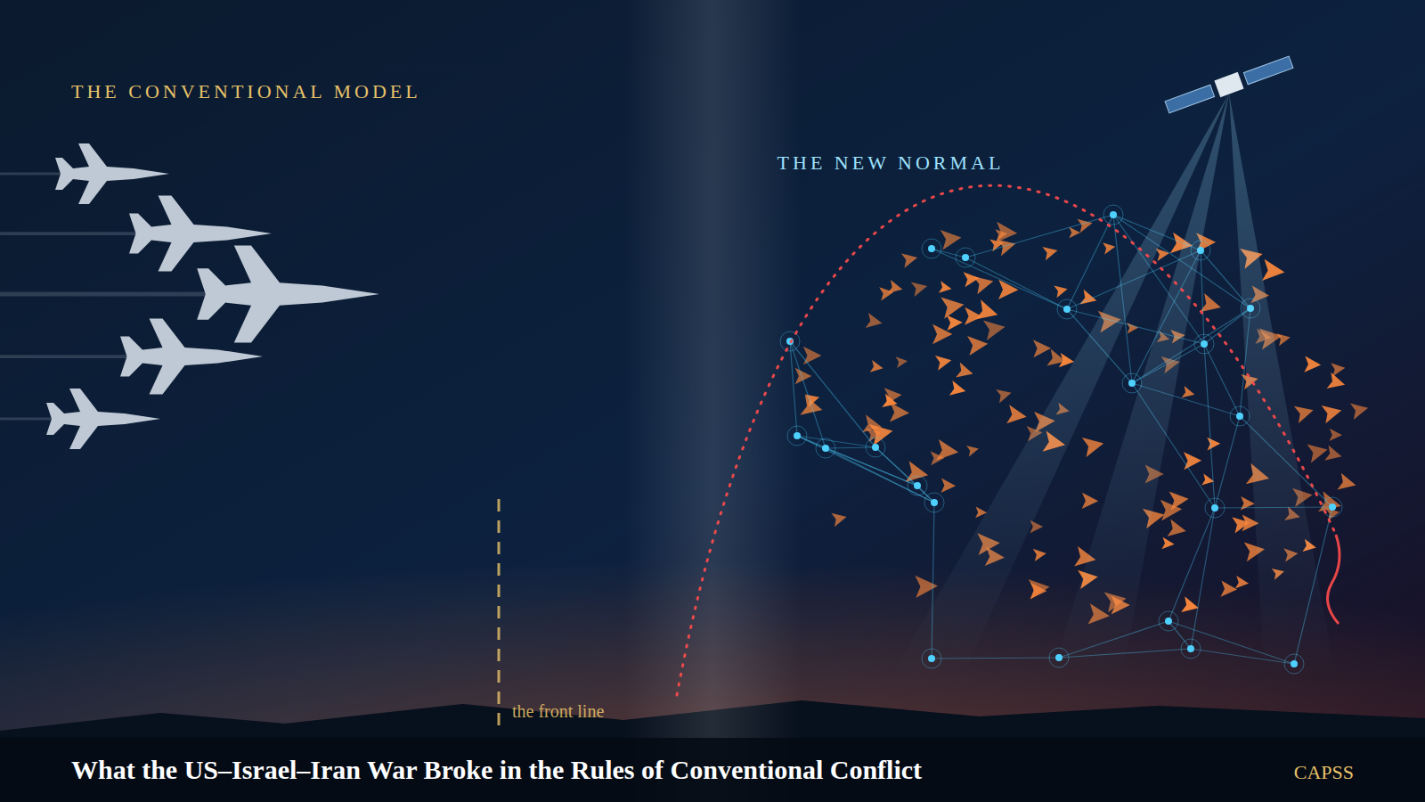
The air campaign is where the conflict departs furthest from a conventional model. From Israeli and US side manned aircraft, not drones, still carried the overwhelming majority of ordnance. What changed was not who flew the aircraft but what fed them target data, and how fast.
Target identification and battle-damage assessment leaned heavily on artificial-intelligence fusion tools layered over traditional sources and open-source reporting into a single picture at a pace not matched earlier. Israeli and US reportedly used AI to compress a targeting cycle, and a continuously updated picture.
Independent open-source researchers, drawing on commercially available imagery, published battle-damage assessments and order-of-battle updates on a timeframe comparable to official military releases, and in some cases ahead of them, running a parallel, unclassified verification loop alongside the campaign. Iran, for its part, drew on satellite support attributed to China to offset its own reconnaissance deficit.
Loitering munitions and low-cost drones employed by both sides, operated at a scale a conventional air order of battle rarely accounted. Blurring what had been a reasonably clean line between an air force’s crewed order of battle and an irregular actor’s improvised arsenal. None of this required a genuinely novel weapon. It required the fusion of AI processing, commercial space access and low-cost strike platforms once available almost exclusively to states with large defence-industrial bases.
Conventional Air-War Assumptions Busted, and Why
Four specific assumptions about conventional air warfare did not hold, each tracing to the same driver: the low-cost availability of artificial intelligence, commercial space imagery and drone technology to actors who previously could not have fielded them.
The first is manned-aircraft primacy as the organising assumption of an air campaign’s centre of gravity. Aircraft still flew the missions, but the campaign’s tempo was set by AI-fused targeting pipeline, not by cockpit availability.
The second is that ISR in a modern air campaign remains a state-monopolised function. Commercial satellite operators and open-source researchers ran a verification loop in near-real time alongside the official one. Commercial space assets partially substituted for a weaker state’s own reconnaissance shortfall. The same category of artificial-intelligence vendor underpinning military targeting pipelines has itself become an object of state supply-chain risk assessment.
The third is that strike economics remain roughly cost-proportionate, expensive interceptors matched against expensive threats. Iran’s asymmetric playbook, reportedly sharpened by its own use of AI to optimise drone and missile employment against Israeli and allied defences, exploited exactly the inverse economics: cheap mass against expensive point-defence.
The fourth is that an air campaign has a definable front line in the way a ground campaign does. Strikes, sabotage and drone incursions occurred against targets scattered across Iranian, Israeli and regional territory without a contiguous air-defence boundary either side could treat as settled, a pattern closer to the diffuse geography of a cyber campaign than a conventional air war’s bounded contest for defined airspace.
The New Normal in Air Warfare
The four claims motivating this question, that speed is displacing stealth, that layered air defence is proving a myth, that air superiority is no longer a panacea, and that a static target will eventually be found, are thanks to this conflict’s record. Coverage of Iran’s Kheibar-class missiles in this conflict makes the same point in reverse: the edge lies less in raw velocity, since conventional ballistic missiles already exceed Mach 5, than in sustained terminal maneuvering that compresses an interceptor’s reaction time. As one assessment put it, Iran’s approach is “not about raw speed… and more about sustained maneuvering,” which turns every engagement into “a moving-target problem at extreme speed”. By late March 2026, Israel had begun rationing its top-tier Arrow interceptors and pushing lower-tier David’s Sling and Iron Dome batteries to engage threats they were not designed for, after Iran launched more than 400 missiles and hundreds of drones over four weeks. The system, built for flexibility rather than sustained high-volume warfare, saw direct hits on Dimona and Arad after intercepts failed. Even as Israel claimed air dominance over Iranian skies, an F-35 reportedly took a hit from an Iranian strike on 23 March 2026. The International Crisis Group’s Ali Vaez drew the wider lesson: “even an F-35 is not invulnerable in a dense, adaptive air-defence environment,” while cautioning that no credible evidence yet shows a basic surface-to-air system achieved it alone. Taleghan 2, a known nuclear-linked site struck once in 2024, was reinforced with additional concrete and soil. It was struck again on 11 March 2026, with satellite imagery showing three precisely placed bunker-buster penetration holes despite the hardening.
Three further shifts sit beside these four. Mass built from attritable, networked systems is displacing the assumption that fewer, exquisite platforms win by quality alone. The electromagnetic spectrum is now as decisive as kinetic strikes. And transparency is double-edged: flooding a command chain with sensor feeds does not automatically yield faster decisions, and can slow them, since reconciling contradictory inputs takes time a compressed targeting cycle no longer allows.
Learnings for India
None of these findings depend on how the conflict is ultimately labelled. The democratisation of AI-fused targeting, commercial-satellite ISR and low-cost drone technology is now a planning fact for India regardless of the conflict’s final classification.
The clearest lesson concerns procurement balance. India’s own commentary on this conflict has already flagged that exquisite, expensive platform when faced with mass, cheap, AI-cued strike systems, may not be true battle winners. High-end platforms require a parallel, lower-cost counter-mass and strike capacity.
The second lesson concerns institutional capacity to absorb AI and cyber tools at speed. Standing service cadres alone may not be the answer. A dedicated national cyber reserve force, drawing on private-sector and reservist technical talent could be what India needs. Prepare against a conflict’s actual character, not its label.
The third lesson concerns the open-source ecosystem itself. As adversarial use of AI for ISR and espionage grows more sophisticated, India’s cybersecurity and counter-ISR posture needs to evolve at a comparable pace, treating commercial-satellite and open-source monitoring as a contested domain rather than a benign civilian sideline.
A fourth lesson is organisational. A targeting cycle compressed from days to hours only pays off if the force around it can decide at the same pace. A responsive command architecture is the precondition for absorbing the fast-cycle campaign this conflict has previewed.
Conclusion
The U.S.-Israel-Iran conflict is not, a conventional war in the fullest sense, nor is its air campaign a conventional air campaign in that sense. It resembles both closely enough. It also diverges from both sharply enough making the comparison qualified. The findings should focus the conditions that produced its departures from the conventional model, and the wider air-warfare “new normal”: AI-fused targeting, commercial-satellite ISR and low-cost, high-speed strike technology, now available to actors well beyond those with large defence-industrial bases. India’s planners should take the conflict less as a template to replicate and more as an early demonstration of that shift. The next conflict India fights is unlikely to resemble this one in detail. It is likely to share its defining feature: a fight decided as much by who fuses information fastest as by who fields the larger force.
(Disclaimer: The views and opinions expressed in this article are those of the author and do not necessarily reflect the position of the Centre for Aerospace Power and Strategic Studies [CAPSS])