Author: Air Vice Marshal Prashant Mohan VM (Retd), Additional Director General, CAPSS
Keywords: Mosaic Defence; Decapitation Resilience; IRGC Decentralisation; Fourth Successor Model; India–Pakistan Command Structures
Introduction
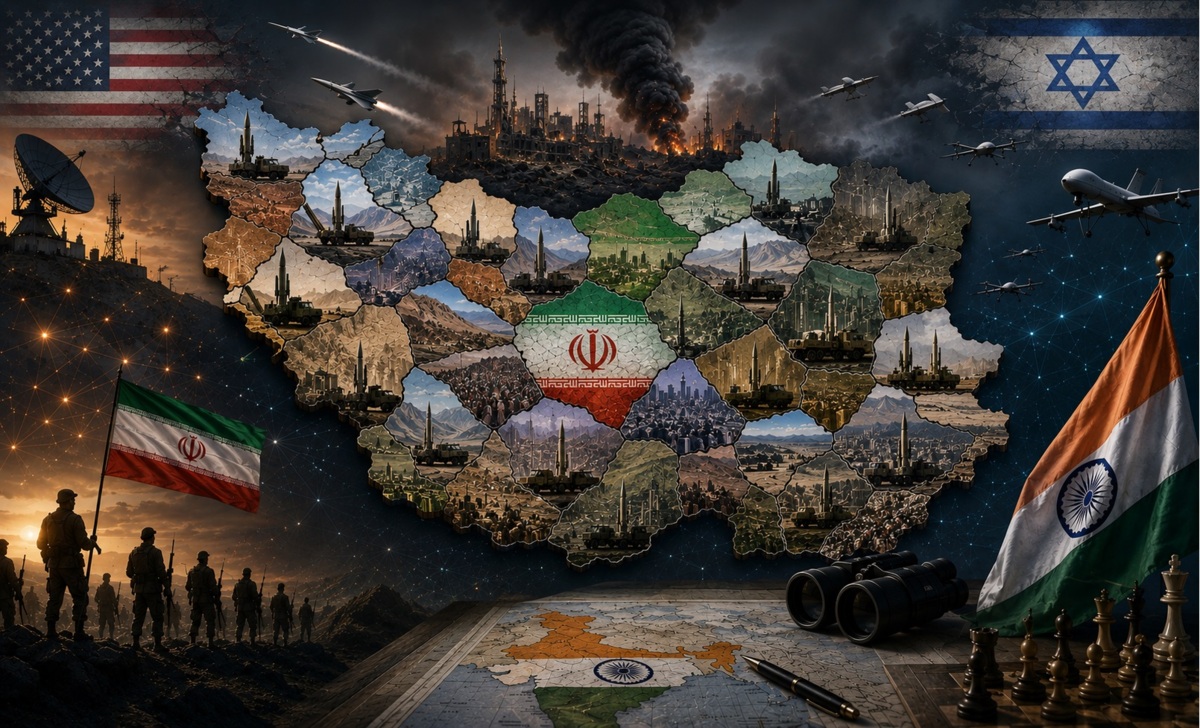
Iran’s “decentralised mosaic defence”—in Persian, defā’-e mozā’īki — has travelled an unusual distance in a single year: from a specialist footnote in Iranian military studies to a widely cited explanation for how Tehran kept fighting through 2026 despite losing its Supreme Leader, its Islamic Revolutionary Guard Corps (IRGC) commander-in-chief, and a substantial share of its missile and nuclear infrastructure.[1] The doctrine’s premise is straightforward: centralisation is a single point of failure. If leadership, communications, or command nodes can be destroyed in one strike, an entire fighting force can be paralysed. Iran’s answer, formalised nearly two decades before it was tested, was to divide the Islamic Revolutionary Guard Corps into thirty-one largely autonomous provincial commands, each carrying its own missile and drone stocks, integrated with Basij militia mobilisation, and backstopped politically by a “Fourth Successor” model that pre-designates replacements several ranks down the chain of command.[2]
When Operations Roaring Lion and Epic Fury killed Iran’s Supreme Leader Ayatollah Ali Khamenei and dozens of senior commanders in February–March 2026, Iranian officials—Foreign Minister Abbas Araghchi prominent among them—cited the doctrine’s survival as proof that Iranian military capacity does not depend on any single leader or command centre.[3] That claim is simultaneously an accurate description of institutional design and deliberate strategic messaging. This paper separates the two, asking what the doctrine actually is, how it performed under real combat conditions, and what it implies for states—India among them—that must plan against, or alongside, decentralised, resilience-oriented adversaries.
Origins: From Iraq’s 2003 Collapse to Jafari’s 2005 Doctrine
The doctrine’s proximate trigger is well documented and largely undisputed among analysts: the collapse of President Saddam Hussein’s Iraqi army within roughly twenty-six days of the March 2003 United States (US) invasion.[4] Iraq’s command structure was rigidly centralised, Baghdad-dependent and personalised around Saddam himself; once the regime’s nerve centre was struck and communications severed, organised resistance dissolved with startling speed. For Iranian planners watching from across the border, the lesson was less about Iraqi cowardice than about architecture—a military built around a single brain is only as durable as that brain.
Iran’s own recent memory reinforced the point. The 1980–88 war with Iraq had already taught the IRGC to value dispersal, redundancy, and the ability to keep fighting when supply lines and command links were cut; wartime improvisation of that kind, born of necessity, later hardened into doctrine. Iranian planners also drew on observation of US operations in Iraq, Afghanistan, and the Balkans through the 1990s and early 2000s, forming a broader conclusion about how Washington fights—through air dominance, precision strikes on leadership and infrastructure, and rapid paralysis of an adversary’s decision-making, the “shock and awe” model that Iraq exemplified in 2003.[5]
The formal response came in 2005, when Mohammad Ali Jafari—then a brigadier general and director of the IRGC’s Centre for Strategic Studies, later IRGC commander-in-chief from 2007 to 2019—supervised the doctrine’s articulation.[6] Structural implementation followed from around 2007–08, when the IRGC was reorganised into provincial commands under regional headquarters, a process that continued and deepened over roughly eighteen years before its 2026 test. This was not an overnight conceptual leap: the doctrine synthesised lessons already partly absorbed from the Iran-Iraq War, layered onto an urgent diagnosis of what had just happened next door. Iraq supplied the shock; the Iran-Iraq War supplied the institutional muscle memory; Jafari supplied the formal architecture.
Basic Tenets and Architecture: Thirty-One Commands, Basij Integration, the Fourth Successor Model
At its core, mosaic defence divides Iran into thirty-one provincial IRGC commands, reportedly grouped under roughly ten regional headquarters.[7] Each provincial command is designed to be self-sustaining. Each has its own intelligence apparatus, missile and drone stockpiles, logistics chain, and, critically, pre-delegated authority to act on general instructions issued in advance rather than real-time orders from Tehran.[8] Analysts have compared the underlying philosophy to the German military concept of Auftragstaktik—mission-type tactics—in which subordinate commanders receive broad objectives and considerable latitude in how to pursue them, rather than being tied to constant central direction.[9]
Basij integration is the second pillar. Iran’s Basij militia, organised down to neighbourhood level across tens of thousands of local bases, gives each provincial command a mobilisable manpower reserve that does not depend on formal military logistics chains.[10] In practice this means a provincial commander cut off from Tehran can still call up local fighters, drawing on a network built for internal security duties and repurposed for external resistance—the doctrine’s designers evidently saw little functional difference between the two missions.
The third pillar, and the doctrine’s most politically sensitive feature, is the “Fourth Successor” model. Every senior position—military, and at the apex, political—carries multiple layers of pre-designated succession, so that the elimination of one, two or even three tiers of leadership does not automatically produce a vacuum.[11] At the political summit, this interacts with Iran’s constitutional machinery. The Assembly of Experts formally selects a Supreme Leader, but an interim council can assume leadership duties in the interval, buying time for a permanent choice.[12] The 2026 succession—a period of interim stewardship ahead of Mojtaba Khamenei’s appointment—broadly followed this script, though the speed and smoothness of that political transition remain more contested among analysts than the provincial-command story, precisely because political succession is harder to verify from outside than a missile launch.[13]
Credit, Timeline, and the Question of Premonition Versus Generic Hedging
Credit for the doctrine is often compressed, particularly in sympathetic Iranian media coverage published after 2026, into a single name. Mohammad Ali Jafari was cast as a lone visionary who foresaw a specific war two decades before it happened.[14] The documented record is more layered. Mohammad Ali Jafari is consistently identified as the doctrine’s principal institutional architect, the officer who carried it from concept to command structure over his 2007–2019 tenure. Hassan Abbasi, a strategist known for his writing on asymmetric warfare and psychological operations, is credited by several accounts with supplying much of the ideological framing around resistance and protracted conflict that underpins the doctrine’s public presentation—though his contribution reads more as intellectual atmosphere than command architecture.[15] Above both sits Ayatollah Khamenei’s own 2005 authorisation, without which neither man’s ideas would have become institutional policy.
On premonition versus generic hedging, the evidence favours the latter, and this matters for how the doctrine should be read. Iran’s military did not design mosaic defence in anticipation of Ayatollah Khamenei’s assassination specifically. It designed a structure to survive decapitation of any kind—invasion, internal uprising, or targeted strikes on any single node—as a category of threat. The doctrine’s two-decade gestation between formulation and test is itself evidence against prescience. An organisation does not spend twenty years preparing a specific answer to an event it could not have scheduled. What it does show is a strategic culture unusually willing to treat institutional survival as a design problem separate from any single war plan, an orientation that predates and outlasts any particular adversary or scenario.
Approval, Ownership, and Prior Testing: IRGC Project or State Doctrine?
Whether mosaic defence is an IRGC institutional project or a considered state doctrine is, on the evidence, not really a binary question. The available record indicates Ayatollah Khamenei’s authorisation at the outset in 2005—this was not a rogue IRGC initiative operating below the political radar—combined with clear IRGC ownership of design, implementation and, evidently, most of the operational judgment calls made in 2026.[16] That dual structure is consistent with the IRGC’s broader institutional character. An organisation founded explicitly to protect the revolution rather than merely to defend the state’s borders, and one that has historically enjoyed wide latitude to translate broad political sanction into detailed military practice.
On prior testing, the honest answer is limited. There is no strong public evidence of the full thirty-one-command structure being exercised as an integrated whole before 2026. There has been no large-scale rehearsal of simultaneous, Tehran-severed provincial operations that would have offered a dry run under realistic stress. What existed instead was steady institutional deepening. Personnel training, local stockpiling, communications planning and successive rounds of internal reorganisation across roughly eighteen years, alongside partial, lower-intensity applications of decentralised thinking in Iran’s support for regional proxies. This distinction matters for assessment. The doctrine that performed in 2026 was, in an important sense, being combat-tested for the first time at full scale even as its component parts had been under construction for two decades.
Performance in 2026: Gains and Documented Downsides
The clearest evidence for the doctrine’s core claim is straightforward and hard to dispute. After Ayatollah Khamenei’s death and the loss of figures including IRGC commander-in-chief Mohammad Pakpour, Iran did not stop fighting.[17] Provincial commands continued missile and drone launches, largely matching the doctrine’s own description of units “acting based on general instructions given to them in advance” rather than real-time direction from a shattered centre.[18] The regime also avoided the kind of rapid institutional collapse that met Iraq in 2003. A leadership transition, however contested in its details, occurred within Iran’s constitutional framework rather than through a vacuum, and public rallies were reported across more than 150 cities in a display of continued domestic mobilisation.[19]
The costs were equally real, and documented in the same reporting that recorded the doctrine’s resilience. Coordination visibly degraded over the course of the campaign, with analysts describing a shift “from coordinated salvos to sporadic launches” as the war progressed.[20] Autonomous units, cut off from central direction, produced escalation that appears to have exceeded Tehran’s intent. Strikes reportedly reached Turkish and Omani territory, incidents Foreign Minister Abbas Araghchi himself attributed to units that “could not be reached directly.”[21] Colin Clarke of the Soufan Center captured the resulting trade-off precisely, describing the model as a “double-edged sword”—harder for adversaries to eliminate, but correspondingly harder for Tehran to coordinate or, more importantly, to de-escalate once a ceasefire became politically desirable.[22] Analysts at the International Institute for Strategic Studies flagged a related structural constraint. The doctrine’s sustainability was never unlimited, since it still depended on finite missile stockpiles and production capacity that remained vulnerable to continued strikes even as command itself survived.[23]
The net assessment, drawn from the documented record rather than from either side’s messaging, is that mosaic defence delivered largely what it was built to deliver—continuity of resistance—while confirming the trade-off its designers had implicitly accepted in 2005. A force this hard to decapitate is also a force whose own government finds it hard to fully control, and harder still to stop.
Were the US and Israel Surprised, and Could the Doctrine Have Been Countered?
The doctrine’s existence was not news to Western analysts in 2026. Iran’s decentralisation strategy had been publicly examined in Western literature for well over a decade, including assessments associated with the US Institute of Peace’s Iran Primer project and subsequent commentary from research centres tracking Iranian military reform.[24] What appears to have been less well calibrated in advance was not the doctrine’s existence but its practical effectiveness under real combat conditions—how much genuine autonomy provincial commands would exercise, how long stockpiles would sustain them, and how quickly coordination would fray.
The scale of Operations Roaring Lion and Epic Fury is itself indirect evidence of this recalibration. Coalition planning reportedly encompassed several thousand aim points across naval, air-defence and missile-related targets, an approach consistent with an understanding that a single decapitating strike would not suffice against a genuinely distributed target set, whatever effect it had on the political leadership.[25] In other words, the operational plan already assumed dispersal even where the political messaging around the strikes emphasised leadership targeting.
Could the doctrine have been countered more effectively? The documented record suggests two broad avenues, neither fully exploited. First, sustained targeting of missile production and storage infrastructure—rather than command nodes alone—directly addresses the resource constraint analysts identified as the doctrine’s real limiting factor, since a decentralised command with empty magazines is strategically inert regardless of its resilience. Second, disruption of Iran’s regional proxy network, which extends decentralised capability beyond Iran’s own borders, would narrow the doctrine’s effective depth.[26] Neither is a decapitation strategy; both accept that mosaic defence has made decapitation, on its own, an insufficient theory of victory.
External Influence, Historical Precedents, and Hallmarks
Claims of external assistance in the doctrine’s design deserve careful separation from claims about Iran’s broader military-industrial cooperation. Technical cooperation with Russia, North Korea and China on missile and drone technology is comparatively well documented and long-standing, forming part of a wider pattern of alignment among states with shared adversarial relationships to Washington.[27] Evidence of doctrinal or command-structure advice specifically—as opposed to hardware and production know-how—is considerably thinner and rests more on inference than on documented transfer. The more persuasive account treats mosaic defence as substantially an indigenous synthesis of Iran-Iraq War lessons, observation of Iraq’s 2003 collapse, and the IRGC’s own institutional instincts, rather than an imported blueprint.
Historical precedent for this kind of resilience-first doctrine is abundant and predates Iran considerably. Viet Cong and North Vietnamese forces built dispersed, cellular command structures explicitly to survive a materially superior adversary’s firepower, prioritising survivability over centralised efficiency in ways mosaic defence closely echoes. Hezbollah’s own cellular military organisation—itself substantially shaped by IRGC training and advice—represents a closer and more direct lineage, effectively an earlier, smaller-scale export of the same institutional philosophy Iran later formalised at home as part of its wider “Axis of Resistance” network.[28] Broader partisan and insurgent traditions share the same underlying logic: when an adversary’s firepower cannot be matched, deny it a concentrated target.
One genuine hallmark of the 2026 case is a feedback loop rarely seen this clearly. Western analytical framing of the doctrine, developed over more than a decade of outside study, appears to have been absorbed back into Iran’s own official vocabulary, with Iranian officials now describing their military architecture in terms partly shaped by the very foreign literature that first named it.
Implications for India: The Pakistan Question and India’s Own Resilience Planning
Indian planners should consider two questions, and they should not be collapsed into one. The first is whether Pakistan is likely to adopt a comparable model. The structural answer is that direct transfer is unlikely. Pakistan’s army retains a strongly centralised command culture built around General Headquarters in Rawalpindi, and its nuclear command sits under a National Command Authority chaired by the Prime Minister that has consistently emphasised centralised civilian control rather than delegated authority to field commanders.[29] Pakistan’s most recent structural reform is instructive precisely because it points in the opposite direction. The Army Rocket Force Command was established in August 2025, following gaps exposed during that year’s conflict with India, centralised conventional missile systems under unified command rather than dispersing them, aiming to close a capability gap without lowering the nuclear threshold.[30] Pakistan also lacks an institution structurally equivalent to the IRGC—a parallel, ideologically mandated force with its own founding mandate to protect the political system itself, which is a large part of what makes Iranian-style decentralisation both legitimate and thinkable within Iran’s system. Without that institutional twin, wholesale adoption of mosaic-style decentralisation by Pakistan’s military would represent a significant departure from its doctrinal and civil-military traditions rather than a natural evolution.
That said, narrower echoes are plausible and worth monitoring. Dispersed missile basing, redundant communications, and localised command latitude for specific formations are all things a conventional military can adopt piecemeal without restructuring its entire chain of command around them, and Pakistan’s western-border deployments in less permissive terrain already show some of this instinct.
The second question is more important and less comfortable. What does the Iranian case reveal about India’s own vulnerabilities, independent of Pakistan entirely? India’s nuclear command authority is deliberately centralised around the Prime Minister-led Political Council, a structure built for tight civilian control rather than battlefield redundancy—an appropriate design against accidental use, but one that raises its own decapitation question in a peer or near-peer crisis. Conventional force commands present a related but distinct issue. Service-level redundancy, communications resilience under electronic and cyber-attack, and the practical ability of formation commanders to sustain coordinated operations if links to Delhi are severed are all questions the Iranian case now places squarely on the strategic studies agenda—not because India faces an Iran-style threat, but because the underlying vulnerability, concentration of authority as a targetable node, is generic to any modern military, India’s own included.
Conclusion
Mosaic defence is neither the infallible doctrinal masterstroke of its own official telling nor a myth manufactured purely for propaganda purposes; it is a genuinely engineered resilience architecture that performed largely as designed, at a cost its architects appear to have accepted in advance. Its 2026 test offers a rare, real-world demonstration of a proposition long debated abstractly in strategic studies—that decapitation-resistant design and centralised controllability sit in real tension, and that a state can buy the former only by spending some of the latter. For the Centre for Aerospace Power and Strategic Studies (CAPSS’s) purposes, the doctrine’s value lies less in what it says about Iran specifically than in the general question it forces onto every planning table, India’s included: whether today’s command architecture, built for peacetime coherence, would survive contact with an adversary capable of reaching its centre.
*****
(Disclaimer: The views and opinions expressed in this article are those of the author and do not necessarily reflect the position of the Centre for Aerospace Power and Strategic Studies [CAPSS])
CLICK TO VIEW THE PDF
Notes:-
[1] “Iran’s ‘Mosaic Defense’ Strategy: Decentralization as a Resilience Factor,” The Soufan Center, March 09, 2026, https://thesoufancenter.org/intelbrief-2026-march-9a/. Accessed on August 15, 2026.
[2] Asad Mirza, “Iran’s ‘Mosaic Defence’ and ‘Fourth Successor’ Models,” The AIDEM, March 15, 2026, https://theaidem.com/irans-mosaic-defence-and-fourth-successor-models/. Accessed on August 15, 2026.
[3] Jay Hilotin, “Mosaic Defence Doctrine: Iran ‘Studied US Wars for 20 Years,’ Says Abbas Araghchi — What It Means,” Gulf News, March 02, 2026, https://gulfnews.com/world/mena/mosaic-defence-doctrine-iran-studied-us-wars-for-20-years-says-abbas-araghchi-what-it-means-1.500460676. Accessed on August 15, 2026.
[4] Alexander Grinberg, “Iran’s Mosaic Defense Faces Its Real Test,” Jerusalem Institute for Strategy and Security (JISS), March 24, 2026, https://jiss.org.il/en/grinberg-irans-mosaic-defense-faces-its-real-test/. Accessed on August 15, 2026.
[5] Syed Raza Abbas, “Iran’s ‘Difay e Mosaic’: The Decentralized Doctrine Defying Regime Decapitation,” Strategic Vision Institute, April 16, 2026, https://thesvi.org/irans-difay-e-mosaic-the-decentralized-doctrine-defying-regime-decapitation/. Accessed on August 15, 2026.
[6] Ibid.
[7] Grinberg, n. 4.
[8] Ibid.
[9] Frud Bezhan, “With Top Brass Dead, Iran Deploys Decentralized ‘Mosaic’ Strategy to Boost Defenses,” Radio Free Europe/Radio Liberty, March 07, 2026, https://www.rferl.org/a/iran-irgc-israel-us-war/33697690.html. Accessed on August 15, 2026.
[10] Mirza, n. 2.
[11] Grinberg, n. 4.
[12] Mirza, n. 2.
[13] Ibid.
[14] Prakriti Parul, “Iran Activates Decentralized Mosaic Defense: IRGC Splits into 31 Independent Regiments for Guerrilla Hell, Provincial Commanders Get Free Rein,” The Sunday Guardian, March 02, 2026, https://sundayguardianlive.com/world/iran-activates-decentralized-mosaic-defense-irgc-splits-into-31-independent-regiment-for-guerrilla-hell-provincial-commanders-get-free-rein-what-happens-next-in-strait-of-hormuz-173392/. Accessed on August 15, 2026.
[15] Grinberg, n. 4.
[16] “IRGC decentralizes command to survive strikes, warns of ‘strategic surprises’ against US-Israel,” The Jerusalem Post, March 04, 2026, https://www.jpost.com/middle-east/iran-news/article-888831. Accessed on August 15, 2026.
[17] Bezhan, n. 9.
[18] Ibid.
[19] “Operations Epic Fury and Roaring Lion,” International Institute for Counter-Terrorism (ICT), March 17, 2026, https://ict.org.il/operations-epic-fury-roaring-lion/. Accessed on August 16, 2026.
[20] Grinberg, n. 4.
[21] Ibid.
[22] Bezhan, n. 9.
[23] Ibid.
[24] Michael Connell, “Iran’s Military Doctrine,” The Iran Primer, United States Institute of Peace, October 11, 2010, http://iranprimer.usip.org/resource/irans-military-doctrine. Accessed on August 16, 2026.
[25] Grinberg, n. 4.
[26] Jonah Brody and Rena Gabber, “The Axis Behind Iran: How China, Russia, and North Korea Sustain Tehran’s Military Threat,” Jewish Institute for National Security of America (JINSA), March 25, 2026, https://jinsa.org/jinsa_report/the-axis-behind-iran-how-china-russia-and-north-korea-sustain-tehrans-military-threat/. Accessed on August 16, 2026.
[27] Jonah Brody and Rena Gabber, “The Axis Behind Iran: How China, Russia, and North Korea Sustain Tehran’s Military Threat,” Jewish Institute for National Security of America (JINSA), March 25, 2026, https://jinsa.org/jinsa_report/the-axis-behind-iran-how-china-russia-and-north-korea-sustain-tehrans-military-threat/. Accessed on August 16, 2026.
[28] The Soufan Center, n. 1.
[29] “Pakistan’s Nuclear Command and Control Structure: Ensuring Security and Deterrence,” Strategic Vision Institute, July 06, 2023, https://thesvi.org/pakistans-nuclear-command-and-control-structure-ensuring-security-and-deterrence/. Accessed on August 16, 2026.
[30] Abid Hussain, “Why Has Pakistan Launched a New Rocket Command After India Conflict?,” Al Jazeera, August 26, 2025, https://www.aljazeera.com/news/2025/8/26/why-has-pakistan-launched-a-new-rocket-command-after-india-conflict. Accessed on August 16, 2026.