Author: Gp Capt VP Naik VM, Senior Fellow, Centre for Aerospace Power and Strategic Studies
Keywords: Democracy, Partnerships, Deterrence, Strategic Credibility, Alliances
Introduction
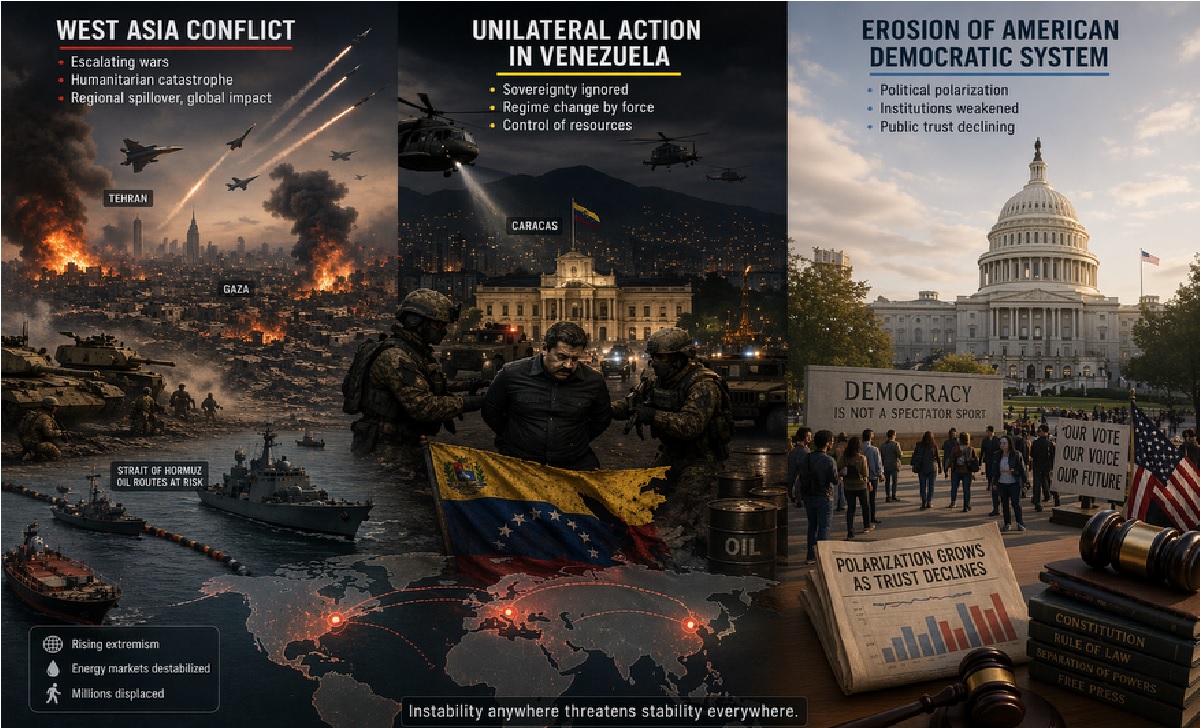
The oldest democracy in the world, the United States of America (USA), has always styled itself as the harbinger of peace, stability, and the rule of law, undertaking the onerous task of ensuring a rules-based international order. US democratic values have been deeply anchored in constitutional checks and balances, credible and effective institutions and the rule of law. Despite that, military actions in Venezuela and Iran in 2026 expose an interesting and stark paradox, wherein a system that was designed to prevent executive overreach proved to be unable and unwilling to restrain the unilateral war-waging spree of President Trump and his administration. This failure heralds far-reaching consequences well beyond Capitol Hill, shaking the USA’s alliances, undermining deterrence guarantees, and casting a very long shadow over potential crises in the East and South China Seas.
This article seeks to examine how a democracy as old as the USA failed to safeguard itself from the idiosyncrasies of an incumbent President. It also explores the fracturing of long-lasting alliances, such as the North Atlantic Treaty Organisation (NATO), the destabilisation of global energy supplies, and more importantly, the erosion of strategic credibility as the world’s lone superpower. Furthermore, the article seeks to understand the geopolitical ramifications of these actions by contrasting their complexities, juxtaposing the West Asian imbroglio with the East and South China Seas.
The Breakdown of Constitutional Restraint
At the very heart of the American constitutional system lies a deliberate allocation of power to declare war and associated activities. While Section 8 of Article I of the US Constitution empowers Congress to declare war, Section 2 of Article II designates the President as the Commander-in-Chief of the armed forces of America.[1] The writing is very clear; no single individual could drag the country into a state of war. Yet, the current year has seen this balance waver. Operation Absolute Resolve, launched in January 2026, was widely considered illegal and carried out without congressional authorisation. The operation was seen not only as a violation of American domestic constitutional norms but also as a significant violation of International Law. On similar lines, Operation Epic Fury in February 2026 was also carried out without formal authorisation, and attempts by Congress to invoke the War Powers Resolution (WPR) failed in both chambers.[2] The WPR has regularly been ignored by various Presidents (Republicans and Democrats alike), and the resolution has never been decisively enforced by the American judiciary. The ensuing result was not just executive assertiveness but also institutional paralysis in the oldest democratic nation in the world. The cumulative effect was the President’s ability to declare war, unconstrained by institutional measures, and simultaneously to discredit the Constitution and the Congress. What follows is pure anarchy in a democratic set-up.
Normalising Unilateral Aggression
Analysing the opening salvos in both operations reveals some common threads. In both cases, initiation of war or the use of force conveniently bypassed legislative approval. The President and his administration tried to legally justify actions post facto, which was contested. International norms and law were blatantly disregarded, and apex domestic institutions, including the Supreme Court, proved reactive and not preventive. This reflects the fragility of the system and brings out large chasms in an otherwise robust system.
The Collapse of Extended Deterrence
Ever since the end of the Second World War, US alliances have always rested on a simple bargain. A guarantee of security in exchange for basing rights, alignment, technological support, and strategic dependence. Collective defence and extended deterrence capability, specifically in Europe, West Asia, and the Indo-Pacific, are now increasingly being questioned by allies and partners and deeply analysed by rivals. Structural fragility and defiance of the rules-based order are now questioning the very basis of the alliance formation. Trump’s Greenland rhetoric deeply undermines Article 5 of NATO, and if that is a sign of what is coming, many other US allies and partners need to start worrying.
The Three Critical Failures
Analyses of the two conflicts of 2026 have revealed some important facets of the security guarantee provided by the US, and the writing on the wall is becoming clearer. The two operations have revealed three critical failures of the US-led system.
(a) Credibility Deficit. Given that President Donald Trump has started acting unilaterally, disregarding domestic and international regulations and violating international norms, commitments made by the US now have an inherent credibility deficit. Allies and partners will no longer ask what the US can do; they would rather ask what this President can do. This is a direct reflection of an autocratic or an authoritative style of functioning rather than a democratic set-up guided by directive principles enshrined in the constitution.
(b) Increased Risks to Allies and Partners. Countries that have been hosting US bases now face retaliatory strikes from enemies of America. The war in West Asia reflects how all West Asian nations have been drawn into it without any decision-making authority. The countries have now got entangled in their own web, which was designed to provide them with comprehensive security.
(c) Moral and Legal Erosion. Traditionally, America has justified its global role by way of adhering to international law and ensuring democratic accountability. Both these have now eroded, and as a result, alliances have lost not only their normative legitimacy but also their military utility.
The broader conclusion on strategic deterrence and security guarantee is that the umbrella has not just weakened but been conceptually broken. It no longer guarantees security; it exports uncertainty.
Taiwan: A Crisis Reframed
The developments in West Asia will have profound implications for Taiwan. The traditional assumption is that Taiwan’s strategic security relies heavily on US military deterrence, forward deployment, basing of elements of the US Indo-Pacific Command (USINDOPACOM), and a credible US commitment to defence in the event of Chinese aggression. Post-Operation Epic Fury, there is therefore a need to reassess such a strategic security framework.
(a) Credibility is Now Contingent. If US intervention largely depends on Presidential discretion rather than on an institutional commitment, deterrence would become very unpredictable, and adversaries would want to test the red lines. A situation like this could also alter the regional balance of power, as allies may resort to hedging because back-ups and security guarantees will always be required. Regional actors may, as a result, diversify security partnerships and focus on strategic autonomy.
(b) The Chinese Strategic Interpretation. From Beijing’s perspective, two very relevant lessons emerge. Firstly, the Americans may act unilaterally and irrationally, which would translate into effective deterrence by the US because Beijing will not be able to anticipate Washington’s thought process. The other lesson that emerges is that the American system lacks internal cohesion and support. This, therefore, presents an opportunity for China to capitalise. The emerging strategic ambiguity is systemic, and therefore, the red lines would have to be recalibrated.
(c) Increased Escalation Risk. The geopolitical situation around Taiwan is unique. The main competitor is a peer with credible nuclear capability and the wherewithal to target mainland USA. The region also has many players in the fray, and an impulsive unilateral action may lead to regional entanglement. In such a fragile environment, the escalation ladder is likely to become compressed, and the situation may quickly spiral out of control.
(d) Efficacy of Overseas Operations Against an Equal Adversary. Operations in West Asia have clearly indicated the pitfalls of conducting operations far from one’s own territory. While overseas bases ensure continuous presence, they do not ensure logistics sustenance in a high-tempo conflict. As supplies diminish, supply chains become unusually long, making them more vulnerable to disruption. The presence of a peer adversary in the region further complicates the matter.
(e) Relevance of Choke Points. Another interesting facet that emerges is that the world’s most advanced and powerful Navy was unable to control transit in the Strait of Hormuz. What emerges is that extra-regional powers may not be able to secure vital choke points and straits, and littorals will play an important role. Controlling the Straits of Malacca, Ombai-Wetar, and Lombok may therefore be an interesting strategy on paper, but physically achieving and maintaining control may not be possible. Navies, the world over , will need to recalibrate their strategies because the oft-touted goal of developing the capability to control the Sea Lines of Communication (SLOCs) may not be viable in a severely contested maritime environment.
Key Takeaways
(a) Institutions Matter Much More than Intentions. In the modern era, deterrence is not just about capability; it has more to do with credibility. While intentions are subjective and often hidden, institutions provide the much-needed assurance, facilitate cooperation, and hold states accountable.
(b) Executive Dominance Undermines Stability. When war-making authority concentrates in one individual, predictability collapses. If that happens, the global system shifts from a state of manageable risk to assured uncertainty. Long-established norms, institutions and diplomatic rules break down, increasing the likelihood of strategic miscalculations.
(c) Alliances Require Trust, Not Just Power. Whilst power (military strength and material capabilities) provides the foundation for an alliance’s utility, trust (reliable and non-detrimental behaviour) remains vital for long-term sustenance. In times of uncertainty, trust permits alliances to function without making the parties vulnerable.
(d) Norms are Strategic Assets. While short-term benefits may accrue by violating laid-down norms, the long-term strategic position may erode. Norms provide strategic legitimacy, which is essential in forging ties and developing partnerships.
(e) The Taiwan Imbroglio. Developments in West Asia and the ensuing conflict underscore a pertinent fact: Taiwan is not just a military problem. It is a credibility test of the American system, and, given what has happened in West Asia, the concept of collaborative defence may need a revisit.
Conclusion
Collaborative defence, anchored in alliances and partnerships, has the potential to multiply capability, distribute risks and reinforce legitimacy. Deterrence becomes a shared venture, thereby raising the threshold for aggression. On the other hand, unilateral wars like the ones being waged by President Trump and his administration erode institutional credibility, strain alliances, and generate long-term instability, which outweighs any short-term gains that might have accrued. One thing is clear: cooperative security architectures underpin credible deterrence. Nations that invest in trust and shared strategic objectives are better positioned to prevent conflict, provided that they avoid strategic overreach and isolation. Any perceived hesitation, fragmentation among allies, or gaps between declared policy and action will shape Beijing’s assessment of how Washington might respond in a crisis involving Taiwan, especially during President Trump’s tenure.
*****
CLICK TO VIEW PDF
Notes:-
[1] Constitution Annotated, Analysis and Interpretation of the US Constitution, United States of America, “Constitution of the United States, Article I, Section 1,”https://constitution.congress.gov/constitution/article-1/; Constitution Annotated, Analysis and Interpretation of the US Constitution, United States of America, “Constitution of the United States, Article II,” https://constitution.congress.gov/constitution/article-2/. Accessed on April 12, 2026.
[2] Scott Wong, Kyle Stewart and Frank Thorp V, “Republicans block effort to halt Trump’s war with Iran after ‘civilisation’ threat,” NBC News, April 09, 2026, https://www.nbcnews.com/politics/congress/republicans-block-effort-halt-trumps-war-iran-civilization-threat-rcna267345. Accessed on April 12, 2026.