
Author: Air Vice Marshal Prashant Mohan VM (Retd), Additional Director General, CAPSS
Keywords: Atlantique Shoot-Down, Air Defence Control, Rules of Engagement, Operation Sindoor, Beyond-Visual-Range Combat
Introduction
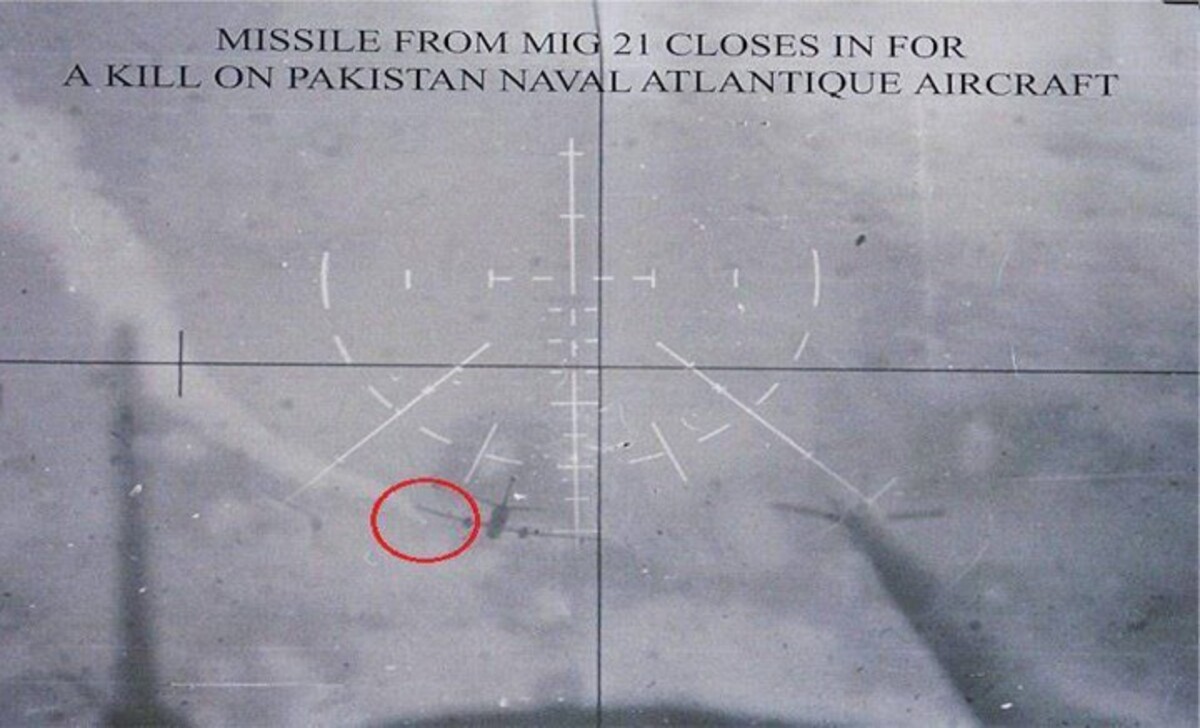
An Indian Air Force (IAF) MiG-21 shot down a Pakistan Navy Atlantique maritime patrol aircraft over the Rann of Kutch on August 10, 1999. The incident happened barely a fortnight after the Kargil War ceasefire of July 26, 1999.[1] Twenty-seven years on, the episode occupies an odd place in service memory. Two documentaries revisiting Operation Safed Sagar and Operation Sindoor have circulated widely in recent weeks. The Atlantique shoot-down has received no comparable retelling. It was, by most measures, at least as significant an event. This paper sets out what happened on August 10, 1999. It asks why the episode deserves renewed attention now. It closes with the lessons the episode still holds for the Indian Air Force. Air combat has since shifted from the within-visual-range intercept of 1999 to the longer-range engagements associated with Beyond Visual Range/Long-Range Beyond Visual Range missiles.
The Incident: Anatomy of an Interception
On August 10, 1999, the air situation started unfolding at 10:51 IST. An IAF ground radar picked up an aircraft track inside Pakistan’s Sindh province, near Badin, closing on the international border on a south-easterly heading.[2] The track first touched the border at 10:54 hrs. The 1991 air agreement between India and Pakistan required non-helicopter aircraft to stay at least 10 kilometres from the border. On at least two occasions, the Atlantique breached that margin outright.[3] In fact, for the next few minutes, the Atlantique manoeuvred close to this boundary, crossing and re-crossing it.
The Breguet Atlantique was a twin-turboprop maritime patrol type. It was purpose-built for long-endurance naval reconnaissance, unlike many rival designs adapted from civil airliners.[4] Powered by two Rolls-Royce Tyne turboprops, it cruised at barely 350 knots and carried a crew of up to twelve on missions lasting up to eighteen hours.[5] That combination of size, endurance, and modest speed suited prolonged, deliberate patrolling along a border. It sat poorly with the idea of an innocent, fleeting navigational error.
Two MiG-21s of No. 45 Squadron, on readiness at Naliya in Kutch, were placed on higher alert as the track approached. The aircraft crossed the border for the first time at roughly 10:57 hrs. Both fighters scrambled and were airborne by 10:59 hrs.[6] Ground control vectored them north, then swung them south as per the intruder’s path. Fighter controller Group Captain V. S. Sharma, filling in for a duty officer with only three months’ experience, took direct charge of the intercept from the operations cabin.[7] Two-way radio contact briefly failed on the primary channel. It had to be re-established on a standby set.[8] The two accounts of the sortie, the IAF’s contemporaneous release and Group Captain V. S. Sharma’s own recollection published a decade later, record intermediate timings a minute or two apart. Both agree closely on the outcome: engagement between 11:17 and 11:18 hrs, and a crash by 11:23 hrs.[9]
At 11:14 hrs, the Atlantique entered Indian airspace a third time. It penetrated roughly 10 kilometres before turning east.[10] The controller placed the lead MiG, flown by Squadron Leader P. K. Bundela, between the intruder and the border. The wingman, then Flying Officer S. Narayanan, closed in from behind.[11] Flying Officer Narayanan, or Nanu, made visual contact first; both pilots identified the aircraft as a Pakistan Navy Atlantique shortly after.[12] Squadron Leader P. K. Bundela closed in, intending to signal the aircraft to land at an Indian airfield. Instead of complying, the Atlantique turned aggressively into him. The IAF’s own account treats this as a hostile act under the rules then in force.[13] Cleared to engage at 11:17 hrs, Squadron Leader Bundela fired a R-60 infrared missile. It struck the Atlantique’s left engine, which caught fire immediately.[14] The aircraft crashed at 11:23 hrs.[15]
A Deliberate Provocation, Not an Accident
The manoeuvring of the Atlantique before the fatal pass rules out an accidental stray across the border. An aircraft that merely wandered off course does not repeatedly cross a boundary it can plainly see on instruments. It does not turn back into that boundary after being intercepted. Standard practice called for lowering undercarriage as a sign of submission; the Atlantique did nothing.[16] What the surviving accounts agree on is this: the aircraft’s behaviour was inconsistent with navigation error. Instead, it was consistent with a reconnaissance profile flown deliberately close to a live border.[17]
Not every contemporary judgement of India’s response was uncritical, and that record deserves acknowledgement. Some international commentary at the time, including from Washington, described the shoot-down as a step beyond what the 1991 agreement anticipated.[18] Critics asked whether radio warning and other non-lethal options had been fully exhausted first.[19] Contact was attempted and lost. The intruder turned into, rather than away from, the intercepting fighter at the moment of decision.
Costs, Claims, and a Forgotten Anniversary
All sixteen personnel aboard the Atlantique were killed, including five officers.[20] Pakistan’s government disputed India’s account almost immediately, describing the flight as a routine training mission and denying any border violation. On September 21, 1999, Pakistan approached the International Court of Justice. It sought roughly sixty million dollars in compensation and a finding that India had breached the United Nations (UN) Charter and the 1991 air agreement.[21] On June 21, 2000, a fifteen-judge bench ruled fourteen to two that the Court lacked jurisdiction to hear the case at all. The matter closed without addressing India’s conduct on the merits.[22]
Squadron Leader Prashant Bundela received the Vayu Sena Medal for Gallantry on January 26, 2000. His citation read “conspicuous act of gallantry in the face of the enemy.”[23] He did not long survive the recognition. In April 2002, he suffered a catastrophic ejection injury during a routine MiG-21 training sortie and died of his injuries four months later, in August 2002.[xxiv] Group Captain V.S Sharma received the same award for his direction of the intercept, the first such combat honour given to a fighter controller since 1971.[25]
Domestically, the loss briefly rallied Pakistani nationalist sentiment around the crew’s memory.[26] That rally did not save Nawaz Sharif’s government. Continuing fallout from Kargil eroded his position with the army, and he was removed in a bloodless coup on October 12, 1999.[27] The coup’s proximate cause was Kargil, not the Atlantique loss. Even so, the sequence shows how thoroughly the crisis-scarred summer of 1999 had destabilised Islamabad.
None of this has translated into comparable public memory. No Atlantique-type intrusion, sustained, slow, and deliberately probing, has recurred since. Pakistan Air Force activity following the IAF’s Balakot strike in February 2019 took a markedly different form: brief, fast-jet incursions rather than a loitering maritime patrol aircraft.[28] Gp Capt Sharma’s own account credits no single stroke of luck for the outcome. The radar pickup, the anticipatory scramble, the two pilots’ flying, the controller’s willingness to order an engagement, and the missile’s guidance all had to work in sequence.[29] Yet the episode has never carried the institutional weight of Balakot or Operation Sindoor in public memory. Part of the reason may be scale: one aircraft against the wider canvas of a war that had just ended. The explanations understate what the event actually demonstrated about institutional readiness.
Remembering It in the Post-Sindoor Shadow
The timing of this anniversary is not neutral. Operation Sindoor, launched on May 07, 2025, after the Pahalgam attack, was the second occasion since 1971 on which the IAF struck targets inside Pakistan, after Balakot in 2019.[30] The Indian Air Force’s own first-anniversary accounting, released on May 07, 2026, credited the operation with destroying eleven Pakistani airbases, thirteen aircraft, and nine terror camps.[31]
What has followed Operation Sindoor is a Pakistani attempted diplomatic recovery that deserves sober attention rather than dismissal. Pakistan’s Field Marshal Asim Munir was hosted for a lunch at the White House by President Donald Trump in June 2025.[32] Pakistani commentary, as expected, has read the meeting as proof of Islamabad’s restored strategic relevance to Washington. Islamabad went on to broker a fourteen-point memorandum between the US and Iran. Pakistan used this to cast itself as a credible regional mediator.[33] That memorandum frayed within weeks. Pakistan has also signed two defence pacts with Islamic-world partners in less than a year. A mutual defence agreement with Saudi Arabia was signed in mid-September 2025.[34] A trilateral accord with Turkey followed in August 2026.[35] Both are pitched as evidence of Pakistan’s value as a security guarantor beyond South Asia. Whether this diplomatic positioning outlasts its current momentum is not yet knowable. What is clear is that Pakistan is contesting the post-Op Sindoor narrative energetically. India’s own institutional memory of decisive, disciplined air action, of which the Atlantique episode is the clearest available example, is a useful corrective to that contest.
Lessons for the IAF: From WVR Discipline to BVR Complexity
The 1999 intercept was a within-visual-range engagement decided by radar handling, controller judgement, and pilot discipline operating as a single chain. Each link had to hold. Correct pickup and tracking came first. An anticipatory scramble had to be ordered without waiting for full confirmation. A controller had to be willing to take responsibility for a shoot order. Pilots had to execute a demanding tail-chase in poor weather without deviating from procedure.[36] That chain of authority, radar to controller to pilot, remains directly relevant today. Modern air battles compress decision timelines further and push identification and engagement decisions to far longer ranges. They do not remove the need for a clear, accountable person empowered to authorise fire.
Conclusion
The Atlantique shoot-down was not an isolated act of good fortune. It was the product of a functioning chain: detection, decision, and execution, each performed correctly under pressure by people trained to do exactly that. It cost Pakistan an aircraft, sixteen lives, a failed legal case, and a measure of political standing at home. It cost India nothing beyond the routine risks of a wartime intercept. Twenty-seven years on, that record deserves to be remembered on its own terms, not merely as a footnote to Kargil. This is true even as Pakistan works hard to reframe its regional standing. It also deserves study rather than mere commemoration. The underlying requirement, that the chain from sensor to shooter must hold under pressure, has only grown harder to satisfy as engagement ranges have lengthened.
*****
(Disclaimer: The views and opinions expressed in this article are those of the author and do not necessarily reflect the position of the Centre for Aerospace Power and Strategic Studies [CAPSS])
CLICK TO VIEW THE PDF
Notes:-
[1] Snehesh Alex Philip, “How IAF Shot Down a Pakistani Naval Aircraft and Killed 16, a Month after Kargil, in 1999,” The Print, June 12, 2019, https://theprint.in/past-forward/how-iaf-shot-down-a-pakistani-naval-aircraft-and-killed-16-a-month-after-kargil-in-1999/248868/. Accessed on August 21, 2026.
[2] “The Atlantique Shoot Down – Indian Air Force,” Bharat Rakshak, October 15, 2009, https://www.bharat-rakshak.com/iaf/history/kargil/atlantique-shootdown/. Accessed on August 21, 2026.
[3]Ibid.
[4]“Atlantic: Origins, Characteristics and Performance Data,” Dassault Aviation, https://www.dassault-aviation.com/en/passion/aircraft/military-dassault-aircraft/atlantic/. Accessed on August 21, 2026.
[5] Ibid.
[6] Bharat Rakshak, n. 2.
[7] V.S. Sharma, “The Atlantique Shoot Down – 20 Years Since,” Bharat Rakshak, August 10, 2019, https://www.bharat-rakshak.com/iaf/history/kargil/atlantique-20/. Accessed on August 21, 2026.
[8] Ibid.
[9] Bharat Rakshak, n. 2.
[10] Ibid.
[11] Ibid.
[12] Sharma, n. 8.
[13] Bharat Rakshak, n. 2.
[14] Ibid.
[15] Ibid.
[16] Ibid.
[17] Sharma, n. 8.
[18]D Suba Chandran, “Shooting the Atlantique,” Institute of Peace and Conflict Studies, August 19, 1999, https://www.ipcs.org/comm_select.php?articleNo=249. Accessed on August 22, 2026.
[19] Ibid.
[20] Philip, n. 1.
[21] “Aerial Incident of 10 August 1999 (Pakistan v. India),” International Court of Justice, Case No. 119, September 21, 1999, https://www.icj-cij.org/case/119. Accessed on August 22, 2026.
[22] “The Court Declares That It Has No Jurisdiction to Adjudicate upon the Dispute,” International Court of Justice, June 21, 2000, https://www.icj-cij.org/node/101419. Accessed on August 22, 2026.
[23]“Sqn Ldr Prashant Kumar Bundela, VM,” Honour Point, https://honourpoint.in/profile/sqn-ldr-prashant-kumar-bundela-vm/.Accessed on August 22, 2026.
[24] Ibid.
[25] Sharma, n. 8.
[26] Chandran, n. 19.
[27]“Nawaz Sharif Says He Was Ousted In 1999 For Opposing Kargil Plan,” NDTV World News, December 09, 2023, https://www.ndtv.com/world-news/nawaz-sharif-says-he-was-ousted-in-1999-for-opposing-kargil-plan-4648978. Accessed on August 22, 2026.
[28] Sakshi Tiwari, “MiG-21’s Forgotten Kill: How IAF Jet Shot Down a Pakistani Aircraft, Killing All 16, Just after the Kargil War,” Eurasian Times, August 10, 2026 https://www.eurasiantimes.com/mig-21s-forgotten-kill-how-iaf-jet-shot-down-a-pakistani-aircraft-killing-all-16-just-after-the-kargil-war/. Accessed on August 22, 2026.
[29] Sharma, n. 8.
[30] “India Struck Down 13 Pakistani Jets, Destroyed 11 Airbases: IAF on Operation Sindoor Anniversary,” Deccan Herald, May 07, 2026, https://www.deccanherald.com/india/operation-sindoor-india-struck-down-13-pakistani-aircrafts-destroyed-11-airbases-iaf-3994433. Accessed on August 22, 2026.
[31] Ibid.
[32] Jeff Mason, Saeed Shah, and Shivam Patel, “Trump hosts Pakistani army chief, disagrees with India over India-Pakistan war mediation,” Reuters, June 19, 2025, https://www.reuters.com/world/asia-pacific/india-will-not-accept-third-party-mediation-relations-with-pakistan-modi-tells-2025-06-18/. Accessed on August 22, 2026.
[33]“How Pakistan Mediated a US-Iran Agreement after More Than 100 Days of War,” Al Jazeera, June 15, 2026, https://www.aljazeera.com/news/2026/6/15/how-pakistan-mediated-a-us-iran-agreement-after-more-than-100-days-of-war. Accessed on August 22, 2026.
[34]“India Reacts to Saudi-Pakistan Defence Pact, Vows to Safeguard National Security,” News on Air, September 18, 2025, https://www.newsonair.gov.in/india-reacts-to-saudi-pakistan-defense-pact-vows-to-safeguard-national-security. Accessed on August 22, 2026.
[35]“Turkiye, Saudi Arabia, Pakistan Sign Joint Defence Agreement: What’s in It?,” Al Jazeera, August 07, 2026, https://www.aljazeera.com/news/2026/8/7/turkiye-saudi-arabi-pakistan-sign-joint-defence-agreement-whats-in-it. Accessed on August 22, 2026.
[36] Bharat Rakshak, n. 2.