
Author: Gp Capt VP Naik VM, Senior Fellow, CAPSS
Keywords: Conflict Termination Criteria, Desired End State, Modern Wars, Geopolitics, Air Power
Introduction
Modern wars are exposing a weakness that military power alone cannot correct. States are getting better at fighting, but not necessarily better at deciding what the fighting must achieve or when to it should stop. The Russia–Ukraine war and the United States (US)–Israel conflict with Iran bring this problem into sharp relief. Military objectives are announced, targets are struck, and capabilities are degraded. Yet the political outcome remains uncertain. The gap between battlefield success and strategic purpose continues to widen.
Wars are easier to begin than to end. Political leaders set the purpose; military commanders translate that purpose into objectives; and armed forces apply force to break the adversary’s ability or will to resist. The assumption that adequate pressure will compel the desired political outcome is fair. But military pressure does not automatically produce political compliance. Nor does destroying an adversary’s capabilities tell us whether the war has achieved its intended purpose.
The pattern is increasingly common across most modern wars. Infrastructure is damaged, military formations suffer losses, and ceasefires are announced. The underlying dispute, however, survives. Fighting resumes, objectives expand, and a pause in hostilities becomes little more than an interval before the next round.
The Iran–US–Israel conflict illustrates the danger. The campaign began on February 28, 2026. An April ceasefire and a June memorandum of understanding offered openings to halt hostilities and pursue a wider settlement, but neither produced a durable resolution. By October, the Strait of Hormuz had become a major source of strategic leverage. Attacks on shipping resumed and negotiations stalled over the conditions for restoring maritime access. The Congressional Research Service’s September assessment described a conflict marked increasingly by attrition, with costs and risks mounting for the parties involved.
The lesson is blunt. A campaign can inflict enormous damage and still fail to produce an acceptable political outcome. Without a credible link between the desired end state and conflict termination criteria, military success can become an endless pursuit of the next target. The central failure is not always the inability to win battles. It is the failure to define what winning was supposed to deliver and what conditions would allow the fighting to stop.
The End State Is Not the Exit Strategy
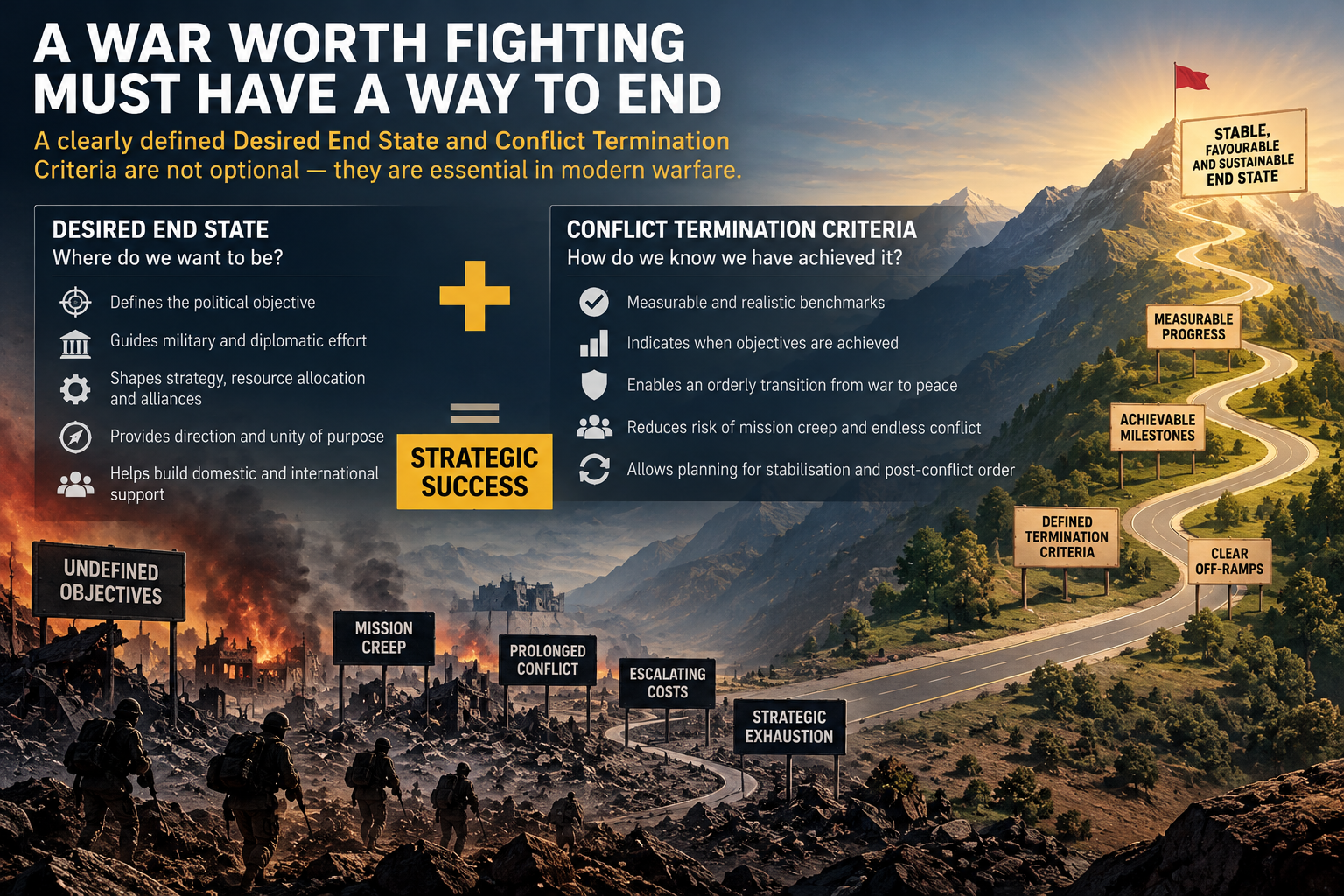
The distinction between a desired end state (DES) and conflict termination criteria (CTC) is fundamental to the conduct of war, yet the language of clearly laid-out military objectives often obscures it.
The DES is defined as a description of one or more conditions that, when achieved, will accomplish the national strategic objectives. It may mean restoring territorial integrity, changing an adversary’s behaviour, removing a specific military threat or creating conditions for a durable peace. CTC is the process leading to the resolution of a conflict and the basis for mutual acceptance of interests and objectives to ensure lasting settlement conditions. An exit strategy describes how the engagement will be brought to a close or shifted to other instruments of national power.
The three concepts are related; however, they are not interchangeable. An exit strategy can withdraw troops or aircraft from a campaign without achieving the political objective. A force can also achieve its immediate military objectives without creating a viable political end state, and a political objective can be so ambitious that no realistic termination criteria can ever be met. The relationship is fairly straightforward: the political end state defines the purpose and sets measures of success; termination criteria turn that purpose into observable conditions; military operations create those conditions; and diplomacy, deterrence, and post-conflict arrangements help preserve the end result. If any link is broken, the campaign risks becoming an exercise in destruction without strategic closure. While the DES is hard to articulate clearly, defining the CTC in tangible terms helps assess whether conditions for cessation of hostilities have been met.
The Iran War: When Objectives Become Blurred
The Iran conflict demonstrates what happens when objectives lack a clear hierarchy. The US–Israeli campaign sought to degrade Iran’s missile capabilities, naval and military infrastructure, and nuclear programme. Political rhetoric raised the prospect of changing Iran’s leadership and strategic orientation through regime change. These ‘ends’ are distinct objectives, with different requirements and strategies. They cannot be bundled together and treated as a single military task. Destroying missile infrastructure is a military task. Preventing nuclear weapon acquisition is a long-term security objective that requires a different approach. Transforming a political system is a much larger undertaking. Air strikes can damage the instruments of a state; they cannot guarantee the political transformation of that state.
The following questions need consideration and deliberation. If nuclear facilities are extensively damaged but the knowledge and capacity to rebuild remain, has the objective been achieved? If the missile threat is reduced but not eliminated, is that enough? If the political leadership survives the mass destruction, does the campaign continue until it is fully eradicated? Unless these questions are answered before or during the campaign, every partial success can become the justification for another phase of war.
The June memorandum of understanding sought to establish a framework for ending hostilities and negotiating a broader settlement, including the reopening of the Strait of Hormuz. The arrangement collapsed amid renewed fighting and formally expired in August. In October, Iran described the US response to its proposal for reopening the strait as insufficient. The parties remained divided over the settlement. Military degradation had not quite translated into an agreement on the political conditions for ending the conflict.
The war in Iran also illustrates a hard strategic truth: a weaker power does not have to match its opponent’s conventional strength to deny it a satisfactory outcome. Maritime disruption, economic pressure and the threat of renewed attacks can impose costs even after substantial military losses. The stronger side may destroy more targets; the weaker side may still retain enough leverage to frustrate its political aims. Military superiority creates options but does not guarantee compliance.
Why Modern Wars Refuse to End
The persistence of contemporary conflicts emerges from the interaction of political ambition, military resilience, incompatible definitions of victory, and the absence of credible arrangements to sustain a settlement. Firstly, political objectives often outrun military means. A state may seek to destroy an adversary’s military capability, change its leadership, eliminate a long-term threat, and reshape a region in a single campaign. These aims demand different instruments and operate on different timelines. Treating every aspiration as an essential war aim makes termination increasingly difficult.
Secondly, an adversary needs only a ‘notion of victory’ to prevent the other side from winning comprehensively. A weaker state can disperse its forces, use asymmetric warfare capabilities, disrupt maritime trade, or prolong the conflict until domestic and international pressure grows. Its objective may be survival, not decisive victory. Denying the opponent a clean outcome can itself become a strategy.
Thirdly, leaders struggle to redefine success, and public promises create political expectations. They also create added pressure. A negotiated outcome that falls short of the original objective can be seen as retreat, even when continued fighting offers diminishing returns. The more a state invests in a war, the more tempted it is to demand one more concession, strike one more target, or pursue one more objective before stopping.
Fourthly, a ceasefire is not the same as a settlement. It can stop the fighting without addressing its causes. Unless the parties agree on verification, enforcement, consequences for violations, and what follows the ceasefire, the pause may simply give both sides time to rearm and reorganise. A ceasefire without a political framework can defer the conflict rather than end it.
Finally, military operations can create new problems faster than political systems resolve existing ones. A campaign to degrade an adversary’s military may trigger a maritime-security crisis. An effort to restore deterrence may widen the conflict. Destroying infrastructure can create humanitarian and reconstruction burdens that complicate any settlement. Operational success can generate strategic obligations that make the war harder to end.
When Ends and Termination Criteria Aligned: Lessons from History
History offers cases in which a bounded political objective was connected to a recognisable condition for stopping military operations. While none is a perfect template, each of them shows the value of knowing what must be achieved and what is sufficient to stop.
-
-
India–Pakistan War, 1971: India’s campaign in the eastern theatre had a clear political and military culmination. Pakistani forces surrendered in Dhaka on December 16, 1971, and Bangladesh emerged as an independent state. The Indian Ministry of Defence’s account of the war’s fiftieth anniversary records the surrender and the emergence of Bangladesh following the defeat of Pakistani forces in the eastern theatre. The political objective in that theatre was closely tied to a concrete military condition: the end of Pakistani military control in erstwhile East Pakistan. This did not resolve every regional dispute. It did, however, give the campaign a defined purpose and a recognisable point of culmination. The lesson is the value of aligning political purpose and joint military action with a measurable outcome.
-
The Gulf War, 1991: The US-led coalition sought to expel Iraqi forces from Kuwait and restore Kuwaiti sovereignty. Offensive operations were suspended on 28 February 1991 after Kuwait City had been liberated and Iraqi forces had been driven from Kuwaiti territory. UN Security Council Resolution 687 subsequently established a more detailed framework for the formal ceasefire and Iraq’s continuing obligations. The liberation of Kuwait gave the coalition a clear basis for stopping the offensive. It did not resolve every security problem involving Iraq; inspections, sanctions and later disputes demonstrated that a bounded military victory is not the same as a durable regional settlement.
-
Kosovo, 1999: The North Atlantic Treaty Organization (NATO) suspended its 78-day air campaign on June 10, 1999 after a Military Technical Agreement with Yugoslavia and confirmation that the withdrawal of Yugoslav forces from Kosovo had begun. The stated objectives included a verifiable cessation of violence, withdrawal of military and police forces, deployment of an international security presence and the safe return of displaced people. These conditions could be observed and assessed. NATO did not need to destroy every Yugoslav military capability before suspending the campaign; termination was tied to commitments and the start of their implementation. Kosovo’s subsequent history also shows the limits: the air campaign’s suspension did not settle every question of sovereignty or governance.
-
The cases point to three different forms of alignment: achievement of a bounded political objective, termination against observable military conditions, and adaptation of the outcome to secure a workable cessation of hostilities. Ending a campaign, ending a war, and resolving the political conflict are three different tasks, and each requires a different strategy.
Air Power and the Illusion of Strategic Closure
For air forces, the distinction between operational success and conflict termination matters especially. Air power offers reach, speed and precision. It can attack an adversary’s military system without the immediate requirement for territorial occupation. These attributes can produce rapid, visible results and the dangerous belief that overwhelming destruction will necessarily compel political compliance. It will not always do so.
Destruction is not coercion and coercion is definitely not settlement. An air campaign can establish freedom of action, suppress enemy air defences, disrupt command networks, and destroy military infrastructure. The adversary may still retain the will to resist, the technical capacity to rebuild, or unleash alternative ways to impose costs. Success, therefore, is measured not by the volume of damage inflicted, but by the ensuing political effect. Before authorising the next phase, planners should ask a simple question: will further operations materially improve the political position? If additional attacks reduce an essential threat, strengthen negotiating leverage or prevent the adversary from exploiting a ceasefire, continued action may be justified. If they add destruction without changing the adversary’s calculations, the campaign is entering diminishing returns.
Targeting cannot be judged by damage alone. Battle damage assessment asks what was hit and what was destroyed. Strategic assessment asks what has changed. Therefore, the question for air power planners is direct: if the next hundred sorties destroy every assigned target, what political condition will become more attainable? If there is no convincing answer, the problem is not the target list; it is the strategy.
Who is Responsible for Answering the Unanswered Questions?
The responsibility for conflict termination must be explicit. It begins with political leadership, not the military commander or the negotiator at the end of a campaign. The political executive must answer fundamental questions: What national interest justifies the use of force? What political condition will count as success? Which objectives are essential, and which can be set aside? What risks is the state prepared to accept? Under what conditions will it stop fighting? The state should make these decisions before the conflict begins, and revisit them when circumstances materially change.
National security leadership must ensure these questions are not left as broad statements of intent. It must bring together intelligence, defence, diplomatic, economic and other relevant assessments; identify contradictions between political ambition and available means; and present decision-makers with realistic options. Its responsibility is to expose trade-offs, not to conceal them behind optimistic assumptions.
The military leadership must provide candid advice on what military power can achieve, the likely costs and risks of continuing, and the consequences of stopping at different points. It must distinguish what is militarily feasible from what is politically attainable. Political leadership must not use military advice as cover for a decision that is ultimately theirs to make.
Diplomatic leadership must assess whether negotiations can secure political objectives, what terms are available and what arrangements would make a cessation durable. It must also identify which issues cannot realistically be resolved during the fighting and should instead be addressed through a phased settlement. Negotiation is not a substitute for strategy; it is one of the available instruments through which political objectives may be achieved.
Finally, a clear process for decision-making and accountability is essential. Who reviews whether the end state remains attainable? Who recommends a change in objectives? Who determines that the conditions for termination have been met? Who authorises the cessation of hostilities? These responsibilities may be supported by many institutions, but the authority for the final political judgement must be unmistakable. Shared advice is essential and diffused accountability is just an excuse.
Parting Shots: A War Without an End State Is a Strategy Without Purpose
Modern warfare is not simply about finding, engaging, and destroying the adversary. It is about converting military effects into a politically sustainable outcome. The Iran–US–Israel conflict shows how a campaign can expand beyond its original military purpose. Ukraine demonstrates how incompatible political end states can obstruct termination even when the costs are immense. Gaza shows how a ceasefire can fail when the political and security arrangements that must follow remain unresolved. These are not simply failures of military power. They are failures to connect the purpose of war with the conditions for ending it.
The sequence must be clear. The end state determines the termination criteria, and the termination criteria shape the campaign. The campaign remains subordinate to political purpose. A state must know not only what it wants to achieve, but what evidence will show that it has achieved enough. It must distinguish essential security requirements from maximalist ambitions, military degradation from durable denial, and a temporary halt in fighting from a sustainable settlement.
Until that relationship is established, modern wars will keep delivering tactical victories, political ambiguity, and ceasefires that set the stage for another round of fighting. The question before every campaign is not merely, “Can we defeat the adversary militarily?” It is: “What political condition are we trying to create? What will count as sufficient success? And what will prevent the adversary from undoing it when the fighting stops?” Clausewitz’s central insight that war serves politics remains relevant. The decision to stop must therefore be governed by political purpose, not by momentum, rhetoric, public sentiment or the availability of excess force.
****
(Disclaimer: The views and opinions expressed in this article are those of the author and do not necessarily reflect the position of the Centre for Aerospace Power and Strategic Studies [CAPSS])