
Author: Ms Anuttama Banerji, Associate Fellow, Centre for Aerospace Power and Strategic Studies
Keywords: Nuclear Power, Naval Deterrence, Submarine, Sea-Based Nuclear Deterrence
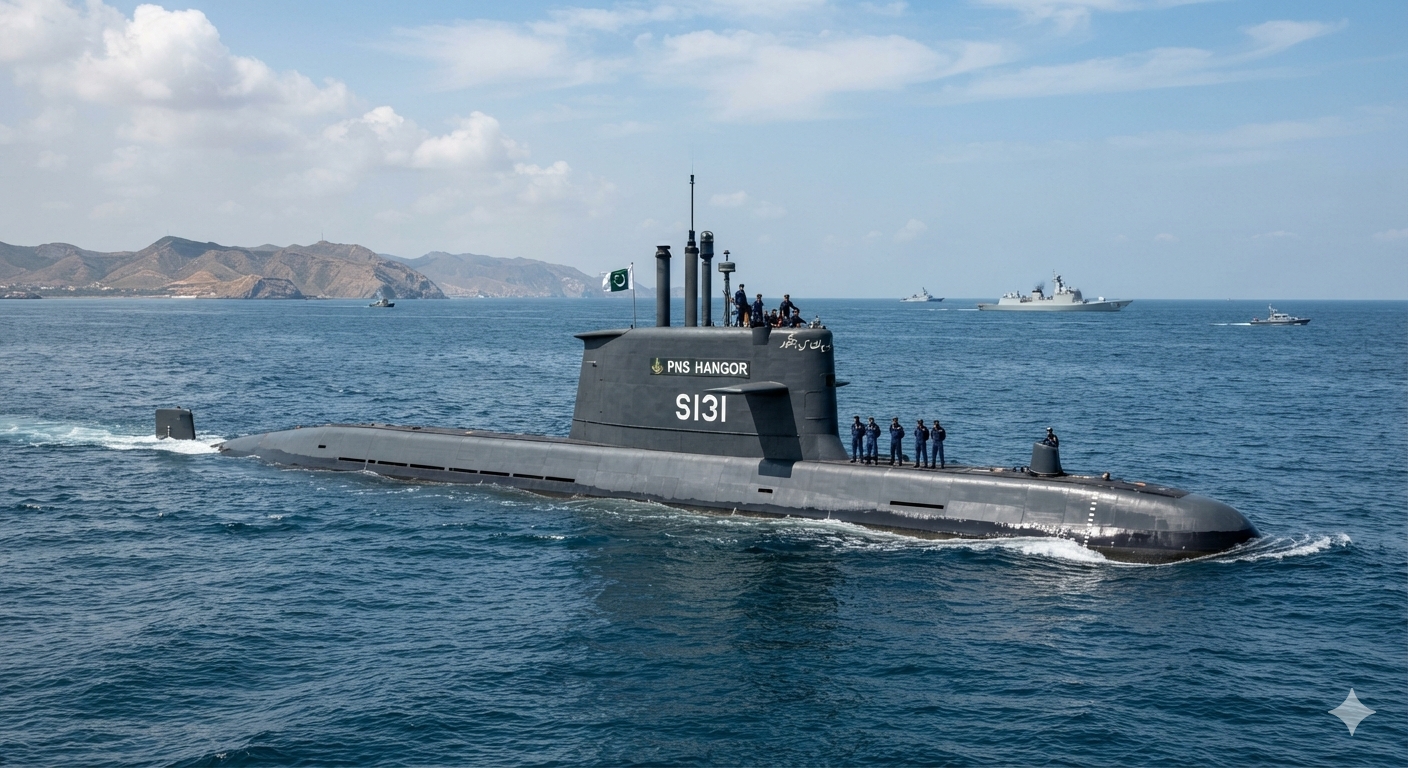
Pakistan recently commissioned the first of eight Hangor-class submarines during Pakistani President Asif Ali Zardari’s visit to China. The official ceremony took place in the Chinese city of Sanya, which hosts the People’s Liberation Army Navy (PLAN’s) surface fleet and submarine support facility. It also hosts the Yulin naval base, which is the most important military base in the South China Sea.1 Hence, not only was the choice of venue significant, but also the commissioning of the Hangor submarine marked a key step in Pakistan’s ongoing naval modernisation programme.
The event also demonstrated the strategic relationship between Beijing and Islamabad. The commissioning of the Hangor submarine is significant as it diversifies Pakistan’s nuclear delivery capability from a purely land-based deterrent. Although built in China and viewed as a traditional replacement for the Agosta 90B submarines Pakistan acquired from France in the 1980s, the commissioning also strengthensPakistan’s “sea denial capabilities.”2
Given Pakistan’s interest in maintaining an enduring presence in the Bay of Bengal, an area of tactical operations where Pakistan’s presence ceased to exist in 1971,3 the acquisition of the submarine also provides Pakistan with a protracted presence in the Bay of Bengal sub-region of the Indian Ocean Region (IOR), with domain awareness being provided by Pakistan’s friends in the region.
Pakistan has suggested that the commissioning of the Hangor submarine is a “historic milestone” for its navy. It is meant to be a strategic deterrent to strengthen its second-strike capability against India, since the submarine is likely to be armed with a submarine-launched nuclear cruise missile. The submarine is also likely to integrate the Babur-3 sea-launched cruise missile (SLCM). With a range of 450 kilometres, this SLCM provides Pakistan with second-strike capability, although the range continues to be limited. Babur-3 is incidentally the sea-launched variant of the ground-launched Babur-2 missile.4
To recall, India has formally commissioned and inducted INS Arihant (S2), INS Arighaat (S3), and INS Aridaman over the years. These ballistic missile submarines (SSBNs) demonstrate the maturity of India’s nuclear triad. For example, INS Aridaman possesses a larger hull and has improved endurance in comparison to its predecessors, Arihant and Arighaat.5 According to existing reports, INS Aridaman can carry either eight K-4 ballistic missiles, with a range of 3,500 kilometres, or about 24 K-15 missiles, with a range of 750 km.
Commissioning of the Hangor Submarine and AIP Technology
In contrast with India’s nuclear-propelled SSBNs, the Hangor-class submarine is a derivative of the Chinese Type 039 submarine6 and is equipped with advanced combat systems, modern sensors, and Air-Independent Propulsion (AIP) technology. This provides it with greater underwater endurance and the ability to remain undetected for longer periods.7 AIP, or air-independent power, is a key marine propulsion technology that enables a non-nuclear submarine to operate sans the need to access atmospheric oxygen, as occurs in traditional diesel-engine submarines through surfacing or the use of a snorkel.8
The operational effectiveness of the submarine is more varied than just being used for delivery of nuclear warheads since it can potentially lay mines and attack adversary craft, while limiting surface appearances. This enhanced stealth capability potentially acts as a credible “force multiplier” during naval battles.9
If the other Hangor-class submarines are delivered on time, Pakistan will have greater operational capability to track Indian ships with greater frequency with Chinese support. Along with its Chinese-origin long-range HQ-9/P, medium-range LY-80, and the short-range FM-90 surface-to-air missiles (SAMs) and its sea-based capabilities, including the C-802 anti-ship cruise missiles10 and the Hangor submarines, Pakistan can potentially counter India at sea.
Larger Picture
With the acquisition of the submarine, Pakistan believes that it has acquired a sort of second-strike capability. Sea-based nuclear forces, especially submarines and vessels carrying nuclear-armed missiles, tend to provide that option to states. But whether this will translate to stable nuclear deterrence remains to be seen. Pakistan’s overall nuclear strategy will determine that. Until now, it has rested on the plank of nuclear brinkmanship. Will the acquisition of the submarines and the confidence in the ability to second strike make Pakistan less reliant on projection of first use? Time will tell. Meanwhile, seen in conjunction with India’s sea-based platforms capable of delivering nuclear ordnance, India will continue to have the strategic edge. Therefore, India should take note of this development but not view this acquisition as a significant strategic shift.
India should focus on ensuring the timely completion of its own submarine acquisition programme so its SSBNs and potentially SSNs (nuclear-powered attack submarines) continue to act as strategic deterrents at sea, and India could eventually move towards a Continuous at Sea Deterrence (CASD) posture if desired in the long run.
Notes: