
Author: Mr Jai Verma, Research Scholars, Unni Kartha Chair of Excellence
Keywords: HAL-Dornier-228, Light Transport Aircraft (LTA), Vayudoot, Hindustan Aeronautics Limited (HAL), Short Take-Off and Landing (STOL)
Is the Dornier aircraft India’s unsung hero? A versatile machine that does not get its deserved recognition? The story of this aircraft started with the landmark contract that was signed between the Government of India and Dornier GmbH of Germany on November 29, 1983, which paved the way for India’s national aeronautical industry to manufacture a light transport aircraft for a variety of roles.1
Start of the German-based Do-228
The Genealogy of the Dornier company can be traced through the story of its legendary founder, Claudius Dornier. He joined Luftschiffbau Zeppelin (a German aircraft manufacturing company) in 1910 and soon began research on improving the strength of light metal sections even as he began investigating the development of rigid airships. In 1913, Count Ferdinand von Zeppelin appointed Dornier as his personal scientific advisor.2
In 1914, the ‘Do’ Department was formed as part of Luftschiffbau Zeppelin and Dornier was provided with better facilities for his research. Upon the outbreak of World War I in 1914, Count Zeppelin decided to build aircraft, and he established the Seemoos shops near Manzell for this purpose.3 Dornier’s research during this period guided later development of the aircraft industry.
With the war ending in 1918, the German aviation industry was left in the lurch. The Seemoos facility was converted into a factory, but Claude Dornier continued his work despite the seemingly bleak prospects for the future. He suffered another setback after the Versailles Treaty, which prohibited aircraft manufacture in Germany by law and forced the Seemoos facility to shut down. He decided to resume operations abroad. During the Second World War, the company concentrated on flying boats and bombers and its Dornier-17 and Dornier-217 ‘flying pencils’ formed a large body of the Luftwaffe’s bomber force and saw extensive use and service during World War II in the Battle of Britain.4 It was later developed into a night fighter to protect Germany from RAF offensive bombers. The only fighter project was the Dornier-335, claimed in its time as the fastest propeller-driven aircraft in the world, but engine delivery delays meant it arrived too late to be introduced into combat service.
In 1945, after WW II, aircraft production was once again forbidden in Germany and the enterprise relocated to Spain, where the Dornier-25 general-purpose liaison aircraft built by Construcciones Aeronáuticas SA (CASA) was the result of a design effort for the Spanish Air Force requirements.5 The Dornier-28 was similarly successful, being used by the German Armed Forces where it served until the introduction of the Dornier-228 in the early 1980s, which was the subject of a major transfer of technology and licence production agreement with India, formalised on November 27, 1983.
The Indian Defence Service Utility
For the defence services, the Dornier-228 provided equal versatility, combining excellent field performance with good payload-range and long endurance, apart from the savings in fuel and maintenance costs owing to its rugged design features. For Hindustan Aeronautics Limited (HAL), the Dornier-228 represented the opportunity to finally participate in the Light Transport Aircraft (LTA) programme. In the comprehensive transfer-of-technology contract, Dornier assisted HAL in establishing production facilities for the aircraft, powerplants, avionics and accessories, jointly developing special variants of aircraft to meet multifarious compatible requirements of various operators.6
Prelude of Indo-German Do-228
In May 1978, HAL and Dornier of West Germany signed a Memorandum of Understanding to design, develop and manufacture a light transport aircraft incorporating the ‘wing of new technology’ evolved in Germany, with potential to grow from the optimum 19-seater category to a 24-seater and eventually to a 30-plus-seater class.7
A large number of design engineers from HAL, led by Wing Commander Inder Mohan Chopra8 (later Chairman of HAL), were nominated for joint studies with the Dornier team. This team was led by Reinhold Birrenbach at Friedrichshafen (southern Germany). Some months later, the team came up with positive recommendations for the government’s consideration.
It took several years of appraisal, flight evaluation, performance limits and intensive industrial-commercial negotiations. Finally, the Indian government confirmed in August 1983 that Dornier-228 derivatives would be India’s choice of light transport aircraft. These derivatives were meant to serve multiple operators like regional airline Vayudoot, the Indian Air Force (IAF), the Navy, the Coast Guard, and others.9
Most of the deliberations took place from the 1970s to the 1980s. During this period, governments constituted various committees and explored various recommendations. These committees were tasked not only with examining the requirement for such feeder airlinks, but also with quantifying the size, type, and quantity of required aircraft.
They also had to determine whether the indigenous aircraft industry was capable of developing and producing such an aircraft in the numbers required. The aim was clear that the country required such regional air links for social, economic, and strategic reasons; considering the multi-purpose use of 18- to 20-seater light transport aircraft, well over 100 aircraft would be needed. Hindustan Aeronautics Limited had the expertise and resources to undertake this national task.
Even as the Design and Development Bureau of HAL, under SC Das direction, started preliminary design studies for such an aircraft, eventually labelled the HAC-33 in 1976, the domestic carrier Indian Airlines nominated their Planning Manager, J.K. Chaudhuri, to initiate an examination of air traffic potential; identify cities to be connected, and the aircraft type that fulfils the needs.
The Ministry of Civil Aviation constituted two more Committees in 1979-80 with the same terms of reference to make recommendations regarding the nature, type and size of aircraft, to identify the stations, assess the number of aircraft required to serve the stations and to recommend the airfield infrastructure required so that the entire country could be covered in phases over three years.10
Thus, in early 1981, the Menon Committee was constituted, with members nominated from the airlines and industry. The Menon Committee had extensive discussions with potential operators of such light transport aircraft, studied the size and performance parameters and worked out projected requirements till the end of the century before drawing a list of all available aircraft types then existing. Nearly two years of examination, flight evaluation to the farthest limits of performance and intensive commercial and industrial negotiations followed before the Govt. of India confirmed, in 1983, selection of the Dornier-228 as India’s choice of light transport aircraft for Vayudoot, the IAF, the Navy, the Coast Guard, plus other operators.11
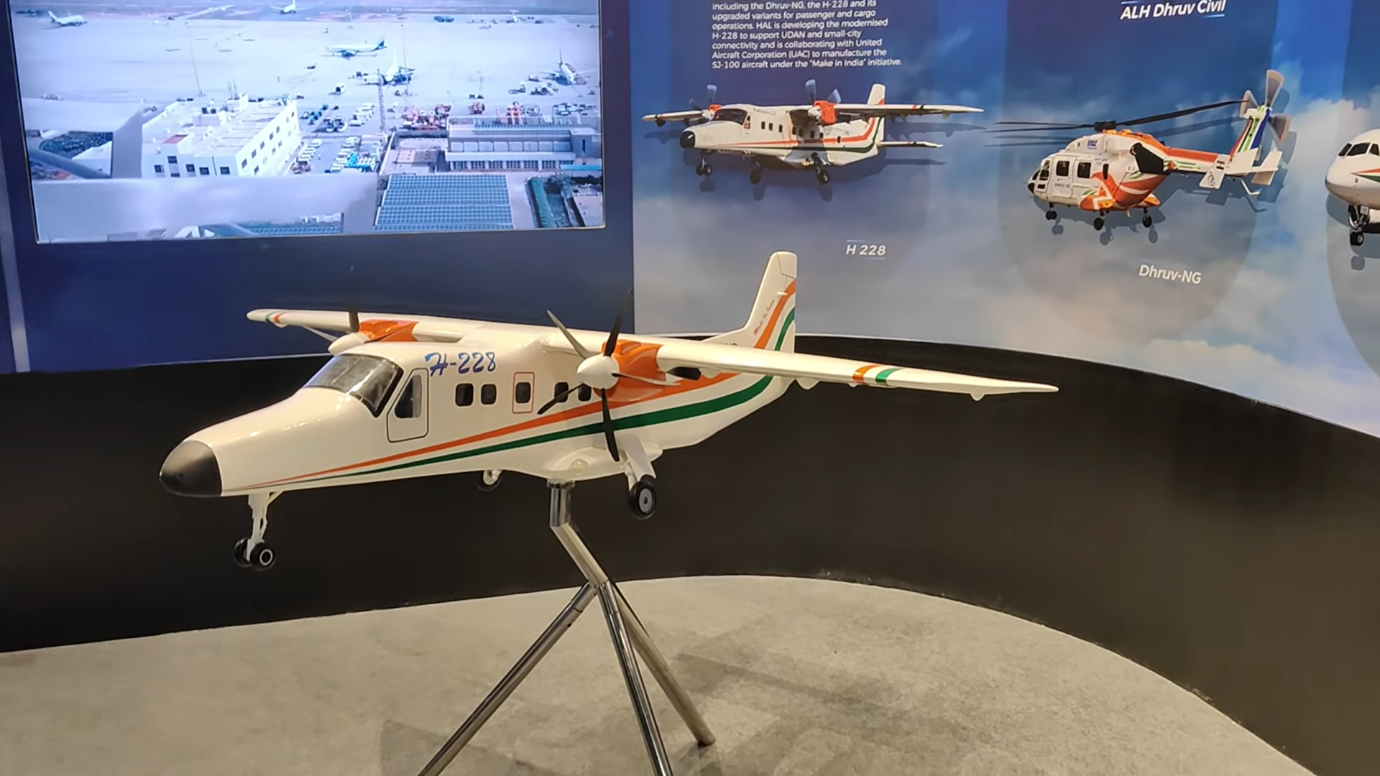
The Dornier-228 aircraft is a high-wing monoplane with a cantilevered wing and two turboprop engines in wing-mounted pods, designed for multipurpose services. Low fuel consumption, short take-off and landing capabilities (STOL), a comfortable air-conditioned cabin and long range make this aircraft situated for many purposes. This aircraft is designed and tested to operate in all weather and other adverse environmental conditions.12 This makes the aircraft extremely versatile and cost-effective, allowing it to operate with flexibility and reliability from a variety of airfields, including semi-prepared airstrips in difficult terrain.
HAL’s Kanpur Division was selected to manufacture the airframe. This included the wing of new technology and composite materials for its structure. The Garrett TPE331-5 turboprop engines would be built at the Engine Division in Bangalore. Accessories and avionics would be manufactured at HAL’s Lucknow and Hyderabad Divisions. Indian operators could take advantage of various developmental benefits that an aircraft of the Dornier-228 at the beginning of its career portended. That the HAL-built Dornier-228 was intended not only to be a fully indigenous aircraft but on which future transport aircraft designs are based was evident from the Indian Government’s comprehensive planning, where even raw material for the airframe, accessories and engines was locally sourced. That, plus the programme for export of HAL-built 228s to a large “exclusive marketing territory,” was a major step towards fulfilment of the national policy for self-reliance in the aeronautical field.13
A project management team under the leadership of C. L. Khosla, B.K. Banerjee, and M. K. Shanmugam from HAL were deputed to the Dornier facilities in the suburbs of Munich (Germering, Neuaubing and Oberpfaffenhofen), as well as the head office and design department at Immenstaad, near Friedrichshafen on the Bodensee. The facilities at HAL’s Kanpur Division clearly had to be augmented, and a brand-new plant was designed and built across the apron, opposite the original hangars and steel hangar which was temporarily used for assembling the first Dornier-228s. The new final assembly hangar, machine shops and centres plus paint shops were ready by 1985-86 and began work on aircraft immediately.14
Initial deliveries of Dornier-228s, built at the manufacturer’s plant at Oberpfaffenhofen, south of Munich, took place ceremoniously in November 1984; the first three to the Indian regional airline were followed by aircraft destined for the Indian Coast Guard, the National Airports Authority, the Oil & Natural Gas Commission (ONGC) and the Indian Navy. Dornier supplied Dornier-228s in kit form for assembly by HAL for Vayudoot, the Coast Guard, National Airports Authority (NAA), and the Indian Air Force.
As with other transfer-of-technology programmes, licence manufacture of the Dornier-228 was in progressive steps, beginning with Phase Zero (supply of a minimum number of “flyaways” directly from the licensors), then CKD-kits sent to the licensee under Phase 1 (six aircraft), followed by Phase II and III (ten aircraft each as sub-assemblies and detailed parts). Phase IV, or the raw-material stage, was to begin for 27 aircraft onwards, and HAL was confident that it would achieve its target of 150 aircraft to be built for both the Indian and export markets.15
As with original designers and manufacturers, Dornier Luftfahrt GmbH changed its corporate strategy to concentrate on regional jet airlines from the mid-1990s; HAL were to become the sole manufacturer of the Dornier-228 Light Transport Aircraft, with worldwide export rights. However, the long-awaited and much-desired induction of the commuter airliner for Vayudoot took place at a formal ceremony at Dornier’s Oberpfaffenhofen airfield on November 15, 1984.16 Mahesh C. Sarin, Secretary for Defence Production, was formally handed over the first two Dornier 228-201 aircraft by Dornier, which, in turn, were formally handed over to Vayudoot, Indian Airlines, and Air India.17
The first two Dornier-228s of Vayudoot were ferried from their Munich departure point in West Germany, arriving at New Delhi on 18 December 1984. Route-proving flights and training of additional aircrew took a few weeks before Vayudoot’s first official scheduled flight with their new Dornier-228 was launched on January 02, 1985, from New Delhi to Rae Bareilly and on to Lucknow-Dehradun and return.18 This marked completion of Phase-I in the transfer-of-technology programme wherein the Dornier-228 was to be built in several other variants by HAL.
The Kanpur Division of HAL achieved a major milestone with completion of the first five Dornier-228 aircraft at their facilities at Chakeri, Kanpur during the financial year ending March 1986.
| Year | Milestone | Details |
|---|---|---|
| 1910 | Dornier origins | Claudius Dornier joined Luftschiffbau Zeppelin; begins research on rigid airships. |
| 1913 | Scientific advisor | Count Zeppelin appoints Dornier as personal scientific advisor; ‘Do’ Department formed in 1914. |
| 1945–50s | Post-WWII revival | After the ban on German aircraft production, Dornier relocates to Spain; produces Do-25 for the Spanish Air Force and Do-28 for the German Armed Forces. |
| May 1978 | MoU signed | HAL and Dornier GmbH sign MoU to design, develop, and manufacture an LTA as a “wing of new technology.” |
| 1976–81 | HAC-33 & committees | HAL’s Design and Development Bureau under S.C. Das begins preliminary studies for HAC-33. Multiple government committees constituted. Menon Committee (1981) recommended aircraft size, stations, and infrastructure. |
| August 1983 | Do-228 selected | After negotiations, the Government of India confirms Dornier-228 as LTA for Vayudoot, IAF, Navy, Coast Guard. |
| November 29, 1983 | ToT contract signed | ToT contract between Govt. of India and Dornier GmbH signed; production licence at HAL Kanpur. |
| 1984–85 | Phase 0 – Flyaway | Initial deliveries of Dornier-228 from Oberpfaffenhofen factory. First three aircraft to Vayudoot ceremonially handed over on 15 Nov 1984. |
| 1985 | ONGC delivery | ONGC receives its Dornier 228-101 (Series 100, VIP/Executive config) in April 1985. |
| January 31, 1986 | First HAL-built flight | Maiden flight of first HAL-manufactured Dornier-228 at Chakeri, Kanpur by Chief Test Pilot Wg. Cdr. B.K. Dhiman. |
| July 11, 1986 | Coast Guard induction | Indian Coast Guard receives first Dornier-228MPA; aircraft flown from Munich to Bombay. Coast Guard Air Squadron established at Daman with 360° radar, IRLS pods, and machine-gun capability. |
| November 1987 | AAI Flight Inspection | AAI begins operating a special Dornier-228 variant fitted with a Flight Inspection System for calibrating airfield ground aids across India and neighbouring countries. |
| March 1988 | IAF induction | First Dornier-228 handed over to IAF at Palam. Replaces piston-engine Otters and Devons. Wide-door variant developed by HAL for elongated stores. |
| April 1990 | Coast Guard 2nd sqn | Second Coast Guard Maritime Patrol Aircraft squadron commissioned at Meenambakkam (Madras). HAL-built Dornier-228MPA also delivered to Mauritius Coast Guard. |
| September 1990 | IAF Eastern Command | Second IAF Dornier-228 squadron at Guwahati supports Eastern Air Command. Dornier-228 flights eventually placed at all Air Commands. |
| August 26 1991 | Navy induction | First HAL-built Dornier-228 enters service at Naval Air Squadron, Dabolim, Goa. |
| 1995 | IAF multi-engine training | HAL-Dornier-228s consolidated into multi-engine training flight at Transport Training Wing, Yelahanka (north Bangalore). |
| Mid-1990s+ | Sole manufacturer | As Dornier Lufthansa GmbH shifts strategy to regional jets, HAL becomes sole worldwide manufacturer of Dornier-228 LTA with exclusive export rights. |
Table No. 1: Timeline of HAL-Dornier-228
Specifications
The HAL Dornier-228 aircraft is a high-wing monoplane with a cantilevered wing and two turboprop engines in wing-mounted pods, designed for multipurpose utility and commuter services. Characteristics like low fuel consumption, short take-off and landing capabilities, operation from semi-prepared runways, a comfortable air-conditioned cabin and long range make this aircraft ideally situated for such applications. This special aerodynamic profile and wing shape ensure a high lift-to-drag ratio, reduced drag, take-off climb, cruise, and a short take-off distance of 655 meters and a landing distance of just 572 meters, enabling swift operation even on semi-prepared runways.
The leading particulars of the aircraft are:
| Type | HAL Dornier-228 AIRCRAFT |
|---|---|
| Number of Crew | 2 |
| Maximum Take-off Weight | 6,400 Kg |
| Maximum Landing Weight | 5,900 Kg |
| Power Plant | 2 Garrett TPE 331-5-252D Turboprops |
| Propellers | 2 four-bladed reversible-pitch Hartzell propellers -HC-B4TN-5ML/LT10574FS |
| Overall Length | 16.56 M (54 ft, 4 in) |
| Wing Span | 16.97 M (55 ft, 8 in) |
| Maximum Height | 4.86 M (15 ft, 11 in) |
| Landing Gears | Hydraulically actuated fully retractable |
| Electrical systems | 28V, 300 amps DC |
Table no 2: Technical specialities19
Testimonies
Group Captain Ganesh Chandra, VSM20
Chief Test Pilot, HAL Lucknow21
The Dornier-228 has certain unique aspects in operations, performance and maintenance, and as a test pilot, that is what I can speak to. We have now flown this aircraft for more than 50 hours, and we have not had a single problem. Every time, we have been able to complete the mission. It is one of the best aircraft available anywhere in the world and, of course, it is indigenously made.
R Madhavan22
Chairman and Managing Director (CMD), HAL Lucknow Division
HAL has produced and supplied 1,135 aircraft to various customers, and we support their operations from our base in Kanpur, where we have full-fledged MRO support alongside the manufacturing facilities. The Directorate General of Civil Aviation (DGCA) has certified these facilities, and we hold approvals not only for manufacturing but also for maintenance and training. We know that civil operations are far more stringent, and that an aircraft has to be turned around much faster than with defence customers. We are geared up for that. We offer special maintenance packages for operators, with spares and our specialists available to help at any point in time.
The Dornier-228 is a Made-in-India product and the only turboprop for civil aviation produced in the country, built from raw material to the final stage entirely in India. We are now offering it for civil use under the government’s Uday Desh ka Aam Nagrik (UDAN) scheme. HAL is seeking tax exemption from the government and making several other efforts to reduce costs. We sell it at around seven million US dollars, which is on par with any other aircraft in its category, and we plan to bring the price down further through more efficient manufacturing techniques and lower input material costs.
Rajiv Kumar23
Chief Executive Officer, HAL Lucknow Division
This is HAL’s light hangar in Kanpur, where the Dornier-228 is manufactured. The structure taking shape is interesting to watch, and so are the machines. The five-axis Computer/ Computerized Numerical Control (CNC) profiler cuts and drills an aluminium sheet eight metres long and 3.5 metres wide, changes its own heads as required, and is controlled from a numerical control monitor. In the composite assembly, the structure is strengthened by covering it with different materials, and our pipe-bending machine works under a computer programme. After the CNC room, parts go to the inspection room, where they are matched with the engineering drawings; the engineer approves only when completely satisfied. Once the structure is ready, the equipping and coupling assembly joins different parts and fits windows, seats and toilets.
The Dornier-228 used by the military has undergone 280 new modifications after DGCA approval, so that passengers get more convenience and comfort. It seats 19; for VIP use, the seating can be reduced to 11, with tables. Baggage capacity is 330 kg. It has a flushing toilet, and the cabin temperature is held between 18 and 28 degrees Celsius. It needs 762 metres of runway for take-off and only 576 metres for landing.
Group Captain Ranjit Panicker24
Senior Test Pilot, HAL Kanpur25
I have been involved in the flight testing and certification of the HAL Dornier-228, from its first flight to completion of type certification. It is the first indigenous aircraft to be manufactured and certified by the DGCA. That is a proud moment for our country and aligns with the theme of Aatmanirbhar Bharat. I was a fighter pilot in the Indian Air Force, and I am trained to take an aircraft to the limits of its envelope. I have also worked on the flight testing of the Saras. For me, the joy of this job is giving the line pilot a product that is proven, safe, reliable and easy to fly. The upgrade brings a new engine, composite propellers that make it quieter and lighter, and a completely glass cockpit. On a hub-and-spoke model, it is an ideal platform for this, and it lets every citizen fly in comfort and safety at a much lower price than on the big jets. It is also a cost-effective, safe option for connecting tier-2 and tier-3 cities to major metro hubs. As one of the pilots who took it from first flight to certification, I assess this is a proven airframe made safer by modern systems: a glass cockpit that keeps the crew fully aware, autopilot that eases their workload, and the ability to operate from short and unprepared runways.
Group Captain R K Sharma26
Commanding Officer, 41 Squadron, Palam (from June 1999)27
I took command of 41 Squadron at Palam in June 1999, at the height of Kargil. The squadron flew a mixed fleet of HS-748 (Avro) and Dornier-228 aircraft. I was already qualified on the HS-748 and converted to the Dornier in two to three months. The Dornier is a high-wing, twin-turbine aircraft with a rectangular cross-section, unpressurised, and a 25,000-foot ceiling. We normally flew below 10,000 feet on VIP duty, with small loads and passengers.
The aircraft was unpressurised and had no anti-icing on the airframe. It was cleared only to 15,000 feet because no maximum allowable airspeed indicator was fitted; a descent from height risked exceeding structural speed limits. Each pilot had one small oxygen bottle, good for 40-45 minutes. We needed about 20,000 feet via Srinagar and 25,000 via Chandigarh, in absolutely clear weather. At Leh, the climb gradient after an engine failure was critical, with a hill we called the “policeman’s rock” ahead and a right turn to follow; at or above zero degrees Celsius, we could not take off with the required fuel and two ground crew. In August, a new C-in-C insisted that military aircraft must be exploited to their maximum. With Command Headquarters’ support, we had no alternative but to plan it.
We went in stages. First, a local sortie at 20,000 feet with one engine shut down: the aircraft drifted down and levelled at 17,000 feet, matching the single-engine ceiling we had been given, though the speed was lower than anticipated. The trial exposed the oxygen problem. The integral bottles were inadequate, and the masks over headsets gave both pilots headaches. My engineering officer suggested Boeing 737 emergency bottles; we borrowed and rigged them behind the pilot seat and requisitioned cloth-and-leather inner helmets. That gave about two and a half hours of oxygen, exactly what a Srinagar–Leh sortie needed, with a return to Srinagar or Jammu in hand. Second, we flew from Srinagar to overhead Leh at 20,000 feet and back without descending. Third, we had a helicopter sortie to study the valley escape route in case of engine failure. With no airframe anti-icing, my rule was to fly only when there was no cloud at our level, and temperatures were at or below zero.
We positioned at Srinagar on November 20 and waited five days for the weather. On the 25th, around 0830 hrs, we took off, climbed to 20,000 feet, descended overhead Leh and landed. We flew circuits and checked actual engine-failure performance; being smaller and slower than other types, the Dornier could approach the Leh runway from either end. My real worry was whether the engines would restart at Leh in sub-zero temperatures. They did, without trouble. We then crossed the Khardung-La to Thoise and landed there the same day. I do consider it a great feat: there were many odds to surmount, and we were lucky that everything went well.
Later, returning from Leh, I kept climbing past 21,000 feet into severe turbulence, and at 23,000 feet I accepted I could not outclimb the cloud, so I night-stopped at Leh. The next morning, it again kept rising. I climbed to the 25,000-foot ceiling and levelled at 25,200 feet, just above a sheet of cloud. It was the quietest cockpit I have known; my co-pilot and I hardly spoke. On another flight, to Chandigarh via Kullu and Shimla with about eight on board, I climbed to 23,000 feet, shut down one engine and drifted down. A passenger fainted and revived on oxygen. On landing, three cabin windows had shattered: the pressure-equalising holes between the panes were hidden behind the trim and choked with dust, as the aircraft had never flown above ten or twelve thousand feet. After an inquiry, they drilled two visible holes in each window.
Of everything I have flown, the HS-748 was the easiest to handle and had the best navigation aids. The Dornier is more modern, with much better instrumentation much better than the Avro’s, and it is a very simple aircraft to fly, though it can still take you for a ride on landing. Its drawbacks are real: no pressurisation; no airframe anti-icing, which was a big drawback because we could not navigate through weather; and stock oxygen unfit for high-altitude work. My verdict is that it is a simple, well-instrumented aircraft whose real limits are weather, pressurisation and icing, not its basic strength
Major Operators
-
Indian Coast Guard: Expansion and equipping of the Indian Coast Guard Air Wing has primarily relied on the Dornier-228, fitted with maritime surveillance radar, advanced navigation systems, and specialist sensors for the variety of roles involved. After strenuous evaluation of various aircraft and airborne systems worldwide, the Dornier-228 was selected to fulfil this exacting role and the aircraft was integrated with 360° airborne surveillance radar, an Omega navigation system, a loud-hailer, and a powerful searchlight to enable the aircrew to detect, monitor and apprehend hostile surface craft. Underwing stores included Infra-Red Line Scan (IRLS) pods to detect oil pollution; the Dornier-228s were also equipped for chemical spray for pollution containment. As a deterrent against smugglers and other clandestine activities, the Coast Guard’s aircraft carry under-wing machine-gun pods.
The Indian Coast Guard received its first Dornier-228MPA on July 11, 1986, the first three aircraft being flown to Bombay from Munich by Coast Guard air crew.28 These aircraft were joined by HAL-built Dornier-228s to equip the Coast Guard Air Squadron at Daman north-Bombay, Arabian Sea. With increasing numbers of Dornier-228MPAs (Marine Patrol Aircraft) being manufactured by HAL at Kanpur, the second squadron was commissioned at Meenambakkam Airport (Madras) in April 1990. Additional aircraft have since enabled the Coast Guard to form additional units to be deployed in the Andaman and Nicobar Islands.
-
Indian Air Force: Selected as the standard Light Transport Aircraft to replace the piston-engined Otters and Devons in service with the IAF, the Dornier-228 was required to fulfil the extended air staff communication and light logistics air support tasks. The Dornier-228 was the first German-origin aircraft type to enter service with the IAF.
To accommodate special elongated stores, HAL developed a wide door in place of the standard entrance, and this arrangement has proved to be extremely practical for the purpose of intra-air base flights; the IAF’s Dornier-228s have proved to be extremely versatile and economical in service. It was no longer necessary to operate medium-sized tactical transport aircraft to fly personnel or light but high-value stores to various parts of the country
The first Dornier-228 for the Indian Air Force was handed over in March 1988 at Palam airfield. New Delhi. The next squadron to re-equip was at Guwahati in September 1990, and was responsible for supporting Eastern Air Command requirements. As additional aircraft were delivered by HAL, the Indian Air Force located the flights of Dornier-228 with each of the seven Air Commands. In support of this programme, the IAF established No. 8 Technical Type Training Unit at Palam for personnel converting on the Dornier-228.29
-
Indian Navy: Sanitisation of the sea around the Indian peninsula is a prime responsibility of the Indian Navy, and the “silent service” has endeavoured for decades to expand shore-based airborne maritime surveillance and information-warfare capability. The Indian Navy had the firm requirement for a larger force of twin-engine, light transport aircraft with adequate range and endurance, and equipped with various sensors including radar, navigation systems and key avionics, and the Dornier-228 has fulfilled this requirement in a most cost-effective manner
The first HAL-built Dornier-228 for the Indian Navy was handed over in Kanpur on August 26, 1991, and entered service with the Indian Naval Air Squadron at Dabolim in Goa. Other Indian Navy Dornier-228s are to be tasked for a number of secondary roles in support of the fleet, including observer training, staff communication flights, target towing and utility transport.30
-
Airport Authority of India: The Airport Authority of India have operated special versions of Dornier-228 since November 1987 for flight inspection and calibration of airfield ground aids throughout India and some neighbouring countries. The special version of the Dornier-228 was developed to incorporate a Flight Inspection System (FIS), including a self-tracking IR theodolite for checking ILS approaches, upgraded capability for an INS-related ground-independent position-fixing system, state-of-the-art communication and navigation equipment, with all processed data being sorted by a microprocessor-controlled tape recorder unit for ground evaluation.
While the first NAA Dornier-228 was delivered by Dornier’s Munich factory, a second aircraft was built by HAL Kanpur, and both aircraft were continuously utilised at scores of airports throughout India, as well as in certain countries like the Maldives, Bangladesh, Nepal, Sri Lanka, and Vietnam. ONGC was an early Indian operator of the Dornier-228, accepting its aircraft in April 1985. The Series 100 was selected and configured for the VIP/Executive role with extremely comfortable seating, with executive tables, a large galley for hot meals, a wardrobe, a toilet and an attendant seat.31
Conclusion
-
Across Dornier’s journey, excellence can be expressed in many ways, but it is truly epitomised by only a few, like the HAL Dornier-228. Built by HAL’s Transport Aircraft Division in Kanpur, this light transport aircraft is powered by fuel-efficient turboprop engines. Designed for multiple roles and missions, it delivers excellent performance, among the best in its class. The HAL Dornier-228 offers immense functional versatility at low operating cost. It is deployed for numerous defence and civil applications, including maritime surveillance; reconnaissance; intelligence warfare; air observation, search and rescue; surveillance and control; troop transport; observer training; aerial photography; air ambulance; flight inspection; and executive transport. What makes the HAL Dornier-228 such a reliable multipurpose workhorse lies in the built-in design features like operational simplicity; minimal maintenance requirements; quick convertibility to mission roles; short take-off and landing capabilities; and continuous upgrades carried out in line with requirements. Today, HAL has established a sizable customer base for the Dornier-228 and has been supporting the Indian Coast Guard, Navy, Air Force, and regional air services within India and abroad on a regular basis.
(Disclaimer: The views and opinions expressed in this article are those of the author and do not necessarily reflect the position of the Centre for Aerospace Power and Strategic Studies [CAPSS])
Notes:


