Author: Wg Cdr Vikas Kalyani, Senior Fellow, Centre for Aerospace Power and Strategic Studies
Keywords: Air Power, Gulf War, Mass Precision, Doctrine, Evolution
Introduction
Air power’s strategic potential remains constrained not by technological limits, but by doctrinal inertia rooted in the 1991 Gulf War paradigm. Modern capabilities of air power, such as persistent Intelligence, Surveillance, and Reconnaissance (ISR) tracking, mass precision effects, and real-time logistics observation, enable decisive air campaigns that can either terminate conflict or soften the way to it. Military history warns that such technological-doctrinal mismatches persist until battlefield reversals compel reassessment, underscoring the urgent need to shorten the doctrinal lag by rethinking at the pace of technological evolution.
The Obsolescence of Gulf War Doctrine in Modern Conflict
The targeting philosophy that defined Operation Desert Storm in 1991 represented a paradigm shift in military affairs. The integrated air campaign designed to systematically degrade Iraqi command and control, destroy air defences, eliminate Scud missile batteries and achieve air superiority before committing ground forces, reflected a particular strategic logic: air power existed to enable ground operations, not to replace them. This doctrine, refined through subsequent interventions in Kosovo, Afghanistan, and Libya, has become the default framework through which military planners evaluate the utility of air power.[1] Yet as geopolitical tensions between the United States (US) and Iran escalate, this inherited wisdom demands rigorous reassessment. The assumption that air power alone cannot achieve strategic objectives is increasingly a statement about outdated doctrine rather than inherent limitations of the medium.
The Ground Force Assumption
The conventional wisdom that wars cannot be won from the air rests on a historically grounded but doctrinally static premise. Critics of air-centric strategy correctly observe that air power struggles to hold terrain, control populations, and destroy the diffuse organisational networks that sustain insurgent and conventional adversaries alike. These limitations are real. However, the critics conflate the limitations of historical air power with those of air power as such, a category error that obscures transformative developments in reconnaissance, precision strike, and persistent surveillance that have fundamentally altered the equation.
The ground-centric view of victory emerged from conflicts in which air power operated with significant constraints: limited sensor reach, weapons with finite persistence, communications architectures that could not process battlefield information at machine speed and adversary forces that could disperse, conceal and regenerate faster than targeting cycles could eliminate them. These conditions no longer describe the operational environment that advanced air forces can create.[2]
The ISR Revolution
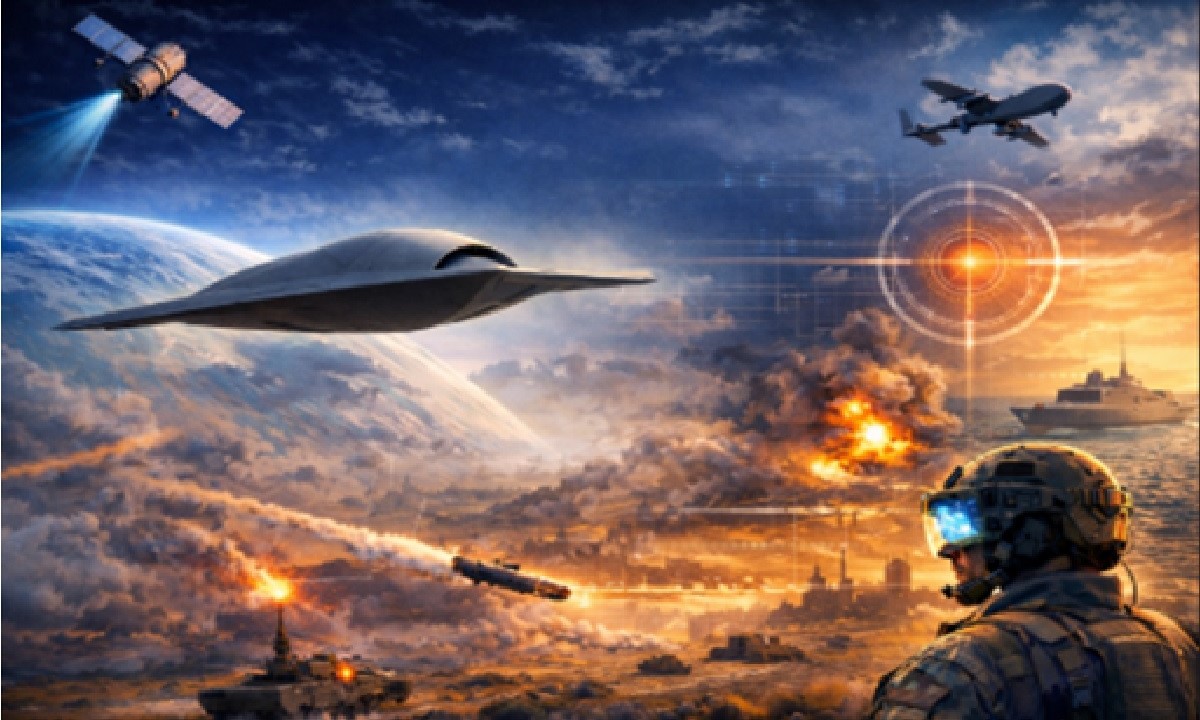
The transformation of ISR represents perhaps the most consequential shift in the air power equation. Modern ISR systems, such as satellite constellations, high-altitude unmanned platforms, networked sensor grids, and artificial intelligence-enhanced data fusion, have created an unprecedented capacity for persistent awareness of adversary activities across vast geographic expanses.[3] While Cold War and Gulf War-era planners worried about “area denial” and the fog of war, advanced ISR has fundamentally compressed the sensor-to-shooter timeline and expanded coverage to continental proportions.
The implications for targeting philosophy are profound. Traditional air campaigns focused on achieving localised effects against high-value, relatively static targets: airfields, command centres, radar installations and industrial facilities. Modern air power can now maintain continuous tracking of mobile targets, observe adversary logistics in near-real time,[4] and identify patterns of operation that reveal intentions before they materialise into action. This is not merely an incremental improvement in targeting accuracy; it represents a qualitative shift toward what some strategists term “omniscient awareness” of the battlespace.
Mass Precision: A Contradiction Resolved
The phrase “mass precision” may appear oxymoronic to those trained on twentieth-century military theory, which held that precision and mass were inversely related. Precision weapons were few, expensive, and required ideal conditions; massed fires were inaccurate, indiscriminate, and politically costly due to concerns about collateral damage. This dichotomy no longer holds.
Contemporary precision-guided munitions can be delivered at scale. The economics of precision strikes have been transformed by advances in guidance technology, manufacturing efficiency, and networked targeting, which allow multiple platforms to engage multiple targets with a high probability of effect. The operational concept of “mass precision” now describes the simultaneous or near-simultaneous application of precision effects across a wide area, overwhelming adversary decision cycles and generating cascading system failures across their operational architecture.[5]
When combined with advanced ISR, mass precision enables a targeting philosophy that operates not on individual high-value nodes but on the connective tissue of adversary systems: logistics convoys, maintenance facilities, communications relays, fuel depots and the human networks that sustain military operations. The objective shifts from destroying enemy forces to degrading enemy capacity and making the adversary’s military apparatus inoperable rather than eliminating it piece by piece.
Persistence and the Elimination of Regeneration
One of the core limitations of historical air power was the adversary’s capacity to regenerate losses. Air campaigns could destroy factories, but industry could relocate. Planners could eliminate tank battalions, but reserves could be mobilised. The temporality of air power operated on a different scale than the adversary’s ability to recover, adapt and reconstitute.
Modern air power, particularly when using unmanned systems and long-endurance platforms extensively, introduces a new variable: persistence. Persistent presence over the battlespace, maintained not by rotating crews through exhausting sorties but by platforms that can loiter for days or weeks, fundamentally alters the regeneration calculus. When a logistics convoy destroyed today is followed by continuous observation that prevents its replacement tomorrow, when maintenance facilities are struck before repair efforts can be brought in, and when leadership is engaged before coordination can be re-established, the adversary’s organisational capacity to recover erodes not gradually but systematically.[6]
This is the conceptual foundation for what some military theorists now call “time-sensitive targeting at operational scale,” as in the sustained, intelligent application of precision strike against the operational rhythms of adversary forces, degrading their capacity faster than they can adapt or regenerate.[7]
Doctrinal Re-imagination
The practical obstacle to realising this transformation is not technological but organisational and intellectual. Military institutions, including the United States Air Force, have inherited doctrinal frameworks, career promotion patterns, and operational concepts that privilege the Gulf War model. Joint force integration still treats air power as a supporting arm[8] rather than a potentially decisive instrument in its own right. Acquisition programmes prioritise platforms and systems designed for the previous era’s conflicts. Training and education emphasise tactics optimised for scenarios that no longer exist.
Rethinking the application of force requires addressing these institutional dimensions. It requires developing operational concepts for air power used independently of ground operations and concepts that account for political constraints on collateral damage, the specific vulnerabilities of twenty-first-century adversaries, and the integration of cyber, electronic warfare, and space capabilities into a coherent operational design.
The Iran scenario illustrates these challenges. An Iranian adversary presents a complex target set: distributed leadership, resilient command networks, tunnel systems, mobile missile launchers, and a population whose attitudes toward military operations are not uniform. Traditional air power doctrine would prescribe a campaign of degrading these targets in preparation for a ground invasion that may never come. But a reimagined approach might instead focus on systematically isolating Iranian military capacity from its support structures by targeting energy infrastructure, financial networks, supply chains, and the technological inputs that sustain military capability, while maintaining persistent observation to prevent adaptation and reconstitution.
Conclusion: The Imperative of Doctrinal Evolution
The proposition that air power alone cannot win wars is an empirical claim about historical experience, not a theoretical law. It reflects what air power has done under particular doctrinal, technological, and political constraints, but not what it could do under conditions of transformed ISR, mass precision, persistent presence, and reimagined operational concepts.
Military history demonstrates that periods of technological transformation are often followed by periods of doctrinal lag, during which institutions cling to inherited frameworks until strategic failure forces reassessment.[9] The current tensions between the United States and Iran, and the broader challenge of deterring or defeating adversaries across the spectrum of conflict, provide the strategic impetus for that reassessment.
The future of force application through the medium of air will not resemble the Gulf War. It will be characterised by distributed, networked operations; by precision effects delivered at scale and speed; by a persistent presence that denies the adversary the time and space to adapt; and by targeting philosophies that aim at system degradation rather than force attrition. The intellectual challenge is to develop these concepts, to resource them appropriately and to overcome the institutional inertia that privileges the familiar over the effective.
Air power has always been the medium of the future. The question is whether today’s air forces will seize that future or remain trapped in the targeting philosophy of thirty-five years ago.
*****
CLICK TO VIEW PDF
Notes:-
[1] Robbin Laird, “Shaping the Future of Airpower: Integration, Innovation and Institutional Transformation,” Defence.info, February 10, 2026, https://defense.info/air-power-dynamics/2026/02/shaping-the-future-of-airpower-integration-innovation-andinstitutionaltransformation/#:~:text=Collaborative%20Combat%20Aircraft:%20From%20Concept,development%20and%20future%20requirement%20refinement. Accessed on March 19, 2026.
[2] Douglas H. Fehrmann, “Air Power Doctrine and the Strategic Label,” Naval War College, June 13, 1997, p.11, https://apps.dtic.mil/sti/tr/pdf/ADA325175.pdf. Accessed on March 20, 2026.
[3] Tim Robinson, “Can air power deter the next war?,” Airspace Power, October 2024, https://airspacepower.com/wp-content/uploads/2024/10/GASCC-report-Oct-2024-AEROSPACE-compressed.pdf. Accessed on March 20, 2026.
[4] United States Air Force, United States of America, “Strategic Attack, Air Force Doctrine Publication 3-02,” August 04, 2025, p.17, https://www.doctrine.af.mil/Portals/61/documents/AFDP_3-02/AFDP_3-02_Strategic_Attack.pdf. Accessed on March 21, 2026.
[5] Nadia Schadlow, “The Three D’s Of Mass: Decentralization, Democratization and Deliverability,” Hoover Institute, February 25, 2026, https://www.hoover.org/research/three-ds-mass-decentralization-democratization-and-deliverability. Accessed on March 21, 2026.
[6] Adrien Gorremans, Jean-Christophe Noël, “The Future of Air Superiority: Command of the Air in High Intensity Warfare”, Focus Stratégique, no. 122, January 2025, p.25, https://www.ifri.org/sites/default/files/2025-09/ifri_gorremans_future_air_superiority_2025.pdf. Accessed on March 22, 2026.
[7] Ibid.
[8] Timothy Gann, Decision from the Sky: Airpower as a Decisive Instrument of National Power, US Army War College, April 15, 1997, p.19, https://apps.dtic.mil/sti/tr/pdf/ADA326954.pdf. Accessed on March 22, 2026.
[9] I. B. Holley Jr, “Technology and Military Doctrine: Essays on a Challenging Relationship,” Air University, August 2004, p.6, https://apps.dtic.mil/sti/tr/pdf/ADA427735.pdf. Accessed on March 22, 2026.