Authors: Mr Adrien Fontanellaz, Military Historian and Analyst Centre d’Histoire et de Prospective Militaires
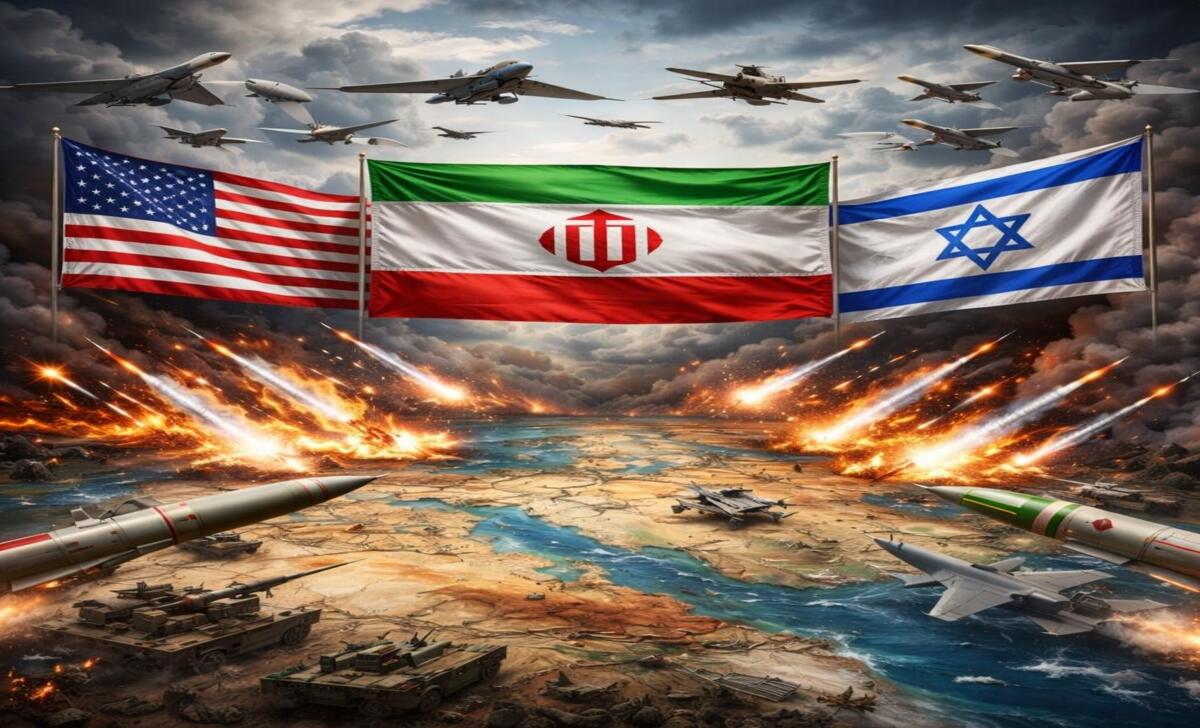
A high-intensity war erupted in Western Asia between 28 February and 7 April 2026, before leading to a ceasefire that may only be a brief pause before the resumption of hostilities. This 38-day war was primarily an air campaign: the Israelis and Americans deployed around five hundred tactical combat aircraft, supported by a wide array of force multipliers such as aerial refuelling tankers, electronic warfare aircraft, and airborne early warning and command platforms. Dozens of reconnaissance and strike drones, a vast intelligence apparatus, communications systems, and cyber warfare capabilities—including a satellite ecosystem with unique capabilities—along with long-range precision strike capabilities from naval and land-based systems, completed this operational setup.
Operating most often from bases or ships located far from Iran’s borders, the Americans, according to their own statements, had struck more than 13,000 targets by 6 April 2026, conducting more than 13,000 combat sorties.[1] As of 1 April, Israeli aircrews had struck 4,000 targets and dropped 16,000 munitions on Iran. More than 2,000 separate aerial refuelings were required to enable their fighters to operate over Iran, approximately 1,500 kilometres from their home bases.[2] These figures attest to a very high-intensity campaign following a classical methodology aimed first at decapitating the enemy’s command structure, then targeting its defences, offensive capabilities, and finally the infrastructure needed to regenerate them.
For their part, the Iranians resisted as best they could despite the overwhelming superiority of the coalition forces and the considerable damage sustained. Their air defences notably succeeded in damaging at least three coalition combat aircraft (a F-15, a F-35, and two F-18), shooting down three others (an F-15E and two A-10s), as well as 30 large reconnaissance and combat drones (11 Hermes 900, 4 Heron TP, 13 MQ-9 Reaper, and 2 Wing Loong II).[3] In addition, between 28 February and 7 April 2026, Iranian forces launched at least 2,300 ballistic and cruise missiles and more than 6’500 attack drones in counter-force strikes—targeting military objectives—and counter-value strikes, aimed at economic, civilian, or symbolic infrastructure in order to inflict maximum cost on their adversaries.[4] They managed to maintain a relatively steady firing rate from 9 March 2026 onward, with an average of about one hundred munitions launched per day, achieving several notable military successes along the way, such as the destruction on the ground of an E-3 airborne early warning and command aircraft, as well as several radars essential for intercepting ballistic missiles.
At this stage, although still little is known about the exact conduct and course of these operations, their observation already allows for some lessons to be drawn that are applicable to Switzerland and its security policy.
Centrality of cyber
The Israeli-American offensive was not only kinetic: it also involved a multitude of cyberattacks, highlighting the critical importance of secure and hardened communications infrastructures. It was also preceded by numerous information and influence operations, which nevertheless did not achieve their objective, namely a popular uprising. These elements encourage the Confederation to continue and intensify the efforts already undertaken in this area within the framework of its security policy.
The importance of civil protection
The fact that Israel recorded only 21 civilian deaths after enduring 479 waves of Iranian attacks is due not only to the effectiveness of its missile defences, but also to a highly developed civil protection infrastructure. It is indeed unrealistic to assume that all enemy munitions can be intercepted. This infrastructure notably includes protected rooms in newer buildings, a large number of public shelters, as well as an alert system enabling the population to be informed in real time. This confirms the crucial role of civil protection in Switzerland, which must be funded accordingly.
Worrisome capability gaps
The assessment is worrying regarding Switzerland’s ability to face a long-range air campaign. The modernisation of its integrated air operation command and coordination system has been delayed, while no system capable of intercepting ballistic missiles is currently in service. Due to repeated delays in the delivery of Patriot systems and the slow decision-making processes in Switzerland to find a substitute, this capability gap is likely to persist.[5] In contrast, the order of five medium-range IRIS-T systems should help meet another major requirement.[6] However, the segment of decentralised air defence systems, designed to intercept low-cost munitions fired in large numbers—particularly long-range attack drones—remains neglected, even though addressing it would require modernising and expanding the existing anti-air artillery inventory or acquiring new dedicated systems.
Extended ranges
The campaign also highlights the limitations of Switzerland’s small fighter fleet, nowadays based around 30 aging F/A-18 C/D. Operations in the Persian Gulf showed that the first line of defence against long-range strikes rests on fighter aircraft, which can intercept part of the enemy munitions (attack drones, cruise missiles) before they reach the engagement envelope of air defence systems. For a small air force, this requires aircraft capable of sustaining repeated missions while carrying a significant number of air-to-air missiles. On the offensive side, the campaign underscores the need for very long-range air-to-ground munitions, allowing targets to be struck without entering adversary defence bubbles. Switzerland currently lacks such capabilities entirely. It must therefore acquire long-range precision strike capabilities, whether ground-based or air-based, adapted to contemporary engagement distances, otherwise it will only be able to absorb attacks without being able to disrupt them.
Stockpiles and attrition
After Ukraine, this third Gulf war confirms the importance of maintaining substantial ammunition stockpiles, essential for sustaining a conflict over time, given that several months or even years can pass between the order and delivery of sophisticated munitions. This issue is even more critical as such munitions—long-range air-to-ground missiles, missile interceptors, or air-to-air missiles—are very expensive. There is a temptation to reduce quantities in order to acquire more weapon systems, at the risk of severely limiting their usefulness due to a lack of available ammunition. This reasoning also applies to reconnaissance drones, which, given their high attrition in combat, must be considered consumables.
The value of hardened infrastructure
The Iranians succeeded in preserving most of their missile arsenal, as well as a large part of their drones and combat aircraft, thanks to deeply buried underground facilities, largely protected against American penetrating munitions. Carved into mountainsides, these installations recall the caverns built in Switzerland during the Cold War. This observation supports maintaining and refurbishing existing fortified infrastructure.
Dispersion and mobility as imperatives
The Iranians also dispersed and concealed their assets, making extensive use of decoys and frequently changing their positions. In contrast, the Americans suffered several losses due to their tendency not to relocate their air defence batteries. In the Swiss context, this confirms the relevance of efforts aimed at operating flexibly from dispersed bases, as well as the need to acquire weapon systems that are easily deployable and compatible with rudimentary infrastructure.
Issues related to the F-35 procurement
These lessons also raise questions about the ongoing acquisition of the F-35 to replace the Hornet. While it has proven effective as a spearhead of the coalition operations thanks to its stealth and advanced information-gathering and exploitation capabilities, its availability rate remains lower than that of other aircraft, and its operation depends on a substantial support infrastructure. Moreover, its design prioritises stealth at the expense of payload capacity. These factors, combined with the known challenges of the programme, suggest that—short of a politically difficult cancellation of the order, already reduced from 36 to 30 aircraft—it could be further reduced to a single squadron of about a dozen aircraft, in favour of a mixed fleet including aircraft better suited to sustained high-intensity operations, such as the Gripen E or the Rafale.
The end of air supremacy as a given
Since the early 1990s, it has been widely assumed that Western armed forces would operate with air superiority, or even air supremacy. This third Gulf war, like the conflict in Ukraine, demonstrates that it is now possible to conduct asymmetric air campaigns based on relatively inexpensive long-range precision munitions. This challenges many doctrinal fundamentals and requires relearning how to operate in an environment where the air threat is omnipresent.
*****
CLICK TO VIEW THE PDF
Notes:-
[1] United Stated Central Command, “Operation Epic Fury Fact Sheet, April 6, 2026” & “Operation Epic Fury Fact Sheet, April 1, 2026”
[2] IDF communique via Emanuel (Mannie) Fabian @manniefabian, X account, April 1 2026.
[3] Elmustek substack account, Operation Epic Fury-Documenting Equipment Losses during the 2026 Israel/USA – Iran war, consulted April 21 2026. Completed by author own’s monitoring based on various US media communiques.
[4] « Iran Missile and Drone Attacks : Full List of Targets and Number Launched” Faytuks Network Intelligence, April 20 2026.
[5] Andy Müller and Dominik Meier, «Swiss face further delay in delivery of US defence system.” Swissinfo.ch, March 5, 2026.
[6] Armasuisse, « DSA MP : le contrat d’acquisition en coopération pour la défense sol-air de moyen portée est signé », 22 juillet 2025.
(Disclaimer: The views and opinions expressed in this article are those of the author and do not necessarily reflect the position of the Centre for Aerospace Power and Strategic Studies [CAPSS ] & CHPM)