
Author: Dr Javed Alam, Research Associate, Centre for Aerospace Power and Strategic Studies
Keywords: Burevestnik, Cruise Missile, Nuclear Reactor, Russia
As the United States (US) is scrambling in its diplomatic outreach to find a solution to the ongoing Russia-Ukraine war, the Russian Federation is readying all its conventional and nuclear weapons with new tests and deployment. Ever since the war started in February 2022, Russia has deployed and tested a variety of weapons. These include the deployment of air-launched ballistic missiles, such as the Kinzhal, an air-to-air nuclear-capable missile variant of the R-37M long-range air-to-air missile, and hypersonic weapons, such as Oreshnik. The tests include the launch of the Bulava Intercontinental Ballistic Missile (ICBM), the test launch of a modified Topol-M ICBM called Topol-ME, and the test launch of the MIRV-capable Yars ICBM. Along with these developments, Russia has also managed to reequip itself with 88 per cent of modern weapons, which are of Russian origin instead of being developed during Soviet times. Unsurprisingly, Russia is now testing new weapons of different classes to make sure that its nuclear and conventional capacities remain at par, if not more, with those of its adversaries. Under this thinking, Russia has recently tested a long-range nuclear-powered cruise missile and now plans to deploy it at the earliest. This article examines the new nuclear-powered cruise missile, its significance, and the repercussions it has for the global nuclear order.
The Missile
On October 27, 2025, it was reported that Russia successfully tested its nuclear-powered cruise missile, Burevestnik. Russia’s Chief of the General Staff of the Armed Forces stated that the missile travelled 14,000 km and was airborne for approximately 15 hours. The missile, officially known as 9M730 Burevestnik (Storm Petrel) and the North Atlantic Treaty Organisation (NATO)-designated SSC-X-9 Skyfall, is described by Russia as “invincible” at penetrating current and future missile defences. The significance of the missile can be understood from the point that Russian President Vladimir Putin touted it as “a unique weapon which nobody else in the world has.”
The test, which was announced as successful, has, however, had its fair share of failures over the year. The 9M730 Burevestnik was revealed in March 2018. The missile typically features cruise-missile capabilities at subsonic speeds. The development of the missile, however, goes back to 2011. In 2018, Russian President Putin stated that Burevestnik “is a low-flying stealth missile carrying a nuclear warhead, with almost unlimited range, unpredictable trajectory and ability to bypass interception boundaries.” The information essentially explained the significant features of the missile, which can be attributed as follows:
-
-
-
Low-flying altitude suggesting cruise capabilities
-
Stealth design meant for survivability
-
Nuclear warhead signifying strategic missions
-
Unlimited range, intended for intercontinental targeting
-
Unpredictable trajectory aiming for counter-air-defence capability.
-
-
One of the essential features of the Burevestnik, highlighted in 2018, was its unlimited range. To fulfil the said requirement, Russia has ensured the integration of a nuclear power engine as the necessary propulsion. The concept on which Burevestnik is based is not new and has been explored during the early phase of the Cold War. The US worked on two plans, known as Project Pluto and Project Rover, from 1956 to 1973. The Pluto Project included tests of two open-loop propulsion reactors — Tory-IIA and Tory-IIC — intended for developing a supersonic nuclear ramjet. Accordingly, the Tory reactors had dimensions of less than ten feet in length and diameter. However, to make a nuclear-powered missile work like the Project Pluto cruise missile, chemical rockets were required to provide the velocity the nuclear ramjet needed.
Regarding the technical parameters of the Burevestnik, no conclusive information is available in the public domain, nor is there any information from the Russian side. Russia conducted four tests of the Burevestnik between November 2017 and February 2018. In February 2018, a test of the missile was reported to have crashed somewhere in the Barents Sea, but the observation yielded only technical details about the missile. It was reported that the reactor of the missile was “very small in size, [and] is likely using highly enriched uranium-235 as fuel. The core diameter is less than half a meter.” In 2021, the United Kingdom (UK) Chief of Defence Intelligence, James Hockenhull, reaffirmed that Burevestnik is a subsonic nuclear-powered cruise missile with a global reach. The other technical considerations that can be proposed are as follows:
-
-
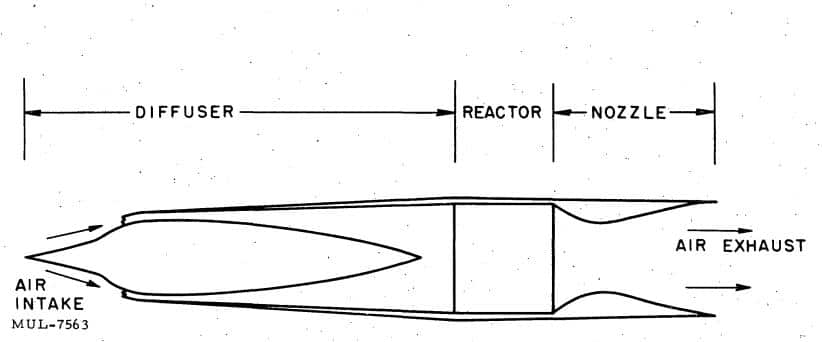
A ramjet design, which essentially works efficiently above Mach 2, can also operate subsonically and thus Burevestnik can be both subsonic and ramjet at the same time. The following image shows the conceptual arrangement of a nuclear ramjet.
-
-
-
An unlimited range of the missile, as claimed by Russia, is more on the lines of a symbolic threat than the actual threat the missile can pose. Yes, indeed, the nuclear ramjet propulsion systems can have a long cruising range, but it is not infinite. Fuel consumption imposes a stricter limit on the range.
-
-
-
While it is still unknown what kind of reactor the missile uses, studies have proposed at least two types of systems which the Burevestnik can utilise to heat the incoming air for acceleration. The first one is an Open-loop system where the “incoming air flows straight through the reactor to extract the heat and propel the missile.” The second is a Closed-loop system, “where the reactor is isolated from the airflow by a heat exchanger that transfers the reactor’s heat to the air.”
-
In addition to the features mentioned above, this missile system must also overcome issues related to inertial forces and atmospheric turbulence while airborne. Both inertial forces and atmospheric turbulence can pose challenges to the reactor’s heat generation. Besides these issues, since the missile is touted as a stealth platform, the onboard platforms which require running the reactor need to be autonomous. Any form of communication during the flight will compromise the missile’s stealth characteristics. Since the missile is subsonic in nature, it won’t be able to outrun the incoming adversaries.
Is Missile Technology Too Risky to be Pursued?
While it is still unknown how Russia has managed to integrate this technology and whether it is working as projected, what can be put out is the technology’s ramifications. The first concerns the accidental launch or loss of the system during a heightened crisis. To date, 32 nuclear weapon accidents have occurred, which are more commonly known as ‘Broken Arrows.’ The concept of Broken Arrows only explains “an unexpected event involving nuclear weapons that result[s] in the accidental launching, firing, detonating, theft, or loss of the weapon.” Perhaps, now that the development of Burevestnik is complete, the time has come to expand the definition of Broken Arrows and involve accidental launch or loss of airborne nuclear reactors. A lesser but related risk of this kind of platform is accidental loss of the nuclear reactor during an exercise or test launch. This kind of accident can result in airborne radioactivity. This happened in September 2017, resulting in a cloud of Ru-106 radioactivity. Besides the problem of accidental launch or loss, this type of missile system is essentially a first-strike platform with a dual-use configuration. The dual-use configuration has its own advantages and disadvantages. Still, when a nuclear reactor-powered missile is involved, it introduces additional risks—the risk of interception, which would result in the dispersion of radiation.
So, What Military Objective Could Russia Achieve?
There are essentially three military objectives Russia seems to achieve from this platform. The following are the three military objectives:
-
-
Cruising ahead of the Ballistic Missile Defence: Since Burevestnik is a cruise missile, it is meant to evade any existing ballistic missile defence technologies that Russia’s adversaries possess. While it may seem like a self-fulfilling prophecy for Russia, given that the US is now pursuing its Golden Dome system, Russia has been wary of US ballistic missile defence technology since the US withdrawal from the Anti-Ballistic Missile Treaty in 2002. Over the years, Russia has managed to build platforms such as hypersonic weapons, which can help evade ballistic missile defences.
-
A second-strike capability beyond sea-based deterrence: Another important military objective, which Burevestnik can fulfil, is to provide an assured second-strike capability to Russia. Fundamentally, it is the sea-based nuclear capabilities which provide such capabilities. However, a platform like Burevestnik, which can remain airborne for an extended period due to its nuclear propulsion, can play the same role as a sea-based platform.
-
-
-
An offensive platform with a political undertone: While Burevestnik is essentially an offensive military platform, it is also a political weapon. Since the Russia-Ukraine war, Russia has managed to showcase to the world the weapons which once seemed too difficult to develop, integrate, and utilise. For example, in the ongoing war, Russia has managed to field its hypersonic weapons quite extensively. These hypersonic platforms may not have helped Russia end the war on its own terms, but they have also played on the fears of Western powers. At the same time, the nuclear sabre-rattling by Russia has, on more than one occasion, helped negate the export of military technology to Ukraine. Announcing the success of Burevestnik is as much a political as a military achievement, sending signals to Western and NATO powers.
-
Conclusion
The announcement of Burevestnik has come at a time when Russia is in the midst of a war with Ukraine and modernising its defence structure, where nuclear modernisation is a primary goal. The proclamation has also come at a time when Russia is developing more advanced nuclear platforms, such as Poseidon, which can carry nuclear weapons that can cause radioactive tsunamis, wiping out huge coastal areas. Both Burevestnik and Poseidon are nuclear-capable platforms and add to Russia’s sea and air-based nuclear triad. Both developments are also significant for Russia, as its new land-based nuclear platform has experienced several major failures in recent testing. Besides military objectives, Russia would not want to lag in integrating these platforms before Russia and the US again sit down for an arms-control agreement, which, as of now, seems a distant dream.
*****