
Author: Wg Cdr A Pichipoo Raja, Senior Fellow, Centre for Aerospace Power and Strategic Studies
Keywords: Military History, Inter-service rivalry, Theatre Command, Air Force
Introduction
The war in West Asia has triggered an interesting set of debates in the Indian military. Veterans from each service have been highlighting the irrelevance of the other services on social media, in TV debates, and in print media. Some have argued that the surface navy is irrelevant, especially the aircraft carriers. Others have opined that manned aircraft are irrelevant and suggested moving to an independent drone and rocket force. Some have questioned the utility of massive ground forces in modern battles, especially tanks and armoured formations. The civilian audience is amused by why the services are fighting amongst themselves in the media when they should ideally be fighting the enemy. While it may appear to be something new and unique to India, it is absolutely common behaviour worldwide. In fact, some past debates have been much fiercer. This article revisits one such debate from the 1920s to show how little things have changed over a century and what lessons can be drawn from these inter-service rivalries.
Origin of Twentieth Century Inter-Service Rivalries: Birth of the RAF
The German air raids on London in 1917 were a turning point in inter-service relations. While millions had died on the Front since 1914, it didn’t matter as much to the politicians as the air strikes on the capital of the mighty British Empire. This was beyond the policymakers’ imagination. Immediately, the British Prime Minister George Lloyd constituted the Committee on Air Organisation and Home Defence Against Air Raids with General Jan Smuts as its head. Its mandate was to examine how to defend Britain from air raids and how air operations and their supporting structures should be organised.
This Committee recommended the creation of an Air Ministry and an Independent Air Service at par with the Army and the Navy. The committee concluded by stating that, “Air supremacy in the long run will become as important a factor in the defence of the empire as sea supremacy.” This laid the foundation for the Royal Air Force (RAF) in 1918. A key argument that justified the creation of an independent air force is reproduced here:
Smuts Committee Arguments as to Why the Air Force Should be an Independent Force
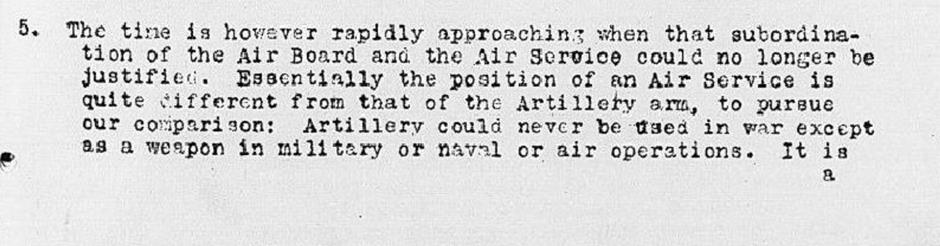
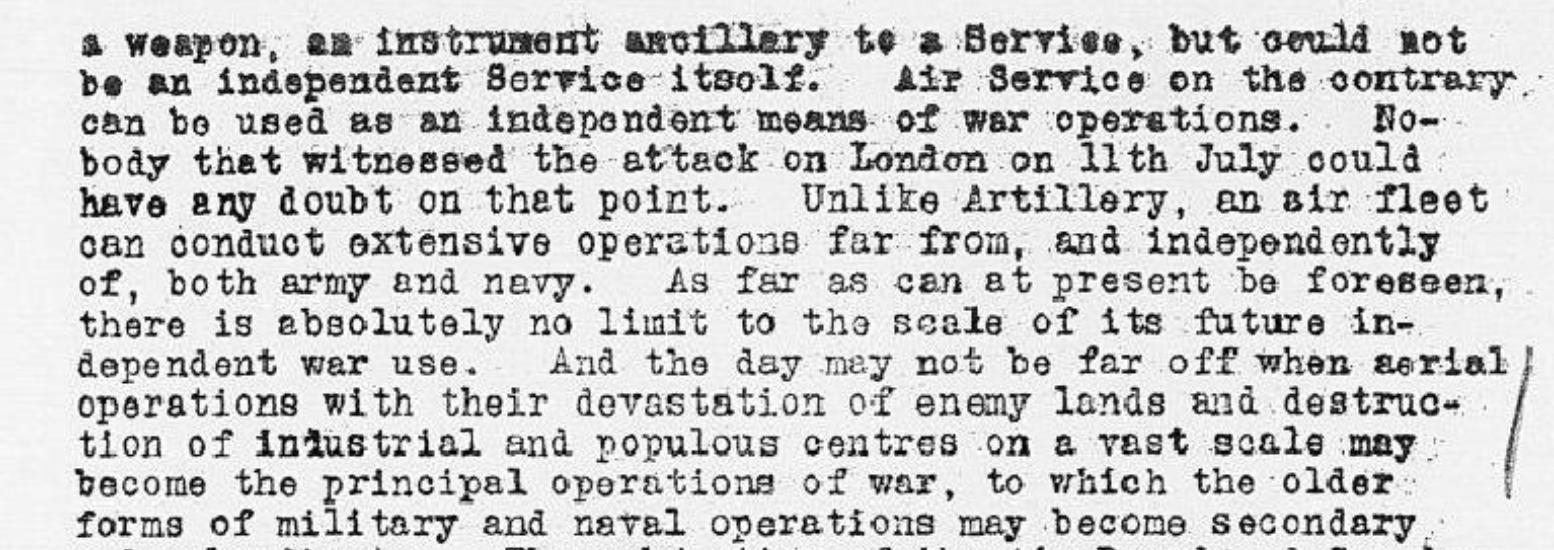
The Royal Air Force was created as the world’s first independent air force, on April 01, 1918, introducing the youngest and most energetic player in inter-service rivalries. The RAF was created by merging the assets and personnel from the air arms and was granted equal status with the Army and the Navy. This naturally caused resentment, as the services essentially viewed it as an elevation of their own support arms to equal combatant status. However, they had no choice but to comply since it was a political decision by the Cabinet.
Every Man for Himself: Survival in the Decade of Fiscal Austerity – 1920s
The timing of the creation of the RAF couldn’t have been worse. The First World War ended within a few months of the creation of the RAF, and the defence budget immediately dried up. As part of post-war demobilisation, there were massive cuts in manpower and material. All institutions created during the war were put under review, and several were threatened with closure. To avoid the axe, each ministry/service often questioned the rationale for the existence of the other while justifying its own relevance.
The Cabinet, on its part, suspended all new warship building until the effectiveness of submarines and aircraft could be assessed through a detailed study. The Army vehemently argued for retaining its manpower in the infantry despite new forms of warfare such as aircraft and tanks, but was overruled by the political authority.
The RAF got a lease of hope when Air Marshal Hugh Trenchard conceived the idea of ‘Air Substitution’- a policy of using aircraft to police colonies without deploying the British Army regulars on the ground. This was both economical and politically preferred, but it challenged the Army’s role in colonial control, leading to a reduction in manpower.
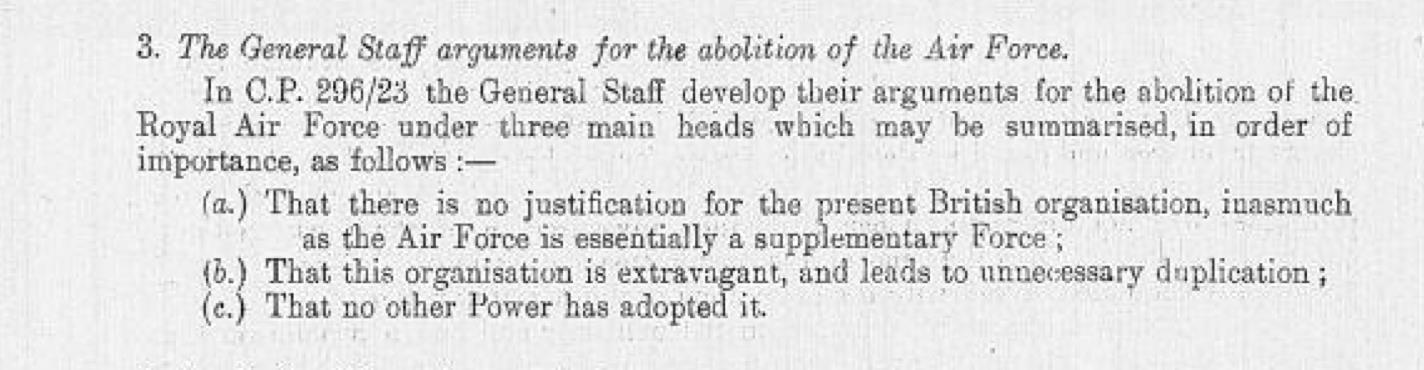
Cabinet Note on The Separate Existence of the Royal Air Force and the Air Ministry Scheme of Expansion for Home Defence, July 1923
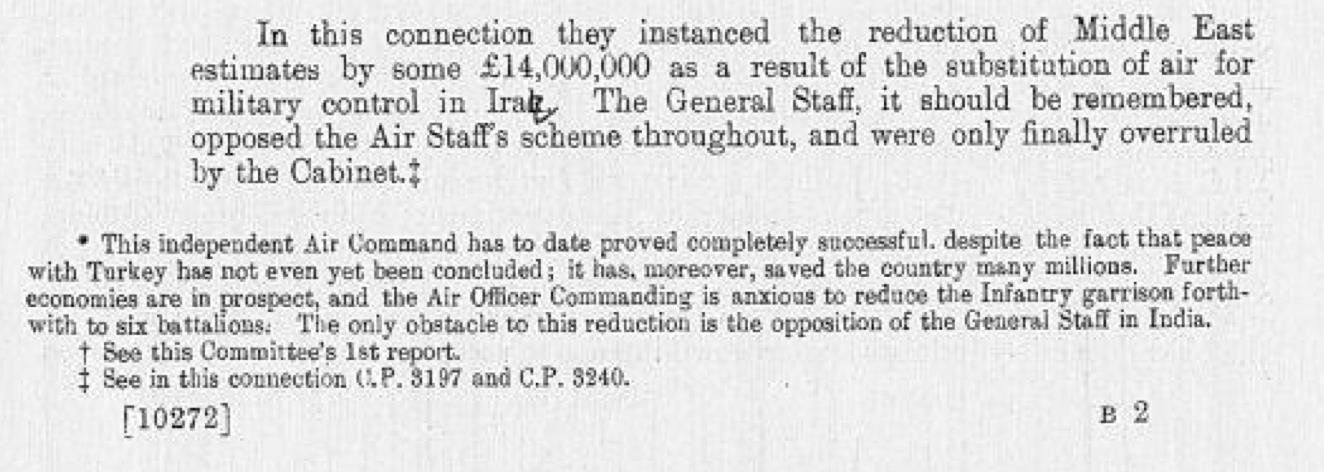
Meanwhile, both the Army and the Navy took the extreme step when they moved the case to abolish the independent RAF.
Cabinet Note on The Separate Existence of the Royal Air Force and the Air Ministry
Role of Political Leadership in Inter-Service Rivalries
Had the military been allowed to decide for themselves, there is a very strong possibility that the independent RAF would have been abolished there and then based on consensus. Here, politicians like Winston Churchill played a major role. One must remember that it was on their initiative that the independent air force was created, not through the military’s efforts. Therefore, while all this intense rivalry amongst the services was on, the Cabinet set up a committee on the Amalgamation of Services Common to the Navy, Army and Air Force on February 17, 1922. This was to identify areas of duplication and bring in economy by amalgamating wherever feasible. All branches except Defence Estates were supposed to be examined. It had already been decided to manage the defence land centrally. This committee had a diverse set of members drawn from the civilian and the military, with the following mandate:
Terms of Reference for the Committee on Amalgamation of Services
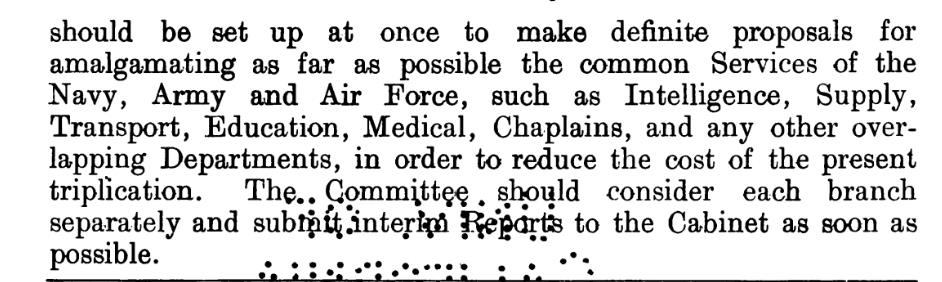
It is very interesting to compare what the committee instinctively thought and what the actual data finally revealed. The initial thoughts, based on the arguments put forth by each service, gave the impression of enormous duplication/triplication, and a huge scope for rationalisation. However, the results at the end of the study by experts revealed quite the opposite. Contrary to popular belief, not much duplication/triplication actually existed.
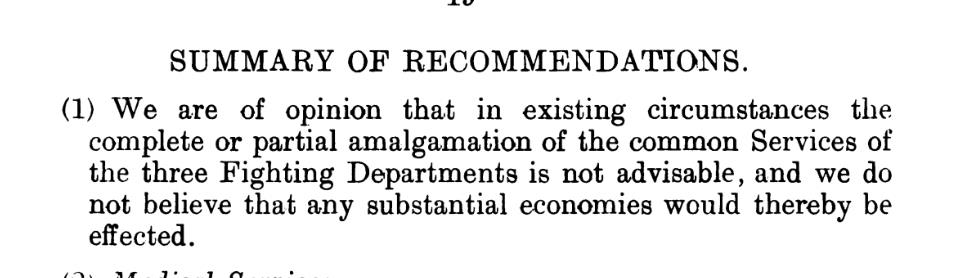
The committee finally recommended only amalgamating Work Services and setting a committee to further examine the medical services. Today, there is a common MES (Military Engineering Services) and a commonly administered medical arm for all three services- an outcome that could be traced to this committee a hundred years ago.
So, Why Discuss This 100-Year-Old Case Now?
History has plenty of lessons to offer those who seek to benefit from it. The terms of reference of the Amalgamation Committee in 1926 and the Department of Military Affairs’ mandate towards optimisation are very similar. Both these initiatives tried to achieve economic benefit by aggregating the service demands or organisations. This 1926 committee laid the initial foundations of the joint services that the Indian Armed Forces subsequently inherited post-independence. A hundred years later, in 2026, it remains the same time-tested structure, with common Defence Estates, MES, and medical services across the Indian Armed Forces. Yet, this committee has not been referred to in any debate/talk so far. This is possibly due to a lack of academic rigour and enquiry into the history.
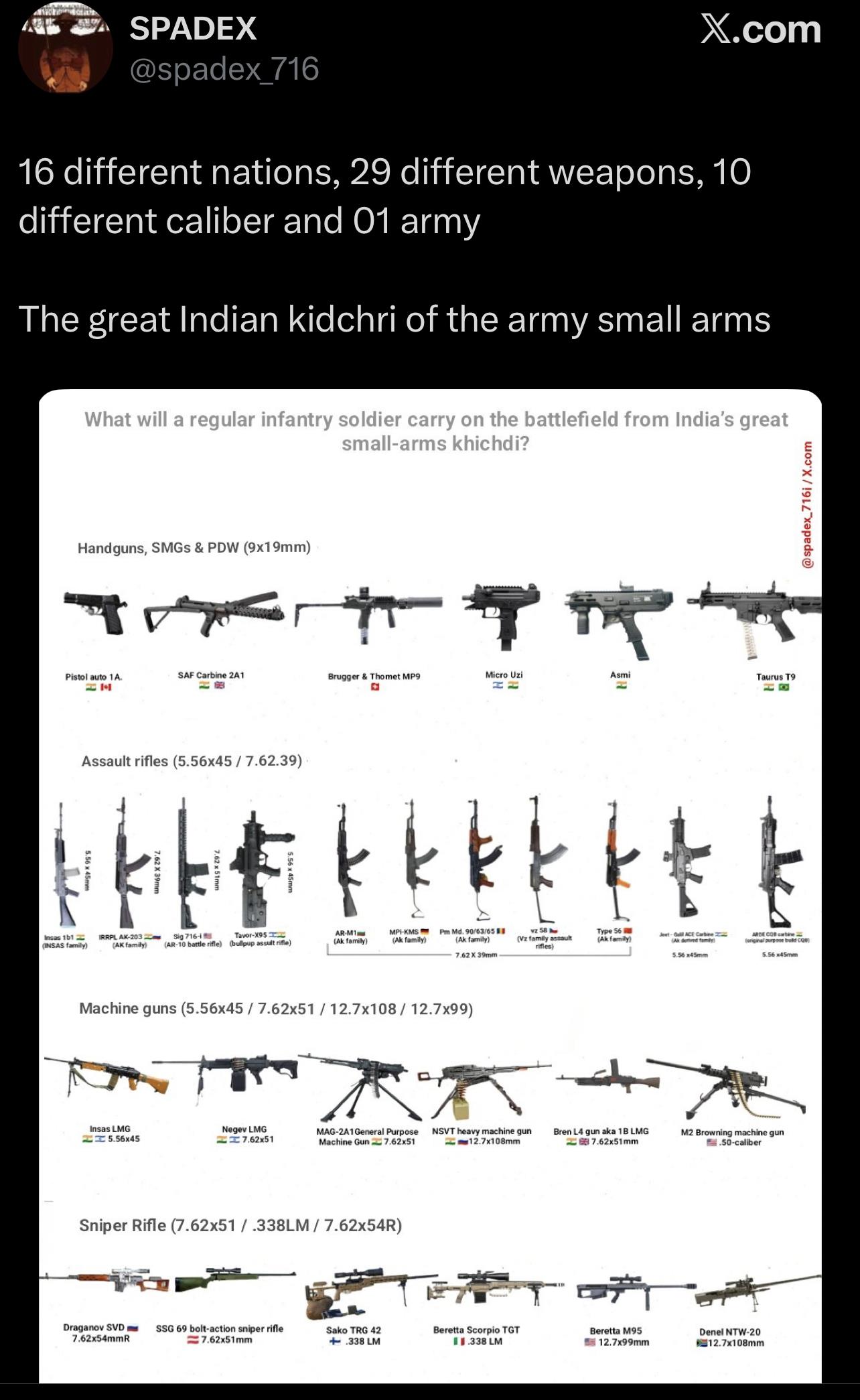
A reading of this 1926 report would also have revealed how operationally ineffective several peacetime jointness ideas are. Take the case of joint logistics. Ships need to be loaded at ports before they sail, air forces need frequent replenishment from fixed bases due to the tempo of air operations, and the Army needed prior positioning in places as the war progressed. During wartime, these places weren’t usually co-located. The report cited the practical difficulties in achieving common technical equipment, as each service had a unique role and therefore unique equipment. This difficulty was in an era when equipment wasn’t so technically complex. Today, the problem is much more severe. An anonymous user on social media platform X compiled images from the official social media handles of the Indian Army and concluded that the Infantry alone operates 29 small arms across 10 calibers from 16 countries. Thus, even single-arm logistics is a nightmare during operations. Why have lessons from history not been considered?
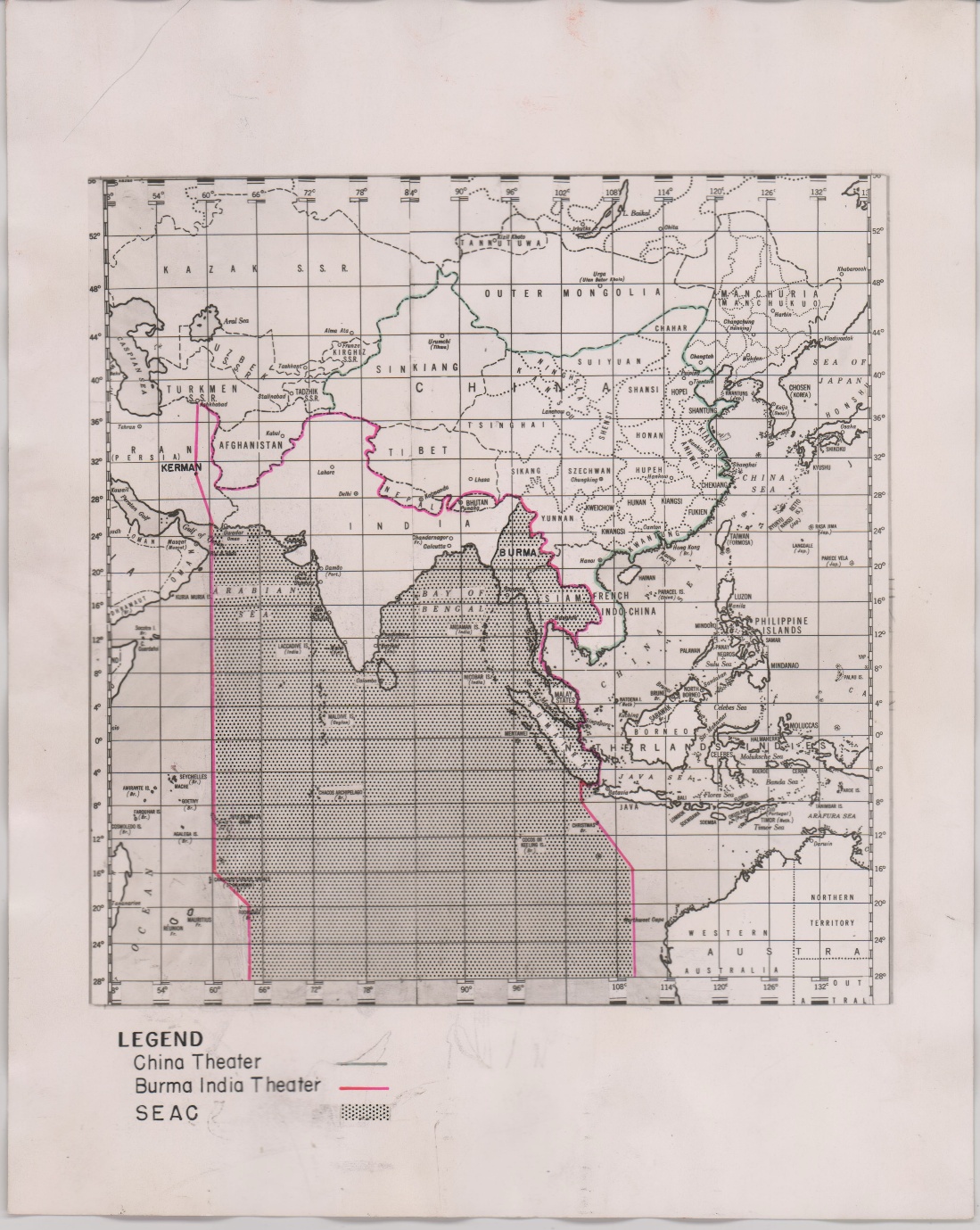
Similarly, instead of looking to theatre commands in the United States, China, or Russia for inspiration, it would be better to refer to India’s own history. The Second World War was fought with China-Burma-India as a single theatre under a single commander, Admiral Louis Mountbatten. If the communication capabilities of that era could facilitate command and control over this expanse of geography and millions of personnel, there is no reason why, in 2026, command and control cannot be exercised by a single India Theatre Command for the whole of India.
1943-44 Map of China-Burma-India Theatre Source: The National Archives, US
These are just two instances in which the past can guide present reforms. There are many more. Churchill once said, “The further backward you can look the further forward you are likely to see.” In the ongoing reforms in India, whether it is a deliberate action to ignore the lessons of the past, since the outcomes do not support the current course of action, or plain ignorance, remains unknown. In the author’s opinion, thorough research of own history and analysis are essential before any policy change. This is as a matter of national interest and needs attention.
*****