Author: Ms Radhey Tambi, Research Associate, Centre for Aerospace Power and Strategic Studies
Keywords: India-Seychelles Ties, Indian Ocean, Institutional Linkages, MAHASAGAR
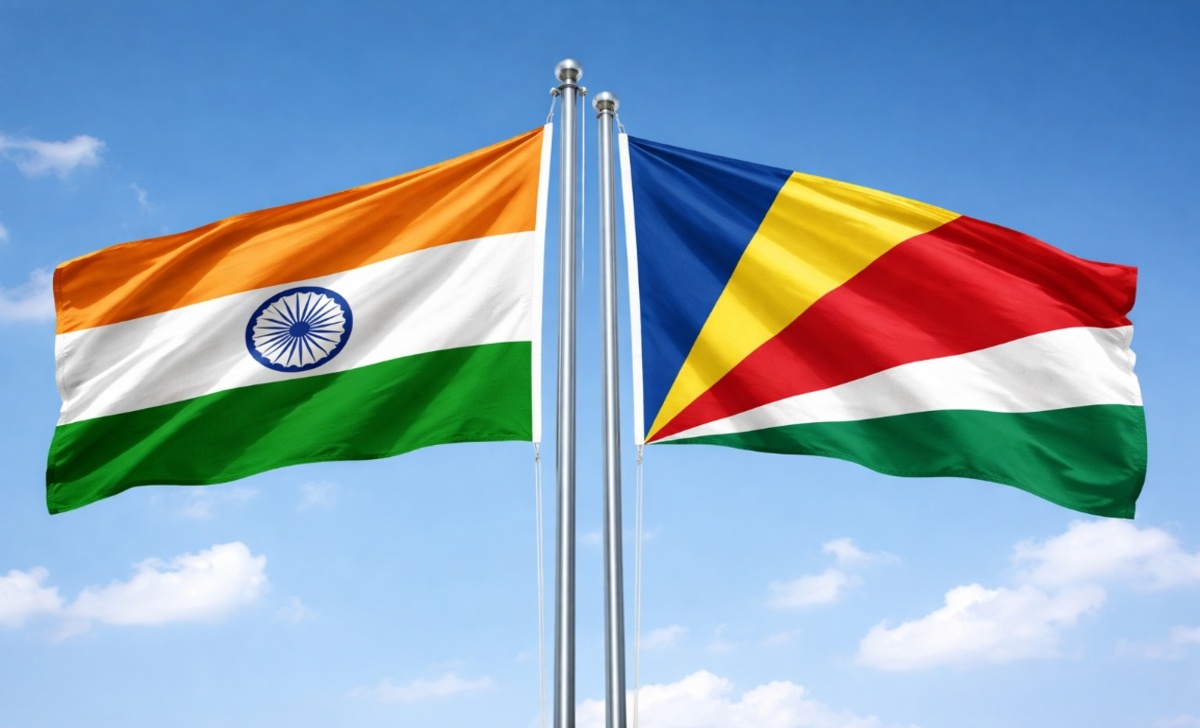
After being elected as the head of state, President Patrick Herminie of the Republic of Seychelles undertook the first state visit to India from February 5 to February 10, to deepen, diversify, and strengthen bilateral ties. Coincidentally, 2026 is also the year when Seychelles celebrates 50 years of independence, along with the golden jubilee of New Delhi-Victoria diplomatic ties. The visit, which was high on symbolism, was also an opportunity for both partners to take stock of past work and envisage a vision that cements the bilateral relationship and contributes to the region’s broader growth, which both are part of. To this end, the launch of India-Seychelles Joint Vision for Sustainability, Economic Growth and Security through Enhanced linkages (SESEL) is truly an effort to build institutionalism and infuse the relationship with stability that can withstand the ebbs and flows of the Indian Ocean waters.
Situated in the Western Indian Ocean (WIO), the island nation of Seychelles has the largest Exclusive Economic Zone (1,331,964 square km) amongst all the island countries of the Indian Ocean. Due to the bounds of geography, it is also at the crossroads of several security challenges, such as piracy, contraband smuggling, Illegal, Unreported and Unregulated (IUU) fishing, and others. In this regard, it is important to note that despite being a small country in both size and population, Seychelles has become a beacon for other countries in dealing with maritime security threats, especially piracy in the WIO, quite effectively. Thereby reducing the challenges at maritime frontiers for large continental nations in the neighbourhood, like India.
As the ‘Neighbourhood First’ policy of India is increasingly becoming comprehensive in its outlook and approach, the maritime sphere is gaining the much-needed importance. This was quite evident from the guest list at the oath-taking ceremony of Prime Minister Narendra Modi in June 2024, where leaders from both India’s immediate maritime and continental neighbourhood were present. Additionally, Indian Ocean littorals and island nations define India’s MAHASAGAR vision, and Seychelles is an important pillar of this vision, as emphasised by PM Modi during President Herminie’s visit to India.
India and Seychelles share historical ties, and 2026 marks the golden jubilee of their diplomatic relationship. While both partners are now at a comfortable juncture, it is essential that the relationship be underpinned with institutional linkages as it leaps forward. Several geo-political and geo-strategic developments in the region, such as the greater involvement of extra-regional players, the enhanced presence of regional countries for economic, strategic, military purposes, evolving nature of non-military challenges, and the internal politico-economic developments require that the time-tested partnership between New Delhi and Victoria must be solidified to withstand the sands of time and emerging dynamism in the Indian Ocean Region (IOR).
In this context, the SESEL vision precisely focuses on deep and diversified institutional linkages, that lends a modicum of stability in times of uncertainty. Seychelles and India are both vibrant multiparty democracies, and the trends in the neighbourhood have shown that changes in government on either side have had a significant impact on diplomacy and development. One such example from India’s maritime neighbourhood is the Maldives in recent years, where the arrival of President Mohamed Muizzu in late 2023 reflected a shift in Male’s traditional stance. The Muizzu administration’s refusal to renew the hydrography agreement with India, while simultaneously signing one with China, exemplifies this. Intensifying parliamentary exchanges, institutional linkages in the areas of mental health and public health, policing, finance, agriculture, climate change, marine conservation, academic institutions, and digital education platforms, as outlined in the vision document, are examples of institutional cooperation across traditional as well as other new areas.
Here, it is important to note that not only cooperation between the institutions on both sides, but also the strength of the relationship has been leveraged to support presence in the institutions. In 2025, Seychelles became a member of the Colombo Security Conclave (CSC), which is an India-led organisation focusing on issues like maritime safety and security, countering terrorism and radicalisation, combating trafficking and transnational organised crime, cyber security and protection of critical infrastructure and technology, humanitarian assistance, and disaster relief in the Indian Ocean. Seychelles has benefited from other India-led initiatives like the International Solar Alliance. It has also pitched in for joining the Coalition for Disaster Resilient Infrastructure (CDRI). Further, Seychelles has expressed faith in India, that being a voice of the Global South, which supports the reforms of the existing global institutions, New Delhi must push for a Multi-Dimensional Vulnerability Index (MVI), Common But Differentiated Responsibilities and Respective Capabilities (CBDR-RC), and nationally determined needs in relevant engagements at the multilateral forums, including banks.
The third aspect of involving institutions is institutional building, which plays a foundational role and creates a long-term impact on nation-building. To this end, New Delhi has long been a traditional partner of Victoria in mapping its maritime domain. India has been regularly providing Seychelles with updated hydrographic charts that help in safe navigation; the most recent was in January 2026. Under the SESEL vision, India will help Seychelles build the Seychelles Hydrographic Unit (SHU) to map the EEZ of Mauritius, which remains fertile ground for major non-military challenges at sea.
As India and Seychelles dive deeper into the waters of the Indian Ocean, drawing institutional linkages in multiple formats is the right way forward to take the partnership to greater heights. It will not only add another layer to the existing cooperation by strengthening it, but also create a sweet spot for each side to uphold and back the cooperation despite all the ups and downs.
*****