
Author: Dr Javed Alam, Research Associate, Centre for Aerospace Power and Strategic Studies
Keywords: RevCon, Nuclear Testing, Article VI, NPT
The 11th Review Conference (RevCon) of the Nuclear Non-Proliferation Treaty (NPT) ended without adopting a final statement on May 22, 2026. This particular conclusion of the Review Conference was not a surprise. Given the way the nuclear world order has been evolving over the past couple of years, any hope for substantive dialogue on the risks and shared responsibility for arms control from the nuclear-armed countries, including the N-5, is a stretch. However, not everything is as gloomy as it may look. The RevCon managed to convey the views of the majority of non-nuclear-armed countries on NPT obligations. This article highlights the major disagreements between nuclear-armed and non-nuclear-armed NPT parties, as well as the concerns raised.
The Ghost of Nuclear Testing is Back
During the RevCon, questions regarding nuclear testing were raised repeatedly. Right at the beginning, the Secretary-General of the United Nations (UN), António Guterres, stated that the issue related to “Nuclear testing is back on the table.” Further, statements from the New Agenda Coalition (NAC) also noted that the threat arises from the “retreat from long-standing commitments to nuclear testing moratoria.” The Group of Non-Aligned States Parties to the Treaty also stated on record that they have a “deep concern over recent public pronouncements and preparations suggesting the possible resumption of nuclear weapon testing.” The European Union led the call for upholding and strengthening the norm against nuclear testing. The President of the Seventh Session of the Conference on the Establishment of a Middle East Zone Free of Nuclear Weapons and Other Weapons of Mass Destruction also expressed concern about “public pronouncements and preparations suggesting the possible resumption of nuclear weapon testing.” A similar concern was raised by the Association of Southeast Asian Nations (ASEAN), which maintained its collective opposition to nuclear testing. Similarly, the African Group also raised the concern about “resum[ing] nuclear weapon testing and affirm[ed] that testing of nuclear weapons undermines the NPT and the Comprehensive Nuclear-Test-Ban Treaty (CTBT).” The Parties to the South Pacific Nuclear Free Zone Treaty and the Pacific Islands Forum, which consists of the countries affected by nuclear testing, expressed concern about nuclear testing.
For the N-5, the issue of nuclear testing did not resonate equally across the board. The United States (US), which has been vocal about nuclear testing, did not raise any point regarding the risks associated with the resumption of nuclear testing. The Russian Federation, against whom allegations of nuclear testing have been made by the US and which has also de-ratified the CTBT, maintained its commitment towards its declared moratorium on nuclear testing. China did not make any remarks about nuclear testing. Its national report presented before the start of the RevCon stated that it has “all along abided by its moratorium on nuclear testing and has not engaged in any activity contrary to the provisions of the Treaty.” The UK stated that it seeks “maintaining… voluntary moratorium on conducting nuclear test explosions.” France reaffirmed its stance in favour of maintaining moratoriums on nuclear testing.
Arms Control: A Distant, Uncertain Future
The 11th Review Conference happened at a time when there are no bilateral arms-control mechanisms between the NPT’s nuclear-armed countries. With the demise of the New Strategic Arms Reduction Treaty (New START) treaty earlier this year, no guardrails are now in place. The failure of the RevCon showcased the lack of concern among the N-5 regarding arms control or Article VI of the NPT. During the Conference, the N-5 effectively shifted attention to geopolitical developments and described their commitments under Article VI as conditional. This is a classic egg-and-chicken paradox that they play. Russia stated that “To return to the path of disarmament, it will first be necessary for all nuclear-weapon states to abandon policies aimed at undermining the fundamental interests of other parties and the principle of equal and indivisible security, as well as to demonstrate readiness for equal and comprehensive work on reducing conflict potential, with emphasis on eliminating the root causes of fundamental contradictions and taking into account all relevant key factors in their interconnection.”[1] France took the same view and justified deterrence by shedding light on the deteriorating strategic environment. The UK made references to Russia’s novel nuclear systems, Iran’s non-compliance with its safeguards obligations, the Democratic People’s Republic of Korea’s (DPRK) continued effort towards nuclear weapon development and China’s rapid rise in nuclear numbers. It categorically stated that “We [the UK] have and will continue to take the steps necessary to maintain our deterrence capability.” China took refuge in words like ‘hegemonism’, ‘power politics’, and ‘unilateralism’, and put the ball in the US court by stating that “the countries possessing the largest nuclear arsenals should take the lead in nuclear disarmament.”[2] The US, surprisingly enough, was the only nuclear-weapon state which did not mention the current geopolitical development to justify its own ongoing nuclear modernisation. It rather accused China of nuclear expansion and the conduct of the alleged yield-producing nuclear tests. The USA reiterated its willingness to establish a multilateral strategic stability and arms control mechanism with Russia and China. But it did not mention how it seeks to fulfil its obligations under Article VI of the NPT.
Clearly, the RevCon failed to bring the so-called N-5 to commit to Article VI of the NPT. Rather, the whole process was hijacked by concerns about North Korea’s nuclear development, China’s nuclear expansion, and French forward deterrence. More importantly, Iran’s nuclear status became a bone of contention with the Russia-Ukraine war also taking centre stage on many occasions.
Under these circumstances, the clearest set of recommendations came from the ‘Non-Proliferation and Disarmament Initiative’ (NPDI). This initiative was put forward by 12 non-nuclear-armed states to strengthen their three pillars. This article has drawn on two points from the initiative to explain the overall disarmament agenda.
-
-
The NPDI, while calling for the need for disarmament, stressed the need for doctrinal reviews to reduce the role and operational status of nuclear weapons.
-
It placed emphasis on transparency and accountability by calling upon all States Parties to commit to regular, standardised reporting on their implementation of NPT obligations across all three pillars. It emphasised that reporting should go beyond general descriptions and include substantive and, where appropriate, comparable information.
-
Along the same lines, the New Agenda Coalition (NAC), which consisted of six non-nuclear-armed NPT countries, reminded the N-5 countries of their commitment to Article VI, including the 2010 Action Plan, to which all State Parties had committed.
The Draft Outcome Document: A Sneak Peek at Today’s Global Nuclear (Dis)Order
While the 11th RevCon failed to produce a consensus document, a similar outcome was observed at the previous two Conferences. As with the 2020 RevCon, a Draft Final Document emerged from this conference, too. A comparison of both the documents, Draft Final Document (2020) and Draft Outcome Document (2026), gives a good sense of how the global nuclear order is emerging and what the states parties to the NPT think about it. The following table compares the progress, or lack thereof, of the two documents.
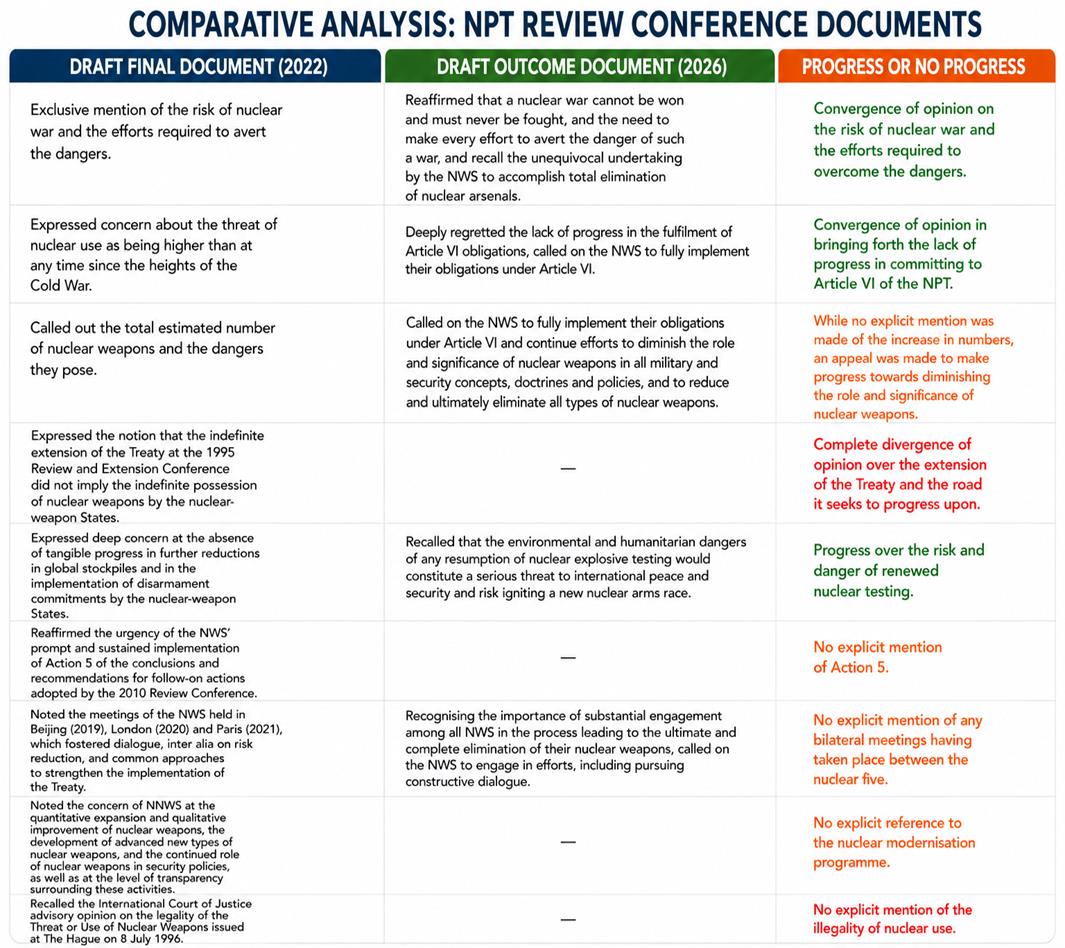
The above comparison reveals a mixed trajectory of continuity, selective progress, and notable omissions within the NPT disarmament discourse. Both documents converge on the acknowledgement of the catastrophic risks posed by nuclear weapons and reiterate the long-standing principle that a ‘nuclear war cannot be won and must never be fought.’ Similarly, there remains a shared concern regarding the inadequate implementation of Article VI obligations and the broader stagnation of nuclear disarmament efforts.
However, the 2026 document failed to express explicit criticism of nuclear arsenals and modernisation trends towards broader, less confrontational language centred on risk reduction and a gradual diminishing role of nuclear weapons. Several critical issues emphasised in 2022 — including the growth and modernisation of nuclear arsenals, the implications of the indefinite extension of the Treaty, transparency, references to the International Court of Justice advisory opinion, and the implementation of Action 5 of the 2010 Review Conference — were either diluted or missing in the 2026 draft. Rather, the 2026 draft introduced stronger apprehensions regarding the dangers of renewed nuclear explosive testing and the risk of a new arms race, reflecting contemporary anxieties. Overall, the comparison demonstrates that while the normative commitment to nuclear disarmament remains intact, progress toward concrete disarmament measures remains limited.
*****
CLICK TO VIEW THE PDF
Notes:-
[1] The original document was uploaded in Russian language. The author has taken help of ChatGPT to translate the document.
[2] The original document was uploaded in Chinese language. The author has taken the help of ChatGPT to translate the document.