Author: Ms Priyanka Yadav, Research Associate, Centre for Aerospace Power and Strategic Studies
Keywords: West Asia, East Asia, Strait of Hormuz, United States
Introduction
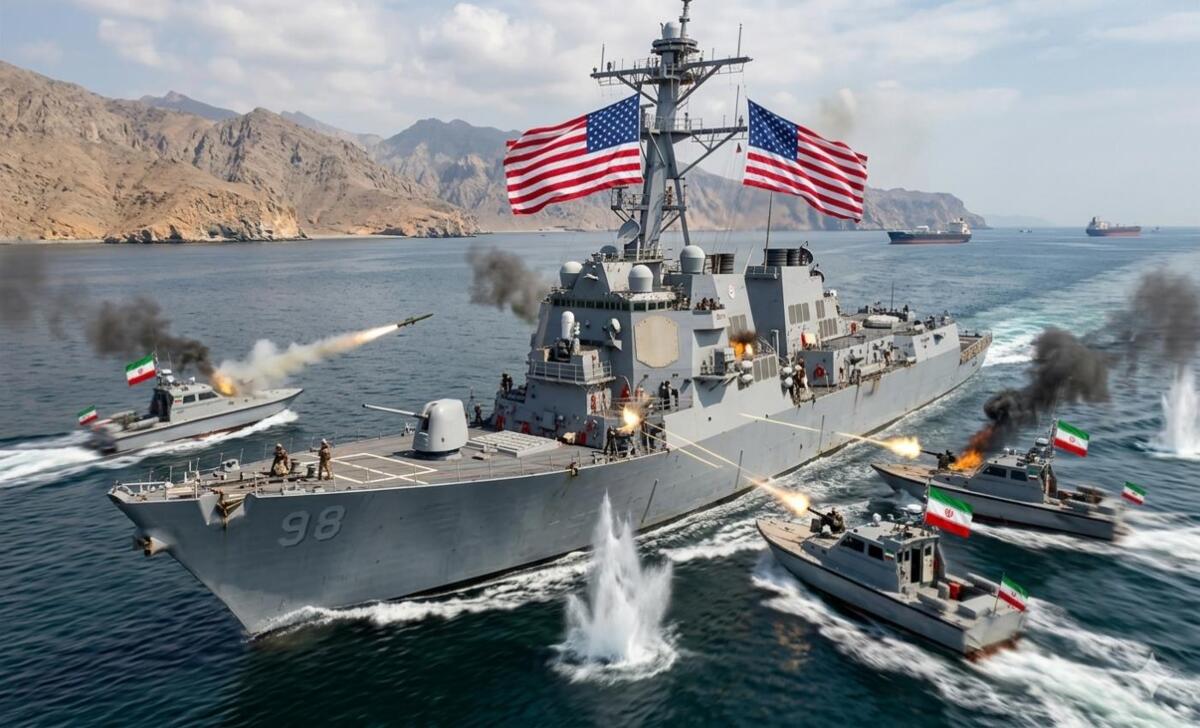
On February 28, 2026, Iran’s Supreme Leader, Ayatollah Ali Khamenei, was killed in a decapitating strike by a joint United States (US)-Israel military operation code-named Epic Fury.[1] Following this attack, Tehran initiated a series of retaliatory missile strikes on the US bases in West Asia, including the United Arab Emirates, Qatar, Bahrain, Kingdom of Saudi Arabia, Iraq, Kuwait, Oman and Jordan. These rapidly unfolding events suddenly plunged the world into chaos when Iran blocked the critical Strait of Hormuz, a narrow waterway that carries one-fifth of global oil exports and connects the Gulf of Persia with the Gulf of Oman and the Arabian Sea.[2] This has left the US allies in East Asia, from South Korea to Japan, scrambling over the situation as they rely heavily on this passage for their energy security.
In response, the US President Donald Trump called on his social media platform, Truth Social, on March 15, 2026, for the North Atlantic Treaty Organisation (NATO) allies like the United Kingdom (UK) and France, and for non-NATO allies such as Japan and South Korea, to secure the Strait of Hormuz by deploying their naval assets to the Strait. Having received lukewarm response from his allies, he hastily announced that he didn’t need his allies, citing America’s military superiority. Amid this crisis in West Asia, which remains uncertain at the time of writing, it becomes imperative for the US allies in East Asia, such as South Korea and Japan, to recalibrate their foreign policies. This piece tries to put forth two questions:
(a) How the crisis in West Asia is impacting the US allies and their strategic responses?
(b) What lessons the US’s strategic rivals, like North Korea, are deriving?
America’s Allies’ Strategic Interpretation and Military Support to the US
South Korea, a highly industrialised economy, remains dependent on the Strait of Hormuz for its energy needs, accounting for around 70 per cent of its crude oil imports and about 20 per cent of its liquefied gas imports.[3] In addition, there have been reports of the US relocating its anti-missiles from South Korea to West Asia in order to protect its bases from Iranian attacks, raising concerns amongst its allies. With continuous and immediate threats from North Korea, such steps by the US put South Korea’s security in a vulnerable position. In the aftermath of the Korean War of 1950-1953, South Korea became reliant on the US security umbrella to protect against threats emanating from North Korea and to ensure peace on the Korean peninsula. In recent times, South Koreans have not been convinced enough by the US’s extended deterrence and have been debating acquiring nuclear weapons for their security.[4] Such concerns are compounded due to the impulsive and transactional nature of the President Trump administration’s transactional approach and inconsistent behaviour towards its allies, demanding a payment of five per cent of their Gross Domestic Product (GDP) for its troop deployment on South Korean soil.[5]
In Japan’s case, it initially outrightly denied the US’s request to send military assistance to the Strait of Hormuz. However, during Japan’s Prime Minister Sanae Takaichi’s visit to Washington on March 19, 2026, she reaffirmed the strength of the US-Japan alliance and signalled her intent to assist the US, despite Japan itself being constrained by its pacifist constitution from engaging overseas militarily.[6] Later issuing a Joint Statement, the leaders from the UK, France, Germany, Italy, the Netherlands, and Japan expressed a “readiness to contribute to appropriate efforts to ensure safe passage through the Strait” and welcomed “the commitment of nations who are engaging in preparatory planning.”[7] These efforts by allies came on the heels of surging oil prices that are destabilising the global energy market.
However, US allies in East Asia remain worried about the nuclear capabilities of China and North Korea, and thus cannot afford to divert their resources completely to the US war in West Asia at this critical juncture. Many of the US allies have been reluctant to provide active support because they believe that the US initiated the escalation. Therefore, in the short to long term, this conflict is going to shape the strategic outlook of states that do not possess nuclear weapons, making them vulnerable to powerful, nuclear-armed states. This would also reignite debates regarding nuclear acquisition and proliferation amid an increasing security dilemma in this region.
North Korea- A Nuclear Threat in East Asia
On March 14, 2025, North Korea fired ten ballistic missiles into the Sea of Japan in response to the US-South Korea annual exercise, Freedom Shield, held at Camp Humphreys, South Korea, raising concerns for neighbouring Japan and South Korea.[8] Such near incursions of adventurism are not new for North Korea, as it has been engaging in such practices of firing missiles at regular intervals. Such frequent actions from North Korea solidify its image as a rogue nuclear power. Its regular testing of missile systems and stockpiling of weapons reflect its evolving military strategy, thereby putting other regional nations at a significant disadvantage. North Korea’s external engagement with other countries is also perceived as an area of concern. In the past, its relations with Iran in terms of providing missile defence, with shared animosity towards the US.[9] There have been reports as well of North Korean weapons being used by Hamas in its war with Israel.[10] These nations have been under economic sanctions for a long time, often resorting to engaging in clandestine business activities. One significant conclusion that North Korean leader Kim Jong-Un has withdrawn from the Iran-Israel-US ongoing conflict is that nuclear weapons provide real protection and are the ultimate source of his regime’s survival.[11] With an analysis of the challenges for US air superiority in its attack on Iran, North Korea would bolster its drone and counter-drone capabilities, along with the stockpiling of conventional missiles.[12]
In early January of 2025, North Korea declared that any talks of stalling North Korea’s nuclear programme should be off the table if future negotiations are to take place. Such actions by North Korea put the US and South Korea in a dilemma vis-à-vis North Korea and on North Korea’s preemptive demands for engagement. North Korea’s continuous expansion of its nuclear arsenal is becoming an immediate problem for states like South Korea and Japan, which they perceive as impacting their regional stability. Moreover, the US becoming entangled in West Asia following its attack on Iran raises apprehensions among these nations about their strategic survival.
Evaluating Outcomes
The Strait of Hormuz crisis ought to make the US realise that its alliances are not globally transferable security instruments; instead, they are regionally bounded partnerships shaped by domestic priorities, energy dependence and strategic prioritisation. The ongoing war in West Asia only exposes US allies to strategic risks. Thus, they need to reflect on recalibrating partnerships and engaging with global mechanisms grounded in multilateral frameworks.
The multiple interstate rivalries in the Indo-Pacific, including India-China, India-Pakistan, North Korea-South Korea, North Korea-Japan, China-Taiwan, and Thailand-Cambodia, make the region highly volatile amid the receding US hegemony. Alongside this, if the war continues for a long period in West Asia, US losses will be manifold:
(a) It will be distracted from China’s strategic ascendance in the Indo-Pacific.
(b) Moving defence assets from South Korea and Japan might give rise to China’s and North Korea’s overtures, making US’s allies like South Korea, Japan, and Taiwan vulnerable.
(c) The crisis is turning in Moscow’s favour in improving its revenue deficit as countries are resorting to buying Russian oil despite sanctions. President Trump must reckon with these outcomes and recalibrate by choosing the path of diplomacy rather than putting its allies at risk of entrapment on the global security stage.
*****
CLICK TO VIEW THE PDF
Notes:-
[1] Sanam Vakil and Bronwen Maddox, “US and Israel attack Iran, killing Khamenei. Tehran launches counterstrikes: Early analysis from Chatham House experts,” Chatham House, March 02, 2026, https://www.chathamhouse.org/2026/02/us-and-israel-attack-iran-early-analysis-chatham-house-experts. Accessed on March 18, 2026.
[2] Shekhar Gupta, “Why Strait of Hormuz is critical oil chokepoint & how Iran is weaponising it | Cut The Clutter” The Print, March 12, 2026, https://theprint.in/world/why-strait-of-hormuz-is-critical-oil-chokepoint-how-ir,an-is-weaponising-it-cut-the-clutter/2876983/. Accessed on March 18, 2026.
[3] Aurelia Schlosser, “Iran War Highlights South Korea’s Vulnerability,” Friedrich Naumann Foundation, March 13, 2026, https://www.freiheit.org/north-and-south-korea/iran-war-highlights-south-koreas-vulnerability. Accessed on March 18, 2026.
[4] Jennifer Ahn, “The Evolution of South Korea’s Nuclear Weapons Policy Debate,” Council on Foreign Relations, August 18, 2026, https://www.cfr.org/articles/evolution-south-koreas-nuclear-weapons-policy-debate. Accessed on March 20, 2026.
[5] Kim Eun-joong and Kim Seo-young, “U.S. urges S. Korea, Asian allies to raise defense spending to 5% of GDP,” The Chosun Daily, June 20, 2025, https://www.chosun.com/english/national-en/2025/06/20/LDZQFQZREZCBVN5WYCLE3FYJZE/. Accessed on March 10, 2026.
[6] Tim Kelly, “Explainer-How Trump’s Hormuz push tests Japan’s pacifist limits,” The Print, March 18, 2026, https://theprint.in/world/explainer-how-trumps-hormuz-push-tests-japans-pacifist-limits/2882175/. Accessed on March 20, 2026.
[7] Ministry of Foreign Affairs of Japan,“Joint statement from the leaders of the United Kingdom, France, Germany, Italy, the Netherlands and Japan on the Strait of Hormuz,” March 19, 2026, https://www.mofa.go.jp/me_a/me2/pageite_000001_01536.html. Accessed on March 20, 2025.
[8] Belinda Culley, United Nations Command, “Multinational Forces Arrive for Exercise Freedom Shield 2026 – Reaffirming Commitment to Stability”, U.S Indo-Pacific Command, 9 March 2026,” https://www.pacom.mil/Media/NEWS/News-Article-View/Article/4429492/multinational-forces-arrive-for-exercise-freedom-shield-2026-reaffirming-commit/. Accessed on March 10, 2026.
[9] Mehmet Kılıç, “A Dangerous Partnership: The Iran-North Korea Nexus,” TRT World Research Centre, November 2024, https://researchcentre.trtworld.com/wp-content/uploads/2024/11/Iran-North-Korea.pdf. Accessed on March 18, 2026.
[10] Gabriela Bernal, “Trouble together: How North Korea sees its growing interests with Iran,” The Interpreter, April 30, 2024, https://www.lowyinstitute.org/the-interpreter/trouble-together-how-north-korea-sees-its-growing-interests-iran. Accessed on March 10, 2026.
[11] Vann H. Van Diepen, “Eight Lessons for North Korea’s Nuclear and Missile Forces From the Ongoing Iran Conflict,” 38 North, March 16, 2026, https://www.38north.org/2026/03/eight-lessons-for-north-koreas-nuclear-and-missile-forces-from-the-ongoing-iran-conflict/. Accessed on March 20, 2026.
[12] Ibid.