Slowly but Steadily India Marches Towards Nuclear Triad

0
257
Image Source: Government of India Press Information Bureau
0
0

Author: Dr Javed Alam, Research Associate, Centre for Aerospace Power and Strategic Studies

Keywords: Aridhaman, SSBN, No-First-Use, Survivability, Credible Minimum Deterrence

Aridhaman (S4)

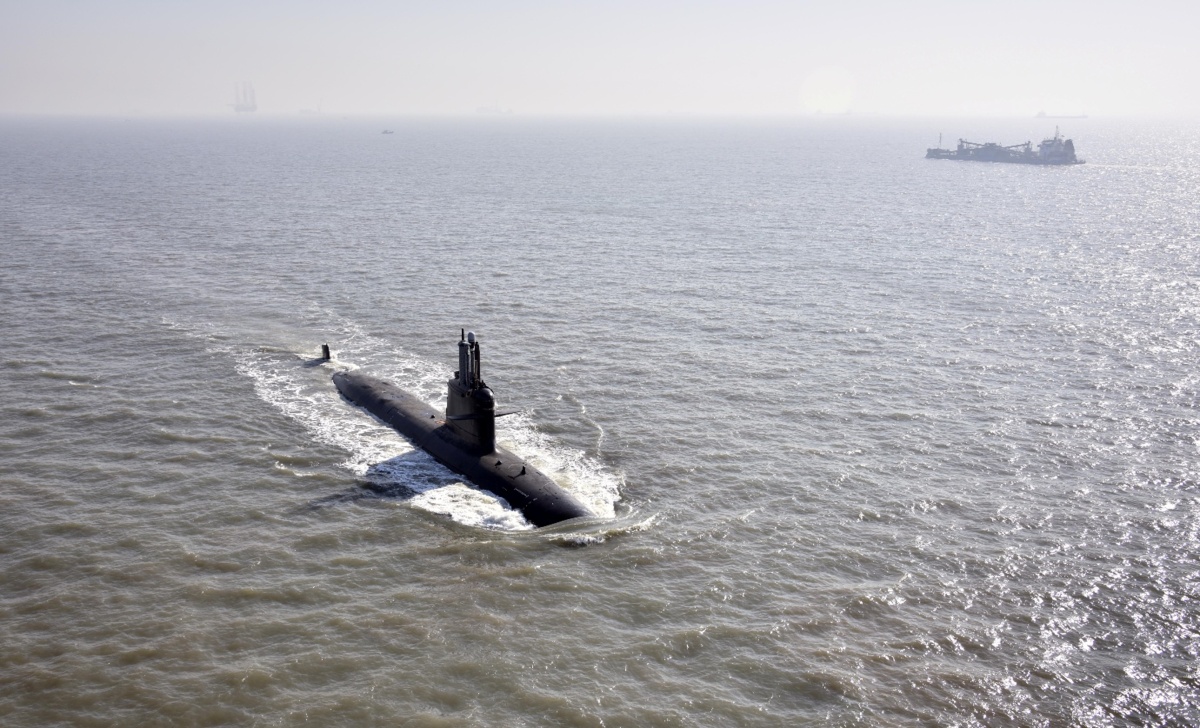
On April 03, 2026, India’s Defence Minister Rajnath Singh posted a message on the social media platform X, stating, “It’s not words but power, ‘Aridhaman’!” The message from India’s Defence Minister was as cryptic as India’s SSBN programme. India’s journey towards nuclear submarines dates back to the late 1970s, when it quietly launched a programme code-named Advanced Technology Vehicle (ATV), resulting in the launch of the Arihant SSBN programme on July 20, 2009, and its induction on August 26, 2016. India commissioned its second SSBN, INS Arighaat, on August 29, 2024. The latest entrant in the SSBN line is INS Aridhaman. In terms of nuclear capabilities, the following table gives an overview of the three SSBNs.

India’s SSBN Programme

Submarine

Armament Capability

Weapon

Ranges

INS Arihant

4 × Vertical Launch System (VLS) tubes

Up to 12 × K-15 Sagarika SLBM or up to 4 × K-4 SLBM

K-15: ~750 km

K-4: ~3,500 km

INS Arighaat

4 × Vertical Launch System (VLS) tubes

Up to 12 × K-15 Sagarika SLBM or up to 4 × K-4 SLBM

K-15: ~750 km

K-4: ~3,500 km

INS Aridhaman

Likely enhanced VLS capacity

K-15 Sagarika SLBM and K-4 SLBM (higher loadout expected than Arihant-class)

K-15: ~750 km

K-4: ~3,500 km

Source: Compiled by Author

India has periodically tested its sea-launched ballistic missiles (SLBM) to cross-check the system’s readiness. Since 2016, India has tested the K-4 SLBM 16 times and the K-15 five times. While K-15 entered service in 2018, K-4 has yet to be operationalised in the existing SLBM fleet. With the existing sea-based assets, India effectively carries a nuclear deterrence posture against Pakistan. However, when it comes to China, a more potent and challenging adversary, India still requires more platforms and systems for deterrence.

China Challenge and Ensuring Survival

China certainly has a lead against India in the nuclear domain. China has made an unprecedented growth in its nuclear modernisation, and this has, of course, raised a lot of concern around the globe. Ever since the discovery of its missile silos, China has not shied away from showing the world its nuclear platforms both in intent and physically. China also understands the vulnerability of land-based platforms, especially of the silo-based missiles. And this is one of the reasons why its sea-based capability has witnessed a remarkable jump. For China, nuclear numbers did not matter for a very long time. However, this notion has changed since the early 2010s. Not only has its nuclear warhead seen a multi-fold increase, now standing at approximately 600, but its delivery platform has also seen a remarkable growth. To fulfil its deterrence strategy, which is premised on the threat of causing unacceptable damage under the No-First-Use (NFU) doctrine, China has followed one of the classic principles of nuclear deterrence: survivability. Sea-based deterrence is the current hallmark of survivability because of the assured retaliation option. The sea leg of the Chinese nuclear triad currently employs the Julang 2 (JL-2), a second-generation SLBM with a range of over 7,000 km. China has also recently begun to replace the JL-2s with JL-3s. The JL-3s have an estimated range of about 10,000 km.

For India, the current SLBM fleet is not an absolute answer to China’s development in the same domain. Over the years, India and China have managed to resolve their issues without bringing nuclear weapons as a flash card. In fact, India’s approach towards nuclear weapons is not based on numbers or warheads or parity of platforms. India has also rejected the concept of nuclear warfighting. This rejection, in a way, has helped India to overcome the problem of numbers or parity. As Kenneth Waltz once iterated, “Forces designed for war-fighting have to be compared with each other. Forces designed for war-deterring need not be compared. The question is not whether one country has less than another, but whether it can do unacceptable damage to another….” For India, the critical question remains how to imagine and implement its Credible Minimum Deterrence (CMD) without getting drawn into the spiral of numbers. To this end, India’s 1999 Draft Nuclear Doctrine (DND) remains a key pillar of its nuclear thinking. The 1999 DND, while explaining what constitutes a doctrine of credible minimum deterrence, stated that “This is a dynamic concept related to the strategic environment, technological imperatives and the needs of national security. The actual size components, deployment and employment of nuclear forces will be decided in the light of these factors.” To this end, India has ensured it keeps a close eye on how technological development is reshaping its nuclear neighbourhood. In this domain, Aridhaman induction brings a crucial development for India, ensuring survivability and an assured second-strike capability simultaneously. There is another important aspect that Aridhaman may help India fulfil in the future: a continuous at-sea deterrence (CASD) posture. To maintain a CASD, India requires at least four SSBNs. The CASD posture ensures that survivability and second-strike capability remain unaffected during a heightened crisis. In 2018, India already achieved the capability to conduct a deterrent patrol with its INS Arihant SSBN.

The Road Ahead

On August 17, 1999, India, following its declaration as a nuclear-weapon state with its nuclear weapons testing in May 1998, introduced a DND. This doctrine delineated the country’s approach to nuclear policy and strategy. Objective 2.3 of the 1999 draft report clearly stated that “India shall pursue a doctrine of credible minimum nuclear deterrence.” The Objective 2.6 (A) also articulated how India would pursue its deterrence requirements and stated that it was required to maintain “Sufficient, survivable and operationally prepared nuclear forces.” Furthermore, objective 3 hinted at how India was going to fulfil its credible minimum deterrence posture and referred that India’s nuclear forces “…will be based on a triad of aircraft, mobile and land-based missiles and sea-based assets.” Less than three years after the release of the 1999 draft report, India issued another core set of guidelines on January 04, 2003, more commonly referred to as India’s official nuclear doctrine. The first subpoint under point 2 of the 2003 guidelines referred to “Building and maintaining a credible minimum deterrent.” However, it is one thing to say that India was aiming to build and maintain a credible minimum deterrent, which is a humongous task, and it’s another to fulfil that aim. Nonetheless, since 2003, India has made slow but steady progress towards the CMD posture via a nuclear triad. The latest entrant in this march towards fulfilling the nuclear triad requirement is the newly commissioned third nuclear-powered ballistic missile submarine (SSBN), Aridhaman (S4).

India’s commission of the third SSBN is not a small feat by any means. India is only the 6th country to have such a capability. As an NFU-oriented nuclear-weapon state, it is imperative for India to focus on survival and assured second-strike capability. However, merely acquiring SSBNs does not help fulfil the national security task. While a sea-based deterrent is the crown jewel of assured retaliation, the assurance component requires adequate communication channels and infrastructure. An NFU state such as India requires the best command-and-control platforms. Undersea, where detection must be avoided at any cost, communication becomes challenging. For SSBNs to make sure that they remain undetected, they have to remain submerged between 60 and 100 metres deep, and carry communication through Extremely Low Frequency (ELF) and Very Low Frequency (VLF) radio waves. Currently, India operates just one VLF station in the state of Tamil Nadu. However, in 2024, the Defence Minister of India laid the foundation stone for the Navy’s second VLF station in the state of Telangana. Besides communication, the command of SSBNs is also a task India is new to. Unlike the two other legs of the triad, the land and air, the sea-based leg requires delegation of authority to launch nuclear weapons. Till now, India has maintained that its nuclear weapons remain in a de-mated position. However, with a CASD posture, India would need to keep some of its weapons at least in a pre-mating position, if not completely mated. The issue here is space inside the submarine, not the commander’s or the political class’s intent. The induction of Aridhaman is certainly a show of intent, as India is now moving in its nuclear domain. With three SSBNs now inducted and a few more to come in the years ahead, India is certainly making sure that its NFU doctrine does not come under pressure through any nuclear blackmail or as has been stated, “India’s nuclear doctrine frees itself of the compulsion of immediate retaliation and bases deterrence instead on the certainty of retaliation that would be punitive in nature.”

CLICK TO VIEW THE PDF