Authors: Gp Capt PK Mulay, VM (Retd),Test Pilot, Commanded an Attack Helicopter Sqn & PhD in Defence Studies
Keywords: Operation Sindoor, NATO, Cyber, Cognitive Warfare, Vision 2047
“The purpose of warfare is not to fight; it is to achieve a political objective. If you can achieve this objective without kinetic conflict, so much the better.”
Prof Nora Bensahel[1]
Introduction
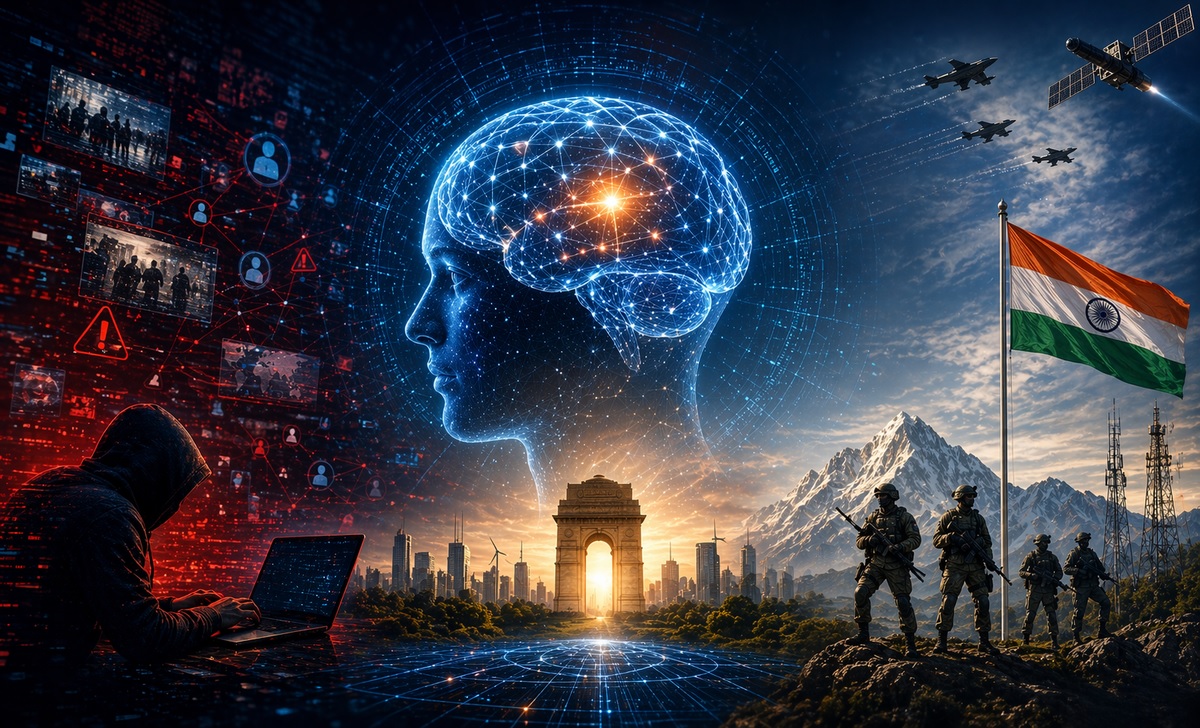
On March 10, 2026, India’s Ministry of Defence released Defence Forces Vision 2047: A Roadmap for a Future-Ready Indian Military. The document outlines reforms, capability enhancements, and structural changes to make the Indian military future-ready. This document envisages, among other initiatives, the setting up of a Cognitive Warfare Action Force.[2] The concept of cognitive warfare capability is a novel inclusion.
Inclusion of Cognitive Warfare may have its genesis in the war of narratives that erupted during and in the wake of Operation Sindoor. The Pakistani narratives overshadowed the Indian stories, leading to the downplaying of the total dominance achieved by the Indian military. In today’s post-truth world, strong narratives catch attention and evoke emotions, shaping public opinion. Appealing narratives, even if based on misinformation and untruth, still manage to catch attention. Facts by themselves carry no story. The story or narrative emerges when facts are woven into a thread to reflect an opinion. Selective inclusion of facts can craft stories that align with the beliefs and emotions of a target constituency. In such a scenario, retaining public support and garnering support of allies requires strong capabilities in crafting and sustaining dominant narratives and discrediting those that are contrary. There is thus a need to craft narratives that advance one’s opinions and challenge and discredit opposing narratives spread by adversaries.
Cognitive Warfare and Narrative Shaping
Narratives are becoming increasingly influential in international relations. A nation’s hard power comprises its capabilities in the military, economic, and social domains. On the other hand, narratives are a powerful tool of a nation’s soft power and shape other states’ perception of its actions and events. Narratives are used to gain influence and may be used as a weapon against rivals and enemies. They facilitate good relations and, if used inappropriately, derail dialogue. The United States (US) and the West are prime examples of narrative weaponisation through news and media control. During the initial days of the Ukraine-Russia War, news and opinions emerging from Russia were blocked, and a one-sided narrative of the war was projected to the world, casting Russia as the villain of the piece.
The Indian focus on cognitive warfare in the Vision 2047 is therefore very timely. Cognitive warfare involves creating compelling narratives that resonate with people, influencing local public opinion and shaping the opinions of target audiences. Cognitive warfare has come to the fore even in the USA, with Frank Hoffman (credited with popularising the term Hybrid Warfare) stressing the need for the US military to actively appreciate its importance.
Understanding Cognitive Warfare
But what is cognitive warfare? Cognitive warfare is a non-kinetic means of supporting the achievement of the nation’s security objectives. It attempts to influence the decision-making of the adversary’s leadership and the opinion of its population. According to Frank Hoffman, it is the application of targeted and tailored messages and nonviolent methods against civilian and military decision-makers, or the general population of a target state, to gain a positional advantage in the cognitive domain or to achieve desired political, military, and informational outcomes. [3]
As per the North Atlantic Treaty Organisation (NATO), cognitive warfare aims to affect attitudes and behaviours by influencing or disrupting individual and group cognition.[4] According to the Defence Forces Vision 2047, cognitive warfare identifies the human mind as a key battlefield. With its three key enablers of cyber, psychological, and information operations, it poses a critical security challenge. Focused disinformation exploits societal, cultural, religious, and economic fault lines to sow disorder and chaos, and to weaken nations from within. [5]
While the term may appear to be of recent origin, a peek into history would reveal that this mode of warfare has a long history. Many would recollect that in the Eastern theatre during the 1971 Indo-Pak War, Indian forces were advancing towards Dacca. Around December 13, 1971, the Chief of Army Staff (COAS) General Sam Manekshaw sent a stern, direct message to Pakistani forces in East Pakistan to surrender or face annihilation. He declared, “You surrender, or we wipe you out.” In return for surrender, he promised treatment according to the Geneva Convention and protection from attacks by Mukti Bahini and agitated Bangladeshis. This message, to a large extent, influenced the Pakistani forces’ decision to surrender.[6] The messaging from General Manekshaw may well be considered as cognitive warfare, shaping the enemy’s decision to align with the Indian military’s objective.
A more recent example of this kind of warfare is China’s attempts over decades to create a mindset among the Taiwanese population to accept reunion with the mainland. On average, Taiwan is flooded with up to 2,400 pieces of disinformation from the mainland daily. Most of these attempts aim to induce people to elect a leadership that is favourable towards reuniting with the mainland. These attempts have yet to yield the desired results for China.[7]
This kind of warfare has therefore been with us for some time. In recent times, however, new technologies have enhanced the efficacy of communication by an order of magnitude. Gone is the earlier model: a large number of posts, millions of fake accounts, and battalions of bots pushing content across the media. Now the measure is not the volume of posts but algorithms and Artificial Intelligence (AI)-driven storytelling. These changes have transformed cognitive warfare into a viable means of manipulating public opinion, influencing the decision-making of target countries.
Cognitive Warfare and Other Non-Kinetic Tools
Cognitive warfare, as per the Defence Forces Vision, employs psychological warfare and cyber and information operations as enablers. In any case, cognitive and psychological warfare both aim to target the adversary’s mind and thinking and are thus similar. Considering that cognitive warfare depends on crafting and spreading narratives, the action group would need to control the necessary cyber and information resources to launch its messages. The proposal for setting up the cyber command and centralisation of cyber operations may restrict the scope of the cognitive action force. Similar interference may occur in information operations as well. A solution may lie in an omnibus non-kinetic action force that combines cognitive action force, cyber, and information operations. This will improve functional efficiency, avoid coordination issues and prevent each function from operating in silos.
The other aspect is that cognitive and other non-kinetic forms of warfare differ substantially between military and civilian applications. Cognitive warfare, when employed by the military, may aim to exploit opportunities for deception or target the will and morale of enemy forces in specific operational contexts, with results expected in the near-term. When used against the adversary’s population or civilian leadership, the objectives would be to change behaviour or alter the thinking on certain contentious issues, such as China’s attempts to influence the Taiwanese population to reunite with the mainland. The means and processes would differ between the military and the civilian applications. In civilian applications, the time frames extend to years or decades, as seen in China’s attempts to influence Taiwan. Influencing people presupposes knowledge of their culture, behaviour, and beliefs. This would require expertise generally residing with the Ministry of External Affairs (MEA) and academicians. Though the Defence Forces Vision 2047 appears to include even civilian applications that relate to sowing disorder among the population, such initiatives are best left to other professionals. It would be better for the military to focus on employing non-kinetic forms of warfare to further their plans rather than assuming responsibility for other facets, such as influencing the adversary’s political leadership or population.
Political Warfare
The coining of cognitive warfare and its inclusion in military parlance reminds one of the eminent military analyst, Colin S. Gray’s term ‘presentism’.[8] He described it as a tendency of each generation to view the problems it faces as unique, something not encountered earlier, disregarding historical continuities. A much better approach to cognitive or non-kinetic warfare was articulated long ago during the Cold War period by George F Kennan, an eminent American diplomat famous for his “Long Telegram.” He called all these non-kinetic means “Political Warfare.” He defined it as applying Carl von Clausewitz’s doctrine in peacetime. Political warfare, as per him, was the employment of all means at a nation’s command short of war, to achieve national objectives.[9]
Cognitive, information, psychological, and cyber operations, which overlap in scope and are often employed together, need to be discussed in the language of political warfare, which refers to the employment of non-kinetic methods in peacetime. It would also obviate the need to look at each of these categories in isolation, leading to operating in silos, duplicating effort, or interfering with each other’s functioning.
Since the use of these tools differs between military and civilian purposes, each is best managed by a different agency. In the Indian context, the civilian part of “Political Warfare” may be managed by the National Security Advisor’s (NSA’s) secretariat, while the military aspects of “Non-Kinetic Warfare” are undertaken by individual Services and coordinated by the Integrated Defence Staff Headquarters (HQ, IDS), which may also liaise with the NSA’s secretariat for improved military-civil coordination.
Limitations of Cognitive Warfare
Even as the military contemplates creating a Cognitive Warfare Action Force, there is a need to understand the major limitations of cognitive warfare. Cognitive warfare results in dissension and harassment within the target country’s military or in confusion in decision-making. However, the disruptions and inconvenience are unlikely to be so severe as to force opponents to yield to unpalatable demands. Such non-kinetic tools are weak, slow to produce outcomes, and their impact is nebulous, making them unlikely to coerce an opponent or tilt the balance of power. Unlike force or violence, cognitive warfare does not threaten death and destruction and thus cannot bring about finality in a confrontation. It is therefore best employed in conjunction with other domains such as land, sea, air, and space. Cognitive operations can be employed in peace and before the commencement of military operations to dent enemy morale and interfere with decision-making by feeding disinformation and sowing discord. During war, all domains can be integrated to overwhelm the adversary.
Another major limitation of cognitive warfare, or of crafting dominant narratives, is their long-term efficacy. Any narrative in the long-term will need to align with reality. In this regard, the Ukraine-Russia War may be illustrative. In the early stages of the war, major global news agencies such as Reuters, Associated Press (AP), and Agence France-Presse (AFP) banned the broadcast of Russian news. As a result, only a one-sided perspective from the West was shared worldwide. Videos such as “Ghost of Kyiv,” which depicted a Ukrainian MiG-29 shooting down innumerable Russian fighters, went viral. The video turned out to be false. Over time, everyone realised the video was fabricated. Even today, news emerging from this war continues to be one-sided, showcasing Ukrainian heroism and resistance. However, all these narratives cannot hide the fact that Russia is today in occupation of over 20 per cent of Ukrainian territory, with Ukraine unable to recapture it. Narrative shaping sounds very good and enthrals followers for some time. But ultimately, reality cannot be brushed aside.
The cliché, “shaping the narrative is as important as shaping the battlefield,” remains what it is: a cliché. Stories ultimately have to yield to reality. Pakistani narratives about air superiority during Op Sindoor initially dominated social media. However, the bull horns have quietened over time when countered with facts. Reality emerged when Western think tanks accepted Indian dominance and commended the exceptionally crafted and controlled punitive strategy. Reality over time doused the flames of false narratives.
Conclusion
The Indian military’s focus on cognitive warfare is timely and appropriate. Enhancing narrative crafting and dissemination skills is necessary in today’s socially connected, wired world. Narrative dominance does bring dividends in the form of improved domestic and foreign support. The methodology of implementing this concept, however, needs more thought. Considering the overlap in scope and similarity of objectives, it would be desirable to bring all non-kinetic tools under unified control. This would enable better coordination and integrated employment. The military should focus only on military applications with immediate, measurable outcomes. The civilian applications, which are long-term and nebulous in their impact, are best undertaken by an agency within the NSA. IDS could enable coordination between the military and civilian applications.
Cognitive warfare is appealing because of its promise to achieve security interests without resorting to force. But it must be understood that, while it may appear formidable, it cannot ensure decisive outcomes. Projecting it as an effective tool to preclude war and violence is, therefore, somewhat of an exaggeration. Such exaggeration would be harmless were it not for the fact that it relates to the serious business of war and a country’s survival. Cognitive warfare and other kinetic tools are best visualised as options for political warfare: employing Clausewitz’s doctrine in peacetime. In war, these may be employed in an integrated multi-domain operation. Any overestimation of the efficacy of this particular tool may distort the overall strategy during wartime, jeopardising the chances of victory. In peacetime, such thinking may lead to the allocation of resources to bolster capabilities in cognitive operations, reducing those for kinetic warfare. The results can prove disastrous when expectations are belied. Prudence and perspicacity demand that cognitive warfare should not be considered as a substitute for force or violence. These tools are best employed to support military operations in wartime and to further diplomatic interests in peacetime. When considering non-kinetic tools, it is best to keep in mind Hannah Arendt’s advice that “The chief reason warfare is still with us is … the simple fact that no substitute for this final arbiter in international affairs has yet appeared on the political scene.”[10].
*****
CLICK TO VIEW THE PDF
Notes:-
[1] Cybèle C. Greenberg, “Could Cyberwar Make the World Safer?” New York Times, August 22, 2021, https://www.nytimes.com/2021/08/22/opinion/cyberwar-world-safety.html. Accessed on April 16, 2026.
[2] Integrated Defence Staff (IDS), Government of India, “Defence Forces Vision 2047,” 2026, https://ids.nic.in/landing_page?id=TVRJek5EVTJOemd4TWpNME5UWTNPREV5TXpRMU5qYzRNVEl6Tkc4ZHZiVENEVGdtNU9lMnMtbnpmVTc2WHZv&type=Home%20Page. Accessed on April 16, 2026.
[3] Frank Hoffman, Assessing “Cognitive Warfare,” Small Wars Journal, November 14, 2025, https://smallwarsjournal.com/2025/11/14/assessing-cognitive-warfare/. Accessed on April 16, 2026.
[6] “Cognitive Warfare: Strengthening and Defending the Mind,” North Atlantic Trade Organisation, April 5, 2023 https://www.act.nato.int/article/cognitive-warfare-strengthening-and-defending-the-mind/. Accessed on April 16, 2026.
[5] IDS, n. 2.
[6] Rustam, “Vijay Diwas – ‘You surrender or we wipe you out’: When Sam Manekshaw threatened Pak in 1971 Bangladesh liberation war,” WION, December 15, 2020, https://www.wionews.com/photos/vijay-diwas-you-surrender-or-we-wipe-you-out-when-sam-manekshaw-threatened-pak-in-1971-bangladesh-liberation-war-349940. Accessed on April 16, 2026.
[7] Matthew Becerra, “The Battle for Reality: Chinese Disinformation in Taiwan,” Geopolitical Monitor, August 24, 2022, https://www.geopoliticalmonitor.com/the-battle-for-reality-chinese-disinformation-in-taiwan/; and Tzu-Chieh Hung and Tzu-Wei Hung, “How China’s Cognitive Warfare Works: A Frontline Perspective of Taiwan’s Anti-Disinformation Wars,” Journal of Global Security Studies, vol. 7, issue. 4, December 2022, https://academic.oup.com/jogss/article/7/4/ogac016/6647447?login=false. Accessed on April 16, 2026.
[8] Chris Tuck, “Hybrid War: The Perfect Enemy,” Defence in Depth, April 25, 2017, https://defenceindepth.co/2017/04/25/hybrid-war-the-perfect-enemy/. Accessed on April 16, 2026.
[9] George F. Kennan, “The Inauguration of Organized Political Warfare,” Wilson Centre Digital Archive, April 30, 1948, https://digitalarchive.wilsoncenter.org/document/george-f-kennan-inauguration-organized-political-warfare. Accessed on April 16, 2026.
[10] Hannah Arendt, On Violence (New York: Harcourt and Brace, 1970), p. 5.
(Disclaimer: The views and opinions expressed in this article are those of the author and do not necessarily reflect the position of the Centre for Aerospace Power and Strategic Studies [CAPSS])