Author: Wg Cdr Dhruv Shukla
Keywords: Jointness, Cost Optimisation, National Interest, Mission Overlap
“A dollar spent on duplicative capability comes at the expense of essential capacity or capability elsewhere. Confused organizational structures lead to sub-optimal employment of forces already stretched too thin. Outdated service roles and missions yield costly, inefficient acquisition programs.”
Recent media reports indicate that the Indian military’s proposed roadmap for theaterisation has finally been submitted to the Ministry of Defence (MoD) after years of debate. Much of the commentary around theatre commands has focused, understandably, on the promise of greater jointness, faster decision-making and increased operational efficiency. Yet theaterisation may not, by itself, resolve several deeper questions of jointness. One of the most important questions is also the most basic: what roles should each service perform, and what should define the limits of service-specific capability development? This question has received limited attention in Indian strategic discourse compared to associated concerns such as duplication of capabilities, inter-service overlap and inefficient defence spending. Just as India’s theaterisation debate has drawn from global models, this fundamental question may also require a comparative study on similar lines. But more importantly, it will require a thorough introspection as far as our higher defence organisation is concerned.
In the United States (US), this issue is discussed through the vocabulary of ‘Roles and Missions.’ The US Department of Defense (DoD) defines ‘Roles’ as ‘the broad and enduring purposes for which the services were established by law’, while ‘Missions’ refer to the ‘the task, together with the purpose, that clearly indicates the action to be taken and the reason therefore’. Amongst the long list of inter-service issues in the US military that continue to persist after the Goldwater-Nichols Act, the ‘Role and Mission’ debate is perhaps the oldest, and the most intensely fought. A veteran United States Air Force (USAF) officer, Lieutenant General David Deptula, said in his speech to the US Senate Committee in 2015 that the Goldwater-Nichols Act and subsequent Joint Doctrines were about interoperability but did nothing to resolve the ‘Role and Mission’ issue affecting the US military since 1947. Like the US DoD Directive that lays down the service Roles and Missions, India has no direct equivalent framework. The closest equivalent, Allocation of Business (AOB) Rules 1961, is not a granular document like the US DoD Directive, and it essentially lays down the area of responsibility of various ministries and government departments. While reforms have been undertaken lately, leading to the creation of the Department of Military Affairs (DMA) in 2019, the issue of delineating the Roles and Missions of the services has not been resolved.
Air Forces across the world are especially exposed to this issue for two reasons. First, a substantial portion of the Air Force is employed towards executing missions in support of land and maritime operations. Secondly, other services commonly maintain organic air arms, whereas Air Forces do not maintain any such auxiliary forces for land or maritime operations. That said, duplication does occur in other domains like Space, where all other services may attempt to develop independent capabilities rather than sharing the products. Given enough money, perhaps this debate would exist only as a ‘coordination’ issue, but the real world works on a limited budget, and even nations with deep pockets are mindful of where they put their taxpayers’ money.
Why is it required – Patchwork vs True Optimisation
At first glance, the question may appear redundant; the three military services by design have distinct domains and associated missions. If so, this entire debate becomes redundant, but history says otherwise. Most militaries, especially larger ones, have repeatedly struggled with inter-service issues such as operational misalignment, procurement competition, and budgetary overlap. In fact, the concept of independent air forces was born out of one of the worst-known cases of inter-service rivalry in Britain, with the Americans following closely.[1]
Till the advent of Air Power, the overlap between services was hardly worthy of mentioning – Armies didn’t want to fight on the seas, and Navies had no intention of fighting on land, even as both did coordinate for amphibious operations at times. Air Power brought along with it the concept of ‘overlapping functions and duplications of effort’, as noted by Brigadier General H.J.F. Miller of the US Army in the 1920s. Even as independent Air Forces came out from the shadow of being auxiliaries of the Army and Navy, the desire to have one’s own little ‘Air Force’ never left the other services. This is not merely about the procurement of platforms, but also about creating an entire ecosystem to field them, which is substantial when it comes to aviation. The total cost (acquisition plus additional costs) of fielding such capabilities should be justified by their output vis-à-vis what it would cost when operated by the primary user service. However, there is no adjudication process which can sense the true financial implications of such duplicative capability development. Once approved, an ecosystem begins to develop and slowly becomes a justified institutional baseline, often at the cost of core domain expertise.
Left unchecked, two services may eventually possess comparable numbers of platforms for a similar mission, but possession of a platform is not the same as the ability to generate comparable operational effect. Domain expertise is not built overnight, and there is no need to do it when it exists with the primary service. The major concern is that as of today, there is no benchmark on how much overlap is acceptable and who draws the line? At this point, it is also essential to understand that a certain amount of duplication is not only acceptable but operationally required. The key is to ascertain where and how much.
Lastly, duplication of capability and mission overlap also deters ‘jointness’. Consider a ‘Theatre Command’ where all three service components are operating a particular platform, say a High-Altitude Long Endurance (HALE) Unmanned Aerial System (UAS). It would not be long before the Theatre Commander realises that optimum utilisation of these platforms spread across services would require centralised planning, common maintenance schedules and common Tactics, Training and Procedures (TTPs). Eventually, the commander would consolidate these assets under a single component for operations while distributing the products across all components. In due course of time, training of operators and maintenance too would need to be centralised to ensure optimisation, which may or may not fall under his purview depending on the command structure. In effect, the Theatre Commander would have to build a patchwork mechanism to correct the ill effects of fragmentation. These issues would not have existed in the first place had the services focused on the products of the platform rather than ownership.
The American Warning
The history of Roles and Missions debate in the US military is comprehensively recorded and easily accessible for any researcher to use. The debate began with the National Security Act of 1947, which laid down the basic functions of each service. In 1948, Secretary of Defense James Forrestal signed the Key West agreement, often known as the Key West Compromise, since it gave each service a bit of whatever they wanted without clarity. Secretary Forrestal divided the missions into ‘primary’ and ‘collateral’, which left room for duplication by default. A report by Stimson Center aptly summarises the agreement – ‘The results were ambiguities in service roles, and redundancy in service functions, which built higher costs into the very heart of the US defense establishment.’
The Key West agreement found its legal framework in 1954 with DOD Directive 5100.1. The Department of Defense Reorganization Act of 1958, enacted during the Eisenhower administration, strengthened the authority of the Secretary of Defense and the Unified Commanders at the expense of the individual military departments. This was done to empower the Secretary of Defence and enable him to adjudicate over service requirements, resolve overlaps and assign specific programs to each service. The core debate of Roles and Missions was, however, not entirely resolved, leading to multiple government agreements, before finally solidifying into the Quadrennial Review (QDR). This review, undertaken every four years, is used to debate modernisation plans, national defence strategy, budget priorities and other issues that directly impact military capability. A chronological evolution of the US military Roles and Missions review is depicted below, and beyond 2001, the issue has been handled by periodic reviews like the QDR.
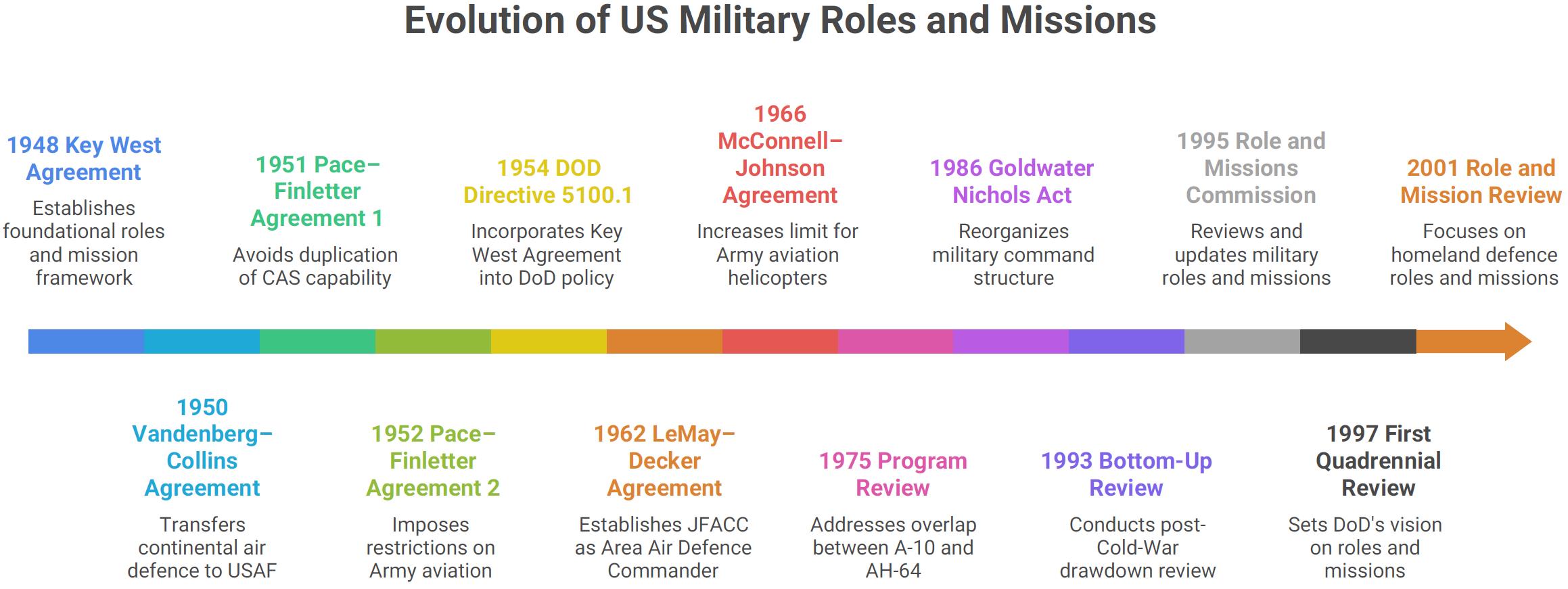
In 1986, a service-level prioritisation board was set up in the form of the Joint Requirement Oversight Council (JROC), which replaced the Joint Requirements and Management Board (JRMB). Unlike its predecessor, the JROC could rule against the service chiefs and individual service requirements if they were found redundant or unable to justify their costs. The council is headed by the Vice Chairman of the JCS and includes Vice Chiefs of all services. In theory, this should resolve all problems since a neutral view of service requirements is jointly undertaken and adjudicated. However, JROC members also represent their services, which means that institutional preferences do not disappear merely because they are placed inside a joint forum; thus, JROC itself is subjected to external audit by the Department of Defense.
Even with JROC in place, the overlap issues in the US military have not subsided, but their negative influence has been mitigated to an extent through Joint Doctrines laying down clear command relationships. Consider the case of Theatre-wide Suppression of Enemy Air Defences (SEAD) for which the Joint Force Air Component Commander (JFACC) is the ‘supported commander’. The JFACC, under the guidance of the Joint Force Commander (JFC), can aggregate assets like Army Tactical Missile System (ATACMS), Navy’s Tomahawk cruise missiles or even Special Operations Command (SOCOM) assets to produce the desired effects in the Area of Operations (AO). However, such arrangements do nothing to ward off the ill effects of overlap, which is wasteful expenditure due to duplicative capability development and stunted growth in critical areas. Where compromise becomes the default method of resolving inter-service disagreement, the result is pacification rather than prioritisation. The persistence of such concerns is visible even in recent legislation. The FY 2021 William Thornberry National Defense Authorization Act required reviews in several areas flagged familiar Roles and Missions questions: redundancy, gaps, integration, operational responsibility and the rationalisation of parallel architectures.
Overall, the American case makes for a good starting line for anyone attempting to study this problem, but it is by no means the only one. An interesting example for analysis would be the Canadian military, wherein a government study in 1960 reported that, ‘There is a growing range of activities of common concern to the services, for which the traditional basis of organization is unsuited. It is increasingly recognized that to maintain three separate organizations for such functions is uneconomic.’ This commission finally resulted in the unification of the three services in 1968, which can be considered an extreme administrative measure. While there are problems associated with such measures, and the Canadians themselves have partly reversed the act, it does point to a very basic question – if shedding service identities solves the problem, then does it mean that the duplication existed purely because of turf wars? Perhaps the core problem needs a deeper analysis with an unbiased lens that is concerned only with national interest.
Why Air Power Bears the Heaviest Costs
This is not a hypothesis; it is observable in almost every case of overlap and duplication. Any requirement projected by other services can be argued strongly enough in the name of ‘organic’ tactical responsiveness. This essentially corners the bureaucracy to choose the easy way out – give each service a share and avoid a hard decision. Over time, that compromise leads to depleted capabilities in the Air Force; a service expected to deliver the widest range of joint effects while still excelling at its core missions. Once a supported service sees the Air Force operating with inadequate numbers and stunted capabilities, it naturally perceives a gap between the Air Force’s stated role and its actual capacity to support coordinated operations. To close that perceived gap, it raises its own case for capability development, which obviously overlaps with the Air Force’s core missions. The result is an iterative cycle: Air Force shortages generate service-specific workarounds; those workarounds dilute the Air Force’s case for capability building; the numerical slump deepens, and the overlap becomes progressively harder to reverse.
If left unmanaged, this trend can erode the institutional logic of an independent air force in due course of time, not because airpower becomes less relevant, but because its core missions are gradually fragmented across all services. In this state, these services cannot, individually or jointly, reproduce effects that the Air Force does with its domain expertise. Some land-warfare experts have already made statements that put the role of the Air Force in long-range targeting into question. Most observers miss the central point – the same weapon used by a service raised for a given role and by another service desirous of organic capability may result in very different outcomes. With critical capabilities fragmented across services, Air Power may fail to produce decisive effects in the opening days of operations. The failure of Air Power in Russia is a good example of what a conflict can look like if the Air Force fails to produce decisive effects. Those interested in alternate history may like to imagine what Desert Storm would have looked like if the USAF had lacked night interdiction capability (F-111F/F-15E and Pave Tack pods) that knocked out the majority of Republican Guard armour. Air Power comes at a cost, but the cost of having a depleted Air Force is far higher. This aspect was aptly put by General George C. Kenney of the US Army Air Force – “Air power is like poker. A second-best hand is like none at all – it will cost you dough and win you nothing.”
Indian Higher Defence Organisation
Allocation of Business rules (AOB) in India assigns the following responsibility to the Department of Defence: ‘Defence of India and every part thereof including defence policy and preparation for defence and all such acts as may be conducive in times of war to its prosecution and after its termination to effective demobilisation.’ This essentially means that even after the formation of the Department of Military Affairs (DMA), all policy decisions must be routed through the Department of Defence, essentially the Defence Secretary. On the other hand, the Department of Defence, which handles capital acquisitions, does not have a mandate of prioritisation but only that of ensuring accountability. Essentially, this gives the DMA a jointness mandate, but not a clear capital-acquisition adjudication mandate on overlap debates. The DoD ensures that the process of acquisition will stand the test of scrutiny by the Controller and Auditor General (CAG), but they do little in terms of optimisation at the deep end. In sum, ours is a classic case of civilian control over the military where civilians do not interfere as long as the process aligns with laid-down rules. Anit Mukherjee remarked in his book, The Absent Dialogue, that “the model of ‘objective control’ as understood and implemented in India has not stood the military in good stead as it has compromised on its effectiveness, and there is an urgent need for change.”[2]
The change, perhaps, was to be the Chief of Defence Staff (CDS), a case as old as independent India. While the present mandate of the CDS may not align with the original concept as envisaged at the time of independence, its present charter does cover the issue at hand to some extent. Out of his eleven stated duties and functions, three are of interest: –
-
-
To be a member of the Defence Acquisition Council (DAC), chaired by the Hon’ble Raksha Mantri.
-
To assign inter-services prioritisation to capital acquisition proposals based on the anticipated budget.
-
To bring about reforms in the functioning of the three Services with the aim of augmenting the combat capabilities of the Armed Forces by reducing wasteful expenditure.
-
From the above, it is evident that the CDS has some US JROC-like responsibilities in inter-service prioritisation, but India still lacks an institutional mechanism designed specifically to test whether a proposed capability duplicates, complements, or undermines another service’s assigned role. Advocates of various processes like the Integrated Capability Development Plan (ICDP) may cite the existence of the Defence Acquisition Council (DAC) itself as a major barrier to wasteful expenditure. To ensure credible oversight, cases of procurement above INR 300 crores are cleared by the Defence Secretary, and above INR 500 crores are cleared by the Hon’ble RM himself. But the caveat here is that both civilian bureaucrats and the politicians may not be viewing procurements through the lens of sensing duplication, but purely from a financial viability standpoint. In their defence, any procurement case reaching them would have already got the nod from CDS, and their approval would be mostly based on financial constraints. Consider this – If the Army were to make a strong case for acquiring fixed-wing transport aircraft or the Air Force asked for a regiment of Multiple Rocket Launch Systems (MRLS), the decisive filter may become financial affordability, even though the question should be whether the capability is required organically with that service at all.
Curious Case of Attack Helicopters
When the Army Aviation Corps (AAC) finally came into being in 1986, the case for command and control of Attack Helicopters was already a highlight. As per the Army, Attack Helicopters were an integral part of the land battle, with some often equating them to an elevated tank. The inter-service debate reached an extent that it required government intervention, and the same was brought out by then Defence Minister AK Antony during a 2013 parliament question on the issue – “Keeping in view operational requirements, Government has decided that ownership of future inductions of attack helicopters will vest with the Army.” Interestingly, just six years later, in 2019, the Indian Air Force (IAF) inducted the first batch of AH-64 Apache Attack Helicopters with a stated role of ‘enhancing the capability of IAF in providing integrated combat aviation cover to the army strike corps’. Within the next five years, the Indian Army will also induct the same platform, with the former Director General AAC reportedly declaring it as a ‘game changer’ in the Tactical Battle Area (TBA). However, operational experience has shown that modern Attack Helicopters are more than just flying tanks and are capable of executing missions which far surpass the traditional roles of Close Air Support. Some of these complex missions include SEAD and Combat Air Patrols (CAP) against UAS. Apaches have even been employed for Anti-Ship role by the US military during Operation Epic Fury. By splitting a relatively small fleet of highly specialised assets across two services, it would be extremely difficult to standardise TTPs and integration of the entire fleet with larger packages if the need arises. In the US military, the fleet is entirely operated by the US Army, while in Israel, the fleet is operated by the Israeli Air Force – every country has their own operational context and reasons. The issue is not of ownership, but of optimisation and operational efficiency.
In a similar manner, the indigenous Light Combat Helicopter ‘Prachand’ has also been split across the Army (90) and the Air Force (66). It would be difficult to imagine how airborne assets placed under different C2 structures will operate with common Rules of Engagement, Secure Identification Friend or Foe (IFF) keys, communications plan, data-link settings, Electronic Warfare (EW) database, etc. If we circle back to the hypothetical example of a Theatre Commander having assets spread across in this manner, the outcome will be the same – aggregate operations under one component and share the capabilities. There is no question that operational integration of these platforms can be achieved by extensive joint training, cross-posting of aircrew, common TTPs, common maintenance schedules and other such measures. But as covered earlier, these are patchwork measures to enhance interoperability, not measures to prevent wasteful duplication. In the absence of publicly available MoD files explaining the adjudication logic, it is difficult to assess whether the split reflected operational necessity, industrial/budgetary considerations, or an unresolved Roles and Missions compromise.
The Attack Helicopter debate is not unique to India, and similar debates exist regarding other platforms in India and across the world. For instance, the case of the People’s Liberation Army (PLA) Navy assets being transferred to PLA Air Force in 2023 would make for an interesting study. The case study highlighted here is to illustrate the larger problem of mission overlap and duplication of capabilities and not to justify the case of either service. The real question to be asked is whether India has a mechanism to decide when overlap is operationally necessary, when it is merely institutional accommodation, and when it becomes costly duplication.
Way Forward
At the outset, it must be reiterated that overlap and duplication to an extent are an operational requirement. Secondly, the role of services-led structures in adjudication of procurement cases must be subject to external audit to ascertain their ability in preventing wasteful duplication. Thirdly, there must be a mechanism for ascertaining the true cost of duplication that goes beyond acquisition costs. This would also involve deficiencies in operational employment of a given platform within a service. The adjudication, thus, will not just be limited to who can buy what, but also about what type of integration standards need to be met to ensure interoperability. This would involve dictating critical aspects like combat identification systems, networking standards and so on. The endgame, that is, operational employment, can be left to joint doctrines or other mechanisms between the services.
To achieve this, the first step would be to institute a Roles and Missions Review Committee headed by the Cabinet Secretary and consisting of representatives from the Ministry of Defence, the Ministry of Finance and the three services. The mandate of the committee can be broadly set as follows:
-
-
To assess existing overlap between the three services, including historical records of how it came into existence.
-
To carry out a study of the financial implications of maintaining duplicative capabilities across the services, including a comparative analysis of how each service operates common platforms. This would include analysis of manpower differentials, maintenance management, operational utilisation and contribution to joint requirements. The first two aspects should involve an independent study through a Comptroller and Auditor General (CAG) audit to ensure that the data captured is true and a solid foundation is laid for future models.
-
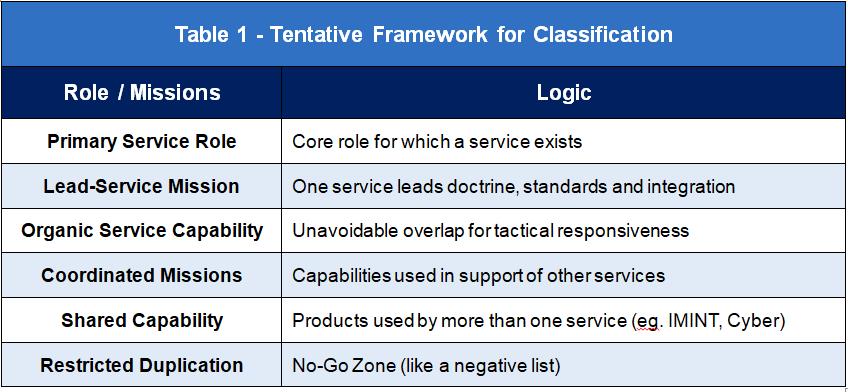
Establish ‘Role and Mission’ clarity after careful analysis of global models. A broad framework is placed in Table 1 below.
-
Modify the existing ICDP, Defence Capital Acquisition Plan (DCAP) and Annual Acquisition Plan (AAP) to include MoD oversight in terms of adjudication and prioritising, not just to ascertain adherence to procedures.
-
Periodic review by the committee with findings submitted to the Standing Committee on Defence (SCOD).
-
To review AOB for inclusion of three service Headquarters (HQs) directly or consider empowering DMA beyond its present scope to adjudicate in capital acquisitions.
-
Conclusion
As America was preparing for a military intervention during the Second World War, it was President Franklin Roosevelt’s foresight that allowed him to make a crucial decision regarding pre-war production – to cut the armoured vehicles production and scale up aircraft production even though some of his generals advised against it vehemently.[3] While we can debate till eternity about the impact of strategic bombing during the war, the impact of Allied Air Superiority on the progress of operations on land and sea cannot be disputed. Had Roosevelt delayed it by deliberating too long, American Air Power may not have prevailed even if the production base was able to keep pace. The reason is that capability is not just about production or acquisition; it is about integrating that platform into the existing warfighting mechanisms and, most importantly, about creating institutions and expertise. There were no Roles and Missions guidelines that existed then, and the USAF did not exist yet. Yet, this decision was made by a politician who understood military requirements.
While a wartime decision like the above would have entirely different connotations than those discussed here, the case should trigger some minds at the apex level as to what it takes to make this call. Does it matter if bureaucrats have an innate knowledge of military matters since they are placed in a position of authority? One may say that it would depend on the maturity and wisdom of military leaders to understand the security dynamics and contours of future warfare and take measured decisions without any service bias. That may be so, but leaving policy matters open to personal attributes is not a sound policy by any standard. The only option that remains is a bounded approach which gives the military and civilian bureaucracy a framework – well-defined military Roles and Missions. Luckily, there is enough data available globally to derive meaningful lessons and make a framework suitable for India. Whatever be the framework, the enduring and final role of civilian oversight is best stated by David Deptula while presenting his case to the US Senate, “After that quarter century of experience I have come to the conclusion that fundamental change in the roles and functions of the Armed Forces can only come from congressional legislation. The role men and women in uniform can best play is to help share insights and perspectives regarding the present state of affairs, where change is needed, and avenues for positive reform. Ultimately, I think we need to seriously consider a Commission on Roles and Missions in the 21st Century that may ultimately inform a revised National Security Act.”
*****
CLICK TO VIEW THE PDF
(Disclaimer: The views and opinions expressed in this article are those of the author and do not necessarily reflect the position of the Centre for Aerospace Power and Strategic Studies [CAPSS])
Notes:-
[1] Anthony J Cumming, The Battle for Britain: Inter-Service Rivalry between the Royal Air Force and Royal Navy 1909-1940 (Annapolis: Naval Institute Press, 2015), pp. 4-7.
[2] Anit Mukherjee, The Absent Dialogue (New York: Oxford University Press, 2019), pp. 29-30.
[3] Phillips Payson O’Brien, How the War Was Won (Cambridge: Cambridge University Press, 2015), pp. 49-55.