
Author: Ms Shrawani Shagun, Research Fellow, Centre for Aerospace Power and Strategic Studies
Keywords: Tactically Responsive Space (TacRS), Private Space Launch, Defence Space Agency, Counter-space Capabilities, Space Resilience, Aerospace Continuum, ISRO
‘In future conflicts, the decisive question will not be who launches first, but who can relaunch fastest.’
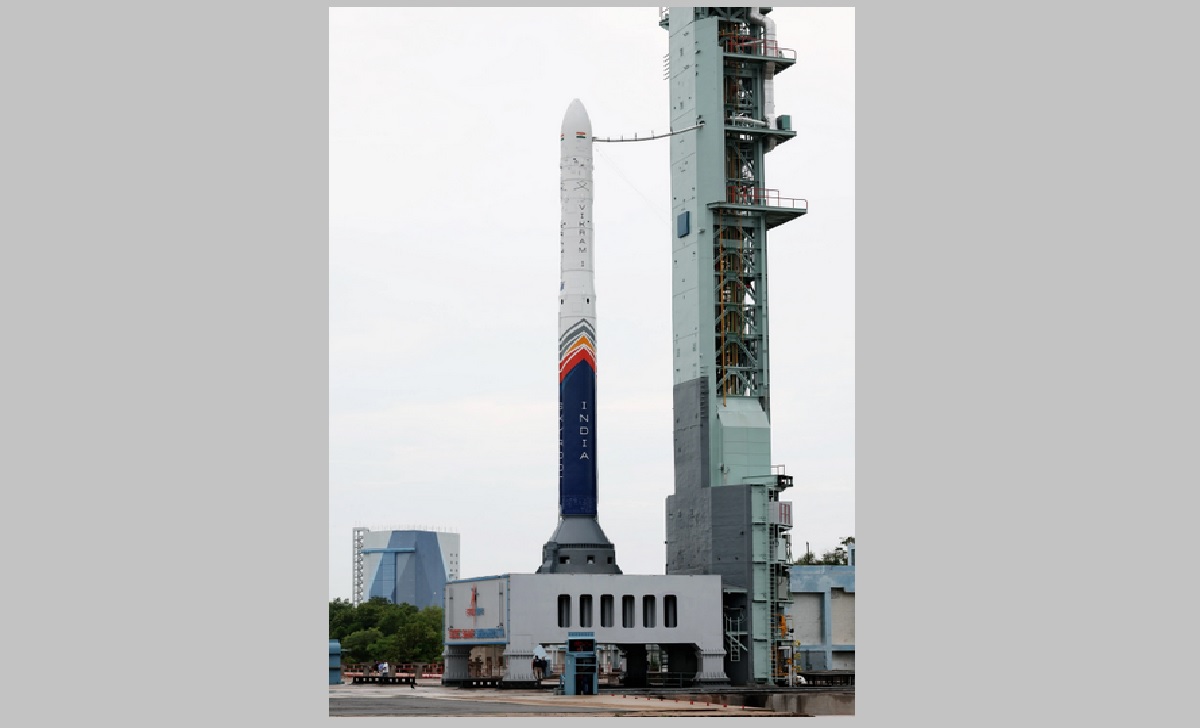
As modern warfare transitions towards Multi-Domain Operations (MDO)[1], the foundation of military readiness is dictated by sovereign control over the ‘aerospace continuum’.[2] On July 18, 2026, the successful launch of Skyroot Aerospace’s Vikram-1 is another feather in India’s orbital access.[3] This is a welcome addition to the nation’s military architecture. This issue brief argues that the Indian Air Force (IAF) and Defence Space Agency (DSA) must leverage this private sector boom to pioneer an Indian ‘Tactically Responsive Space’ (TacRS) doctrine. To clarify the adoption path, India must first overcome the bureaucratic friction of the ‘absent dialogue,’ then establish a private wartime reconstitution reserve, and finally build the rapid-launch resilience required to secure its ‘unblinking eye’ and dictate the Observe-Orient-Decide-Act (OODA) loop in the next conflict.
The Cosmic Coastline and the July 18 Paradigm Shift
Space is no longer a benign scientific sanctuary; it is a highly contested military domain.[4] Space technology is fundamentally characterised by its military-industrial genesis. Bowen challenges the cliché of space as the ‘ultimate high ground’. He argues instead that Earth’s orbit must be understood as a vulnerable ‘cosmic coastline’ that provides vital logistical and intelligence support to terrestrial forces.[5] On the morning of July 18, 2026, India’s ability to defend this cosmic coastline strengthened. A four-stage, carbon-composite rocket built by a Hyderabad startup, Skyroot Aerospace, lifted off from Sriharikota and successfully reached a 450-kilometre orbit.[6] While headlines understandably framed Vikram-1 as a commercial milestone for India’s unicorn space economy, its true significance is military. A state that can place payloads into orbit through multiple independent domestic providers possesses an operational resilience that a state relying on a single, congested national agency lacks. The Doctrine of the Indian Air Force formally recognises the seamless nature of the ‘aerospace continuum.’[7] Within this continuum, Vikram-1 represents a massive leap in national capacity; India must use it to reconstitute a constrained orbital capability, whether reconnaissance, communications, or navigation, on a timeline that matters to a tactical commander rather than to a five-year peacetime procurement cycle.
Operation Sindoor and the ‘Unblinking Eye’
Modern military operations are no longer merely enabled by space; they are absolutely dependent upon it. In the mature ‘precision-warfare regime,’ military dominance relies on a ‘reconnaissance-strike complex.’[8] Because space-based Intelligence, Surveillance, and Reconnaissance (ISR) platforms act as the ‘unblinking eye’ of this complex, adversaries have a massive operational incentive to blind them early in a conflict. India witnessed this absolute dependence first-hand during Operation Sindoor in May 2025, where near-real-time satellite imagery was central to identifying and striking targets deep inside Pakistani territory.[9] Because of this reliance, India is accelerating the deployment of its constellation of roughly 50 surveillance satellites, with completion by 2029. This expansion incidentally coincides with China’s heavy investment in a broad spectrum of counter-space capabilities.[10] As the IAF seeks to compress the OODA loop, the strategic question is no longer just ‘how do we protect our satellites?’ but ‘how quickly can we replace the ones we lose?’ If a cyber-attack or kinetic strike blinds the IAF’s ‘unblinking eye,’ India’s reconnaissance-strike complex collapses. Therefore, an agile, distributed launch capability is not just an industrial asset; it is a direct component of India’s combat power.
Tactically Responsive Space (TacRS) vs The ‘Absent Dialogue’
To address this vulnerability, the United States Space Force has spent the last five years pioneering Tactically Responsive Space (TacRS). Its VICTUS NOX demonstration answered a single critical question: if a satellite is destroyed mid-conflict, can a replacement be orbited within days rather than months? During VICTUS NOX, a satellite was readied within 24 hours of notice and was operational within 37 hours of liftoff.[11]
India took a first step in this direction when the Defence Minister released the Joint Military Space Doctrine (JP 2.07) on 16 September 2025, formally recognising space as a warfighting domain alongside land, sea, air, cyber, and the electromagnetic spectrum.[12] That doctrine, however, addresses space-centric warfare and asset protection at a broad, tri-service level; it does not yet specify a tasking chain, contractual mechanism, or authorisation pathway for surging private launch capacity in a crisis. India therefore does not yet have an equivalent to TacRS itself, but it now has the technical foundation for one.
Skyroot has stated that Vikram-1 is designed to be assembled and launched from any compatible site within 24 hours, a specification that could support a military responsive-launch requirement if adopted through the appropriate institutional and operational pathway.[13] However, translating this civilian capability into a military reconstitution reserve requires overcoming severe bureaucratic friction. A structural fracture in Indian civil-military relations exists where tight bureaucratic control frequently isolates operational military expertise from national planning.[14]
Historically, the Ministry of Defence’s reliance on defence public-sector monopolies has led to delayed, suboptimal acquisitions. It may be argued that the Indian Space Research Organisation (ISRO) already possesses decades of reliable launch experience. But it is important to understand that no single state agency, crowded with its own scientific and commercial missions, should be asked to double as India’s sole wartime reconstitution reserve. Integrating private players like Skyroot and Agnikul Cosmos generates ‘surge capacity,’ distributed parallel production, and vital systemic redundancy. If one facility is kinetically targeted or compromised, multiple independent launch pathways ensure India’s access to the aerospace continuum is not severed by a single point of failure.
Bridging the Continuum: An Indian ‘VICTUS NOX’
To transform private launch capabilities into a strategic force multiplier across all operational domains, the IAF and DSA must pursue integration at three distinct levels:
1. Institutional Integration: The DSA, IN-SPACe, and ISRO must establish a clearly defined, pre-authorised tasking chain that includes private launch providers as named parties. This requires IN-SPACe’s regulatory mandate to extend beyond peacetime commercial licensing to include fast-tracking emergency wartime authorisations.
2. Industrial Integration: The Ministry of Defence must overcome its legacy procurement models by establishing ‘standing framework contracts’ negotiated in advance with qualified private providers. These cannot be bespoke agreements negotiated after a crisis breaks out. They must include indemnification for the wartime loss of civilian vehicles or personnel, priority-of-service clauses to pre-empt commercial payloads, and the creation of jointly held strategic reserves of propellant and long-lead avionics for India.
3. Operational Integration: Responsive launch must be exercised, not merely legislated. The Indian Armed Forces must execute a dedicated tactically responsive space demonstration—an indigenous VICTUS NOX equivalent. By pairing a tactical military satellite with a private launcher on a compressed, previously undisclosed timeline, India can convert a latent commercial capacity into a demonstrated, hard-power capability.
Conclusion
Strategy is the indispensable bridge connecting tactical military tools to ultimate political purposes.[15] A privately built rocket or an advanced satellite bus has no inherent meaning beyond the strategy that directs it. Equally, the demonstration of space capability is a potent diplomatic weapon. States utilise ‘rhetorical coercion’ and legitimation strategies to achieve narrative dominance.[16] By proactively conducting an Indian responsive-launch drill, the military does for its launch base what Mission Shakti did for its anti-satellite capability: it establishes an undeniable, visible deterrent. Demonstrating this capability publicly frames India as a rule-bound, resilient ‘Net Security Provider’ in the Indo-Pacific, paralysing adversaries with steep hypocrisy costs if they attempt to disrupt India’s defensive aerospace architecture. The true measure of space power is no longer the ability to reach orbit once, but the ability to sustain military effectiveness in orbit when that capability is under fire. The July 18 launch of Vikram-1 proves India has the technology. By urgently constructing the institutional strategy bridge to harness it, the Indian Armed Forces can secure the cosmic coastline and guarantee decision superiority in tomorrow’s conflicts.
*****
CLICK TO VIEW THE PDF
Notes:-
[1] U.S. Army Training and Doctrine Command, United States of America, The U.S. Army in Multi-Domain Operations 2028, TRADOC Pamphlet 525-3-1 (Fort Eustis, VA: TRADOC, December 6, 2018), p. 5.
[2] Indian Air Force, Government of India, Doctrine of the Indian Air Force (New Delhi: Headquarters Indian Air Force, 2022), p. 2.
[3] Indian Space Research Organisation, Government of India, “First private orbital launch lifts off from Sriharikota,” July 18, 2026, https://www.isro.gov.in/First_private_orbital_launch_lifts_from_Sriharikota.html. Accessed on July 18, 2026.
[4] Department of the Army, United States of America, Joint Publication 3-14: Space Operations (Washington, DC: Joint Chiefs of Staff, October 26, 2020), pp. I-1.
[5]Bleddyn E. Bowen, Original Sin: Power, Technology and War in Outer Space (New York: Oxford University Press, 2022), pp. 13–14.
[6] Jeff Foust, “Skyroot Aerospace reaches orbit on first Vikram-1 launch,” SpaceNews, July 18, 2026, https://spacenews.com/skyroot-aerospace-reaches-orbit-on-first-vikram-1-launch/; Mike Wall, “The dawn of a new space era’: Vikram-1, India’s 1st private orbital rocket, aces debut launch,” Space.com, July 18, 2026, https://www.space.com/space-exploration/launches-spacecraft/skyroot-aerospace-india-first-private-orbital-launch-vikram-1. Accessed on July 18, 2026.
[7] Yuvraj Tyagi, “Indian Air Force’s new doctrine aims to enhance India’s ‘aerospace power’,” Republic World, February 20, 2023, https://www.republicworld.com/india-news/general-news/indian-air-forces-new-doctrine-aims-to-enhance-indias-aerospace-power-report-articleshow.html. Accessed on July 18, 2026.
[8] Andrew F. Krepinevich Jr., The Origins of Victory: How Disruptive Military Innovation Determines the Fates of Great Powers (New Haven: Yale University Press, 2023), pp. 549–568.
[9] Huma Siddiqui, “Operation Sindoor: India’s Satellites Lead Way in Precision Warfare,” Bharat Shakti, May 13, 2025, https://bharatshakti.in/how-isro-satellites-backed-iafs-decisive-blows-during-operation-sindoor/. Accessed on July 18, 2026.
[10] Andrew Jones, “China expands counterspace capabilities, new report finds,” Space News, April 03, 2025, https://spacenews.com/china-expands-counterspace-capabilities-new-report-finds/; Victoria Samson, Kathleen Brett, 2026 Global Counterspace Capabilities Report (Broomfield: Secure World Foundation, 2026,) pp. 33-34, https://www.swfound.org/publications-and-reports/2026-global-counterspace-capabilities-report. Accessed on July 18, 2026.
[11] United States Space Force, United States of America, “U.S. Space Force successfully concludes VICTUS NOX Tactically Responsive Space mission,” February 20, 2024, https://www.spaceforce.mil/News/Article-Display/Article/3680689/ussf-successfully-concludes-victus-nox-tactically-responsive-space-mission/; Mikayla Easley, “Space Force selects Firefly Aerospace for next tactically responsive space mission,” Defense Scoop, February 14, 2025, https://defensescoop.com/2025/02/14/space-force-victus-sol-firefly-aerospace-contract-tacrs/. Accessed on July 18, 2026.
[12] Joint Military Space Doctrine, released at the 16th Combined Commanders’ Conference, Kolkata, 16 September 2025; P.C. Katoch, “Joint Military Space Doctrine,” SP’s Naval Forces, September 27, 2025, https://www.spsnavalforces.com/experts-speak/?id=835&h=Joint-Military-Space-Doctrine; Joseph P Chacko, “Space Emerges as India’s Fourth Warfighting Domain,” Raksha Anirveda, September 20, 2025, https://raksha-anirveda.com/space-indias-fourth-warfighting-domain/. Accessed on July 18, 2026.
[13] Aria Alamalhodaei, “Indian launch startup Skyroot successfully completes full-duration stage test,” TechCrunch, May 20, 2022, https://techcrunch.com/2022/05/20/indian-launch-startup-skyroot-successfully-completes-full-duration-stage-test/. Accessed on July 18, 2026.
[14] Anit Mukherjee, The Absent Dialogue: Politicians, Bureaucrats, and the Military in India (New York: Oxford University Press, 2020), pp. 2, 5, and 34–35.
[15] Colin S. Gray, The Strategy Bridge: Theory for Practice (Oxford: Oxford University Press, 2010), pp. 29–30 and 132.
[16] Stacie E. Goddard, When Right Makes Might: Rising Powers and World Order, Cornell Studies in Security Affairs (Ithaca: Cornell University Press, 2018), pp. 24-25.