
Author: Wg Cdr Vikas Kalyani, Senior Fellow, Centre for Aerospace Power and Strategic Studies
Keywords:Air Power, MDO, C5ISR, Joint Doctrine, IAF
Introduction
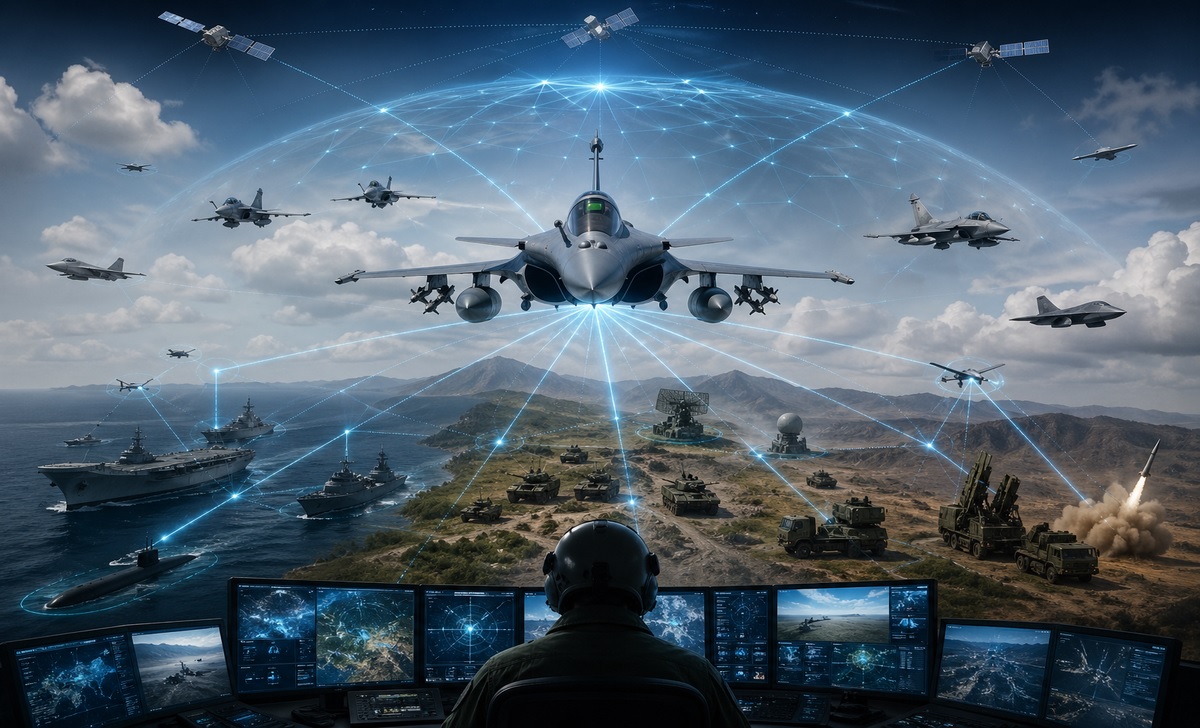
The character of warfare has fundamentally changed, with simultaneous contestation across land, sea, air, space, cyber, and cognitive domains demanding a new paradigm for military operations. Multi-Domain Operations (MDO) has emerged as the doctrinal response to this reality, in which integrated effects across domains overwhelm adversaries faster than they can react. For India, facing simultaneous continental and maritime threats, compressed decision cycles, and aggressive grey zone coercion, the ability to orchestrate military and non-military instruments as a coherent whole will determine strategic outcomes.
India’s Joint Doctrine for Multi-Domain Operations (2025) formalises this shift, calling for synchronised employment of forces and national capabilities to achieve decisive advantage. Yet doctrinal ambition must be matched by practical implementation, and herein lies the critical question: which service can lead this transformation? This article argues that the Indian Air Force (IAF) is uniquely positioned as the lead enabler of Indian MDO, providing the cross-domain Intelligence, Surveillance, and Reconnaissance (ISR), networks, long-range precision strikes and paving the path for C5ISR (Command, Control, Communications, Computers, Cyber, Intelligence, Surveillance, and Reconnaissance), the backbone essential for joint success. Far from being merely a supporting arm, the IAF’s vertical reach, speed, and connectivity make it the natural integrator of tri-service kill webs and joint operations in India’s vast battlespace.
Concept of Multi-Domain Operations and Indian Joint Doctrine
The idea of MDO emerged from recognition that contemporary conflicts unfold simultaneously across mutually interacting domains, where effects in one domain rapidly cascade into others. Western militaries initially developed MDO concepts to overcome anti-access/area-denial environments through tightly integrated operations across land, sea, air, space, and cyberspace, but recent wars have shown that the information and cognitive domains are equally contested and decisive. For India, with its simultaneous continental and maritime challenges, a compressed battlespace, and a dense information environment, MDO offers a framework to orchestrate military and non-military instruments of national power as a coherent whole rather than as segregated, service-centric campaigns.[1]
In doctrinal terms, MDO seeks to break down rigid domain silos and replace them with cross-domain “kill webs” that can rapidly generate, sequence, and sustain effects against an adversary’s critical vulnerabilities. Looking at evolving capabilities, it can be said that air power is inherently multi-domain because it can “create effects in all domains” from kinetic strikes and air superiority to enabling maritime surveillance, land manoeuvre, cyber operations, and information campaigns. The goal of MDO is not merely the co-existence of multiple domains but their deliberate integration so that actions in one domain are designed from the outset to create leverage in others.[2] This logic translates well to the Indian context, where air- and space-enabled ISR, precision strike by IAF and integrated networks can act as cross-domain enablers for both the Army and Navy in tightly contested theatres.
India’s formal articulation of MDO came with the Joint Doctrine for Multi-Domain Operations, promulgated by the Headquarters Integrated Defence Staff (HQ IDS) and released by the Hon’ble Raksha Mantri in August 2025. This doctrine defines MDO as the “coordinated, integrated and synchronised employment of military forces and non-military national capabilities across Land, Sea, Air, Space, Cyber and Cognitive domains” to achieve national security objectives. The doctrine grounds MDO in a Whole-of-Nation Approach (WONA), explicitly bringing together diplomatic, informational, economic, technological, and industrial levers alongside the armed forces, recognising that future wars will be “contested in multiple domains, both physical and virtual, simultaneously and continuously.” It situates MDO within India’s specific threat environment of two-front challenges, grey zone coercion and rapid technological change and argues that traditional sequential, domain-segregated campaigns will not suffice.[3]
There are several doctrinal pillars visible after taking reference from the new doctrine. First, it is joint force integration, calling for seamless synergy between the three services through common planning, shared situational awareness and interoperable Command and Control (C2) systems. Second, it stresses cross-domain integration, wherein actions in one domain are planned specifically to generate complementary effects in others, for instance, using cyber and electronic warfare to create windows of opportunity for air, land and maritime forces. Third, the doctrine highlights Civil–Military Fusion (CMF) and partnerships with Indian industry, startups and academia to harness Artificial Intelligence (AI), big data analytics, autonomy, space-based assets and resilient communications as foundational enablers of MDO.[4] Finally, it recognises the importance of allied and partner cooperation, particularly in information sharing and domain awareness, without compromising India’s strategic autonomy.
Commentators have pointed out that Indian thinking on MDO has been shaped not only by foreign doctrinal debates but also by empirical observation of recent conflicts. One observation is that wars such as those in Ukraine and the West Asia have demonstrated how tightly integrated employment of long-range fires, drones, electronic warfare, cyber-attacks and information operations can rapidly degrade an opponent’s combat potential, logistics and national will. These conflicts underscore the premium on resilient C2, dispersed force posture, survivable networks and the ability to fight under conditions of severe electromagnetic and cyber disruption. These are also core themes embedded in India’s MDO doctrine.[5] A study on Operation Absolute Resolve describes contemporary conflict as “explicit multi-domain warfare,” in which airpower, Electronic Warfare (EW), cyber, precision strike and information operations were synchronised to “digitally conquer the sky” and impose paralysis on the adversary’s system of systems. These assessments strengthen the doctrinal case for India to pursue MDO as the central organising concept for its future force.[6]
At the same time, Indian professional and academic writings caution that doctrine alone cannot deliver MDO without parallel progress in organisational structures, capabilities and training. We must understand that while India has taken important steps, such as creating the Defence Cyber Agency, Defence Space Agency, and Defence Intelligence Agency, significant gaps remain in joint C2 architecture, tri-service communications, common operating pictures, and shared data standards.[7] It is also important to point out the absence of real-time, interoperable tri-service C2 systems due to incomplete integration of the Indian Air Force’s networks with those of the Army and Navy, as well as limitations in indigenous space-based ISR and navigation capabilities. Presently, the Army’s Akashteer network system and Navy’s Trigun network system have been integrated at the root level with IACCS (Integrated Air Command and Control System), and work is in progress to make it more robust. Together, these assessments suggest that MDO, as defined in doctrine, is aspirational unless underpinned by structural reforms, investment in enabling technologies and sustained joint training.[8]
Within this evolving doctrinal and analytical landscape, the Indian Air Force appears not merely as one of the services adapting to MDO but as a natural lead enabler of multi-domain combat power. The IAF, on the path of transformation, has become central to providing the cutting edge for future joint operations, and it must build operational capability across air, land, sea, space and cyber domains. Strengthening cyber capabilities, securing data and communications, and achieving multi-domain integration through robust networks, sensors, and decision-support tools are the way forward.[9] The recent doctrine and associated studies together imply that any practical realisation of MDO will depend heavily on the IAF’s ability to integrate ISR, precision strikes, space, cyber and electronic warfare capabilities into joint kill webs. The next section, therefore, examines in detail how the IAF can function as the lead enabler of Multi-Domain Operations and what this implies for force development and joint integration with the Army and Navy.
Indian Air Force as Lead Enabler of Multi-Domain Operations
The Indian Air Force is uniquely positioned to function as the lead enabler of MDO because its core capabilities directly influence all physical and virtual domains of conflict. Air and space-enabled ISR, mobility with responsiveness, long-range precision strike capability, electronic warfare and networked air defence form the backbone of any credible joint force’s ability to sense, decide and act faster than the adversary. In the Indian context, where the theatre of operations varies from mountainous land borders to far-flung maritime territories, the IAF’s reach, speed, and access to the vertical dimension make it the natural cross-domain integrator.
The IAF can be the decisive spearhead of future joint operations, provided it undergoes a phased transformation across infrastructure, logistics, human resources, technology and indigenisation. This time-sensitive transformation must be organised into short-, mid-, and long-term phases, beginning with strengthening joint operational doctrines, bridging capability gaps, and inducting new technologies and systems to meet contemporary needs. Crucially, the need to embed jointness and multi-domain integration into every aspect of IAF development, from C2 architecture and data networks to training and innovation ecosystems, must be addressed.[10]
From a conceptual standpoint, air power historians provide a powerful theoretical basis for viewing air forces as a natural connector of MDOs. It is opined that air power is fundamentally multi-domain because, from kinetic strikes and air dominance to enabling ops of other services, it is a key strength of all air forces. The task of air forces is not limited to delivering fires but also to orchestrating a web of sensors, shooters, and decision-makers that allows joint forces to exploit fleeting windows of opportunity.[11] Applying this logic to India suggests that the IAF’s sensor and communication networks, and its ability to rapidly project power, make it the logical core around which integrated multi-domain kill webs and joint C5ISR should be built. The deviation from conventional C4ISR is recommended because ‘Cyber’ has become an intricate part of all combat operations, so that sometimes it precedes all other kinds of planning and then remains enmeshed.
Operational experience of the IAF also reinforces this conceptual argument. It is known that Operation Sindoor, as a joint operation, was “led by air power” that delivered a calibrated but increasingly intense response to Pakistani actions. The integration of IAF and Indian Army air defence systems produced an “impregnable defence” against standoff weapons, drones and missiles, demonstrating India’s ability to integrate legacy and modern AD systems into a seamless architecture. All the future responses to state-sponsored terror are likely to be “fiercer,” and the strategy of deterrence by punishment requires the IAF and other services to jointly plan responses of much larger scope and in multiple domains simultaneously. This operation itself illustrates how IAF-led operations, when underpinned by integrated C2 and air defence networks, can serve as practical precursors to more fully developed MDO constructs.[12]
All recent conflicts have underscored the successful outcomes achieved when airpower, ISR, cyber, electronic warfare, and information operations are synchronised effectively. These lessons are directly relevant to the IAF’s enabler role. The Venezuela operation was an example of mature multi-domain warfare, in which air defence networks collapsed quickly when not backed by resilient power, robust networks and disciplined doctrine. Future wars will begin in the electromagnetic spectrum long before missiles fly, and that intelligence preparation now exceeds all other priorities. It draws the lesson that India must build a genuinely integrated C5ISR architecture and achieve cyber and electromagnetic spectrum dominance.[13] For the IAF, these lessons translate into specific enabler responsibilities: leading the design of resilient joint networks, providing ISR and targeting data to all services, and ensuring that air and space-based capabilities are fully integrated into tri-service plans and theatre commands.
India’s MDO blueprint must be built by combining armed forces, industry, academia and government agencies. The establishment of cyber and space agencies, the push for indigenous technologies, and the emphasis on civil–military fusion are intended to generate capabilities that can be knitted together into an integrated MDO framework. The capabilities like space-based ISR, AI-enabled decision support, resilient communications and integrated air defence are precisely those that the IAF is best placed to operate and integrate on behalf of the joint forces. This reinforces the view that the IAF must be at the heart of operationalising India’s MDO blueprint.[14]
At the same time, professional military scholarship has underlined that the IAF’s enabler role will remain constrained unless persistent structural and capability gaps are addressed. Service-specific orders and legacy systems still inhibit the seamless flow of data and the rapid, cross-domain decision-making that MDO requires. For the IAF, this implies that becoming the lead enabler of MDO will demand not only modernisation of platforms and sensors, but also deep integration of its networks and doctrines with those of the Army and Navy, and active participation in designing joint C2 structures and theatre commands.[15]
The joint doctrine calls for integrated planning, shared situational awareness and collaborative execution across services and ministries, underpinned by modern C5ISR and information-centric operations. In this framework, the IAF is not simply one more contributor but a key provider of domain awareness, precision engagement and rapid mobility that can knit the joint force together in real time. IAF’s transformation into a “future ready force” is inseparable from India’s broader transition to genuine Multi-Domain Operator, and that its role as lead enabler may be formally recognised and resourced in future joint doctrine, force planning and theatreisation efforts.[16]
Conclusion
The Indian Air Force stands at the threshold of becoming the decisive lead enabler of Multi Domain Operations in India’s evolving joint force structure, leveraging its unique capabilities in ISR, precision strike, space, cyber and networked C2 to integrate the Army, Navy and tri-service agencies into coherent kill webs. As demonstrated through doctrinal analysis, operational precedents like Operation Sindoor, and lessons from global conflicts, the IAF’s vertical reach and cross-domain effects position it not as a supporting service but as the central nervous system of future joint operations. Realising these potential demands accelerated efforts towards robust interoperable networks, and civil-military fusion to bridge persistent gaps in tri-service integration, ensuring that India’s Armed Forces can deliver decisive effects across all domains simultaneously. By formally recognising and resourcing the IAF’s enabler role in doctrine, procurement and training, India can operationalise its 2025 Joint Doctrine for Multi-Domain Operations and build a genuinely future-ready force capable of deterring aggression and securing national interests in an era of compressed decision cycles and multi-domain contestation.
*****
CLICK TO VIEW THE PDF
(Disclaimer: The views and opinions expressed in this article are those of the author and do not necessarily reflect the position of the Centre for Aerospace Power and Strategic Studies [CAPSS])
Notes:-
[1] AB Shivane, “Operation Absolute Resolve and the Future of Warfare: Military Lessons for India,” Manohar Parrikar Institute for Defence Studies and Analyses (MPIDSA), February 13, 2026, https://idsa.in/publisher/issuebrief/operation-absolute-resolve-and-the-future-of-warfare-military-lessons-for-india. Accessed on April 01, 2026.
[2] János Csengeri, “Some Elements of Multi-Domain Operations Regarding Air Power,” International Scientific JournalSecurity & Future, vol. 6, issue. 1, 2022, p. 12, https://stumejournals.com/journals/confsec/2022/1/11.full.pdf. Accessed on April 01, 2026.
[3] Manish Kumar, “Fostering Joint Warfighting: India’s Joint Doctrine for Multi-Domain Operations,” MPIDSA Commentary, March 03, 2026, p. 2, https://idsa.in/wp-content/uploads/2026/03/Commentary-Mr-Manish-Kumar-03-March-2026.pdf. Accessed on April 01, 2026.
[4] PP Singh, “India’s Joint Doctrine for Multi-Domain Operations: A Whole-of-Nation Framework,” United Service Institution Journal, September 12, 2025, p. 4, https://usiofindia.org/pdf/file_68c3c9dd2b33e.pdf. Accessed on April 02, 2026.
[5] Ankit Abbott, “Multi-Domain Operations Air Force as the Central Node,” MPIDSA Journal of Defence Studies, February 2025, p. 134, https://www.idsa.in/wp-content/uploads/2025/09/07-jds-19-2-2025-Ankit-Abbott.pdf. Accessed on April 02, 2026.
[6] Shivane, n. 1.
[7] Dushyant Singh, “Multi-Domain Warfare: Are we Geared for it?” USI Journal, Jan-Mar 2024, p. 10, https://usiofindia.org/pdf/USI_Journal_Jan_March_2024_Revised.pdf. Accessed on April 02, 2026.
[8] Abbott, n. 5, p.136
[9] Vikas Kalyani, “Cutting Edge for Future Joint Operations: A Transformed Indian Air Force,” USI Journal, Oct-Dec 2025, p. 735, https://usiofindia.org/pdf/USI_Journal_2025_Oct-De_15.pdf. Accessed on Apr 03, 2026.
[10] Ibid.
[11] Csengeri, n. 2, p.14
[12] RGK Kapoor, “Indian Air Force – Post Operation Sindoor,” SP’s Aviation, issue: 09, 2025, https://www.sps-aviation.com/story/?id=3795&h=Indian-Air-Force-Post-Operation-Sindoor. Accessed on April 03, 2026.
[13] Shivane, n. 1.
[14] MS Mokha, “Indian Military’s Multi-Domain Warfare Blueprint Unfolds,” Bharat Shakti, April 03, 2026, https://bharatshakti.in/indian-militarys-multi-domain-warfare-blueprint-unfolds/. Accessed on April 04, 2026.
[15] Singh, n. 7, p.11
[16] Singh, n. 4, p.5